

« Vedānta-sūtra: The Govinda-bhāṣya of Baladeva Vidyābhūṣaṇa
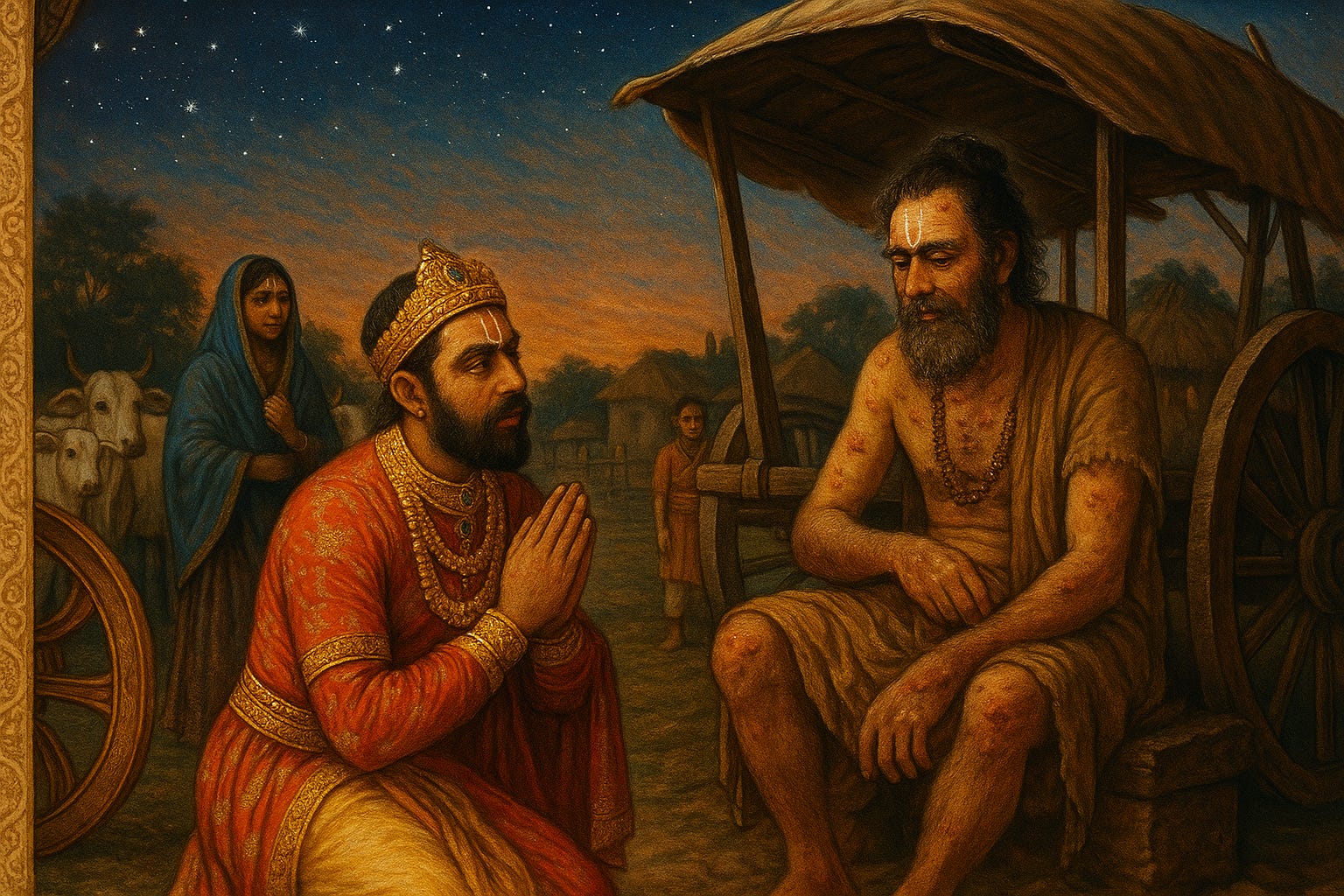
The meeting of Jānaśruti and Raikva from the Chāndogya Upaniṣad
Here is the complete passage from the Chāndogya Upaniṣad with the meeting of Jānaśruti and Raikva, and he being called a śūdra:
om jānaśrutir ha pautrāyaṇaḥ śraddhādeyo bahudāyī bahupākya āsa
sa ha sarvata āvasathān māpayām cakre, sarva eva me ’nnam atsyantīti
“Jānaśruti of the lineage of Pautrāyaṇa was a highly charitable person. He used to give many gifts in charity, always with great respect. He was very hospitable and had large quantities of food cooked for all kinds of guests. With the desire of receiving all kinds of people, he built many shelters and rest-houses, where all could be received and eat to their satisfaction.” (Chāndogya Upaniṣad 4.1.1)
atha ha hamsā niśāyām atipetus tad dhaivam hamso hamsam abhyuvāda bho bho ’yi bhallākṣa bhallākṣa jānaśruteḥ pautrāyaṇasya samam divā jyotir ātatam tan mā prasānkṣīs tat tvā mā pradhākṣīr iti
“Once, he saw a group of swans flying overhead at night. The swan flying behind called the one ahead: Hey bhallākṣa (auspicious one)! Don’t you see that the effulgence of Jānaśruti Pautrāyaṇa has spread all over the sky, like daylight? Be careful not to come too close, or it will burn you.” (Chāndogya Upaniṣad 4.1.2)
Jānaśruti was a pious king. This is not directly stated in the text, but can be easily concluded by the description of his activities and the mention of his lineage. Only a king can give charity on such a large scale. A śūdra would not have such a disposition, nor resources to do that, and would not be addressed with a patronymic.
Ranga Ramanuja explains that the swans speaking were not common animals, but saintly persons who, impressed with the king’s charitable disposition, took the form of swans to visit him and help to deepen his spiritual insight.
tam u ha paraḥ pratyuvāca — kam vara enam etat santam sayugvānam iva raikvam āttheti, yo nu katham sayugvā raikva iti
“The second swan replied, ‘O noble one, why are you unnecessarily glorifying this person, as if he were Raikva the Sayugvā?’ The first bird answered: “Who is Raikva the Sayugvā you mention?” (Chāndogya Upaniṣad 4.1.3)
Sayugvā is not a name, but a title, like “John the blacksmith”. The word has a deep philosophical meaning. In the literal sense, it indicates that Raikva was a wandering sadhu who traveled on a cart pulled by two bulls that he used as a shelter and a transport for his meager possessions. Apart from this literal sense, it also indicated he had great spiritual wisdom, having yoked (joined) the ultimate principles of knowledge. The second bird cuts the first, making the point that whoever Jānaśruti was, he was nothing compared to the great Raikva, who knew Brahman and possessed great spiritual power.
yathā kṛtāya-vijitāyādherayāḥ samyanti evam enam sarvam tad abhisamaiti yat kiñca prajāḥ sādhu kurvanti, yas tad veda yat sa veda, sa mayaitad ukta iti
“Just as in a game of dice, when a person wins with a kṛta (four), all the lesser numbers are included in it, and just as the spokes are joined to the hub of the wheel of a cart, everything converges upon him. He knows the supreme principle, and thus his knowledge includes whatever anyone else knows. This is the person I mentioned.” (Chāndogya Upaniṣad 4.1.4)
The second sage (in the form of a swan) explains that due to his knowledge of Brahman, the unifying principle of everything, Raikva was the convergence of all knowledge and all that is good. Kṛṣṇa includes everything, and therefore, one who has Kṛṣṇa has everything. Jānaśruti certainly had good qualities, but they were not in pair with Raikva. By speaking this within reach of Jānaśruti’s hearing, the sage encouraged him to approach Raikva and enquire from him.
tad u ha jānaśrutiḥ pautrāyaṇa upaśuśrāva, sa ha sañjihāna eva kṣattāram uvācāngāre ha sayugvānam iva raikvam āttheti, yo nu katham sayugvā raikva iti, yathā kṛtāya-vijitāyādhareyāḥ samyanti evam enam sarvam tad abhisamaiti yat kiñca prajāḥ sādhu kurvanti, yat tad veda, yat sa veda, sa mayaitad ukta it
“Jānaśruti Pautrāyaṇa overheard what the swan said. He got up from his bed and asked his attendant: ‘O my child, can I be compared to Raikva Sayugvā?’ The man answered: ‘Raikva Sayugvā? Who is this Raikva, the yoke-bearer? What sort of person is he?’ Jānaśruti then repeated what the swan had said.” (Chāndogya Upaniṣad 4.1.5-6)
sa ha kṣattānviṣya nāvidam iti pratyeyāya tam hovāca yatrāre brāhmaṇasyānveṣaṇā tad enam arccheti
“The attendant returned and said, ‘I did not find him.’ The king answered, ‘My friend, don’t search aimlessly, search for him where knowers of Brahman reside.’” (Chāndogya Upaniṣad 4.1.7)
so ’dhastāc chakaṭasya pāmānam kaṣamānam upopaviveśa tam hābhyuvāda tvam nu bhagavaḥ sayugvā raikva ity aham hy arā iti ha pratijajñe sa ha kṣattāvidam iti pratyeyāya
“Searching again, he found a man sitting under a cart, afflicted with sores and scratching himself. Sitting close to him, he asked, ‘Venerable sir, are you Raikva the yoke-bearer?’ The man answered, ‘Yes, I am the spoke of the wheel.’ The attendant thought, ‘I have found him!’ and returned.” (Chāndogya Upaniṣad 4.1.8)
Many have the image of sages as majestic figures; this verse breaks this stereotype, describing a great sage living in very simple conditions, with his body afflicted by disease. Raikva’s concern was in his internal meditation on the Lord, and therefore, his body was neglected.
Raikva answered “aham hi arā“, identifying himself as the spoke of the wheel, which follows the same metaphor used by the swan. The bird had described him as the hub of the wheel, where all the spokes converge, but he described himself as just one of the spokes that converge into the central hub, or in other words, as a servant of the Lord.
tad u ha jānaśrutiḥ pautrāyaṇaḥ ṣaṭ śatāni gavām niṣkam āśvatarī-ratham tad ādāya praticakrame, tam hābhyuvāda
raikvemāni ṣaṭ śatāni gavām ayam niṣko ’yam aśvatarī-ratho nu ma etām bhagavo devatām śādhi yām devatām upāsse iti
“Then, Jānaśruti Pautrāyaṇa, taking six hundred cows, a gold necklace, and a chariot, went to Raikva and addressed him: ‘O Raikva! Please accept the six hundred cows, the necklace, and the chariot I have brought. Dear Sir! Kindly tell me about the deity you worship.’” (Chāndogya Upaniṣad 4.2.1-2)
tam u ha paraḥ pratyuvācāha hāretvā śūdra tavaiva saha gobhir astv iti tad u ha punar eva jānaśrutiḥ pautrāyaṇaḥ sahasram gavām niṣkam āśvatarī-ratham duhitaram tad ādāya praticakrame
“Raikva replied, ‘Take them away, O śūdra! Let them be yours along with the cows.’ Then, once again, Jānaśruti came to him, this time with a thousand cows, the gold ornament, the chariot, and his daughter.” (Chāndogya Upaniṣad 4.2.3)
tam hābhyuvāda raikvedam sahasram gavām ayam niṣko ’yam aśvatarī-ratha iyam jāyā’yam grāmo yasminn āsse ’nv eva mā bhagavaḥ śādhīti
“He said to him, ‘O Raikva! I am giving you these thousand cows, this gold necklace, this chariot, this daughter of mine to be your wife, and also this village in which you live. Now, sir, please teach me.’” (Chāndogya Upaniṣad 4.2.4)
It is already well-defined that Jānaśruti is a kṣatriya by his attitude and the riches he offered to the sage in charity. Still, Raikva refused to teach him, calling him śūdra. This, however, does not indicate a lack of qualification. Raikva addressed Jānaśruti as the one who ran to him, being unhappy. He used the word “śūdra” as the combination of “suk” (unhappy) and “dru” (he who ran).
At first, he rejected him to test his eagerness to hear. However, seeing the eagerness of Jānaśruti, he finally agreed to teach him.
tasyā ha mukham upodgṛhṇann uvācājahāremāḥ śūdrānenaiva mukhenālāpayiṣyathā iti te haite raikva-parṇā nāma mahā-vṛṣeṣu yatrāsmā uvāsa tasmai hovāca
“Accepting his gifts, Raikva said, ‘O śūdra! By making me accept this gift, you make me speak about Brahman’ In these villages known as Raikva-parṇa in the place called Mahā-vṛṣa, Raikva resided and spoke to the King.” (4.2.5)
Raikva calling him śūdra even after accepting him as a disciple makes clear that he is not speaking about varṇa, but referring to the state of unhappiness of the king. Thus, the point made by Vyāsadeva is maintained: One should be instructed on the Vedas only after being reformed.
Sūtra 1.3.36 - There are no saṃskāras prescribed to śūdras
samskāra-parāmarśāt tad-abhāvābhilāpāc ca
samskāra: purificatory rites; parāmarṣāt: because of the reference; tad: of them; abhāva: absence; abhilāpāt: because of mention, statement; ca: also.
The scriptures mention purificatory rites for the high classes and the absence of them for śūdras.
Commentary: The scriptures mention the necessity of members of the three higher classes to go through saṃskāras, or purificatory ceremonies, before being allowed to study the Vedas. These saṃskāras implant the right impressions on the mind, creating the conditions for one to develop the right qualifications to understand the scriptures.
However, in order to undergo saṃskāras, the student has to already possess certain qualifications. In the śruti-śāstra (Pāraskara-gṛha-sūtra 2.1.1), it is mentioned that one should perform the samskara and start teaching a brāhmana boy at the age of eight, a kṣatriya boy at the age of 11, and a vaiśya boy at the age of 12. In this way, different classes of people start their studies at different ages, when it is considered that the necessary qualification to undergo the necessary saṃskāra is achieved.
The scriptures, however, mention that persons qualified as śūdras are not allowed to undergo these saṃskāras, and are thus not allowed to study the Vedas: nāgnir na yajño na kriyā na samskāro na vratāni śūdrasya (the śūdra does not light fire, does not perform sacrifice or rituals, and does not undergo saṃskāras or vows). In this way, it’s again emphasized that unqualified people should not be allowed to study the Vedas or perform the rituals.
Sūtra 1.3.37 - The qualification of the student
tad-abhāva-nirdhāraṇe ca pravṛtteḥ
tad-abhāva-nirdhāraṇe: after ascertaining the absence of that (being a śūdra); ca: also; pravṛtteḥ: from inclination (to initiate)
In this way, care is taken to determine that a student is not a śūdra.
Commentary: Although the scriptures are clear in explaining that śūdras should not be allowed to study the Vedas because of their sinful mindset and lack of higher principles, the classification of people as brāhmanas, kṣatriyas, vaiśyas, and śūdras is not done on a hereditary basis, but by judging one’s qualifications. The Chāndogya Upaniṣad (4.4.4-5), for example, narrates the story of Satyakāma Jābāli, the son of a maidservant.
Jābāli approached Gautama ṛṣi, anxious to be initiated and study the Vedas, but being cautious, Gautama ṛṣi first asked who his father was. The boy couldn’t answer, and thus the guru ordered him to go and ask his mother. The mother had relationships with many men, and therefore she didn’t know who the father was. Unhesitatingly, the boy returned and frankly admitted that his mother was a prostitute and she didn’t know who his father was. Surprised by his honesty, Gautama ṛṣi initiated him as a brāhmana.
The sage said: naitad abrahmano vivaktum arhati samidham saumyahara tvopanesye na satyad agah, “One who is not a brāhmana cannot speak in this way. O gentle one, please bring the wood for the sacred fire, and I shall initiate you as a brāhmana, since you did not deviate from the truth.”
The reason many passages from the scriptures refer to the four classes as a more or less hereditary classification is because in previous ages children would normally have similar qualities as the parents because the system of garbhādhāna saṃskāra was rigidly followed by persons of the higher classes, preparing the mentality of the father and mother before conception and thus making sure that a soul with the right qualities would enter into the womb. In this way, the level of qualification of the family would be maintained generation after generation. The determination of caste was never hereditary, but in the past, children having the same qualifications as their parents were far more common.
In the current age, however, the process of garbhādhāna saṃskāra is rarely performed, and thus parentage says little about the nature of a child. Therefore, when one is capable of following the brāhminical principles of purity by following the four principles, chanting the prescribed number of rounds, and studying under discipline, one may be accepted by the spiritual master to be initiated and trained as a brāhmana, regardless of parentage, just like in the story of Jābāli.
Sūtra 1.3.38 - A higher grade of knowledge
śravaṇādhyayanārtha-pratiṣedhāt smṛteś ca
śravaṇa: hearing; ādhyayana: study; artham: for the purpose of; pratiṣedhāt: because it is forbidden; smṛteḥ: from the smṛti-śāstra; ca: also.
The smṛti-śāstra also forbids the śūdras from hearing and studying the Vedas.
Commentary: The smṛti-śāstra very clearly prohibits unqualified persons from studying the Vedas and performing Vedic sacrifices, with verses such as tasmāc chūdro bahu-paśur ayajñīyaḥ (A śūdra is unfit to perform sacrifices, being unqualified). Because of these prohibitions, a śūdra is not allowed to hear the Vedas, and thus it’s not possible for him to understand their meaning or perform the rituals and penances prescribed in them.
We are also cautioned that vedākṣara-vicāraṇe śūdro patati tat-kṣaṇāt (A śūdra who studies the Vedas falls into degraded life). As the saying goes, “Little knowledge is dangerous”. If a person is not capable of properly understanding the Vedas, it’s better not to study at all, since misunderstanding and misusing the knowledge will do more harm than good.
Of the four Vedas, the Ṛg, Sāma, and Yajur Vedas deal with mantras and ceremonies, as well as intricate spiritual topics, and thus are not fit to be studied by śūdras. Apart from the deep philosophical and ritual sections, the Atharva Veda deals with material sciences such as health, architecture, astrology, and so on. These are also unfit to be studied by unqualified persons (just like a person who doesn’t fulfill the necessary academic requirements will not be accepted into a university). There is no gain for the individual or society if an unqualified person starts working as a physician or engineer. Even in fields such as astrology, an unqualified professional can create havoc in the lives of people who trust his advice, as it’s common nowadays. In this way, śūdras are barred from studying all the four Vedas.
When we hear passages like this, we often think that they apply only to others, but the fact is that in our age, practically all of us are less than śūdras in terms of qualification. Although lacking high intelligence to understand the Vedas, śūdras are capable of accepting and following higher authorities, and thus they can be gradually guided upwards. Most of us lack even this, and thus, in terms of the classification of varnāśrama, we are mostly outcasts, uncivilized beings. So, how can we acquire transcendental knowledge and gradually achieve higher qualifications?
Śrīla Baladeva Vidyābhūṣaṇa concludes his commentary on this section with these words:
“Some souls, such as Vidura and others, although born as śūdras, become elevated by their attainment of perfect transcendental knowledge. By hearing and understanding the Purāṇas and other transcendental literatures, śūdras and others can become liberated. The only real classes of higher and lower among men are determined by the final result of their lives.”
Although a person who lacks the proper qualification is barred from studying the four Vedas, there is no such restriction for studying books such as the Bhagavad-gītā and the Śrīmad-Bhāgavatam. These books actually contain a higher grade of knowledge than what is offered in the four Vedas, dealing directly with devotional service to the Lord, which is the only effective process in the age we live in. By studying these books and following the spiritual process left by our previous ācāryas, we can purify ourselves and improve our qualification.
This is the process followed by Vidura and others, who were able to achieve the highest level of qualification despite starting from a lower birth. As Śrī Baladeva concludes, higher and lower classes of men are determined by the final results of their lives, not by their qualification at birth.
As mentioned in Śrīmad-Bhāgavatam 6.13.8:
“One who has killed a brāhmaṇa, one who has killed a cow or one who has killed his father, mother or spiritual master can be immediately freed from all sinful reactions simply by chanting the holy name of Lord Nārāyaṇa. Other sinful persons, such as dog-eaters and caṇḍālas, who are less than śūdras, can also be freed in this way. “
As Prabhupāda concludes in the Nectar of Devotion (ch. 5): “Thus a Vaiṣṇava automatically becomes a brāhmaṇa. This idea is also supported by Sanātana Gosvāmī in his book Hari-bhakti-vilāsa, which is the Vaiṣṇava guide. Therein, he has clearly stated that any person who is properly initiated into the Vaiṣṇava cult certainly becomes a brāhmaṇa, as much as the metal known as kamsa (bell metal) is turned into gold by the mixture of mercury. A bona fide spiritual master, under the guidance of authorities, can turn anyone to the Vaiṣṇava cult so that naturally he may come to the topmost position of a brāhmaṇa.”
Exercise
Now it’s your turn. Can you answer the following arguments using the ideas from this section?
Opponent: “Śūdras are not barred from studying the Vedas. If a śūdra is eager to learn, why not? We can see that in the Chāndogya Upaniṣad, Raikva agrees to teach the Vedas to Janaśruti when he approached him with valuable gifts, saying: ‘O śūdra! By making me accept this gift, you make me speak about Brahman’. At first, he was reluctant, but when Janaśruti increased the value of his offering, he accepted, understanding he was eager to hear. There is thus no problem for an enlightened person to instruct a śūdra and teach him to perform sacrifices if well remunerated.
Another example mentioned in the scriptures is Vidura, who, although a śūdra, was instructed in Vedic knowledge by Maitreya, and later taught Dhṛtarāṣṭra.
The Upaniṣads themselves explain about the Supreme Brahman, the universal self, and prescribe knowledge (vidyā) as the direct means to attain fearlessness. This would not make sense if only certain classes of human beings were eligible to attain such knowledge. The principle thus is that all human beings are qualified to study the Vedas, and if a śūdra has the ability to study, he should be immediately accepted, especially in the case of a rich, charitable person, like Janaśruti, who can properly remunerate the teacher.”
Description: Note that there is a fine line between the interpretation of our ācāryas, that a person of lower birth becomes qualified to study the Vedas and perform sacrifices after becoming purified by the appropriate process, and the interpretation of the pūrvapakṣa, which argues that anyone can study the Vedas regardless of qualification. We need to be careful in observing this line, without falling into the mistakes of the caste system.
This view may seem to be very liberal and inclusive, but it doesn’t represent any of the six schools. We can see that in his eagerness to prove that anyone can study the scriptures, regardless of qualification, the opponent completely misunderstands the passage, failing to capture the subtleties of the words of the verses, concluding that Raikva was greedy and agreed to teach Jānaśruti for money, failing to understand the high qualification of Vidura despite his lower birth, and so on.
You can also donate using Buy Me a Coffee, PayPal, Wise, Revolut, or bank transfers. There is a separate page with all the links. This helps me enormously to have time to write instead of doing other things to make a living. Thanks!
« Vedānta-sūtra: The Govinda-bhāṣya of Baladeva Vidyābhūṣaṇa