

« Vedānta-sūtra: The Govinda-bhāṣya of Baladeva Vidyābhūṣaṇa
Topic 9: Kampanādhikaraṇam - The cause of trembling
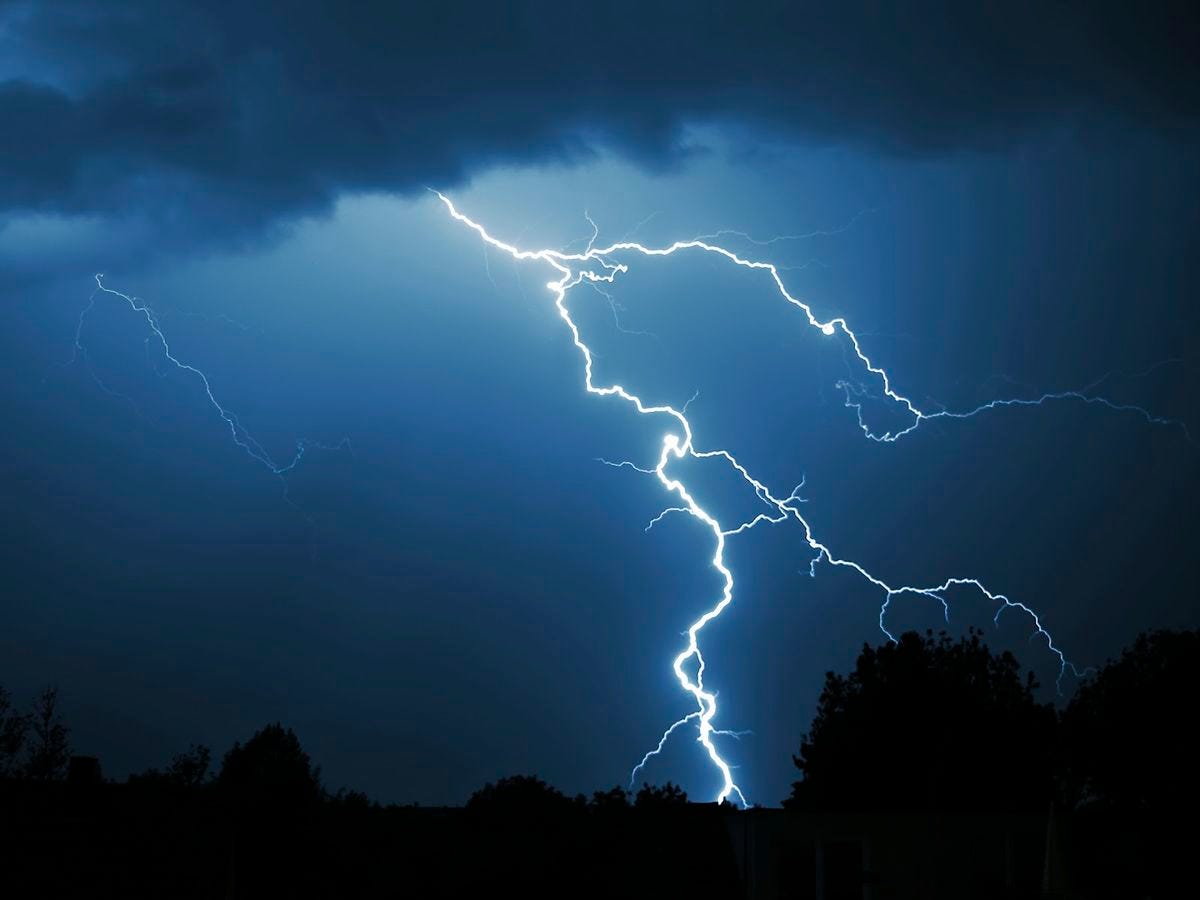
The thunderbolt mentioned in the Kaṭha Upaniṣad is the Lord. He causes the world to tremble.
kampanāt, jyotir-darśanāt
“The thunderbolt mentioned in the passage is the Lord, because He causes the world to tremble, and because of the contiguous passage, describing Him as the Lord of light and fire.”
Sūtra 1.3.39-40 - Mysterious passages that indicate the Lord
kampanāt
kampanāt: because of trembling.
The thunderbolt mentioned in the passage is the Lord, because He causes the world to tremble.
jyotir-darśanāt
jyotiḥ: light; darśanāt: because of seeing.
And because of the contiguous passage, describing Him as the Lord of light and fire.
Commentary: The main topic of this third pāda of the first book of the Vedānta-sūtra is to examine how the Supreme Lord is discussed in different references from the Upaniṣads and other scriptures. After discussing other topics (namely, the demigods and the śūdras), this sūtra brings the discussion back to direct talks about the Supreme Lord.
The Kaṭha Upaniṣad (2.3.2) brings us the following passage:
yad idam kim ca jagat sarvam prāṇa ejati niḥsṛtam
mahad bhayam vajram udyatam, ya etad vidur amṛtās te bhavanti“The whole world which emanated from prāṇa (the Lord) and is situated in Him, trembles out of great fear of this great awe-inspiring power, who is like an upraised thunderbolt. Those who understand this become immortal.”
This verse describes a life principle (prāṇa) that is the origin of the whole universe. This same life principle that creates everything also causes fear (bhaya) in the hearts of all, just like a raised thunderbolt (vajram udyatam). However, the ones who can successfully understand this principle attain amṛtā, immortality.
The same Kaṭha Upaniṣad, at the end of the previous chapter (text 2.2.15), mentions:
na tatra sūryo bhāti na candra-tārakam
nemā vidyuto bhānti kuto’yam agniḥ
tam eva bhāntam anubhāti sarvam
tasya bhāsā sarvam idam vibhāti“The sun does not shine in His presence, nor the moon or the stars. Lightning does not shine, and what to speak of this earthly fire. Everything shines only after That shining One. By His light, everything shines.”
This verse also indicates the Lord only indirectly, but the meaning becomes clear when we examine the qualities described. Only the Lord can be the source of all light. This becomes even more evident when the verse is studied in context, since it comes just after one of the most iconic verses of the Upaniṣads:
nityo nityānām cetanaś cetanānām, eko bahūnām yo vidadhāti kāmān
tam ātmastham ye’nupaśyanti dhīrāḥ, teṣām śāntiḥ śāśvatī netareṣām“There is a Supreme eternal (the Lord), amongst all eternals (the innumerable souls). A Supreme consciousness, amongst all conscious ones. One Supreme Lord who maintains all others with everything desirable. Those who see that Supreme Lord, who is situated in their own hearts, attain eternal peace, and not others.” (Kaṭha Upaniṣad 2.2.13)
Similarly, text 2.3.3, which immediately follows the first, says:
bhayād asyāgnis tapati bhayāt tapati sūryaḥ
bhayād indraś ca vāyuś ca mṛtyur dhāvati pañcamaḥ“Out of fear of Him, fire burns, and the sun shines. Out of fear of Him, Indra, Vāyu, and death hastily perform their functions.”
In this way, these verses form a continuous passage that makes it clear that the thunderbolt described in the Kaṭha Upaniṣad 2.3.2 is indeed the Lord.
Another related passage is found in the Brahma-vaivarta Purāṇa. Here, the word vajra (thunderbolt) mentioned in the Kaṭha Upaniṣad 2.3.2 is clearly defined as a name of the Lord:
cakram cankramaṇād eṣa, vajanād vajram ucyate
khaṇḍanāt khaḍga evaiṣa, heti-nāmā hariḥ svayam“Because He goes everywhere, He is called Cakra. Because He moves about, He is called Vajra (thunderbolt). Because He cuts apart the demons, He is called Khaḍga (sword). These are names of Lord Hari.”
One could try to misinterpret the word “vajram” mentioned in the Kaṭha Upaniṣad 2.3.2 as meaning an ordinary thunderbolt, by dismissing the words amṛtās te bhavanti (one becomes immortal) as just poetic exaggeration, and interpreting the word “prana” as meaning “protector”. In support of it, one could argue that vajram udyatam means “raised thunderbolt” and nothing more. However, when we take the verse into the context of preceding and following verses, as well as in the context of other verses from the scriptures, it becomes clear that the thunderbolt mentioned in the verse refers to the Supreme Lord.
The life principle that creates the whole universe is thus the Supreme Lord. He is the one who causes fear in the hearts of everyone, as the passage of time, which ultimately brings unavoidable death. However, one who understands Him attains immortality by reaching the imperishable planets in the spiritual sky for a life of eternal bliss and knowledge.
Exercise
Now it’s your turn. Can you answer the following arguments using the ideas from this section?
Opponent: “In the description of the Kaṭha Upaniṣad (2.3.2), vajra means thunderbolt, and not the Supreme Person. The verse says: mahad bhayam vajram udyatam (a raised thunderbolt that makes the whole world tremble). The word udyatam (upraised) is weapon-language; it suits a missile poised to strike, not the transcendental Brahman. Similarly, the first line of the verse, yad idam kiñcit jagat sarvam prāṇa ejati niḥsṛtam, makes more sense when prāṇa is interpreted as “protector”, the force that maintains the body and moves the world. In this case, prāṇa can be interpreted as Indra, who makes the whole world shake with his thunderbolt weapon. This explanation makes much more sense than vajram (thunderbolt) being taken as a cryptic name of God.
We can see that this interpretation is supported by the verse itself, which
mentions: ya etad vidur amṛtās te bhavanti (those who understand this become immortal). Indeed, by meditating on Indra’s power and worshiping him, one can attain immortality, being elevated to the celestial planets.
This interpretation of amṛtā (immortality) being equated with promotion to the heavenly planets is consistent with other passages of the scriptures, such as apama somam amrta abhuma: “We have attained immortality by drinking the soma juice.” (Rg Veda 8.18.3)
In Vedic usage, vajra ordinarily denotes Indra’s weapon; to make it a proper name of the Supreme here is a secondary, strained sense against the immediate imagery of fear caused by a raised weapon. Therefore, in this passage, vajra means thunderbolt, not the Supreme Personality of Godhead.”
Description: The opponent really took milk out of the neck of the goat on this one. It may appear well based on the surface, but the argumentation is little more than speculative nonsense. Surely you can find arguments to defeat it.
You can also donate using Buy Me a Coffee, PayPal, Wise, Revolut, or bank transfers. There is a separate page with all the links. This helps me enormously to have time to write instead of doing other things to make a living. Thanks!
« Vedānta-sūtra: The Govinda-bhāṣya of Baladeva Vidyābhūṣaṇa