

« Vedānta-sūtra: The Govinda-bhāṣya of Baladeva Vidyābhūṣaṇa
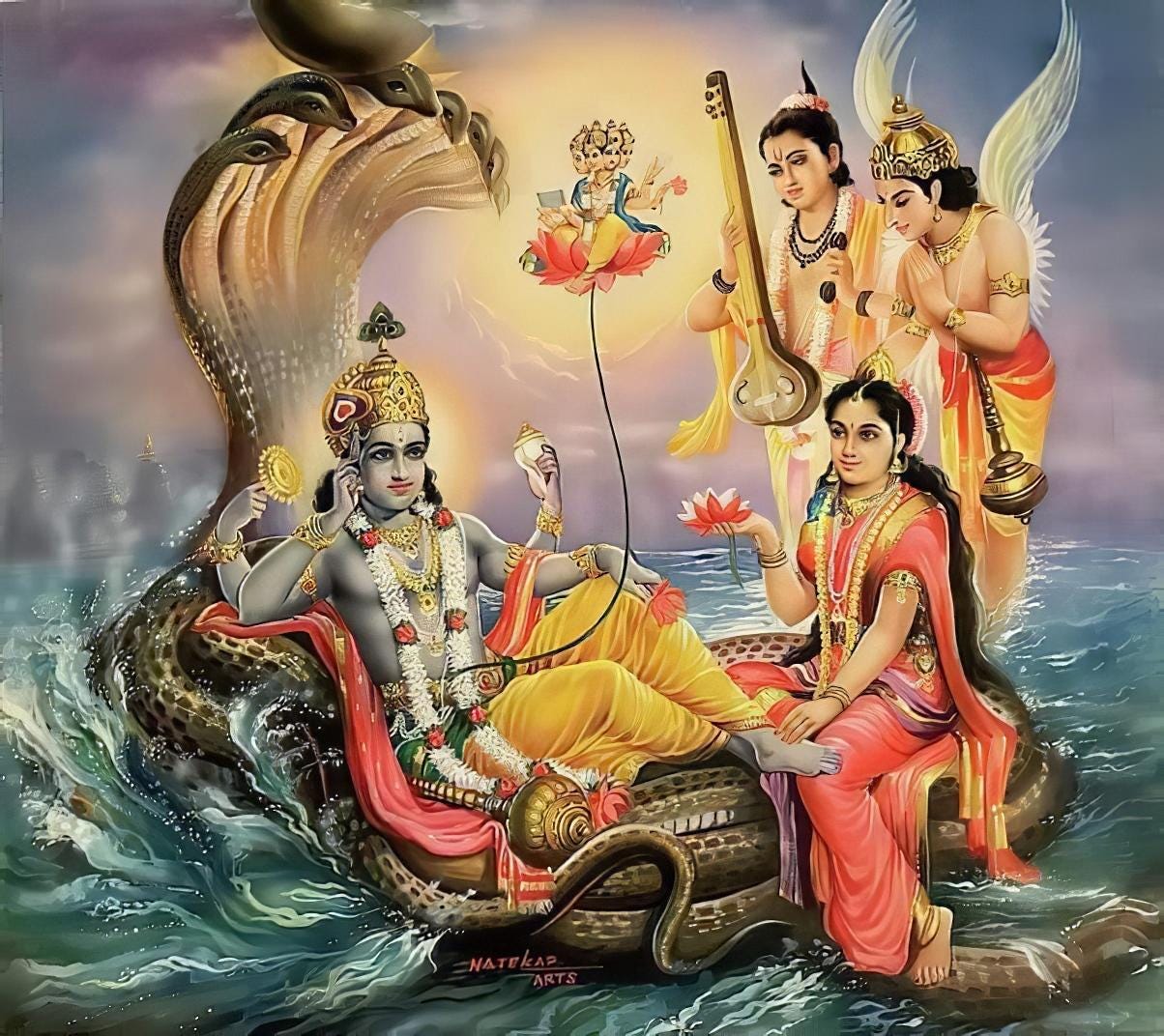
Topic 10: Arthāntarādhikaraṇam - Ākāśa refers to the Lord, who is different from the jīva
The ether described in the Chāndogya Upaniṣad refers to the Supreme Lord.
ākāśo’rthāntaratvādi-vyapadeśāt, suṣupty-utkrāntyor bhedena, paty-ādi-śabdebhyaḥ,
“Ākāśa here refers to the Lord, because the text describes the qualities of a person different from the jīva, and so on. The word Brahman does not indicate the jīva, because the descriptions of difference in both death and dreamless sleep. The jīva is not Brahman because words like pati indicate the subordinate position of the jīva, even in the liberated state.”
Sūtra 1.3.41 - Dismissing incorrect interpretations
ākāśo’rthāntaratvādi-vyapadeśāt
ākāśaḥ: sky, or ether; artha: meaning; antaratva: difference; ādi: beginning with, and so on; vyapadeśāt: because the scriptures describe it as such.
Ākāśa here refers to the Lord, because the text describes the qualities of a person different from the jīva, and so on.
Commentary: This passage is connected with verse 8.14.1 from the Chāndogya Upaniṣad:
ākāśo vai nāma nāmarūpayor nirvahitā, te yad antarā tat brahma tad amṛtam sa ātmā, prajāpateḥ sabhām veśma prapadye, yaśo ’ham bhavāmi brāhmaṇānām yaśo rājñām yaśo viśām yaśo ’ham anu prāpatsi, sa hāham yaśasām yaśaḥ śvetam adatkam adatkam śvetam lindu mā ’bhigām lindu mā ’bhigām
“He who is famous as ākāśa is the creator and maintainer of all names and forms. That which resides in them is the immortal Brahman, who is ātmā, the Self. I thus pray: ‘Entering the abode of the Prajāpati (the material universe), may I become virtuous amongst the Brāhmaṇas. May I be virtuous amongst the kings. May I be virtuous amongst common people. May I remain virtuous in all circumstances. May I remain pure, uncontaminated, without stain. May the material contamination never come near me. May all that is impure remain distant.’”
We already studied different examples of the word “ākāśa” meaning the Lord. This is just one more example. The Lord is the creator of names and forms (being the creator of the whole material manifestation); He is unlimited and eternal. He is ātmā, the Supreme Self.
However, one could argue that the ākāśa described in this passage is the jīva after attaining liberation from material bondage. He could point to the words “yad antarā“ (which is within) as referring to the jīva after attaining liberation, becoming free from all names and forms. Following this interpretation, one could argue that the words “nāma-rūpayor nirvahitā“ (the creator of names and forms) apply to the jīva in his conditioned state, when under material dualities, that the word, “ākāśa” means “effulgence” and that the words “tad brahma tad amṛtam“ (that spirit which is immortal) again describe the qualities of the jīva after attaining liberation.
Making these assumptions, the verse could be translated as something like:
“That effulgence that is within, the creator of names and forms, that spirit which is immortal, is the self.”
We can see that in this case, the word “ākāśa” ends up being interpreted as the jīva and not the Lord. This shows how Sanskrit verses must be interpreted according to other verses of the passage and the general conclusions of the scriptures; otherwise, one comes to the wrong meaning.
To this incorrect interpretation, Śrīla Vyāsadeva answers: ākāśo’rthāntaratvādi-vyapadeśāt. The word “ākāśa” used here refers to the Supreme Personality of Godhead, in his form as Paramātmā, because the ākāśa (sky) described here is different from the liberated jīva, being unlimited and all-pervading.
Again, the correct interpretation of the verse takes into account a very important conclusion of the scriptures: The Lord is great and the jīva is very small. When this conclusion is accepted, it becomes easier to understand when verses speak about the Lord, because in these passages the Lord is always described as unlimited, all-pervading, the creator, and so on.
For example, the word “nirvahitā” used in the verses refers to the creator of names and forms. This can’t be applied to the jīva, because in the conditioned state, the jīva accepts material names and forms (different material bodies) under the influence of karma, and in the liberated state, the jīva gives up all material names and forms altogether. In this way, the only one who creates names and forms at any stage is the Lord.
This is corroborated in the Chāndogya Upaniṣad (6.3.2), where it is mentioned:
seyam devataikṣata, “hantāham imās tisro devatā anena jīvenātmanā ’nupraviśya nāma-rūpe vyākaravāṇīti tāsām trivṛtam trivṛtam ekaikām karavāṇi” iti
“The Lord deliberated: Together with the jīvas I will now enter the material creation, and make each material element threefold, creating a variety of names and forms.”
The word ādi in the sūtra (beginning with) indicates that there are also other reasons. The word “Brahman” in the verse (great without limit) can’t be used to describe the jīva (even in the liberated stage), but it can be very naturally used to describe the Supreme Lord. Similarly, the word “ākāśa” in the way it’s used in this verse, meaning all-pervading, is applicable to the Lord in His form as Paramātmā, but not to the jīva.
By all these arguments, it’s proved that verse 8.14.1 from the Chāndogya Upaniṣad speaks about the Lord, and not the jīva, who can’t attain the qualities mentioned in the verse even in the liberated stage.
Sūtra 1.3.42 - How the soul is embraced by the Lord
suṣupty-utkrāntyor bhedena (vyapadeśāt)
suṣupti: in dreamless sleep; utkrāntyor: and in death; bhedena: because of the difference; vyapadeśāt: because of descriptions in the scriptures.
The word Brahman does not indicate the jīva, because the descriptions of difference in both death and dreamless sleep.
Commentary: Śrīla Baladeva Vidyābhūṣaṇa explains that the word vyapadeśāt from the previous verse applies to this also. In this way, the verse speaks about the descriptions in the śāstras of the difference between the jīva and the Lord in the stage of deep sleep and while leaving the body. These are descriptions that counter arguments that could be used against the explanations of the previous sūtras.
What arguments are these?
After hearing the arguments offered in the previous sūtra, our monistic opponent could disagree that the word “Brahman” can be used to describe anything other than the jīva in his liberated state, arguing that different verses describe the jīva in the conditioned state and in the liberated state.
For example, Bṛhad-āraṇyaka Upaniṣad 4.3.7 describes the jīva in the conditioned state:
katama ātmeti – yo ’yam vijñānamayaḥ prāṇeṣu hṛdy antarjyotiḥ puruṣaḥ
sa samānaḥ sann ubhau lokāv anusamcarati dhyāyatīva lelāyatīv
sa hi svapno bhūtvemam lokam atikrāmati mṛtyo rūpāṇi“Janaka said, “What is the ātmā?” Yājñavalkya said, “It is the soul, situated in the heart among the vital airs, who illuminates the whole body with consciousness. Thinking himself independent, he wanders in this world and the next, both in the awake and dream state, falsely thinking that he is thinking and doing.”
But later in the same Upaniṣad, the liberated state of the jīva is described as Brahman:
sa vā ayam ātmā brahma vijñānamayaḥ
“This jīva is Brahman, full of knowledge.” (Bṛhad-āraṇyaka Upaniṣad 4.4.5)
brahmaiva san brahmāpyeti
“Becoming Brahman, the jīva attains Brahman.” (Bṛhad-āraṇyaka Upaniṣad 4.4.6)
At the end, describing the result of the process, it is said that:
abhayam vai brahma bhavati ya eva veda
“Whoever knows this becomes Brahman, he becomes fearless.” (Bṛhad-āraṇyaka Upaniṣad 4.4.25)
Based on references like these, our opponent could argue that although sometimes distinctions are made between the jīva and the Supreme Brahman, these distinctions are just like the difference between the air closed in a pot and the air in the sky. Although the air inside the pot can be temporarily separated from the sky, it never really becomes different from it, and it can merge back into the sky as soon as the pot is opened. Similarly, he could argue, the jīva may appear to temporarily become different from Brahman due to upādhis (material designations), but ultimately, when these false material designations are given up, the jīva merges into the Supreme Brahman, just like the air in the pot merges back into the sky when the pot is opened. When this happens, the jīva becomes one with Brahman and thus gains the power to create universes and so on.
To this, Vyāsadeva answers with the current sūtra: suṣupty-utkrāntyor bhedena (vyapadeśāt). The jīva is not the Supreme Brahman, because of different descriptions (vyapadeśāt) showing that the jīva is different (bhedena) from the Lord while in deep sleep and while leaving the body (suṣupty-utkrāntyor).
In the Bṛhad-āraṇyaka Upaniṣad 4.3.21, the jīva is described as being distinct from the Lord in the state of deep sleep:
tad vā asyaitad aticchando ’pahata-pāpmābhayam rūpam, tad yathā priyayā striyā sampariṣvakto na bāhyam kim cana veda nāntaram, evam evāyam puruṣaḥ prājñenātmanā sampariṣvakto na bāhyam kim cana veda nāntaram, tad vā asyaitad āptakāmam ātmakāmam akāmam rūpam śokāntaram
“Now, a description of the most pleasant state, free from sin or fear. Just as a man embraced by his wife does not know anything beyond that experience externally or internally, the soul, embraced by the Supreme Lord called prajñā (Paramātmā, as the Lord of deep sleep), falls into an unconscious, blissful state, and does not know anything inside or outside. This is his state where all desires are attained, where the Self is his only desire, desireless, and beyond all sorrow.”
The state of deep sleep, or prajñā, is described in several of the Upaniṣads as a state of unconscious bliss, where the jīva becomes completely unaware of the external senses, or even the mind or false-ego, and is embraced by the Lord inside the heart. This is similar to a state of impersonal liberation, but it is temporary, lasting for the period of deep sleep. However, because at this stage the jīva still has desire for material enjoyment and is not awakened for his eternal position in the devotional service to the Lord, we later return to external consciousness upon awakening.
This, however, makes clear the distinction between the soul and the Lord in the state of deep sleep, and the subordinate position of the soul.
What about the difference between the two while leaving the body, mentioned by Vyāsadeva in the sūtra? This is indicated in the Bṛhad-āraṇyaka Upaniṣad 4.3.35:
tad yathānaḥ susamāhitam utsarjam yāyād evam evāyam śārīra ātmā prājñenātmanānvārūḍha utsarjam yāti, yatraitad ūrdhvocchvāsī bhavati
“Just as a cart, heavily loaded, leaves one place for another, the jīva, impelled by the Lord, leaves the body at the time of the last breath.”
Just as a cart doesn’t go from one place to the other by itself, the jīva is dependent on the Lord for transmigrating from one body to another, just as in everything else. Just as in the previous example, the jīva is fully dependent on the Lord. The mention of the cart being loaded is also significant, because the jīva also leaves the body loaded, not by cargo, but by the results of his material activities.
In this second verse, the word “utsarjan” is used, meaning that the jīva leaves the body while groaning in pain. Similarly, the first verse describes that while in deep sleep, the jīva does not know anything inside or outside. We can see that in both cases the jīva has very limited knowledge and is dependent upon the Lord, the omniscient ātmā (Paramātmā). The jīva can’t be embraced by himself, or be impelled by himself, and he can’t also be embraced or ride on another jīva, since the text describes the companion of the jīva as “omniscient” (prajñātmā), which can be applied only to the Supreme Lord. Therefore, it is proved that Chāndogya Upaniṣad 8.14.1 and other verses describe the Lord.
Sūtra 1.3.43 - The subordinate position of the jīva
paty-ādi-śabdebhyaḥ
pati: Lord, master; ādi: beginning with; śabdebhyaḥ: because of the words used.
The jīva is not Brahman because words like pati indicate the subordinate position of the jīva, even in the liberated state.
Commentary: One could argue that the previous arguments don’t prove that the jīva cannot become Brahman, but just that the jīva becomes different from Brahman while materially conditioned, due to different material false identifications (upādhis). According to this idea, once the soul becomes free from material identifications, one merges back into Brahman, just like the air inside a pot merges back to the sky when the pot is opened.
In this sūtra, Vyāsadeva provides additional arguments against this idea, stating that paty-ādi-śabdebhyaḥ: The usage of the word master (pati), as well as other terms, shows that there is a difference between the jīva and the Lord even in the liberated state.
In the Bṛhad-āraṇyaka Upaniṣad (4.4.22), for example, a little after the two verses quoted in the explanation of the previous sūtra, it’s mentioned:
sa vā eṣa mahān aja ātmā yo ’yam vijñānamayaḥ prāṇeṣu
ya eṣaḥ antar hṛdaya ākāśaḥ, tasmin chete
sarvasya vaśī, sarvasya īśānaḥ, sarvasya adhipatiḥ
sa na sādhunā karmaṇā bhūyān, no eva asādhunā kanīyān
eṣa sarveśvaraḥ, eṣa bhūtādhipatiḥ, eṣa bhūtapālaḥ
eṣa setuḥ vidharaṇa eṣām lokānām asambhedāya“The Lord is the great, unborn Self, full of knowledge, who dwells in the space of the heart among the vital functions, maintaining this space in which all rests. He is the controller of all, the master of all, the Lord of all. He does not become greater by pious acts or smaller by sinful acts. He is the Lord of lords. He is the ruler of all beings. He is the protector of all beings. He is the boundary that prevents the worlds from falling apart.”
Verses like this clearly show that the Lord is different from the liberated jīva. The jīva is always very small, both in the conditioned and liberated stages. It can’t be said that the jīva is the controller of all, or that it can ever rule over all, or that the jīva is master and protector of all the worlds. The jīva also doesn’t have the power to create universes, another attribute that applies only to the Lord.
The idea that the jīva and the Lord are identical is also refuted in the Taittirīya Upaniṣad, where it is mentioned: antaḥ praviṣṭaḥ śastā janānām, “He is the controller in the living entities’ hearts.”
Nowhere in the scriptures is it said that the distinction between the jīva and the Lord is only because of the jīva’s identification with the material body and different material designations. Rather, the eternal difference between the two is clearly stated in many passages. Although the jīva is one with the Lord in the sense that both are spiritual and eternal, and although both are eternally related, the jīva is eternally different from the Lord, just like the son and the father are two different persons. The jīva may at some point attain impersonal liberation and be put in the effulgence of the impersonal Brahmajyoti, but even in this position, the jīva never really merges into the Lord. The proof of that is that one can fall from the Brahmajyoti and come back to this material world in search of variety.
When the scriptures mention that “ayam atma brahma“ (the self is Brahman), it simply means that the jīva has a small portion of Brahman’s qualities, just like a ray of light from the sun has some of the qualities and potency of the sun, but is not identical with the sun in all respects. Similarly, the expression “brahmaiva san brahmāpyeti“ (becoming Brahman, he attains Brahman) should be understood in the sense that, in the liberated stage, the jīva attains a small portion of the qualities of the Lord, and in this sense becomes “like” Him, although the jīva can’t ever become Him.
Later in the Govinda-bhāṣya (in the section starting with sūtra 2.3.41), this point will be discussed in more detail. The Lord and the jīvas are eternally separated. The jīva is not like a piece of stone cut out of a big stone, or a fragment of gold cut from a bar of gold. Such separation is not possible because the Lord is unchangeable. He can’t be cut into smaller parts. Just as the Lord exists eternally as an entity, the jīvas also exist eternally as entities, and both are eternally separated. Impersonal liberation means to just become a small particle of light in the bodily effulgence of the Lord, and not to merge unto Him.
Exercise
Now it’s your turn. Can you answer the following arguments using the ideas from this section?
Opponent: “Some conclude that the term ākāśa described in the Chāndogya Upaniṣad 8.14.1 refers to Narāyana, but we can’t agree with this conclusion. Our understanding is that ākāśa refers to the liberated ātmā, or jīva. The text mentions “ākāśo vai nāma nāmarūpayor nirvahitā, te yad antarā tat brahma”. The words “yad antarā” indicate the jīva, which is the substratum that sustains the names and forms that form material illusion. This jīva is thus “nāma-rūpayor nirvahitā”, the creator of names and forms, just as a silkworm creates its own cocoon. This jīva is Brahman, effulgent and immortal, and after attaining liberation, becomes free from all names and forms.
The verse thus describes the same object, the ātma, in two states: the conditioned state, as the creator of names and forms, residing inside the heart, and the liberated state, when the eternal qualities of the Self are revealed, and one becomes effulgent, as one with the Supreme Brahman. This is also described in the text with the words “tat brahma tad amṛtam sa ātmā”. In this way, the whole passage can be translated as “That effulgence that is within, the creator of names and forms, that spirit which is immortal, is the Self.” As we can see, there is no reference to a separate entity here apart from the ātma in its conditioned and liberated state.
This view is also supported in the previous verse (8.13.1): aśva iva romāṇi vidhūya pāpam: he is like a horse, shaking off all sin. Prior to liberation, the ātmā accepts names and forms and performs all kinds of material activities, good and bad, but after liberation, this is all left behind. One thus sees oneself as transcendental, one with Brahman.
It’s also important to note that the word ākāśa doesn’t mean just “ether” or “open space”. It also indicates luminosity, or effulgence, the splendor of the liberated ātmā, showing its splendor as one with the Supreme Brahman, as beautifully described in the Chāndogya Upaniṣad and other texts.”
Description: Just because something makes sense and appears to follow a logical sequence doesn’t mean it is correct. Often, we accept different pieces of information just because they “make sense”, without checking the true facts. As we can see in these different pūrvapakṣas we are studying and learning to refute, this is a dangerous attitude that can make us vulnerable to all kinds of incorrect interpretations. In this particular example, the arguments mimic an independent thinker who mixes arguments from the Māyāvāda school with some proto-advaita reasoning. Technically speaking, it is not bona fide neither according to the Vaiṣnava school, nor the Advaita line, but it still makes sense, even though it is incorrect on so many levels.
All the sūtras of the third pāda in prose
“The passage mentioning the abode of heaven, earth, and other material creations refers to the Lord, because the words specifically describe Him, and because it is described that He is attained by liberated souls. The abode of heaven and earth is also not pradhāna, because there is no word denoting it in the passage. It is also not the jīva, for the same reason. And also because the difference between them is clearly described. It does not refer to the jīva because of the context of the passage, and also because of the latter mention that one bird is eating and the other is standing.
Bhūmā refers to the Supreme Personality of Godhead, because the passage mentions that Bhūmā is superior to the jīva, who is dependent on the Lord’s mercy, and also because the qualities mentioned in the passage can only be appropriately attributed to the Lord. Akṣara is the Lord, because He supports all material elements, up to the ether, and also because He is defined as the controller. Because the passage describes His attributes, this excludes any other possibility. The person seen is the Lord, because the qualities described can be applied to Him only.
The dahara is the Lord, because of the subsequent statements in the Upaniṣad, and also because of the description of the soul going to the Lord, because of the word denoting Brahman, and because it is both directly stated and hinted at in the text. It refers to the Lord also because of the description of His glory in maintaining the Universe, and because this is the well-known usage of the word. If one argues that the dahara is the jīva, because the jīva is mentioned in the text, I say no. It’s impossible for the jīva to have the qualities mentioned. If one insists that the dahara is the jīva, based on a later passage, the answer is again no. These qualities are manifested in the jīva through sādhana. The reference to the jīva has a different purpose. If it is argued that because the passage describes the space in the heart as small, it must be the jīva, I say it is not so. This argument has already been refuted. The jīva merely resembles the Lord in some aspects; this is also described in the smṛti-śāstra.
The person the size of a thumb is Viṣnu. This is indicated by the words of the passage. He appears in a form the size of a thumb because that is the size of the heart of humans, who are qualified for meditation on the Lord.
The demigods, who are above men, also worship the Supreme Lord. That’s possible because they also have bodies. This is the opinion of Bādarāyaṇa (Vyasa). If one argues that this contradicts their activities, I say no, because it is seen that the demigods can manifest in many forms simultaneously. If one argues that this contradicts the eternal nature of the words of the Vedas, I say no, because the demigods are created from eternal words. This is shown in statements of the śruti and smṛti. Therefore, the eternity of the Vedas is proved. Indeed, because the names and forms remain the same in each new cycle of creation, there is no contradiction. This is confirmed in the śruti and smṛti. Jaimini is of the opinion that devas do not engage in the madhu-vidyā and other forms of Vedic meditation and duties because it is not possible for them to do so. The demigods can’t perform these types of worship because they meditate on the effulgence of the Lord, the supreme light, he argues. Vyāsadeva, however, maintains that the demigods perform the Vedic duties, but with a specific mentality.
The word śūdra is used in the passage because Janaśruti approached Raikva in sorrow after hearing the disrespectful words. It is understood that he was a kṣatriya because of the cue later on, in the passage about Caitraratha. The scriptures mention purificatory rites for the high classes and the absence of them for śūdras. In this way, care is taken to determine that a student is not a śūdra. The smṛti-śāstra also forbids the śūdras from hearing and studying the Vedas.
The thunderbolt mentioned in the passage is the Lord, because he causes the world to tremble, and because of the contiguous passage, describing Him as the Lord of light and fire. Ākāśa here refers to the Lord, because the text describes the qualities of a person different from the jīva, and so on. The word Brahman does not indicate the jīva, because the descriptions of difference in both death and dreamless sleep. The jīva is not Brahman because words like pati indicate the subordinate position of the jīva, even in the liberated state.”
You can also donate using Buy Me a Coffee, PayPal, Wise, Revolut, or bank transfers. There is a separate page with all the links. This helps me enormously to have time to write instead of doing other things to make a living. Thanks!
« Vedānta-sūtra: The Govinda-bhāṣya of Baladeva Vidyābhūṣaṇa