

« Vedānta-sūtra: The Govinda-bhāṣya of Baladeva Vidyābhūṣaṇa
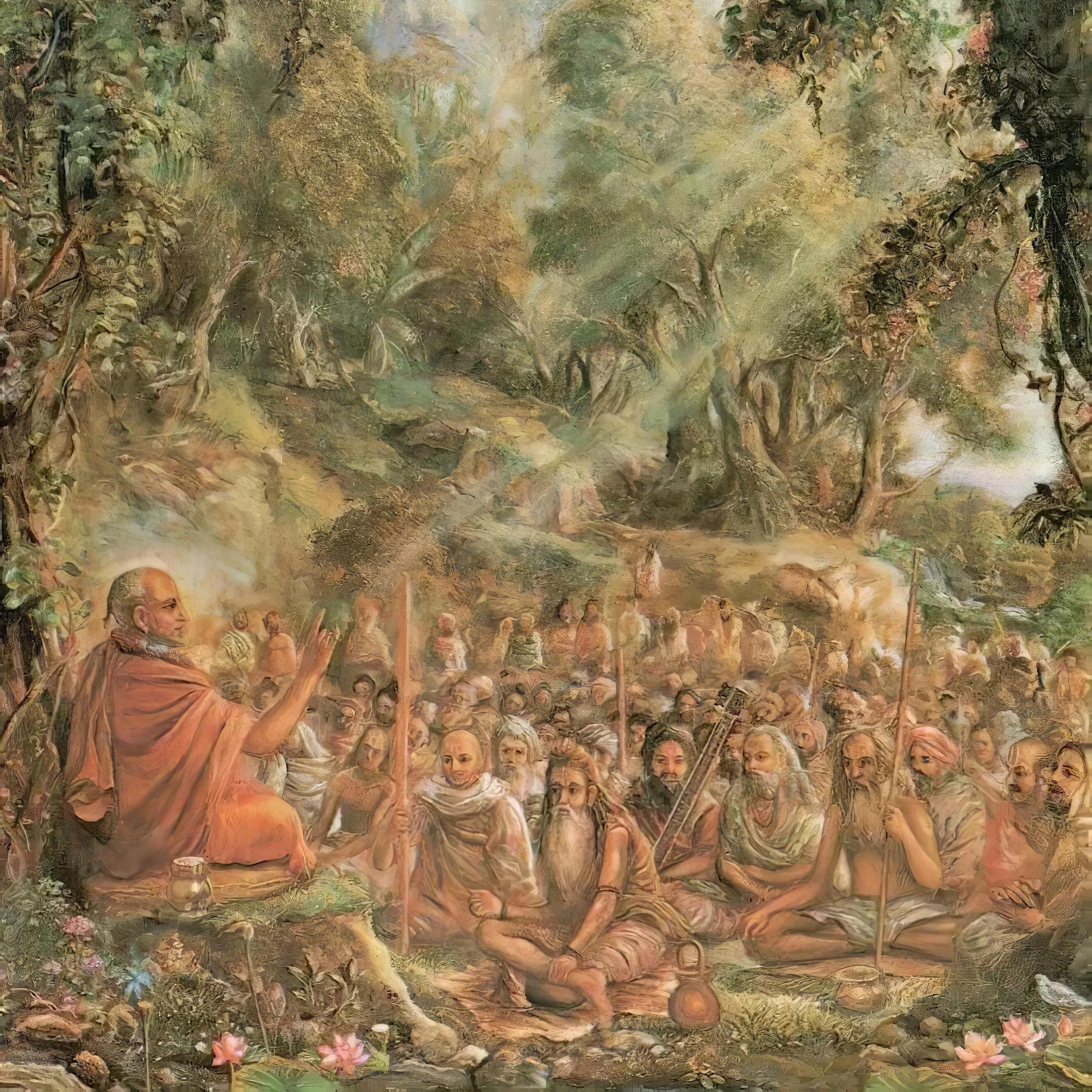
The six philosophical systems
Sānkhya is one of the ṣaḍ-darśanas, one of the six philosophical views based on the Vedas that are refuted in the Vedānta-sūtra.
In His purport to SB 1.1.7, Śrīla Prabhupāda explains that:
“Śrīmad-Bhāgavatam is a natural commentation on the Brahma-sūtra, or the Bādarāyaṇi Vedānta-sūtras. It is called natural because Vyāsadeva is author of both the Vedānta-sūtras and Śrīmad-Bhāgavatam, or the essence of all Vedic literatures. Besides Vyāsadeva, there are other sages who are the authors of six different philosophical systems, namely Gautama, Kaṇāda, Kapila, Patañjali, Jaimini and Aṣṭāvakra. Theism is explained completely in the Vedānta-sūtra, whereas in other systems of philosophical speculations, practically no mention is given to the ultimate cause of all causes. One can sit on the vyāsāsana only after being conversant in all systems of philosophy so that one can present fully the theistic views of the Bhāgavatam in defiance of all other systems.”
The six philosophical systems that Śrīla Prabhupāda mentions here are:
1- The Nyāya system of Gautama Ṛṣi;
2- The Vaiśeṣika system of Kaṇāda Ṛṣi;
3- The Sānkhya doctrine, of the atheistic Kapila;
4- The system of mystic yoga of Patañjali;
5- The Pūrva-mīmāmsā philosophy of Jaimini;
6- The impersonalism of Aṣṭāvakra and later Śankarācārya, which covers the proper interpretation of the Vedānta, as intended by Vyāsadeva.
Different philosophies that come from India can be divided into two groups: āstika (philosophies that follow the Vedas) and nāstika (philosophies that reject the Vedas). Different from nāstika philosophies like Buddhism, Jainism, and the atheistic empiricism of the followers of Cārvāka (philosophies that reject the Vedas), the ṣaḍ-darśanas, or the six systems of philosophy mentioned here by Śrīla Prabhupāda are considered āstika philosophies because they all accept the Vedas as authoritative.
Originally, these six philosophical systems were different parts of a unified system of understanding of the Vedas, but with time the scholars started disagreeing and the systems became separated, with none of them having a complete view of the goal of life.
The resultant six philosophical systems are predominantly atheistic, studying different aspects of material nature separately from the Supreme Lord. Logic, meditation, and so on are part of our spiritual studies and practice, but when disconnected from Kṛṣṇa, they become just materialistic philosophies that have little purpose in bringing one back to Godhead.
It seems that these six systems also become separated in other cycles of creation of the universe, serving different classes of materialistic persons. Just like Lord Śiva comes as Śankarācārya to establish the Māyāvāda doctrine and thus bewilder the atheists, different philosophers propound these different philosophical systems at different times for different purposes.
So, what do these six schools teach?
1- The Nyāya system deals with reasoning and logic, establishing rules of philosophical debate, identifying subjects for discussion, etc. The main concern is in establishing the conditions for obtaining correct knowledge (pramāṇa), and the means of acquiring valid knowledge, analyzing the nature and source of different types of knowledge to determine their validity or non-validity, and so on. Logic has a very important role in the study of the Vedānta-sūtra, for example, since it is full of logical arguments that lead us to a conclusive understanding of the Upaniṣads. However, when separated from the authority of śāstra and devotion to the Lord, logic becomes merely a tool for debate and the exercise of intellectual ego.
2- The Vaiśeṣika system, propounded by Kaṇāda (often discussed alongside Nyāya), studies the material world in great detail, determining its causes and effects in order to destroy material suffering. It holds that ignorance (avidyā) is the root cause of misery and concludes that liberation (mokṣa) is attainable through the cultivation of correct knowledge. The main focus in this school is on studying the causes and effects of the material creation, and especially the material elements and their attributes. Their conclusion, however, is that the atomic combination of material elements is the original cause of creation. This theory, called Paramāṇuvāda, is similar to what is believed by modern physicists.
3- The Sānkhya doctrine is an analytic study of the material elements. Although it bears the same name as the ancient system introduced by Lord Kapila, the son of Devahūti, the modern system was propounded by another Kapila, who taught an atheistic interpretation.
4- The process of mystic yoga is offered in the Vedas as a bona fide process of self-realization. Kṛṣṇa himself describes the system of aṣṭānga-yoga in the Bhagavad-gītā. Originally, yoga means to link our consciousness with the Supreme Personality of Godhead, reviving our original spiritual identity. The system that is counted amongst the six philosophical systems is the Pātañjala-yoga, propounded by Patañjali in his Pātañjala-yoga-sūtra. This system is focused on examining the nature of the mind, its workings, the impediments it creates, the causes of material suffering, and so on. The ultimate goal in this system is kaivalya, or impersonal liberation.
5- The Pūrva-mīmāmsā (or karma-mīmāmsā) philosophy was propounded by Jaimini. This is a philosophical school that stresses fruitive activities. For them, the results of one’s material activities are supreme, and if there is a God, he is nothing more than an order supplier, who just delivers the results of one’s karma. According to this system, there is no real need to become a devotee of the Lord. One should just follow moral principles and perform pious activities, and thus be happy in this world by receiving the results of one’s good karma. Vyāsadeva quotes Jaimini a few times in the Vedānta-sūtra (although not always in agreement with him), and Baladeva Vidyābhūṣaṇa explains in his commentary that in reality he was a devotee who wrote instructions to guide common people who lacked higher qualifications.
6- The last system is the Vedānta school, presented by Vyāsadeva (Bādarāyaṇa) in the Vedānta-sūtra, which brings the final conclusion of the Vedas, further explained in the Śrīmad-Bhāgavatam. However, other sages have also presented their own interpretations of Vedānta. The chief amongst them was Aṣṭāvakra, whose Aṣṭāvakra-gītā reflects an impersonalistic understanding of the Upaniṣads. His conclusions are very close to the Advaita Vedānta later systematized by Śankarācārya, which declares the material world to be false, the self to be one with Brahman, and liberation to consist in merging into the impersonal Absolute. Such teachings represent only a partial understanding of the Vedas, since they stop at the Brahman realization and fail to reach the ultimate truth of Bhagavān, the Supreme Person. Both offer an incomplete, impersonal interpretation; the main difference is that Śankara based his philosophy on an interpretation of the Vedānta-sūtra of Vyāsadeva, while Aṣṭāvakra taught based on his own book.
Vyāsadeva was well aware of all these different philosophical systems and strived to offer the proper conclusion of the Vedas in his own school, propounding the philosophy of Brahma-mīmāmsā, or Vedānta, which brings the ultimate conclusion of the absolute truth.
Vyāsadeva appeared at the end of Dvāpara-yuga to restore the correct understanding of the Vedas, which at the time had been covered by these different philosophies. In the Bhagavad-gītā (15.15), Kṛṣṇa mentions how he personally comes as Vyāsadeva to compile the Vedas and establish the Vedānta school at the end of Dvāpara-yuga: “I am seated in everyone’s heart, and from Me come remembrance, knowledge and forgetfulness. By all the Vedas, I am to be known. Indeed, I am the compiler of Vedānta, and I am the knower of the Vedas.”
In his purport to the same verse, Śrīla Prabhupāda, speaking about the Supreme Personality of Godhead, mentions:
“He is worshipable not only as the impersonal Brahman, the Supreme Personality of Godhead and the localized Paramātmā, but as the form of the incarnation of the Vedas as well. The Vedas give the right direction to people so that they can properly mold their lives and come back to Godhead, back to home. The Vedas offer knowledge of the Supreme Personality of Godhead, Kṛṣṇa, and Kṛṣṇa in His incarnation as Vyāsadeva is the compiler of the Vedānta-sūtra. The commentation on the Vedānta-sūtra by Vyāsadeva in the Śrīmad-Bhāgavatam gives the real understanding of Vedānta-sūtra. The Supreme Lord is so full that for the deliverance of the conditioned soul He is the supplier and digester of foodstuff, the witness of his activity, and the giver of knowledge in the form of the Vedas and as the Supreme Personality of Godhead, Śrī Kṛṣṇa, the teacher of the Bhagavad-gītā. He is worshipable by the conditioned soul. Thus God is all-good; God is all-merciful.”
Māyāvādis claim to be Vedāntists, but they don’t understand the correct conclusion of the Vedānta philosophy. Being misguided, they think that Vedānta means the interpretation of Śankarācārya. The correct interpretation of the Vedānta-sūtra is given in the Śrīmad-Bhāgavatam, the commentary given by the author himself, Śrīla Vyāsadeva. The Bhāgavatam concludes that Kṛṣṇa, the son of Nanda Maharaja, is the Supreme Personality of Godhead, and the perfection of life is to attain pure love for Him. This conclusion is the basis for the Govinda-bhāṣya of Śrīla Baladeva Vidyābhūṣaṇa, whose arguments are precisely aimed at contesting different incorrect assumptions from these philosophies. The current pāda is aimed specifically at the atheistic Sānkhya propounded by the false Kapila.
The atheistic Sānkhya
The original Sānkhya system was introduced during the reign of Svāyambhuva Manu, at the beginning of the current day of Brahmā, by Lord Kapila, the son of Devahūti. This original system explains the material elements, as well as the workings of the universe, studies the causes of suffering for the jīvas, and so on, leading ultimately to the process of devotional service to the Lord. This original philosophy of Sānkhya is explained in the Third Canto of Śrīmad-Bhāgavatam.
In the foreword of Teachings of Lord Kapila, Śrīla Prabhupāda offers the following definition:
“What is Sānkhya? Insofar as Sānkhya deals with the elemental categories or principles of the physical universe, Sānkhya is what Western scholars generally refer to as “metaphysics.” The term sānkhya literally means “to count.” This name is used because Sānkhya philosophy enumerates principles of cosmic evolution by rational analysis. The etymological meaning of the word sānkhya is “that which explains very lucidly by analysis of material elements.” Philosophically, this term is used because the Sānkhya system expounds analytical knowledge that enables one to distinguish between matter and spirit. This understanding culminates in bhakti, devotion for and service to the Supreme. It may be said, therefore, that Sānkhya and bhakti form two aspects of the same process, bhakti being the ultimate goal or ultimate aspect of Sānkhya.”
Later, however, an impostor Kapila appeared, propounding another philosophy with the same name. This atheistic Sānkhya studies the material elements (prakṛti) and accepts the existence of the soul (puruṣa) without accepting the existence of Īśvara, or God. According to this atheistic Sānkhya philosophy, the entire material manifestation is simply based on a principle of cause and effect that has its ultimate cause in prakṛti, the material nature.
In Vaiṣnava philosophy, we accept that this material world is not false, but illusory. Although temporary, the material manifestation factually exists, and everything that exists should be used in Kṛṣṇa’s service. When we do that, we understand that ultimately there is no material world. Since everything is a transformation of Kṛṣṇa’s energy, everything is connected with Him, and everything is ultimately spiritual. However, under the influence of Māyā, we try to separate things from Kṛṣṇa, and that’s what makes them material. As long as we are under the false concepts of “I” and “mine”, we live in the material illusion, and as soon as we start seeing everything in connection with Kṛṣṇa and using everything in His service, we become liberated, even if we are still technically living in this world. In other words, there is a delicate balance between the ideas of this world being real and illusory.
However, other schools of thought have other ideas. The philosophers of the Advaita school (Māyāvādis), for example, accept the principle of vivarta-vāda, the idea that the material manifestation is ultimately unreal, and is caused simply by illusion. For example, I may see a rope on the road and mistake it for a snake. In this case, the rope is not factually transformed into a snake; the appearance of the “snake” is just caused by my misconception. As soon as the mistake is clarified, I understand that there is no snake. Similarly, according to the Māyāvādis, this world is unreal and becomes possible only because of avidyā, or illusion. They conclude that there is a form of avidyā that makes Brahman act as the puruṣa, assuming the numerous forms of Viṣnu (which they call saguṇa Brahman), and another form of avidyā that makes Brahman act as the conditioned souls, but when avidyā is removed, they say, we all become one. These are misconceptions we already learned to refute.
The Sānkhya philosophy, on the other hand, follows the view that there is a factual transformation of the cause into the effect, just like a slab of stone into a statue, wood into furniture, or milk into yogurt. In other words, their opinion is that the material manifestation exists in fact, not just an illusion.
Cārvāka Muni believed that atoms are the material causes of everything, an opinion that is also shared by Buddhists, Jains, and so on. The Sānkhya philosophy is a little more evolved, believing that prakṛti, the subtle aggregate of material energy, is the ultimate material cause, producing both the gross material elements, as well as the subtle components, such as mind, intelligence, the three material modes, and so on. Apart from prakṛti, there is puruṣa, or consciousness, which is the collective of all souls who interact with prakṛti.
Sānkhya philosophers believe that the conscious souls are completely different in nature from the inert material energy. Originally, they are separated, but when they somehow come closer, the chain of transformations in the material nature that leads to the creation and eventual destruction of the universe starts.
According to them, in the process of creation, prakṛti gives rise to different subtle energies, which are gradually transformed into gross energies, which in turn give origin to atoms and finally to different material objects. During the process of dissolution, the opposite happens, with physical objects being broken into atoms, which in turn dissolve into the gross energies, which dissolve into the subtle energies, and everything ultimately dissolves back into prakṛti, the unmanifested. Between the two stages, many material manifestations appear due to the influence of the three modes of material nature: goodness, passion, and ignorance. According to the Sānkhya philosophy, these three modes are the cause of everything we experience in this world, being characterized by pleasure (goodness), pain (passion), and indifference (ignorance). The same object can be the cause of pleasure (for one who possesses it), pain (for someone who wants but can’t obtain it), and indifference (for someone who doesn’t know about its existence). All these three different attitudes come from the three gunas or three material modes.
In Vaiṣnava philosophy, we also study the interaction between matter and spirit due to the influence of the three gunas. The main difference is that in Sānkhya, there is no reference to God, which makes the explanation very materialistic and incorrect in some points. For example, because Īśvara, or God, is not accepted, the three material modes are considered the ultimate cause of the cosmic manifestation. According to this idea, the three modes originally exist in a state of equilibrium in prakṛti, and when this equilibrium is somehow disturbed, they become distinct and start to act as three separate forces. When separated, the gunas are constantly reacting to each other, and this becomes the cause of the whole material manifestation. According to them, Pradhāna or prakṛti is the origin of the gunas, and the gunas are the cause of everything else; therefore, prakṛti is the ultimate cause of everything.
According to this understanding, the whole cosmic manifestation is experienced by the souls, puruṣa, which is the intelligent principle that guides it. All the material objects that come from prakṛti (which are by nature pleasurable, painful, or neutral) have no meaning if they are not experienced by some intelligent force. That intelligent force is puruṣa, the collective of all souls. They thus accept both prakṛti and puruṣa as eternal and originally separated, with puruṣa being transcendental to prakṛti. When they come close, they say, the material manifestation happens. In the stage of material bondage, the soul performs actions and, in this way, enjoys and suffers under the influence of the three modes. When the soul finally understands its nature distinct from matter, one eventually becomes free, going back to his original transcendental state.
The Sānkhya philosophy is based on studying the different material elements and interactions between them with the goal of finally becoming free from material influence. The study of buddhi, or intellect, is given special importance. Buddhi, in their philosophy, is said to possess eight qualities: virtue (dharma); knowledge (jñāna); detachment (vairāgya); excellence (aiśvarya); non-virtue (adharma); ignorance (ajñāna); attachment (avairāgya); and imperfection (anaiśvarya). The first four manifest under the influence of sattva-guna, and the other four manifest when buddhi is overpowered by ignorance. The soul identifies with buddhi, the material intelligence, and thus experiences what the material intelligence is experiencing. Through knowledge, however, one can eventually understand oneself to be transcendental to it.
This conditioning of the soul by material intelligence is also studied in Vaiṣnava philosophy. In the Fifth Canto of Śrīmad-Bhāgavatam, we have the description of the allegory of King Purañjana. In this allegory, the soul is described as the king and the material intelligence as the queen, both living in the city of the body. The helpless condition of the soul while living under this false identification is described in the following verses:
“When the Queen drank liquor, King Purañjana also engaged in drinking. When the Queen dined, he used to dine with her, and when she chewed, King Purañjana used to chew along with her. When the Queen sang, he also sang. Similarly, when the Queen cried, he also cried, and when the Queen laughed, he also laughed. When the Queen talked loosely, he also talked loosely, and when the Queen walked, the King walked behind her. When the Queen would stand still, the King would also stand still, and when the Queen would lie down in bed, he would also follow and lie down with her. When the Queen sat, he would also sit, and when the Queen heard something, he would follow her to hear the same thing. When the Queen saw something, the King would also look at it, and when the Queen smelled something, the King would follow her to smell the same thing. When the Queen touched something, the King would also touch it, and when the dear Queen was lamenting, the poor King also had to follow her in lamentation. In the same way, when the Queen felt enjoyment, he also enjoyed, and when the Queen was satisfied, the King also felt satisfaction.” (SB 4.25.57-61)
In this way, the Sānkhya philosophy more or less describes the interactions between the souls and the material nature, which are also explained by Lord Kapila in the original Sānkhya. However, because they don’t accept the existence of God, their theory is incomplete. Their concept of liberation is also impersonal, with the souls attaining kaivalya, impersonal liberation, upon achieving freedom from prakṛti.
Śrīla Prabhupāda gives us an elaborate description of the atheistic Sānkhya in his purport to CC Adi 6.14-15:
“The Sānkhya philosopher Kapila has connected the different elementary truths according to his own opinion. Material nature, according to him, consists of the equilibrium of the three material qualities — goodness, passion and ignorance. Material nature produces the material energy, known as mahat, and mahat produces the false ego. The ego produces the five objects of sense perception, which produce the ten senses (five for acquiring knowledge and five for working), the mind and the five gross elements. Counting the puruṣa, or the enjoyer, with these twenty-four elements, there are twenty-five different truths. The nonmanifested stage of these twenty-five elementary truths is called prakṛti, or material nature. The qualities of material nature can associate in three different stages, namely as the cause of happiness, the cause of distress and the cause of illusion. The quality of goodness is the cause of material happiness, the quality of passion is the cause of material distress, and the quality of ignorance is the cause of illusion. Our material experience lies within the boundaries of these three manifestations of happiness, distress and illusion. For example, a beautiful woman is certainly a cause of material happiness for one who possesses her as a wife, but the same beautiful woman is a cause of distress to a man whom she rejects or who is the cause of her anger, and if she leaves a man she becomes the cause of illusion.
“The two kinds of senses are the ten external senses and the one internal sense, the mind. Thus there are eleven senses. According to Kapila, material nature is eternal and all-powerful. Originally there is no spirit, and matter has no cause. Matter itself is the chief cause of everything. It is the all-pervading cause of all causes. The Sānkhya philosophy regards the total energy (mahat-tattva), the false ego and the five objects of sense perception as the seven diverse manifestations of material nature, which has two features, known as the material cause and efficient cause. The puruṣa, the enjoyer, is without transformation, whereas material nature is always subject to transformation. But although material nature is inert, it is the cause of enjoyment and salvation for many living creatures. Its activities are beyond the conception of sense perception, but still one may guess at them by superior intelligence. Material nature is one, but because of the interaction of the three qualities, it can produce the total energy and the wonderful cosmic manifestation. Such transformations divide material nature into two features, namely the efficient and material causes. The puruṣa, the enjoyer, is inactive and without material qualities, although at the same time He is the master, existing separately in each and every body as the emblem of knowledge. By understanding the material cause, one can guess that the puruṣa, the enjoyer, being without activity, is aloof from all kinds of enjoyment or superintendence. Sānkhya philosophy, after describing the nature of prakṛti (material nature) and puruṣa (the enjoyer), asserts that the creation is only a product of their unification or proximity to one another. With such unification the living symptoms are visible in material nature, but one can guess that in the person of the enjoyer, the puruṣa, there are powers of control and enjoyment. When the puruṣa is illusioned for want of sufficient knowledge, He feels Himself to be the enjoyer, and when He is in full knowledge He is liberated. In the Sānkhya philosophy, the puruṣa is described to be always indifferent to the activities of prakṛti.”
By the time of Vyāsadeva, the atheistic Sānkhya philosophy was already present; therefore, we can find mentions of it in some of his works, where its incorrect ideas are refuted.
Modern scientific theories are much less developed than Sānkhya since they are based only on the study of the gross material elements and physical laws, while Sānkhya offers a more evolved view of the universe, including the subtle material elements, the interactions of the three modes, the role of the mind, intellect and false-ego, as well as the presence of the soul, serving as the guide and observer of the material creation. As a result, Sānkhya offers a more logical explanation of the workings of the material universe, although still imperfect and incomplete, since it doesn’t accept the existence of Īśvara, the Supreme Controller.
In this way, once we become capable of understanding and defeating the shortcomings of the Sānkhya philosophy, defeating modern materialistic theories becomes comparatively easy.
Śrīla Baladeva Vidyābhūṣaṇa starts his explanation by offering the following prayers:
tamaḥ sankhya-ghanodīrṇa-vidīrṇam yasya go-gaṇaiḥ
tam samvid-bhūṣaṇam kṛṣṇa-pūṣaṇam samupāsmahe“Let us offer our respectful obeisances to the Kṛṣṇa-sun, which is decorated with transcendental knowledge, and which with its effulgence dispels the deep darkness of Sānkhya.”
You can also donate using Buy Me a Coffee, PayPal, Wise, Revolut, or bank transfers. There is a separate page with all the links. This helps me enormously to have time to write instead of doing other things to make a living. Thanks!
« Vedānta-sūtra: The Govinda-bhāṣya of Baladeva Vidyābhūṣaṇa