

« Vedānta-sūtra: The Govinda-bhāṣya of Baladeva Vidyābhūṣaṇa
Sūtra 1.4.3 - Material nature is dependent on the Lord
tad-adhīnatvād arthavat
tad: Him, the Lord; adhīnatvād: because of dependence upon; arthavat: has a meaning.
This meaning should be accepted because pradhāna is ultimately dependent on the Lord.
Commentary: Unconscious, inanimate matter can’t be the cause of anything. It always has to be manipulated by a conscious force. When a sculptor uses a chisel to make a sculpture, the cause of the sculpture is the sculptor, not the chisel. We could also say that the sculptor is the true cause, while the chisel is the immediate, or apparent cause, being the tool used to do the job. Without the sculptor, the chisel will just lie on the ground for millions of years without ever sculpting anything.
Because matter doesn’t have consciousness or desire, it is not capable of acting independently. It always has to be put in motion by a superior force. The movement can be very simple (like a sculptor using a chisel) or very complex, like a computer working after being loaded with software written by a programmer, but the same principle always applies. Just like a computer, the material nature may appear to be moving by itself to the layman, but a person who has better knowledge understands that it was put in motion by the Lord. In reality, the Vedas explain that everything that exists in the universe is conscious; the sun may appear to be just a ball of plasma to someone observing it from Earth, but there is a personality who presides over the sun, Vivasvān, the demigod. Similarly, all other planets and universal forces have presiding deities, just like all bodies are presided over by individual souls. The soul is the force that gives life to the body, and the soul is placed within the body by the will of the Lord. Therefore, the Lord is the ultimate cause.
Śrīla Prabhupāda mentions:
“Material nature is inert, and as such it cannot be the cause of matter, neither as the material nor as the efficient cause. Seeing the wonderful arrangement and management of the cosmic manifestation generally suggests that a living brain is behind this arrangement, for without a living brain such an arrangement could not exist. One should not imagine that such an arrangement can exist without conscious direction. In our practical experience we never see that inert bricks can themselves construct a big building.”
“Sometimes the material scientist suggests that trees grow from the earth automatically, without assistance from a gardener, because that is a tendency of matter. They also consider the intuition of living creatures from birth to be material. But such material tendencies as bodily intuition cannot be accepted as independent, for they suggest the existence of a spirit soul within the body. Actually, neither the tree nor any other body of a living creature has any tendency or intuition; the tendency and intuition exist because the soul is present within the body. In this connection, the example of a car and driver may be given very profitably. The car has a tendency to turn right and left, but one cannot say that the car itself, as matter, turns right and left without the direction of a driver. A material car has neither tendencies nor intuitions independent of the intentions of the driver within the car. The same principle applies for the automatic growth of trees in the forest. The growth takes place because of the soul’s presence within the tree.” (CC Adi 6.14-15)
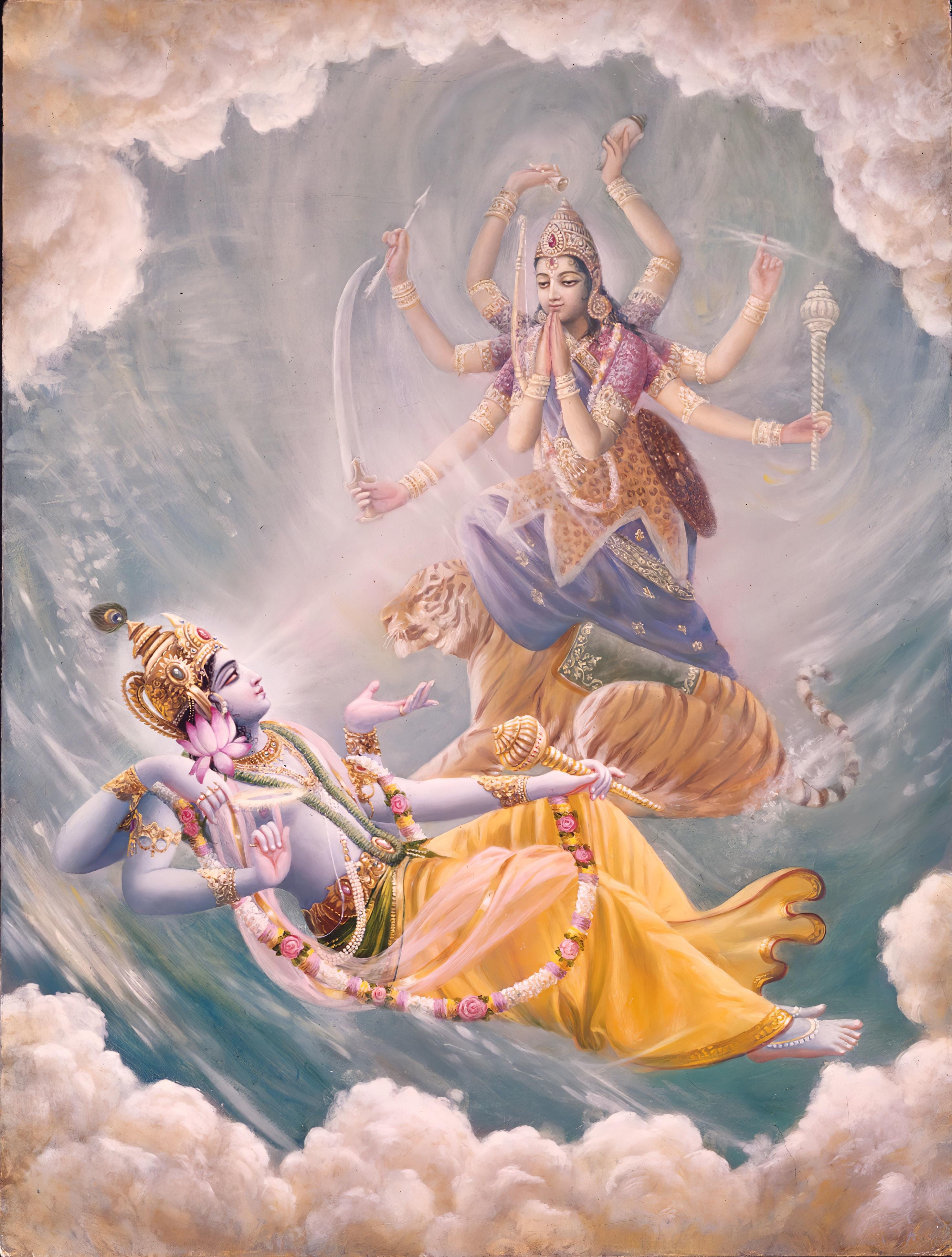
Why is the universe created in the first place? To give a chance to these souls to reconnect with their eternal spiritual nature. The Lord expands Himself as Mahā-Viṣnu and lies on the causal ocean, immersed in His pastime of creating and destroying the material universes. It’s explained that Lord Mahā-Viṣnu looks in the direction of the material energy, and this glance (Lord Sadāśiva) carries all the souls who desire to participate in the material creation.
Alongside the innumerable souls, the glance of Lord Mahā-Viṣnu carries also kāla, the time energy, which puts the material energy in motion. This is revealed in the Brahma-samhitā (5.7) by the words “tyakta-kālam” (by casting His glance in the shape of sending His time energy).
Every time Lord Mahā-Viṣnu exhales, millions and billions of complete material universes emanate from the pores of His body, and every time he inhales, all these universes are destroyed, and the souls who took part in them have to wait inside the body of Mahā-Viṣnu until the next creation.
In his commentary, Śrīla Baladeva Vidyābhūṣaṇa mentions that:
“The meaning here is that because pradhāna is ultimately dependent on the Supreme Brahman, which is the original cause of all causes, the creative actions of pradhāna are not the original cause, but are themselves caused by the Supreme Brahman. Because pradhāna is naturally inactive, it only acts when inspired by the glance of Brahman.”
He offers several quotes to substantiate this point:
māyām tu prakṛtim vidyān māyinam ca maheśvaram
tasyāvayava-bhūtais tu vyāptam sarvam idam jagat“Know māyā as prakṛti, the material nature, and know the controller of māyā as the Supreme Lord, Viṣṇu. By His parts and parcels (the jīvas) this whole universe is pervaded.” (Śvetāśvatara Upaniṣad 4.10)
chandāmsi yajñāḥ kratavo vratāni bhūtam bhavyam yac ca vedā vadanti
asmān māyī sṛjate viśvam etat tasmimś cānyo māyayā sanniruddhaḥ“The Vedas speak about meters and hymns, sacrifices, rituals, vows, and whatever exists in the past and future. The controller of māyā (the Lord) creates the Vedas and the whole universe. The others (the jīvas) become bound in this world of māyā.” (Śvetāśvatara Upaniṣad 4.9)
ya eko’varṇo bahudhā śakti-yogād varaṇān anekān nihitārtho dadhāti
vi caiti cānte viśvam ādau sa devaḥ sa no buddhyā śubhayā samyunaktu“He who is the one without a second, creates the varieties of this world, using His own potencies according to His own wish. At the end, that same Lord withdraws the entire universe, just as in the beginning He brought it forth. May that Supreme Lord grant us auspicious intelligence.” (Śvetāśvatara Upaniṣad 4.1)
sa eva bhūyo nija-vīrya-coditam sva-jīva-māyām prakṛtim sisṛkṣatīm
anāma-rūpātmani rūpa-nāmanī vidhitsamāno ‘nusasāra śāstra-kṛt“The Personality of Godhead, again desiring to give names and forms to His parts and parcels, the living entities, placed them under the guidance of material nature. By His own potency, material nature is empowered to re-create.” (Śrīmad-Bhāgavatam 1.10.22)
pradhānam puruṣam cāpi, praviśyātmecchayā hariḥ
kṣobhayām āsa samprāpte, sarga-kāle vyayāvyayau“At the time of creation, Lord Hari, by His own will, stirred into activity both the pradhāna and the living souls. He thus brought forth both the perishable material creation and the imperishable jīvas who try to enjoy it. (Viṣṇu Purāṇa)
mayādhyākṣeṇa prakṛtiḥ, sūyate sa-carācaram
hetunānena kaunteya, jagad viparivartate“The material nature, which is one of My energies, is working under My direction, O son of Kuntī, producing all moving and non-moving beings. Under its rule this manifestation is created and annihilated again and again.” (Bhagavad-gītā 9.10)
Sūtra 1.4.4 - Pradhāna is not indicated in the text
“jñeyatvāvacanāc ca”
jñeyatva: the state of being the object of knowledge; avacanatvāt: absence of description, silence; ca: and.
And also because it is not described in the text as an object of knowledge.
Commentary: Here Śrīla Vyāsadeva gives yet another argument against the idea of avyakta in the passage referring to pradhāna, as put forward in the Sānkhya philosophy: Pradhāna is not indicated as an object of knowledge in the text; therefore, the interpretation of material nature being the ultimate cause of creation is not supported.
Sānkhya philosophers believe that one should study the material nature in detail to become free from it. In other words, in their philosophy, knowledge of pradhāna as distinct from puruṣa (the soul) is essential for achieving kaivalya (liberation). For the Sānkhya philosopher, material nature is the object of knowledge.
The text, however, does not support this. The passage from the Kaṭha Upaniṣad simply mentions avyakta as part of the analogy of the body, without giving any special importance to it. If the word “avyakta” was a reference to pradhāna, and knowledge of pradhāna would be essential to achieve liberation, as believed in the Sānkhya philosophy, the text would mention that knowledge of avyakta is important. However, it doesn’t mention anything about it.
This further dismisses the atheistic Sānkhya interpretation and reinforces the correct understanding of the text, of avyakta meaning the body and pradhāna being not mentioned at all in the passage.
Sūtra 1.4.5 - Sānkhya loses its foundation
vadatīti cen na prājño hi prakaraṇāt
vadati: it is declared (in the śruti); iti cet: if it is objected; na: not so; prājño: the omniscient Lord; hi: indeed; prakaraṇāt: because of reference.
If one argues that pradhāna is described as the object of knowledge in another passage, I say it is not so. The reference applies to the omniscient Supreme Personality of Godhead.
Commentary: Following up on the arguments from the last sūtra, our opponent could argue that the argument we made, giving the idea that the word avyakta does not mean pradhāna because of the lack of description, is weak, because a few verses later, on Kaṭha Upaniṣad 1.3.15, pradhāna is described as the ultimate object of knowledge:
aśabdam asparśam arūpam avyayam
tathā-rasam nityam agandhavac ca yatanādy anantam mahataḥ param dhruvam
nicāyya tam mṛtyu-mukhāt pramucyate
If interpreted from the viewpoint of the atheistic Sānkhya, this verse could be translated as:
By meditating on the soundless, touchless, formless, unchanging, tasteless, eternal, fragranceless, beginningless and endless that is beyond mahat, one becomes free from the mouth of death.
As we can see, this interpretation of the verse appears to support the conclusion of the Sānkhya doctrine, of mahat being the mahat-tattva, avyakta being pradhāna, the ultimate cause, and puruṣa being the soul who comes to enjoy the material creation.
To this, Vyāsadeva answers: vadatīti cen na prājño hi prakaraṇāt. These words describe the Supreme Personality of Godhead, not pradhāna. In this way, the ultimate object of knowledge is the Lord, which just reinforces our argument.
When the verse is properly translated, this meaning becomes self-evident:
“Seeing the Lord, who is eternally transcendental, unchanging, free from material qualities such as sound, touch, form, taste, and smell, who is without beginning and superior to the jīva, one becomes free from birth and death.” (Kaṭha Upaniṣad 1.3.15)
Mahat is the jīva, who is superior to the intelligence. Avyakta is the subtle body that encases the soul. The verse describes the transcendental Lord, who is free from material qualities, as superior to the jīva. With this, the Sānkhya speculation is dismissed.
There are many other references where the Supreme Lord is described similarly.
The Kaṭha Upaniṣad (1.3.11), for example, mentions:
puruṣān na param kiñcit sā kāṣṭhā sā parā gatiḥ
“There is nothing superior to the puruṣa (the Supreme Lord). He is the final goal.”
This is the final part of the same verse we studied in sūtra 1.4.1. Sānkhya philosophers interpret the word “puruṣa” in this verse as meaning the individual soul, but in reality, it actually applies to the Supreme Lord. In this way, the verse describes the different components of the conditioned self up to avyakta, the subtle body, and then concludes that the Supreme Lord is the highest of all.
This is confirmed in the next verse (Kaṭha Upaniṣad 1.3.12), where it’s mentioned:
eṣa sarveṣu bhūteṣu gūḍho’tmā na prakāśate
“This Supreme Self (the Lord) resides together with the soul in all beings, but He is hidden, not showing His radiance.”
The Lord is described in both 1.3.11 and 1.3.12. Then, on 1.3.13 and 1.3.14, the process of achieving Him is described, culminating with the description of meditation on the eternal and transcendental Lord, described on 1.3.15, which makes one free from birth and death.
Since the Lord is described in 1.3.11 and 1.3.12, and then 1.3.15 describes His attributes (being free from material qualities, eternal, supreme, and the giver of liberation), it’s clear that the whole section of the Kaṭha Upaniṣad refers to the Supreme Lord. The argument from the Sānkhya philosophers that 1.3.15 describes pradhāna is proved baseless.
In this way, the main foundation of the atheistic Sānkhya philosophy, the idea that pradhāna is the ultimate cause of the universe and that there is no conscious God in control, is broken, and without it, the whole philosophy loses sustenance. Just like in the case of Māyāvādis, Sānkhya philosophers base their philosophy on just a few verses from the scriptures interpreted out of context. When the correct meaning of the verses is revealed, both philosophies lose their foundation.
When dealing with philosophies that reject the Vedas, such as Buddhism, Islam, Christianity, and Jainism, our arguments are limited, since arguments based on passages from the Vedas will not be accepted. In such cases, we can just argue using logic and common sense. However, when we deal with āstika philosophies like Sānkhya, monistic Advaita, Karma-mīmāṃsā, and so on, we can point out their deficiencies easily by just arguing on passages of the scriptures that are central to their arguments.
In his purport on CC Adi 6.14-15, Śrīla Prabhupāda mentions:
“Śrīla Baladeva Vidyābhūṣaṇa, in his commentary on the Vedānta-sūtra, has tried to nullify this conclusion because he thinks that discrediting these so-called causes of the cosmic manifestation will nullify the entire Sānkhya philosophy. Materialistic philosophers accept matter to be the material and efficient cause of creation; for them, matter is the cause of every type of manifestation. Generally they give the example of a waterpot and clay. Clay is the cause of the waterpot, but the clay can be found as both cause and effect. The waterpot is the effect and clay itself is the cause, but clay is visible everywhere. A tree is matter, but a tree produces fruit. Water is matter, but water flows. In this way, say the Sānkhyites, matter is the cause of movements and production. As such, matter can be considered the material and efficient cause of everything in the cosmic manifestation.”
Sūtra 1.4.6 - Three questions and answers
trayāṇām eva caivam upanyāsaḥ praśnaś ca
trayāṇām: of the three; eva: indeed; ca: certainly; evam: in this way; upanyāsah: presentation, introduction; praśnaḥ: question; ca: and.
Only three subjects are introduced, answering three questions.
Commentary: Here, an additional argument is presented. The Kaṭha Upaniṣad describes a conversation between Naciketā and Yamarāja, the Lord of death. In the dialogue, only three questions are presented:
1) Naciketā’s request for his father to be well disposed towards him.
2) His request to be taught the secret of the celestial fire.
3) His desire to know the true nature of the Self.
Since nothing else is asked, it would have been irrelevant for the teacher to have given teachings on pradhāna. There is no mention of pradhāna because there was no inquiry about it. The verses thus explain the nature of the Supreme Lord, and the word avyakta is part of the description of the analogy of the body as a chariot. There is no mention whatsoever of pradhāna in the text.
Sūtra 1.4.7 - Mahat means the soul
mahadvac ca
mahat: the mahat; vat: like, similar to; ca: also.
Apart from that, the word mahat is already used as a modifier for ātmā.
Commentary: In the Kaṭha Upaniṣad 1.3.10-11, indriyas means senses, arthā means the objects of the senses, manas means the mind, buddhi means intellect, mahat means the soul, avyakta means the subtle body, and puruṣa means the Supreme Lord. As mentioned, the reason the body in the analogy is considered higher than the soul is that this analogy follows the logic of the whole being greater than the parts. The subtle body is thus considered higher because the soul is included there alongside the mind, intelligence, etc. The Lord, however, is completely transcendental and above all: puruṣān na param kiñcit sā kāṣṭhā sā parā gatiḥ, “There is nothing superior to the Supreme Lord (puruṣa). He is the final goal.”
Sānkhya philosophers dispute the meaning of these last words, arguing that avyakta means pradhāna and puruṣa means the individual soul. However, Śrīla Baladeva Vidyābhūṣaṇa argues that if it is so, then the word “mahat” in the verse has to be interpreted as meaning the mahat-tattva (the whole material nature), which is the usual meaning of the term accepted in the Sānkhya philosophy. The mahat-tattva (first evolute of primordial matter, or pradhāna, when agitated) is just a transformation of pradhāna, and thus the two words mean basically the same thing.
In this way, if the mahat mentioned in the verse were the mahat-tattva, the verse would reference the same thing two times, which would not make any sense. The verse compares the mahat and the avyakta (mahataḥ param avyaktam), therefore, both must be different, otherwise the comparison would be meaningless.
Apart from that, the text mentions that “buddher ātmā mahān paraḥ“ (the great ātmā is higher than intelligence). Mahat modifies ātmā, acting like an adjective for it. The ātmā (soul) is “mahat”, or great. In this way, mahat cannot mean mahat-tattva, and after the soul is mentioned, avyakta cannot mean pradhāna.
Since it’s universally accepted that mahat means the self and not the mahat-tattva, then it does not make sense to break the sequence of the description of the verse, trying to argue that avyakta means pradhāna. Instead, avyakta must be accepted according to the analogy being described in the passage, meaning the subtle body.
In this way, the main pillar of the materialistic Sānkhya, the idea that the pradhāna is the ultimate cause of the cosmic manifestation, is proved not to have support in the Vedas. The attempt of the Sānkhya philosophers to use the verse of the Kaṭha Upaniṣad to sustain this thesis, by taking the verse out of context and trying to impose an artificial meaning on the word avyakta, is thus proven baseless.
The Vedas conclude that the Lord is the Supreme Lord of everything, and pradhāna is just inert material energy that is put into movement when agitated by the look of Lord Mahā-Viṣnu, being impregnated with His spiritual potency. The same principle applies to all living beings, where the body can’t develop or be maintained without the presence of the soul. This same principle of matter not acting independently can be used to question other atheistic philosophies, including modern scientific theories. The only logical conclusion is that there is a Supreme Controller behind everything.
Śrīla Prabhupāda concludes:
“Thus one should understand that pradhāna, matter, cannot act unless impelled by a living creature. The materialistic theory that matter independently acts cannot, therefore, be accepted. Matter is called prakṛti, which refers to female energy. A woman is prakṛti, a female. A female cannot produce a child without the association of a puruṣa, a man. The puruṣa causes the birth of a child because the man injects the soul, which is sheltered in the semen, into the womb of the woman. The woman, as the material cause, supplies the body of the soul, and as the efficient cause she gives birth to the child. But although the woman appears to be the material and efficient cause of the birth of a child, originally the puruṣa, the male, is the cause of the child. Similarly, this material world gives rise to varieties of manifestations due to the entrance of Garbhodakaśāyī Viṣṇu within the universe. He is present not only within the universe but within the bodies of all living creatures, as well as within the atom. We understand from the Brahma-samhitā that the Supersoul is present within the universe, within the atom and within the heart of every living creature. Therefore the theory that matter is the cause of the entire cosmic manifestation cannot be accepted by any man with sufficient knowledge of matter and spirit.” (CC Adi 6.14-15)
Exercise
Now it’s your turn. Can you answer the following arguments using the ideas from this section?
Opponent: “Apart from pradhāna (material nature) and puruṣa (the souls), nothing more exists. These two comprise everything that exists. There is no separate God. This is explained in the Kapila-tantra and also supported in the Vedas.
The Katha Upaniṣad, for example, mentions that “Superior to the senses are the sense objects. Superior to the sense objects is the mind. Superior to the mind is intelligence. Superior to intelligence is mahat. Superior to mahat is avyakta. Superior to avyakta is the puruṣa. There is nothing superior to the puruṣa. That is the final goal.” In this passage, avyakta refers to pradhāna. This is confirmed in both śruti and smṛti, which give the sequence as first mahat, then avyakta, and then puruṣa; therefore, the word avyakta here must refer to the pradhāna.
Pradhāna, by its own inherent guṇas (the material modes), evolves into prakṛti, from which arise mahat (the mahat-tattva), ahankāra, the tanmātras (the subtle elements), and all the gross elements. The puruṣa (the jīva), although transcendental, becomes bound by ignorance (avidyā) and enjoys or suffers in contact with prakṛti (the material nature). By cultivation of buddhi (discriminative knowledge), one can gradually understand that he is distinct from matter and eventually become free.
You argue that avyakta means the body, but the very etymology of the word contradicts this interpretation: avyakta means ‘that which is not manifest’. Since the body (śarīra) is clearly manifest, it cannot be called avyakta. Only pradhāna, which is subtle, unmanifest, and prior to all effects, properly fits the word.”
Description: This objection follows the arguments of a Sānkhyite. You can defeat this argumentation easily using the arguments we studied in the text. Note that the Sānkhya explanation for the soul coming in contact with matter more or less corresponds with what we study in the scriptures. There is no need to argue on this point. The point that needs to be established is the existence of the Lord as the independent creator and ultimate destination behind the workings of material nature, which starts from first establishing the correct interpretation of the verses.
Most of the objections in this pāda are written from the perspective of the Sānkhya philosophy, different from the previous three pādas, where the objections were presented from the point of view of different philosophies. You can defeat all of them using the arguments discussed in each adhikarana.
You can also donate using Buy Me a Coffee, PayPal, Wise, Revolut, or bank transfers. There is a separate page with all the links. This helps me enormously to have time to write instead of doing other things to make a living. Thanks!
« Vedānta-sūtra: The Govinda-bhāṣya of Baladeva Vidyābhūṣaṇa