

« Vedānta-sūtra: The Govinda-bhāṣya of Baladeva Vidyābhūṣaṇa
Tamas, the subtle potency
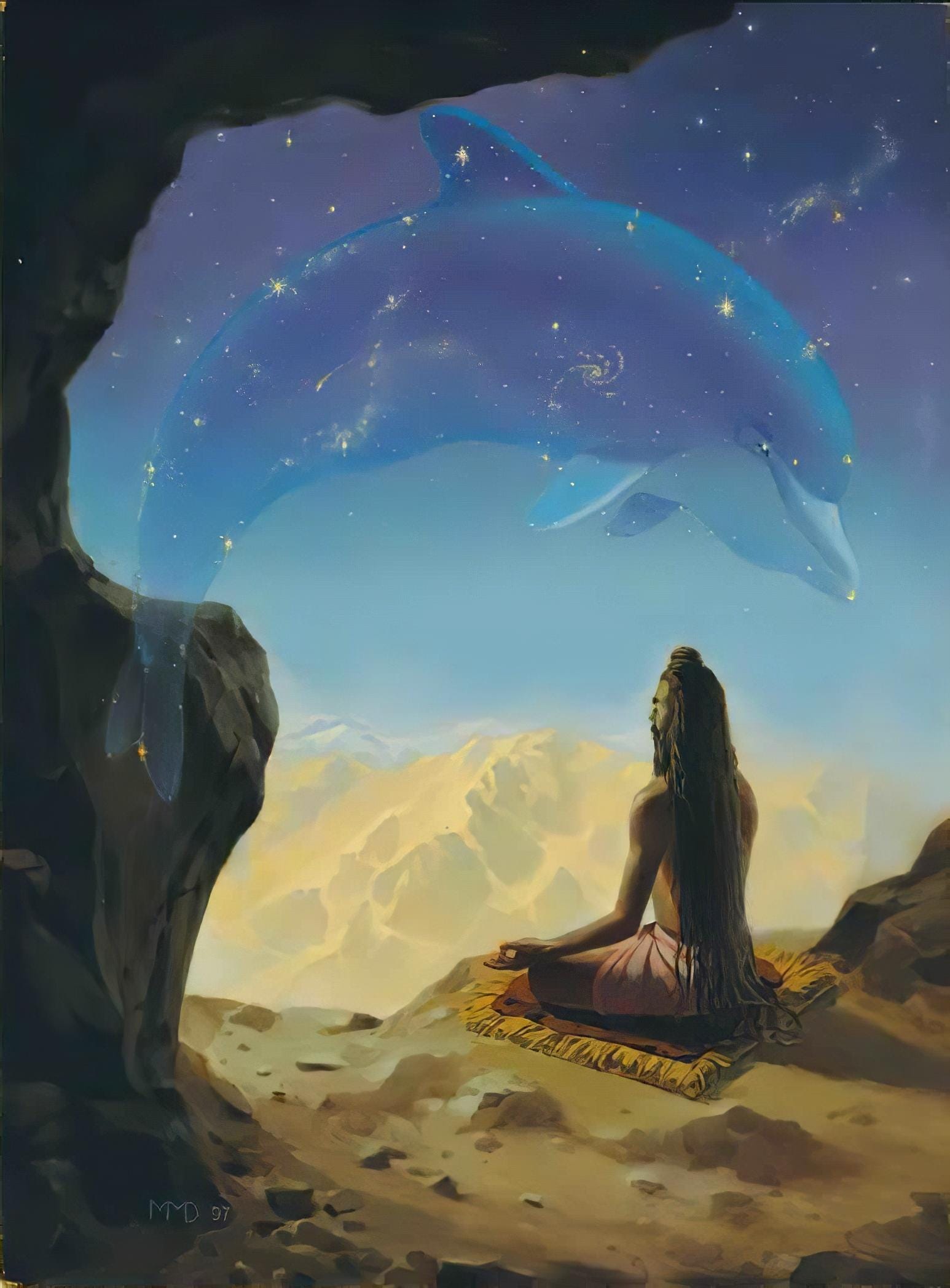
Elaborating on the topic of how the material nature can be unborn and created at the same time, Śrīla Baladeva Vidyābhūṣaṇa explains about the tamas potency of the Lord.
It’s described that the Lord has a potency called tamas (darkness), which is very subtle. This potency is different from the mode of ignorance (also called tamas), which is an effect of it. This original tamas potency is like the shadow of the Lord and is capable of capturing the souls who desire to turn their backs on Him. Kṛṣṇa refers to this energy as “daivī” (divine, or transcendental) in Bg 7.14.
This tamas potency is described in the Rg Veda (10.1.29.3):
tama asit tamasa gudham agre praketam yada tamas tan na diva na ratrih
“In the beginning was darkness (tamas). Darkness covered everything. When the darkness was manifested, there was neither day nor night.”
The Cūlikā Upaniṣad states: gaur anādy-antavatī, “Tamas is like a cow that has no beginning or end.”
It’s mentioned in the scriptures that after the destruction of the universe, the material elements merge into tamas (darkness), but there is no mention of tamas merging into something else. Tamas is thus the original potency, and the material creation (starting from the manifestation of pradhāna) is an effect of it.
This tamas is one of the spiritual potencies and is thus one with the Lord. At the same time, however, tamas is not identical to Him, just like the electrical energy is one with the power plant, but at the same time not the same as the power plant.
When the Lord desires to create, the avyakta (unmanifested) pradhāna emerges. Next, the three modes of material nature become apparent, and pradhāna becomes prakṛit (or mahat-tatva), the material nature in its active state. From prakṛit, the material elements and other components of the material creation appear one after the other, as described in the Śrīmad-Bhāgavatam.
This is also explained in the śruti-śastra:
mahān avyakte līyate avyaktam akṣare akṣaram tamasi
“The mahat merges into the avyakta, the avyakta merges into the akṣara, and the akṣara merges into tamas.”
In this verse, both the words avyakta and akṣara refer to prakṛti/pradhāna. The verse thus describes four stages of the energy of the Lord, with mahat describing the stage where the cosmic manifestation is fully manifest, avyakta a stage where the creation is not manifest (but the three modes are distinct), akṣara as the stage where the three modes are inactive, and tamas as the original potency of the Lord, which returns unto Mahā-Viṣnu at the end of the process of dissolution and again becomes apparent at the beginning of the next cycle. It is also important to note that in other passages the words mahat, avyakta, and akṣara are used in relation to the Lord Himself; therefore, the meaning should be understood in context.
Another reference is the Mahābhārata, which explains:
tasmād avyaktam utpannam tri-guṇam dvija-sattama
“O best of the Brāhmanas, from tamas, the divine potency of the Lord, arose the unmanifested pradhāna, and from it prakṛti with the three modes of material nature.”
The Viṣṇu Purāṇa explains:
pradhāna-pumsor ajayoḥ, kāraṇam kārya-bhūtayoḥ
“The Supreme Lord is the cause of both the unborn pradhāna and the unborn jīvas who enjoy the material creation. Both are eternal, but simultaneously they are effects of the Lord.”
This verse describes a few very delicate concepts. The Lord is the Supreme cause, as described by the word kāraṇam. He is the origin of everything, and nothing is independent of Him. The Lord is the cause of both the jīvas and the material nature, pradhāna (pradhāna-pumsor ajayoḥ). Both are thus effects of the Lord.
However, at the same time, pradhāna becomes the cause of the material creation, manifesting the three material modes and the whole material manifestation, which is then further manipulated by the jīvas, who assume material forms and perform actions. In this way, pradhāna and the jīvas are simultaneously the cause of the material creation, and an effect of the Lord (kārya-bhūtayoḥ). The Lord is thus the cause of all causes, and pradhāna and the jīvas are simultaneously secondary causes and effects of the Lord. As a cause, pradhāna is eternal, but as an effect, it emanates from the Lord.
In this way, pradhāna is eternal and unborn, but at the same time is manifested by the Lord at each cycle of creation. There is no contradiction in that, just as in the case of the madhu-vidyā, which is eternal, but at the same time emanates from the sun.
As Śrīla Prabhupāda concludes, in his purport to CC Adi 6.14-15:
“The form of the Supreme Personality of Godhead is described to be transcendental, very subtle, eternal, all-pervading, inconceivable and therefore nonmanifested to the material senses of a conditioned living creature. He desired to expand Himself into many living entities, and with such a desire He first created a vast expanse of water within the universal space and then impregnated that water with living entities. By that process of impregnation a massive body appeared, blazing like a thousand suns, and in that body was the first creative principle, Brahmā. The great Parāśara Ṛṣi has also confirmed this in the Viṣṇu Purāṇa. He says that the cosmic manifestation visible to us is produced from Lord Viṣṇu and sustained under His protection. He is the principal maintainer and destroyer of the universal form.
“This cosmic manifestation is one of the diverse energies of the Supreme Personality of Godhead. As a spider secretes saliva and weaves a web by its own movements but at the end winds the web within its body, so Lord Viṣṇu produces this cosmic manifestation from His transcendental body and at the end winds it up within Himself. All the great sages of the Vedic understanding have accepted that the Supreme Personality of Godhead is the original creator.”
One and separated
Another delicate aspect is that although the material manifestation is created from the Lord’s potency, He never associates directly with it. As Mahā-Viṣnu, He impregnates the material nature with the jīvas, as well as the kāla potency (eternal time), by just His look. This look is Lord Sadā-Śiva, who in turn expands himself into the many Śivas present in each material universe. These different expansions of Lord Śiva become associated with material energy and act as the fathers for all living beings in each particular universe. Because of this association, Lord Śiva doesn’t exhibit all the potencies of the Lord, becoming Śiva-Tattva and exhibiting only 84% of His qualities. Śrīla Prabhupāda gives the example of curd, which is nothing more than milk combined with an acid. Curd is nothing more than milk, but it doesn’t have the same properties, nor can it be used in the same recipes.
The Lord also enters into every universe as Garbhodakaśāyī Viṣnu, but in this case, He doesn’t associate with the material energy, remaining completely transcendental.
The sequence is that the Lord first expands Himself as Mahā-Viṣnu (Kāraṇodakaśāyī Viṣnu). In this gigantic form, he emanates all material universes from the pores of His body and impregnates material nature with His look. He then expands Himself as Garbhodakaśāyī Viṣnu and enters into each universe, lying down on the Garbhodaka ocean and creating Brahmā from His navel. From this form, he expands Himself as Kṣīrodakaśāyī Viṣnu, the Supersoul.
This intricate process of creation is explained by Śrīla Prabhupāda in his purport to SB 1.3.5:
“The puruṣa, after creating innumerable universes in the mahat-tattva, entered in each of them as the second puruṣa, Garbhodakaśāyī Viṣṇu. When He saw that within the universe there was only darkness and space, without a resting place, He filled half of the universe with water from His own perspiration and laid Himself down on the same water. This water is called Garbhodaka. Then from His navel the stem of the lotus flower sprouted, and on the flower petals the birth of Brahmā, or the master engineer of the universal plan, took place. Brahmā became the engineer of the universe, and the Lord Himself took charge of the maintenance of the universe as Viṣṇu. Brahmā was generated from rajo-guṇa of prakṛti, or the mode of passion in nature, and Viṣṇu became the Lord of the mode of goodness. Viṣṇu, being transcendental to all the modes, is always aloof from materialistic affection. This has already been explained. From Brahmā there is Rudra (Śiva), who is in charge of the mode of ignorance or darkness. He destroys the whole creation by the will of the Lord. Therefore all three, namely Brahmā, Viṣṇu and Śiva, are incarnations of the Garbhodakaśāyī Viṣṇu. From Brahmā the other demigods like Dakṣa, Marīci, Manu and many others become incarnated to generate living entities within the universe. This Garbhodakaśāyī Viṣṇu is glorified in the Vedas in the hymns of Garbha-stuti, which begin with the description of the Lord as having thousands of heads, etc. The Garbhodakaśāyī Viṣṇu is the Lord of the universe, and although He appears to be lying within the universe, He is always transcendental. This also has already been explained. The Viṣṇu who is the plenary portion of the Garbhodakaśāyī Viṣṇu is the Supersoul of the universal life, and He is known as the maintainer of the universe or Kṣīrodakaśāyī Viṣṇu. So the three features of the original puruṣa are thus understood. And all the incarnations within the universe are emanations from this Kṣīrodakaśāyī Viṣṇu.
In different millennia there are different incarnations, and they are innumerable, although some of them are very prominent, such as Matsya, Kūrma, Varāha, Rāma, Nṛsimha, Vāmana and many others. These incarnations are called līlā incarnations. Then there are qualitative incarnations such as Brahmā, Viṣṇu, and Śiva (or Rudra) who take charge of the different modes of material nature.
Lord Viṣṇu is nondifferent from the Personality of Godhead. Lord Śiva is in the marginal position between the Personality of Godhead and the living entities, or jīvas. Brahmā is always a jīva-tattva. The highest pious living being, or the greatest devotee of the Lord, is empowered with the potency of the Lord for creation, and he is called Brahmā. His power is like the power of the sun reflected in valuable stones and jewels. When there is no such living being to take charge of the post of Brahmā, the Lord Himself becomes a Brahmā and takes charge of the post.
Lord Śiva is not an ordinary living being. He is the plenary portion of the Lord, but because Lord Śiva is in direct touch with material nature, he is not exactly in the same transcendental position as Lord Viṣṇu. The difference is like that between milk and curd. Curd is nothing but milk, and yet it cannot be used in place of milk.”
Exercise
Now it’s your turn. Can you answer the following arguments using the ideas from this section?
Opponent: “In the Śvetāśvatara Upaniṣad (4.5) it is said: ajam ekam lohita-śukla-kṛṣṇam bahvīḥ prajāḥ sṛjamānām sarūpāḥ, ajo hy eko juṣamāṇo ’nuceteyam, jahāty enām bhukta-bhogam ajo ’nyaḥ (There is one unborn female of red, white, and black colors, producing many creatures of similar form; one unborn male enjoys her, and another abandons her after having enjoyed.) Here, the word ajā refers to pradhāna, the root material principle described in the Sānkhya philosophy, appearing as prakṛti. Why so? Because this female (ajā) is said to be of three colors (red, white, and black), which directly correspond to the three guṇas: rajas, sattva, and tamas. This tri-colored description is the distinguishing characteristic of prakṛti, not of some spiritual śakti of Brahman. Moreover, the passage says bahvīḥ prajāḥ sṛjamānām (producing many progeny of like form). Such an activity is nothing other than the natural function of prakṛti as the source of all bodies, all beings, all variety. Sānkhya consistently teaches that without any external aid, primordial matter evolves into manifold forms by the inherent force of the three gunas. This is exactly what the Upaniṣad describes. Further, it is said that one unborn male enjoys her, and another abandons her. These two unborn males can be understood as the multitude of puruṣas, or conscious souls. Some of them become entangled with material nature, enjoying her products through attachment to sense-objects, while others turn away, renouncing her allurements, and attaining liberation. This imagery perfectly reflects the paths of bondage and release acknowledged in Sānkhya.
Therefore, there is no need to force this passage into some esoteric interpretation of ‘divine potency’. The plain sense of the text, supported by the explicit mention of the three colors and the production of beings, is that ‘ajā’ refers to the unmanifest prakṛti of Sānkhya. The Śvetāśvatara Upaniṣad here agrees with Kapila. Moreover, the use of the word ajā, unborn, is itself most proper. Pradhāna is unborn, for it is eternal and without beginning. The Upaniṣad here confirms the very same truth. To argue that ajā means a potency of Brahman implies that it is created at some point, which contradicts all logic. How can something eternal be created?
To read ajā as anything else apart from the eternal pradhāna, source of all creation, is artificial. The text clearly describes material nature, the tri-colored, mother of creatures, enjoyed or renounced by the souls. In this way, the correct conclusion is that ajā in this verse means pradhāna, and not some creation of a personal God.”
Description: In the Sānkhya philosophy, there is no Supreme Controller. Everything that exists is a combination of matter and the individual souls. Prakṛti produces the material creation without any external supervision, and the souls come here to enjoy the material creation, abandoning it after attaining self-realization. How to prove the existence of the Supreme Lord and define prakṛti as His divine energy and not as an independent force?
You can also donate using Buy Me a Coffee, PayPal, Wise, Revolut, or bank transfers. There is a separate page with all the links. This helps me enormously to have time to write instead of doing other things to make a living. Thanks!
« Vedānta-sūtra: The Govinda-bhāṣya of Baladeva Vidyābhūṣaṇa