

« Vedānta-sūtra: The Govinda-bhāṣya of Baladeva Vidyābhūṣaṇa
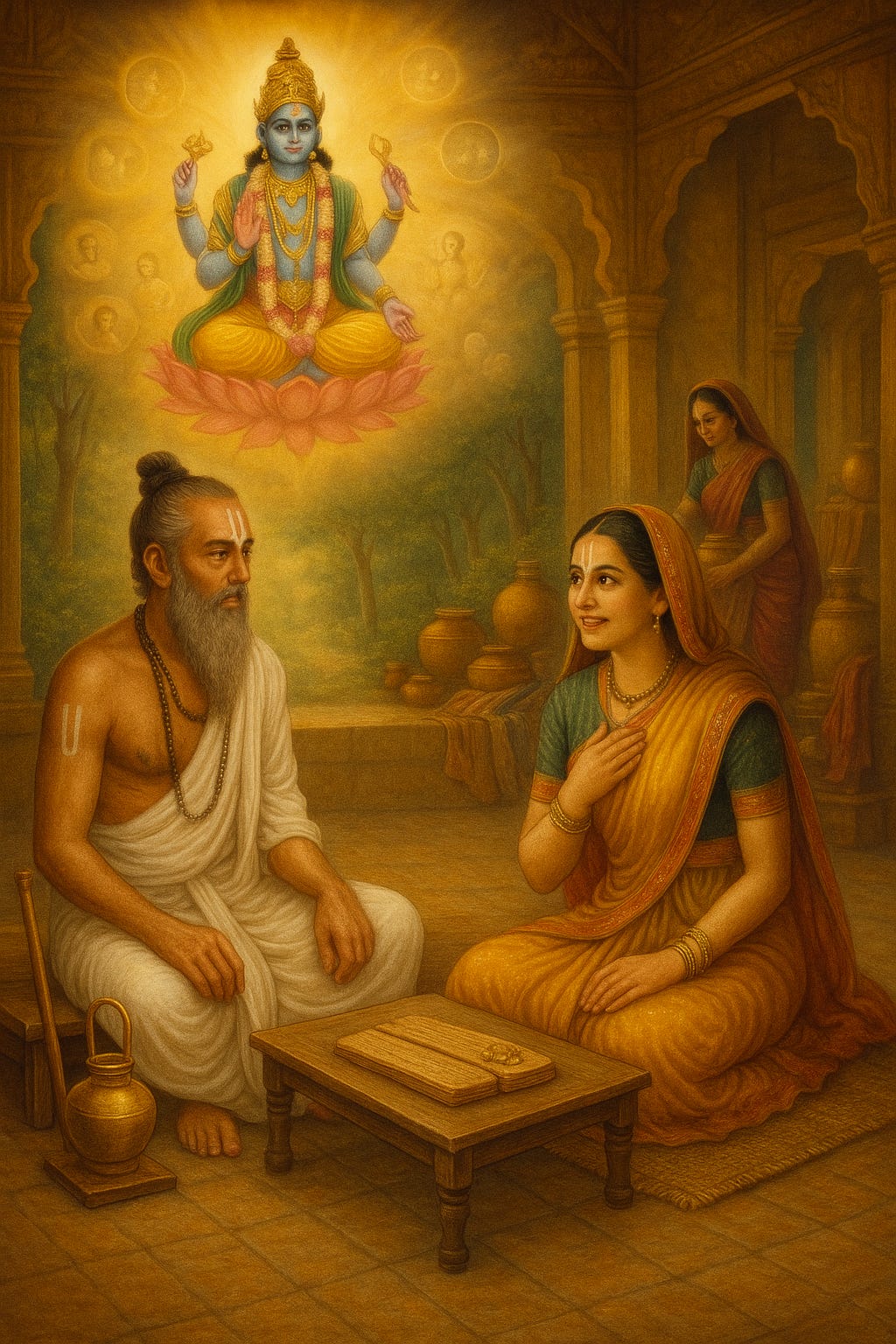
Yājñavalkya teaches Maitreyī: The passage from the Bṛhad-āraṇyaka Upaniṣad
Here is the full passage with the teachings of Yājñavalkya to Maitreyī. The context is that Yājñavalkya had two wives: Maitreyī and Kātyāyanī. The second was just interested in regular household affairs, while Maitreyī was interested in spiritual knowledge. When, later in life, Yājñavalkya was preparing to accept the Vānaprastha order and go to the forest, he called Maitreyī and proposed to make a settlement, dividing the properties between her and Kātyāyanī.
maitreyīti hovāca yājñavalkyaḥ, udyāsyan vā are ’ham asmāt sthānād asmi, hanta te ’nayā kātyāyanyāntam karavāṇīti
“When Yājñavalkya was preparing to depart, he said to his wife Maitreyī: My dear wife, I am about to renounce household life. Therefore, let me make a final division of the properties between you and Kātyāyanī.” (Bṛhad-āraṇyaka Upaniṣad 2.4.1)
sā hovāca maitreyī, yan nu ma iyam bhagoḥ sarvā pṛthivī vittena pūrṇā syāt katham tenāmṛtā syām iti, neti hovāca yājñavalkyaḥ, yathaivopakaraṇavatām jīvitam tathaiva te jīvitam syāt, amṛtatvasya tu nāśāsti vitteneti
“Maitreyī answered: My lord, if this entire earth filled with riches were mine, could I attain immortality through it? Yājñavalkya replied: No. Your life would be like that of a wealthy person, but there is no hope of attaining immortality by possessing wealth.” (Bṛhad-āraṇyaka Upaniṣad 2.4.2)
sā hovāca maitreyī, yenāham nāmṛtā syām kim aham tena kuryām, yad eva bhagavān veda tad eva me brūhīti
“Maitreyī then said: If a thing cannot make me immortal, what need would I have for it? Teach me instead, O revered husband, what you know about the process to achieve immortality.” (Bṛhad-āraṇyaka Upaniṣad 2.4.3)
Maitreyī is a very wise person, worthy of being the wife of a great sage. Having gone through family life, she already realized that material possessions can’t bring anyone happiness, or even a permanent situation. She wants instead to use her last moments with her husband to inquire from him about transcendental knowledge. Let the other wife keep all properties.
sa hovāca yājñavalkyaḥ, priyā batāre naḥ satī priyam bhāṣase, ehy āssva, vyākhyāsyāmi te, vyācakṣāṇasya tu me nididhyāsasveti, bravītu me bhagavān iti
“Yājñavalkya said: Ah, dear one, truly you are dear to me, and you speak what is precious. Come, sit down; I will explain it to you. But while I speak, you must listen attentively and consider it carefully. Maitreyī replied: ‘Yes, O revered one, please instruct me.’” (Bṛhad-āraṇyaka Upaniṣad 2.4.4)
sa hovāca, na vā are patyuḥ kāmāya patiḥ priyo bhavaty ātmanas tu kāmāya patiḥ priyo bhavati, na vā are jāyāyai kāmāya jāyā priyā bhavaty ātmanas tu kāmāya jāyā priyā bhavati, na vā are putrāṇām kāmāya putrāḥ priyā bhavanty ātmanas tu kāmāya putrāḥ priyā bhavanti, na vā are vittasya kāmāya vittam priyam bhavaty ātmanas tu kāmāya vittam priyam bhavati, na vā are brahmaṇaḥ kāmāya brahma priyam bhavaty ātmanas tu kāmāya brahma priyam bhavati, na vā are kṣatrasya kāmāya kṣatram priyam bhavaty ātmanas tu kāmāya kṣatram priyam bhavati, na vā are lokānām kāmāya lokāḥ priyā bhavanty ātmanas tu kāmāya lokāḥ priyā bhavanti, na vā are devānām kāmāya devāḥ priyā bhavanty ātmanas tu kāmāya devāḥ priyā bhavanti, na vā are bhūtānām kāmāya bhūtāni priyāṇi bhavanty ātmanas tu kāmāya bhūtāni priyāṇi bhavanti, na vā are sarvasya kāmāya sarvam priyam bhavaty ātmanas tu kāmāya sarvam priyam bhavati
“It is not for the sake of the husband that the husband is dear; it is because of the Self (ātmā) that he becomes dear. It is not for the sake of the wife that the wife is dear; it is because of the Self that she becomes dear. It is not for the sake of the children that the children are dear; it is because of the Self that they become dear. It is not for the sake of wealth that wealth is dear; it is because of the Self that wealth becomes dear. It is not for the sake of the brāhmana that the brāhmana is dear; it is because of the Self that he becomes dear. It is not for the sake of the kṣatriya that the kṣatriya is dear; it is because of the Self that he becomes dear. It is not for the sake of the worlds themselves that the worlds are dear; it is because of the Self that the worlds become dear. It is not for the sake of the demigods that the demigods are dear; it is because of the Self that they become dear. It is not for the sake of the beings themselves that the different beings are dear; it is because of the Self that they become dear. Indeed, it is not because of the objects themselves that all things are dear; it is because of the Supreme Self that all becomes dear.” (Bṛhad-āraṇyaka Upaniṣad 2.4.5)
The word “ātmā” (self) is commonly used to refer to the Lord in the scriptures. Sometimes ātmā is used in the sense of our personal self, being it the soul, or even the mind or body, according to the context, but the original meaning of the word ātmā is the Supreme Lord, the Supreme Self. The Lord should be our ultimate object of love, and by loving the Lord, everyone will automatically love us.
In this way, Yājñavalkya explained that all the people and things we consider dear in this world, like the husband, wife, children, wealth, brāhmanas, kings, planets, demigods, and in fact all other living entities, and everything that exists are not dear to us for their own sake but because of their connection to the Lord. When we love these persons and objects for their own sake, without realizing their connection with the Lord, we are rejected by them, or in other words, we lose them in due course of time. This applies to even the Vedas, since the knowledge of the Vedas is precious because of its connection with the Lord. When one sees the passages of the Vedas as disconnected from the Lord, one gets only superficial, material knowledge, and his study becomes mundane and useless. One is thus abandoned by the Vedas, just as by everything else.
Another meaning is that everyone looks for love, but real love can be found only in connection with the Lord. When one loves the Lord, he is automatically loved also by His parts and parcels. Therefore, one who becomes dear to the Lord automatically also becomes dear to all living entities, for the Lord inside the heart inspires them to love and serve such a pure devotee.
This meaning is also mentioned by the Gopis when Kṛṣṇa teased them before the rāsa dance, telling them to go home:
“Our husbands, friends, family members and children are all dear and pleasing to us only because of Your presence, for You are the Supersoul of all living creatures. Without Your presence, one is worthless. When You leave the body, the body immediately dies, and according to the injunction of the śāstras, a dead body must immediately be thrown into a river or burned. Therefore, ultimately You are the dearmost personality in this world. By placing our faith and love in Your personality, we are assured of never being bereft of husband, friends, sons or daughters. If a woman accepts You as the supreme husband, then she will never be bereft of her husband, as in the bodily concept of life. If we accept You as our ultimate husband, then there is no question of being separated, divorced or widowed. You are the eternal husband, eternal son, eternal friend and eternal master, and one who enters into a relationship with You is eternally happy.” (Kṛṣṇa Book ch. 29)
In this way, Yājñavalkya made a powerful statement that sent Maitreyī on the path of self-realization, expressing the illusory nature of this world and revealing the Lord as the underlying principle behind everything that exists, and the ultimate destination.
The key in the instructions is the word kāmāya (desire): na vā are patyuḥ kāmāya patiḥ priyo bhavati, ātmanas tu kāmāya patiḥ priyo bhavati. It is not for the sake of the husband that the husband is dear, but for the sake of ātma, the Lord, that he becomes dear. The same is repeated for the wife, children, etc.
How does this attraction work? Lord Śrī Caitanya Mahāprabhu explains that: jīvera svarūpa haya — kṛṣṇera nitya-dāsa, “It is the living entity’s constitutional position to be an eternal servant of Kṛṣṇa”. He also says: nitya-siddha kṛṣṇa-prema ‘sādhya’ kabhu naya, “Pure love for Kṛṣṇa is eternally established in the hearts of the living entities. It is not something to be gained from another source.”
Love for Kṛṣṇa is the eternal characteristic of the soul and thus can’t be separated from it, as much as liquidity can be separated from water. However, this love for Kṛṣṇa can be covered, and when this happens, it manifests as lust: attraction to objects of sense enjoyment. At the same time, however, as Kṛṣṇa explains in the Gītā, “Know that all opulent, beautiful and glorious creations spring from but a spark of My splendor.”
Just like the light of the sun is just a faint reflection of the light of Kṛṣṇa’s effulgence, all beauty, power, strength, intelligence, knowledge, and renunciation, or in other words, all the qualities that we find attractive in different beings and objects, are just faint reflections of the opulence of Kṛṣṇa. These different people and objects are just like mirrors, where the beauty, opulence, etc. of Kṛṣṇa are reflected. However, due to the influence of illusion, we become attracted to the mirror instead of becoming attracted to the person being reflected. When we become attracted to the illusion instead of the real Self, we end up being abandoned by all these things, since this is the nature of the material illusion.
Yājñavalkya then proceeds with his explanation in the second part of text 2.4.5. This essence of everything, the true source of attraction and unifying principle of everything, this Supreme Lord should be our object of attraction. When we do that, everything is revealed.
ātmā vā are draṣṭavyaḥ śrotavyo mantavyo nididhyāsitavyo maitreyi, ātmano vā are darśanena śravaṇena matyā vijñānenedam sarvam viditam
“O Maitreyī, the Supreme Lord, ātmā, should be sought, heard, contemplated, and always meditated upon. By seeing, hearing, worshiping, and understanding this Supreme Self, everything becomes known.”
Why is that the Supreme Lord, the Supreme ātmā, should be investigated, heard, contemplated, and meditated upon? Because knowing the Lord is the only path to immortality, by reestablishing our original nature as pure souls in our original relationship with the Lord. Even impersonal liberation does not achieve this goal, since one becomes free from material conditioning, but does not revive one’s relationship with the Lord.
In this way, Yājñavalkya explained to Maitreyī how affection should be centered around the Lord, and not directly placed in the different objects of the senses. If a wife loves her husband and thinks that by her own power, she will make him love her, she will end up not being loved by her husband. Similarly, if one loves his children or his wife and thinks that by his own power, he will make them love him, he will, in the end, not be loved by them. If, however, one loves the Lord and from there loves the husband, children, and wife, seeing them in connection to the Lord, only then will the Lord make them love this devoted wife, husband, father, or mother.
brahma tam parādād yo ’nyatrātmano brahma veda, kṣatram tam parādād yo ’nyatrātmanaḥ kṣatram veda, lokās tam parādur yo ’nyatrātmano lokān veda, devās tam parādur yo ’nyatrātmano devān veda, bhūtāni tam parādur yo ’nyatrātmano bhūtāni veda, sarvam tam parādād yo ’nyatrātmanaḥ sarvam veda, idam brahmedam kṣatram ime lokā ime devā imāni bhūtānīdam sarvam yad ayam ātmā
“Whoever sees the brāhmaṇa as something other than the Self is abandoned by the brāhmana. Whoever sees the kṣatriya as something other than the Self is abandoned by the kṣatriya. Whoever sees the words, the demigods, or other beings as something other than the Self, is abandoned by them. Whoever sees anything as something other than the Self is abandoned by this thing. For this brāhmana, this kṣatriya, these planets and worlds, these demigods and other beings, all of this is the Supreme Self alone.” (Bṛhad-āraṇyaka Upaniṣad 2.4.6)
Due to the influence of Māyā and our own covering by lust, we look at attractive people and objects and see them as separate from Kṛṣṇa, and thus as objects of our enjoyment. We think then that the husband, wife, etc., are dear to us for their own sake, but in reality they are attractive to us because of the presence of Kṛṣṇa, who manifests both externally (in the form of His illusory energy, which manifests as different material bodies and objects) and inside, as Paramātmā. In other words, we love people and things because they carry a spark of His presence. Ultimately, we are all looking for Kṛṣṇa, but due to the covering of Māyā, this longing manifests in the form of material lust.
It is only due to this connection with Kṛṣṇa that things appear to be attractive to us. When we fully realize this connection, we see beyond the material illusion and become attracted to Kṛṣṇa, the source of all attractiveness. We then awaken our eternal nature of love and service to Kṛṣṇa. When we fail to do that, however, we just live the material experience of attraction, loss, and grief.
The words ātmanas tu kāmāya, thus, mean that what is dear is not the persons or material objects themselves, but the potency and presence of the Lord in them. Another word for “dear” is priya, and this is also used later in the Bṛhad-āraṇyaka Upaniṣad (part four) in relation to the Lord: priyam iti enat upāsīta, “One should worship the Supreme Lord as priya, the dearest”. All these points reinforce the idea of cultivating our eternal relationship with the Lord as the most important aspect of our existence and indeed, the very purpose of human life.
No one can attain happiness by chasing people or material objects. Only when we connect ourselves with the Supreme Lord can all desirable things be attained.
When one is young, one can try to fix one’s mind on the Lord by performing one’s duties in family life and offering such activities to Him, as Kṛṣṇa explains in the Gītā. However, in old age, we are recommended to enter into vānaprastha life and directly control our senses, freeing ourselves from the calamity of a new birth.
Maitreyī is in this stage, therefore Yājñavalkya proceeds in explaining the process of sense control in order to facilitate her fixing her mind on the Lord:
sa yathā dundubher hanyamānasya na bāhyāñ chabdāñ chaknuyād grahaṇāya, dundubhes tu grahaṇena dundubhyāghātasya vā śabdo gṛhītaḥ
sa yathā śankhasya dhmāyamānasya na bāhyāñ chabdāñ chaknuyād grahaṇāya, śankhasya tu grahaṇena śankhadhmasya vā śabdo gṛhītaḥ
sa yathā vīṇāyai vādyamānāyai na bāhyāñ chabdāñ chaknuyād grahaṇāya, vīṇāyai tu grahaṇena vīṇāvādasya vā śabdo gṛhītaḥ
“Once a drum is beaten, one cannot stop or capture the sound once it leaves the drum. However, by seizing the drum or stopping the beating of the drum, the sound can be stopped. Similarly, once a conch or a flute is played, it’s impossible to stop the sound from propagating. However, by seizing the conch or the flute, or stopping the person who is playing, the sound can be stopped.” (Bṛhad-āraṇyaka Upaniṣad 2.4.7-9)
To fix our minds on the Lord, we have to learn to control our senses. Once the senses come into contact with the sense objects, it is very difficult to stop, and it is even more difficult to eliminate the impressions registered in the mind, both of which are obstacles for fixing our mind on the Lord. However, by taking away the sense objects (by living in a secluded place), or by directly controlling the senses, mental agitation can be avoided.
In this way, the Lord should be sought, heard, contemplated, and always meditated upon. He is the cause, and the world is the effect. It is not possible to perfectly understand the world by separately studying each material creation, but if one comes to know the Lord, the cause of all causes, then everything becomes known.
sa yathārdraidhāgner abhyāhitāt pṛthag dhūmā viniścaranty eva vā are ’sya mahato bhūtasya niḥśvasitam etad yad ṛgvedo yajurvedaḥ sāmavedo ’tharvāngirasa itihāsaḥ purāṇam vidyā upaniṣadaḥ ślokāḥ sūtrāṇy anuvyākhyānāni vyākhyānāni, asyaivaitāni niḥśvasitāni
“Just as clouds of smoke appear when we light a fire using damp firewood, in the same way, O dear one, the Rg Veda, Sāma Veda, Yajur Veda, Atharva Veda, Purāṇas, Itihāsas, Vidyās, Upaniṣads, ślokas, sūtras, vyākhyās (commentaries) and anuvyākhyās (further expositions), as well as everything that exists, all come from the breath of the Supreme Person.” (Bṛhad-āraṇyaka Upaniṣad 2.4.10)
This verse makes reference to Lord Mahā-Viṣnu creating all the universes and everything that exists through his exhalation. During the interval between his exhalation and his inhalation, all the universes become manifest, and the one hundred years of the life of Brahmā go on. When He inhales, all the universes are destroyed, and all the souls merge into his body for a long period of rest until the next creation.
While everything is created by the Lord, Yājñavalkya emphasized the creation of the Vedas because they are the most valuable component of the material creation. Most of what exists in the material world exists simply to allow the living entities to enjoy their senses, so they may eventually become frustrated and seek self-realization. Their usefulness is thus secondary at best. The Vedas, however, are the part of the creation that directly helps one on the transcendental path. They are thus orders of magnitude more valuable than everything else.
Having explained the Vedas and the purpose of life, Yājñavalkya speaks more about sense control:
sa yathā sarvāsām apām samudra ekāyanam, evam sarveṣām sparśānām tvag ekāyanam, evam sarveṣām gandhānām nāsike ekāyanam, evam sarveṣām rasānām jihvaikāyanam, evam sarveṣām rūpāṇām cakṣur ekāyanam, evam sarveṣam śabdānām śrotram ekāyanam, evam sarveṣām sankalpānām mana ekāyanam, evam sarvāsām vidyānām hṛdayam ekāyanam, evam sarveṣām karmaṇām hastāv ekāyanam, evam sarveṣām ānandānām upastha ekāyanam, evam sarveṣām visargāṇām pāyur ekāyanam, evam sarveṣām adhvanām pādāv ekāyanam, evam sarveṣām vedānām vāg ekāyanam
“The ocean is the receptacle of all waters. Skin is the receptacle of all touch sensations. The nose is the receptacle of all smells. The tongue is the receptacle of all tastes. The eye is the receptacle of all forms. The ear is the receptacle of all sounds. The mind is the receptacle of all decisions. The heart is the receptacle of all knowledge. The hands are the receptacle of all actions. The genital is the receptacle of all sexual bliss. The anus is the receptacle of all excretion. The feet are the receptacle of all movement. The voice is the receptacle of all the Vedas (knowledge).” (Bṛhad-āraṇyaka Upaniṣad 2.4.11)
The key in this verse is the word “ekāyanam” (receptacle), which is repeated at each sentence. The vast ocean is the receptacle of all waters, being continuously filled by numerous rivers, but still it is never filled. Similarly, each sense is the receptacle of a certain type of sense object, and they are constantly being filled with more and more sense enjoyment, but still, they are never satisfied. The process of controlling the senses thus consists in restricting them, and not in increasing sense gratification in the hope that the senses may some day become satisfied. They will never.
This verse serves thus as a graphic representation to help us to remain in the path of sense control, understanding that sense enjoyment just makes us further bound to this material world.
To further emphasize this point, Yājñavalkya speaks another verse:
sa yathā saindhava-khilya udake prāsta udakam evānuvilīyeta na hāsyodgrahaṇāyeva syāt, yato-yatas tv ādadīta lavaṇam, evam vā ara idam mahad bhūtam anantam apāram vijñāna-ghana eva
etebhyo bhūtebhyaḥ samutthāya tāny evānuvinaśyati, na pretya samjñāstīty are bravīmi, iti hovāca yājñavalkyaḥ
“When a piece of salt is dissolved in water, it appears to be lost in it, but its presence can still be noted by the salty taste of the water. In the same way, O dear one, Brahman, who is great, infinite, boundless, and full of knowledge, makes Himself present in the material creation.
Arising from the material elements (at birth), a person dissolves back into them (at death). Having died, one has no knowledge of the body, or identity with it.” (Bṛhad-āraṇyaka Upaniṣad 2.4.12)
Both the Lord and the jīva are spiritual, and thus full of eternity, bliss, and knowledge. The jīva is also a possessor of unbroken knowledge, just like the Lord, but because the jīva is infinitesimal, we can fall into illusion and have our knowledge covered.
Just as the salt dissolved in water, the Lord becomes present in the material creation through the diffusion of His energy, but He is not seen. In the same way, the jīva, covered by the material body, can’t be seen, even though its presence can be identified by the presence of consciousness.
Because we identify with matter, we receive new material bodies, one after the other. These bodies are created from material elements, and thus it is said that we “arise” from these material elements. “We” in this case means our current conditioned identity, connected with the body. This same material identity is later dissolved back into the original material elements at death, with the destruction of the body. This is another strong image of the temporality of material existence and the futility of the process of material sense gratification. Just as a man compulsively cleaning and maintaining his car and forgetting to eat, we spend our efforts trying to satisfy our body and senses, and forget our real interests.
Once we leave a particular body, we lose our knowledge of it. The previous identity is destroyed, and we accept another temporary material identity. This process continues until we come to the platform of self-realization and restore our original spiritual identity.
When these concepts are explained, they become clear, but when we just hear the verse itself, these concepts are hard to grasp. Maitreyī thus raises a question, leading Yājñavalkya to further clarify the conditioned state of the jīva:
sā hovāca maitreyī, atraiva mā bhagavān amūmuhan na pretya samjñāstīti
sa hovāca, na vā are ’ham moham bravīmi, alam vā ara idam vijñānāya
“Maitreyī said: O revered one, please don’t confuse me with such a statement such as na pretya samjñā asti (after death there is no consciousness). Yājñavalkya answered: No, dear one, I do not speak anything confusing. This is sufficient to understand.” (Bṛhad-āraṇyaka Upaniṣad 2.4.13)
Yājñavalkya uses the sentence “na pretya samjñā asti“ in the sense of the soul losing knowledge of the body and the material identity connected with it at death, but Maitreyī understands it in the sense of the consciousness or individuality of the soul being extinguished at death. This sounds contradictory, and thus she requests clarification.
Yājñavalkya signals that Maitreyī should try to go deeper into the meaning of the teaching and not insist on the superficial meaning of the words. He reassures her that he is not speaking about nihilism, but about the end of worldly cognition tied to the body. What remains is the Self, pure consciousness, and this must be realized.
yatra hi dvaitam iva bhavati tad itara itaram jighrati tad itara itaram paśyati tad itara itaram śṛṇoti tad itara itaram abhivadati tad itara itaram manute tad itara itaram vijānāti, yatra vāsya sarvam ātmaivābhūt tat kena kam jighret tat kena kam paśyet tat kena kam śṛṇuyāt tat kena kam abhivadet tat kena kam manvīta tat kena kam vijānīyāt, yenedam sarvam vijānāti tam kena vijānīyāt, vijñātāram are kena vijānīyād iti
“When one is absorbed in duality, seeing an existence separated from the Lord, then one smells another, sees another, hears another, speaks to another, thinks of another, and knows another. But when one becomes aware of the Supreme Self and understands that nothing is separate from him, then who smells what? Who sees what? Who hears what? Who speaks what, who thinks of what, and who knows what? How could that Supreme Person, by whom all this is known, be known by another? O dear one, the ultimate knower is beyond the grasp of material knowledge.” (Bṛhad-āraṇyaka Upaniṣad 2.4.14)
It’s not really possible to be independent from the Lord. Everything that exists is nothing but a combination of different potencies of the Lord (including the individual souls, who are part of His marginal energy); therefore, in fact, there is nothing apart from the Lord. However, under material duality, we think there is a world separated from the Lord, or that we are separated from Him. Under this false concept, we live the material experience, interacting with different manifestations we see as separated from the Lord. However, when we become Kṛṣṇa Conscious, we understand that everything is connected with Kṛṣṇa and should be used in His service. We see then that everything and everyone is eternally connected with Him. At this stage, our whole experience becomes centered around our relationship with Him.
Yājñavalkya explains that the Lord can’t be known by experimental knowledge, which hints that He can be known only by the process of devotional service. This is a constant in the Upaniṣads: the ultimate conclusions of the text are just hinted at, instead of being directly stated, since the idea is to keep the real meaning hidden from unauthorized persons. The full meaning of the text can thus be understood only when the text is studied under the proper conclusions, received from the spiritual master.
This dialogue is repeated later in the Bṛhadāraṇyaka Upaniṣad, in part four, where extra details about the characteristics of the Lord are added:
sa eṣa neti nety ātmā, agṛhyo na hi gṛhyate, aśīryo na hi śīryate, asango na hi sajyate, asito na vyathate na riṣyati, vijñātāram are kena vijānīyād ity uktānuśāsanāsi maitreyi, etāvad are khalv amṛtatvam iti hoktvā yājñavalkyo vijahāra
“The Lord is indeed the Supreme Self. He is neti nety — not this, not this — free from material, limiting attributes, and beyond all material description. He is ungraspable, for He cannot be apprehended by the senses or mundane intellect. He is undecaying, for He never perishes. He is unattached, untouched by matter, beyond all suffering or harm. Therefore, O dear one, how can one know this Supreme Knower, except by His own grace? Thus have I instructed you. Indeed, this is immortality. Having spoken thus, Yājñavalkya departed.” (Bṛhad-āraṇyaka Upaniṣad 4.5.15)
Exercise
Now it’s your turn. Can you answer the following arguments using the ideas from this section?
Opponent: “In the Bṛhad-āraṇyaka Upaniṣad (2.4 and 4.5), Yājñavalkya tells Maitreyī: “The Self should be seen, heard, reflected upon, and meditated upon. By seeing, hearing, reflecting upon, and understanding the Self, everything is known.” Which Self is described here? The jīva or Viṣnu? It should be understood that the passage refers to the jīva, not to a Supreme Lord distinct from it. Why? The section speaks of the attachments of husband and wife (patyuḥ kāmāya patiḥ priyo bhavati), and then of death (na pretya samjñāstīty are bravīmi). These statements describe the embodied soul who lives and dies in the material world. Such remarks cannot belong to an eternal Paramātmā untouched by samsāra.
Knowledge of the jīva brings knowledge of the world. When Yājñavalkya mentions, “By knowing the Self, everything is known”, this can be understood figuratively as knowledge of the jīva. The jīva, after all, enters this world for enjoyment; therefore, to know the jīva is to know the experiencer of the world, and thereby the world itself. There is no need to postulate a separate Paramātmā for this teaching to make sense. One may object that the text also speaks of immortality: amṛtatvasya tu nāśāsti vitteneti (there is no hope of attaining immortality by possessing wealth), but this too can be explained in relation to the jīva. By realizing the jīva’s essential difference from matter, one transcends birth and death, becoming immortal. Thus, even this phrase can apply to the jīva.
All the apparently exalted descriptions of the Self in this section (the dearest of all, the basis of everything, the knower of all) can be accommodated in terms of the jīva. Indeed, the jīva is the conscious principle, and the one who, by association, is said to support the world. If one insists that these words must denote a Supreme Being different from the jīva, then the teaching becomes inconsistent: why begin by describing the embodied self with birth, death, and ignorance, and then suddenly switch to a transcendent Paramātmā?
Therefore, the only consistent conclusion is that the Self in this passage is the jīva, the conscious enjoyer distinct from matter. By knowing this Self, everything else can be known, and immortality is attained.”
What is your answer to these arguments?
You can also donate using Buy Me a Coffee, PayPal, Wise, Revolut, or bank transfers. There is a separate page with all the links. This helps me enormously to have time to write instead of doing other things to make a living. Thanks!
« Vedānta-sūtra: The Govinda-bhāṣya of Baladeva Vidyābhūṣaṇa