

« Vedānta-sūtra: The Govinda-bhāṣya of Baladeva Vidyābhūṣaṇa
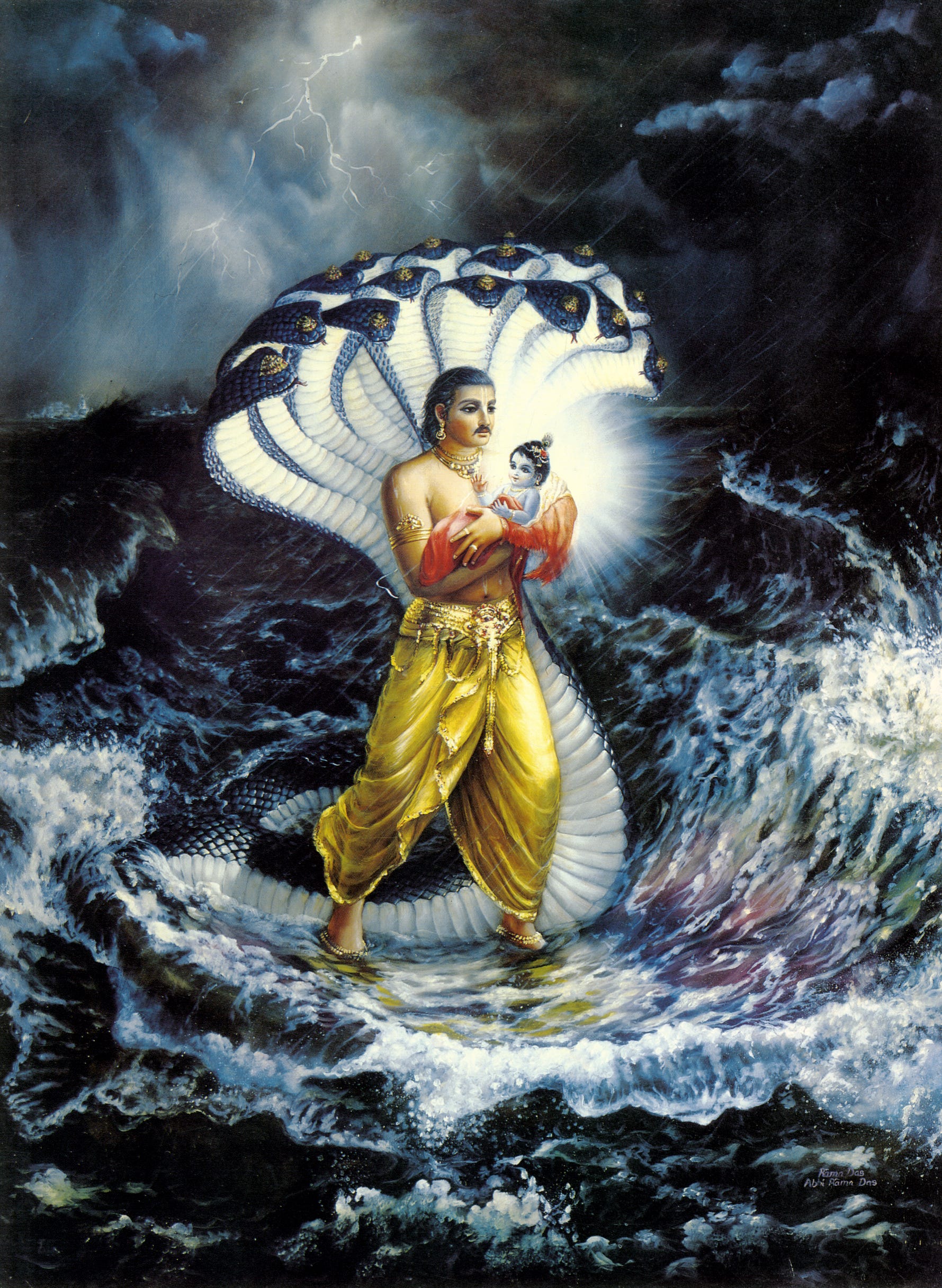
Sūtra 1.4.25 - Brahman created from Himself, standing upon Himself
sākṣāc cobhayāmnātāt
sākṣāt: directly; ca: certainly; ubhaya: both (the material and efficient cause); āmnānāt – because of a direct statement in the scriptures.
He is certainly the creator and also the ingredient of creation, because both truths are directly stated in the scriptures.
Commentary: Śrīla Baladeva Vidyābhūṣaṇa mentions that the word “ca” in this sūtra means “certainly”, emphasizing that Brahman is indeed both the creator and the ingredient of creation.
The material energy appears as pradhāna, a feature of Kṛṣṇa’s external potency, and when activated by kāla, the time-energy, it becomes prakṛti, which is the source of the material creation. In his purport to CC ādi 6.14-15, Śrīla Prabhupāda uses an interesting analogy to explain this point:
“This cosmic manifestation is one of the diverse energies of the Supreme Personality of Godhead. As a spider secretes saliva and weaves a web by its own movements, but at the end winds up the web within its body, so Lord Viṣṇu produces this cosmic manifestation from His transcendental body and at the end winds it up within Himself. All the great sages of the Vedic understanding have accepted that the Supreme Personality of Godhead is the original creator.”
When we think about a creator making some creation, we think about someone using some external ingredient, like paint, stone, or fabric. When we think under this prism, it may sound illogical that the Lord could create the material world from Himself. However, in the case of the spider, the ingredient for the creation of the web also comes from the spider. Therefore, we can say that the spider is both the creator and the ingredient. When we consider the example of the spider, the Lord being also the ingredient of the material creation becomes easy to understand.
The Taittirīya Brāhmaṇa (2.8.9.6) mentions:
kimsvid vanam ka u sa vṛkṣa āsīt, yato dyāvā-pṛthivī niṣṭatakṣuḥ
maṇīṣiṇo manasā pṛcchataitat, yad adhyatiṣṭhad bhuvanāni dhārayan
brahma vanam brahma sa vṛkṣa āsīt, yato dyāvā-pṛthivī niṣṭatakṣuḥ
manīṣiṇo manasā prabravīmi, vo brahmādhyatiṣṭhad buvanāni dhārayan“What was the timber and what was the tree, from which heaven and earth were made? O wise ones, ponder this within your hearts: ‘Where did He stand when He created the worlds?’ O wise ones, I hereby declare to you: Brahman was the wood, Brahman was that tree from which heaven and earth were fashioned. From Brahman, He created heaven and earth. Standing upon Himself, Brahman created the worlds and used Brahman as the ingredient.”
There is nothing apart from Brahman. Kṛṣṇa is everything, and there is nothing else apart from Kṛṣṇa. When Kṛṣṇa created the world, He stood on Himself. He was both the wood and the tree, the ingredient and the source of the ingredient, both the creator and the substance from which the world was made.
Sūtra 1.4.26 - Permutation of energy
ātma-kṛteḥ pariṇāmāt
ātma-kṛteḥ: due to the Self’s action (the Lord being the cause of the world); pariṇāmāt: because of permutation.
He creates the world by the permutation of His energy.
Commentary: This topic under discussion is focused on dismissing the vivarta-vada, the philosophy that something apart from Brahman exists and that this something else is the ingredient for the creation of the material world. Māyāvādis, for example, postulate that this material world is false, an illusion created by Māyā. The problem is that by accepting that something else exists apart from Brahman, one concludes that Brahman can be covered. Māyāvādis believe that Māyā is different from Brahman and that it can cover fragments of Brahman, who become the conditioned souls in this material world. Not only that, but they also conclude that Kṛṣṇa Himself is covered by Māyā when He comes to perform His pastimes in the material world, accepting a material form and acting under the material mode of goodness, which is most offensive.
Similar ideas are propounded by other philosophies that share the conclusion of the existence of a force or element different from Brahman.
In order to defeat these philosophies, Vyāsadeva establishes pariṇāma-vāda, the philosophy that only Brahman exists and that the material world is just a permutation of His energy. The material world is thus just another of His potencies. In other words, the material world is not false (as believed by the Māyāvādis and some other schools), and the material energy is completely under the control of the Lord. This is supported everywhere in the scriptures, as in verses 2.6.1 and 2.7.1 of the Taittirīya Upaniṣad quoted previously:
“The Lord desired, “May I become many! May I produce offspring!” After deliberating in this way, He created the material universes and whatever exists... In the beginning, the creation was non-existent. It was not yet defined by forms and names. From the unmanifest was born whatever exists. The Lord created it by His own potency.”
One could question how exactly Brahman can be both the creator and the ingredient of creation. To this, Vyāsadeva answers: ātma-kṛteḥ pariṇāmāt. Brahman creates the world by permuting His śakti, or energy (pariṇāmāt). In other words, the material world is just the product of the permutation of one of Brahman’s potencies. The Lord is thus called pariṇāmi (that which undergoes permutation).
One could argue that this idea violates the principle of Brahman being unchangeable, but that’s not the case. Permutation means that the material energy is never transformed into something else, but it is permuted, or rearranged in the form of the material creation. When the universe is destroyed, the material energy returns to its original state, just like lego blocks can be assembled into different toys and later disassembled. In this way, the same material energy can be reused eternally in the different cycles of creation, which are in turn connected with the breath of Lord Mahā-Vishnu.
Śrīla Baladeva Vidyābhūṣaṇa confirms this point by giving another example: a lump of clay may be shaped in different ways and later be brought back to its original form. In this case, the lump “changes” into different shapes, without being truly transformed, since it can be brought back to its original form at any moment. This is another example of permutation.
Similar to clay being shaped, energy can be transformed in different ways without being lost or changed in nature during the process. This process of conservation of energy is also accepted in modern scientific theories. When this principle is understood, the idea of Brahman being unchangeable but at the same time permuting His own energy into this material world becomes clear.
Prabhupāda explains this point in his purport to SB 7.2.37:
“Apart from the separate existence of the soul, the material elements remain unmanifested before creation. From this subtle state of unmanifestation comes manifestation, just as from ether, air is generated; from air, fire is generated; from fire, water is generated; and from water, earth becomes manifested. From the earth, many varieties of manifestations take place. For example, a big skyscraper is manifested from the earth. When it is dismantled, the manifestation becomes again unmanifested and remains as atoms in the ultimate stage. The law of conservation of energy remains, but in the course of time things are manifested and unmanifested — that is the difference. Then what cause is there for lamentation, in either manifestation or unmanifestation? Somehow or other, even in the unmanifested stage, things are not lost. Both at the beginning and at the end, all elements remain unmanifested, and this does not make any real material difference.”
The material creation exists eternally as a potency or energy, but it is sometimes manifested and sometimes unmanifested. The energy thus never changes, but it can be shaped in different ways due to the influence of time (which activates the three material modes, resulting in the successive transformations that produce the material elements and the complete manifestation) and the conditioned souls.
The Śvetāśvatara Upaniṣad explains that the Lord has many different potencies:
na tasya kāryam karaṇam ca vidyate
na tat-samaś cābhyadhikaś ca dṛśyate
parāsya śaktir vividhaiva śrūyate
svābhāvikī jñāna-bala-kriyā ca“The Lord does not have a material body or senses like those of an ordinary living entity. He is transcendental and performs no action. No one is found to be equal to or greater than Him. His supreme potencies are indeed multifarious, expressed as knowledge (jñāna), strength (bala), and intent (kriyā). Thus, all His deeds are automatically performed as a natural sequence.” (Śvetāśvatara Upaniṣad 6.8)
sa viśva-kṛd viśva-vid ātma-yonir, jñaḥ kāla-kālo guṇī sarva-vid yaḥ
pradhāna-kṣetra-jña-patir guṇeśaḥ, samsāra-mokṣa-sthiti-bandha-hetuḥ“The Lord is the creator of everything and the knower of everything. He dwells in the hearts of everyone as the Supersoul. He is omniscient and controls everything, even time itself. He has transcendental qualities and is the source of all knowledge. He is the Lord of both pradhāna, the unmanifested material nature, and the conditioned jīvas, who are part of His marginal energy. He is the master of the material modes, and the cause of bondage, sustenance, transmigration, and liberation.” (Śvetāśvatara Upaniṣad 6.16)
ya eko’varṇo bahudhā śakti-yogād varaṇān anekān nihitārtho dadhāti
vi caiti cānte viśvam ādau sa devaḥ sa no buddhyā śubhayā samyunaktu“He who is the one without a second, creates the varieties of this world, using His own potencies, and according to His own wish. At the end, that same Lord withdraws the entire universe, just as in the beginning He brought it forth. May that Supreme Lord grant us auspicious intelligence.” (Śvetāśvatara Upaniṣad 4.1)
This is also confirmed in the Viṣṇu Purāna. Prabhupāda gives his translation to this verse on CC ādi 7.119:
viṣṇu-śaktiḥ parā proktā, kṣetrajñākhyā tathā parā
avidyā-karma-samjñānyā, tṛtīyā śaktir ucyate“The potency of Lord Viṣṇu is summarized in three categories: namely, the spiritual potency, the living entities, and ignorance. The spiritual potency is full of knowledge; the living entities, although belonging to the spiritual potency, are subject to bewilderment; and the third energy, which is full of ignorance, is always visible in fruitive activities.”
This same point is explained by Śrīla Prabhupāda in many other passages. In SB 7.3.34, for example, he wrote:
“The Lord is endowed with unlimited potencies (parāsya śaktir vividhaiva śrūyate), which are summarized as three, namely external, internal and marginal. The external potency manifests this material world, the internal potency manifests the spiritual world, and the marginal potency manifests the living entities, who are mixtures of internal and external. The living entity, being part and parcel of Parabrahman, is actually internal potency, but because of being in contact with the material energy, he is an emanation of material and spiritual energies. The Supreme Personality of Godhead is above the material energy and is engaged in spiritual pastimes. The material energy is only an external manifestation of His pastimes.”
The Lord thus creates through His spiritual potency, and the ingredients of the creation are His two other potencies: the external potency and the marginal potency.
The material energy does not change, but is shaped by the other two potencies (the Lord and the jīvas) into different forms, and is eventually returned back to the unmanifested state (pradhāna) at the end of the material manifestation, just to become manifested again in the next cycle. Similarly, the souls are awakened or sleeping in the body of Mahā-Viṣnu following the same cycles. In the Sānkhya philosophy, both the material energy (prakṛti) and the souls (the marginal potency) are studied, but because they ignore the Supreme Lord, as well as His internal potency, their philosophy is flawed.
The conclusion is that this material world is not false, as postulated by Māyāvādis and other types of vivarta-vādis. The material world is composed of different material elements organized in different ways and is thus much like a dream, where everything is temporary and unstable. The material world is, however, not false. When passages from the scriptures appear to give this idea, the purpose is just to awaken renunciation. It should not be taken literally. Śrīla Baladeva Vidyābhūṣaṇa concludes that this is the opinion of those who know the truth.
You can also donate using Buy Me a Coffee, PayPal, Wise, Revolut, or bank transfers. There is a separate page with all the links. This helps me enormously to have time to write instead of doing other things to make a living. Thanks!
« Vedānta-sūtra: The Govinda-bhāṣya of Baladeva Vidyābhūṣaṇa