

« Vedānta-sūtra: The Govinda-bhāṣya of Baladeva Vidyābhūṣaṇa
Sūtra 1.4.27 - The womb of the material creation
yoniś ca hi gīyate
yoniḥ: the womb, or source; ca: also; hi: indeed; gīyate: is declared.
The scriptures thus declare that the Lord is the womb, or source, from which the material world is born.
Commentary: As a final argument, the word yoni used in this sūtra hints at a few verses from the scriptures that describe the Lord as the womb, or source from which the material world is born.
In the Muṇḍaka Upaniṣad, for example, it’s mentioned:
yat tad adreśyam agrāhyam agotram
avarṇam acakṣuḥ-śtrotram tad apāṇipādam
nityam vibhum sarva-gatam susūkṣmam
tad avyayam yad bhūta-yonim paripaśyanti dhīrāḥ“The wise perceive that imperishable Supreme Brahman, who is invisible, ungraspable, without family or caste, without form, without eyes and ears, without hands and feet; who is eternal, all-pervading, extremely subtle, and unchanging, and who is the source of all beings.” (Muṇḍaka Upaniṣad 1.1.6)
yadā paśyaḥ paśyate rukma-varṇam
kartāram īśam puruṣam brahma-yonim
tadā vidvān puṇya-pāpe vidhūya
nirañjanaḥ paramam sāmyam upaitiWhen the enlightened soul finally sees the golden-hued Lord, the creator, the Supreme Person, who is the source of everything that exists, he finally becomes free from material duality and attains the Supreme destination, becoming pure like the Lord. (Muṇḍaka Upaniṣad 3.1.3)
The word yoni in the two verses describes Brahman as the ingredient or source of the material creation, while the words kartāram puruṣam describe the Lord as the original creator. In this way, these verses describe the Lord as simultaneously the creator and the ingredient.
This interpretation is reinforced by a common metaphor found in many passages of the Vedic literature, where the word yoni is used in the same way: pṛthivī yonir oṣadhi-vanaspatīnām, “The earth is the source from which the trees and plants are born.”
Just as the earth creates all plants from itself, without a separate ingredient, the Lord produces the material creation from His own energy.
Ordinarily, we don’t see a person being simultaneously the creator and the ingredient of something, but this is only because we live inside the material creation conceived by the Lord, where many material ingredients are available. When the Lord desired to create the material universe, there was nothing else apart from Him; therefore, he had to create the material elements from Himself, or more specifically from His external potency. The Lord is thus both the creator and the ingredient. Everything emanates from the Lord, and there is no other force that is separated or independent from Him. This conclusion is supported by all the passages and arguments we studied in this topic.
Internal, external, and marginal energies
The Lord possesses unlimited potencies, but they are grouped into three groups: the internal potency (antarangā-śakti), which includes all the spiritual planets, pastimes, and paraphernalia, the external potency, or material nature (bahiranga-śakti), and the marginal potency (taṭasthā-śakti), consisting of the individual souls, who are free to take shelter on one or the other.
All the spiritual planets, as well as the Brahman refulgence and so on, are part of the spiritual potency. Everything there is eternal, blissful, and full of knowledge. There is no creation, no destruction, and no ignorance there. All the individual souls are originally part of this internal potency, but we can come in contact with the external potency due to free will. The external potency includes both matter and Māyā, the illusory potency, which makes the souls identify with it. Māyā can cover the individual souls who choose to forget their eternal relationship with Kṛṣṇa, but the Lord is always transcendental to it, and she remains always under His complete control. The function of māyā is to create an alternate, illusory world, where the forgotten jīvas can play.
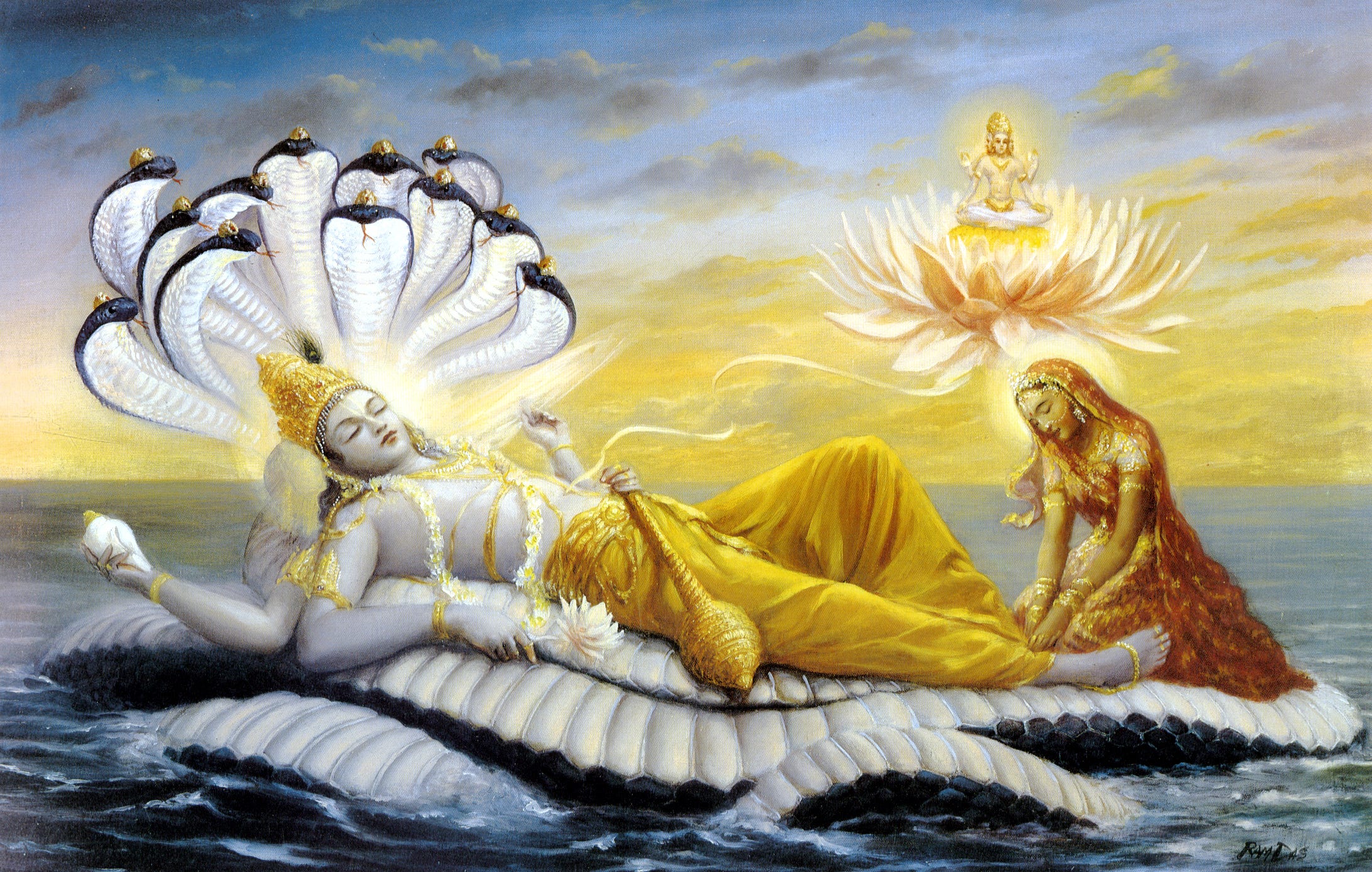
After the spiritual realm, there is the causal ocean (kāraṇodaka), the abode of Lord Mahā-Viṣnu, which, although also spiritual, represents the very border between the spiritual world and the material creation. Lord Vāmanadeva created a crack in the coverings of the universe when He kicked it, allowing this spiritual water to enter the universe in the form of the river Ganges.
The causal ocean is sometimes compared to a cloud that “covers” part of the spiritual sky. In this analogy, the impersonal Brahmajyoti, the light that emanates from Kṛṣṇa’s body and all spiritual planets, is like sunshine, which engulfs the whole transcendental realm, and the causal ocean is like a rain cloud that covers a small part of it. Lord Mahā-Viṣnu lies on this ocean (or cloud), absorbed in His yoga-nidrā, or mystic slumber. However, His “sleep” is not a state of unconsciousness like ours, but a mystic state where He associates with His internal potency. Therefore, even while “sleeping”, He casts His glance over the external potency and produces the whole material creation.
The causal ocean is also described as the virajā river, giving the idea of a border between the spiritual and material realms. In the metaphor, one of the banks represents the spiritual world, and the other the material energy, the external potency of the Lord.
“Virajā is a river that divides the material world from the spiritual world. On one side of the river Virajā is the effulgence of Brahmaloka and innumerable Vaikuṇṭha planets, and on the other side is this material world. It is to be understood that this side of the Virajā River is filled with material planets floating in the Causal Ocean. The name Virajā indicates a marginal position between the spiritual and material worlds, but the Virajā River is not under the control of the material energy. Consequently, it is devoid of the three guṇas.” (CC Madhya 15.172 purport)
The prefix “vi” means “vigata” (completely eradicated), and “rajas” means the influence of the material world. The causal ocean, or virajā river, is thus free from the influence of the material modes. Many jīvas live there (just like in the impersonal Brahmajyoti), remaining completely free from material entanglement. However, because in this position they are not awakened to their eternal position of service, they eventually fall back to the material creation.
From our point of view, there are many planetary systems beyond our planet, including Bhuvarloka, Svargaloka, Maharloka, Janaloka, Tapoloka, and Brahmaloka, which are progressively larger and more distant. After all these different planetary systems, there are the seven coverings of the universe, each one ten times larger than the previous. Beyond the last covering is the causal ocean, which is inconceivably large. Beyond the causal ocean is the impersonal Brahmajyoti, and beyond it are the Vaikuṇṭha planets and Goloka Vṛndāvana.
As explained in the Brahma-samhitā, the Lord does not come in direct contact with the illusory potency, which lies beyond the borders of the causal ocean. The work of creation is performed by the mere look of Lord Mahā-Viṣnu, who inseminates the material energy with the time-energy (kāla), Śambhu, and the jīvas who desire to participate in the material creation.
“The Lord of Gokula is the transcendental Supreme Godhead, the own Self of eternal ecstasies. He is the superior of all superiors and is busily engaged in the enjoyments of the transcendental realm and has no association with His mundane potency.
Kṛṣṇa never consorts with His illusory energy. Still, her connection is not entirely cut off from the Absolute Truth. When He intends to create the material world, the amorous pastime, in which He engages by consorting with His own spiritual [cit] potency Ramā by casting His glance at the deluding energy in the shape of sending His time energy, is an auxiliary activity.” (Brahma-samhitā 5.6-7)
The look of Lord Mahā-Viṣnu is personified in the form of Lord Sadaśiva, who associates with the material nature and becomes the father of all living entities. Because of this association with the material energy, Lord Śiva is compared to yogurt, which is nothing but milk, but can’t be used in the place of milk. Lord Sadaśiva is originally Viṣnu-tattva and has his eternal abode on the spiritual side, where he eternally glorifies the Lord. However, when he comes in contact with the material energy and expands himself in the numerous Śivas inside each material universe, part of his qualities are covered.
The relationship of Lord Śiva and the material energy is described by Śrīla Bhaktisiddhānta Sarasvatī Thākura in his commentary on the Brahma-samhitā:
“In the transcendental atmosphere (para-vyoma), where spiritual majesty preponderates, there is present Śrī Nārāyaṇa who is not different from Kṛṣṇa. Mahā-Sankarṣaṇa, subjective plenary facsimile of the extended personality of Śrī Nārāyaṇa, is also the divine plenary portion of the propagatory embodiment of Śrī Kṛṣṇa. By the power of His spiritual energy a plenary subjective portion of Him, eternally reposing in the neutral stream of Virajā forming the boundary between the spiritual and mundane realms, casts His glance, at creation, unto the limited shadow potency. Māyā, who is located far away from Himself. Thereupon Śambhu, lord of pradhāna embodying the substantive principle of all material entities, who is the same as Rudra, the dim reflection of the Supreme Lord’s own divine glance, consummates his intercourse with Māyā, the efficient mundane causal principle. But he can do nothing independently of the energy of Mahā-Viṣṇu representing the direct spiritual power of Kṛṣṇa. Therefore, the principle of mahat, or the perverted cognitive faculty. is produced only when the subjective plenary portion of Kṛṣṇa, viz., the prime divine avatāra Mahā-Viṣṇu who is the subjective portion of Sankarṣaṇa, Himself the subjective portion of Kṛṣṇa, is propitious towards the active mutual endeavors of Māyā, Śiva’s consort (śakti), and pradhāna or the principle of substantive mundane causality. Agreeably to the initiative of Mahā-Viṣṇu the consort of Śiva creates successively the mundane ego (ahankāra), the five mundane elements (bhūtas) viz., space etc., their attributes (tan-mātras) and the limited senses of the conditioned soul (jīva). The constituent particles, in the form of pencils of effulgence of Mahā-Viṣṇu, are manifest as the individual souls (jīvas). This will be elaborated in the sequel.” (Brahma-samhitā 5.10 purport)
Apart from Māyā, another feature of the external potency is pradhāna, the unmanifested, undifferentiated amalgamation of all material elements, which remains dissolved in perfect equilibrium. Pradhāna is the material energy in its dormant state, with no variety, no activity, and no manifestation of the three material modes. Pradhāna exists beyond the causal ocean, on the material side. Sometimes it is described as being on top of the waters, but without touching them.
This pradhāna is agitated by the look of Lord Mahā-Viṣnu, which activates it, leading to the manifestation of the three material modes. The contact with kāla (eternal time) leads to a series of permutations, resulting in the appearance of the material elements. These elements amalgamate with the seeds of the universes that emanate from the breath of Mahā-Viṣnu, resulting in the many material universes in their inactive state.
This process is also described in the Brahma-samhitā:
“The prime divine avatāra lying in the spiritual Causal Ocean is such a great affair that in the pores of His divine form spring up myriads of seeds of the universes. Those series of universes are the perverted reflections of the infinite transcendental region. As long as they remain embedded in His divine form they embody the principle of spiritual reflection having the form of golden eggs. Nevertheless by the creative desire of Mahā-Viṣṇu the minute particles of the great elements, which are constituents of the mundane efficient and material causal principles, envelop them. When those golden sperms, coming out with the exhalation of Mahā-Viṣṇu, enter into the unlimited accommodating chamber of the limited potency (Māyā) they become enlarged by the nonconglomerate great elements.” (Brahma-samhitā 5.13 purport)
These innumerable universes float on top of the causal ocean, just like many balls or bubbles floating on water. Another analogy that is sometimes made is with a board of styrofoam floating on water, since styrofoam is also composed of many small bubbles.
Once pradhāna becomes active (starting with the manifestation of the three material modes), it is called mahat-tattva, or prakṛti. These three words thus describe the same material nature, but in different stages. The word prakṛti is also used as a generic term for the material energy, as a potency of the Lord.
To activate the material universes, Mahā-Viṣnu enters each of them as Garbhodakaśāyī-Viṣnu, who in turn expands as Kṣīrodakaśāyī-Viṣnu (Paramātmā), powering the whole cosmic manifestation and acting as the source of all incarnations that appear in each particular universe. As explained by Lord Kapila in the Third Canto of Śrimad-Bhāgavatam, the Lord becomes present as Garbhodakaśāyī-Viṣnu and Kṣīrodakaśāyī-Viṣnu inside of each universe as a reflection, and not directly. In this way, the principle that the Lord never associates with the material energy remains valid.
Once creation happens, the cosmic manifestation remains active for 311.04 trillion years, the lifetime of Brahmā. When the creation is withdrawn, the souls merge back into the body of Mahā-Viṣnu for a very long sleep during the inactive phase of the material manifestation, and the material energy returns to its original state as pradhāna. In this way, the material energy is never really transformed; it is just assembled into the material manifestation, and later returns to its original state, just like a bar of gold hammered into different objects and later melted back into the original form.
This is described in Prabhupāda’s purport to SB 1.10.21:
“There are two types of dissolution of the manifested cosmos. At the end of every 4,320,000,000 solar years, when Brahmā, the lord of one particular universe, goes to sleep, there is one annihilation. And at the end of Lord Brahmā’s life, which takes place at the end of Brahmā’s one hundred years of age, in our calculation at the end of 8,640,000,000 × 30 × 12 × 100 solar years, there is complete annihilation of the entire universe, and in both the periods both the material energy called the mahat-tattva and the marginal energy called jīva-tattva merge in the person of the Supreme Lord. The living beings remain asleep within the body of the Lord until there is another creation of the material world, and that is the way of the creation, maintenance and annihilation of the material manifestation.
The material creation is effected by the interaction of the three modes of material nature set in action by the Lord, and therefore it is said here that the Lord existed before the modes of material nature were set in motion. In the śruti-mantra it is said that only Viṣṇu, the Supreme Lord, existed before the creation, and there was no Brahmā, Śiva or other demigods. Viṣṇu means the Mahā-Viṣṇu, who is lying on the Causal Ocean. By His breathing only all the universes are generated in seeds and gradually develop into gigantic forms with innumerable planets within each and every universe. The seeds of universes develop into gigantic forms in the way seeds of a banyan tree develop into numberless banyan trees.”
The idea of the jīvas merging into the body of Mahā-Viṣnu may sound strange at first, but it doesn’t mean they lose their identity. It’s just like a fish entering the ocean, or a bird entering a tree. It just describes proximity, and not loss of identity. Prabhupāda explains this point later in the same purport:
“The merging of the living beings into the body of Mahā-Viṣṇu takes place automatically at the end of Brahmā’s one hundred years. But that does not mean that the individual living being loses his identity. The identity is there, and as soon as there is another creation by the supreme will of the Lord, all the sleeping, inactive living beings are again let loose to begin their activities in the continuation of past different spheres of life. It is called suptotthita-nyāya, or awakening from sleep and again engaging in one’s respective continuous duty. When a man is asleep at night, he forgets himself, what he is, what his duty is and everything of his waking state. But as soon as he awakens from slumber, he remembers all that he has to do and thus engages himself again in his prescribed activities. The living beings also remain merged in the body of Mahā-Viṣṇu during the period of annihilation, but as soon as there is another creation they arise to take up their unfinished work. This is also confirmed in the Bhagavad-gītā (8.18-19).”
In this way, we can see that all the components of the material creation are different potencies of the Lord. Mahā-Viṣnu is His expansion, who lies on the causal ocean, which is a feature of His spiritual potency. Both pradhāna and māyā are features of His external potency. The time-energy and the jīvas are also potencies of the Lord, just as Lord Sadaśiva. The material elements and the cosmic manifestation itself are nothing more than the same material energy previously present in the pradhāna after being agitated by the contact with these different potencies.
The material energy is also spiritual in nature, being one of the potencies of the Lord. However, the presence of Māyā, the illusory potency, makes the jīvas see it as separate from the Lord, as an object of their enjoyment. This is what makes the cosmic creation appear material. The material creation is thus illusory, due to the presence of Māyā, but it is not false. The Lord appears inside of it in many different incarnations, but He never comes in contact with the material energy and never falls under the control of Māyā. Because He remains transcendental, He can give liberation to the jīvas who desire to be reinstated in their original position of service to the Lord.
Exercise
Now it’s your turn. Can you answer the following arguments using the ideas from this section?
Opponent: “It cannot be accepted that Brahman is both the efficient cause and the material cause of the universe. Brahman may be the directing cause, but the ingredient cause must be prakṛti alone. This is supported by both śruti and smṛti. The Cūlikā Upaniṣad explicitly states: vikāra-jananīm ajñām aṣṭa-rūpām ajām dhruvam: “He contemplates the eternal, unborn, unintelligent prakṛti of eight forms. By His direction, she produces the universe. She is beginningless and endless. All beings drink her milk, without understanding her, while He who is Bhagavān enjoys her with thought and deed.”
This passage clearly distinguishes between prakṛti (the cow, the mother, the material source) and Brahman (the enjoyer, the director). Brahman is the overseer, while prakṛti is the material cause. The Viṣṇu Purāṇa makes the same point: yathā sannidhi-mātreṇa gandhaḥ kṣobhāya jāyate: The Supreme Lord is merely the instrumental cause of creation. Pradhāna (material nature) is the operative cause, the substance from which the world arises.
Logical consistency requires this separation. Brahman is eternal, immutable, and pure. To say that this changeless Brahman itself transforms into the mutable, perishable world of guṇas and elements contradicts the very nature of Brahman. Transformation (pariṇāma) implies modification and diminution of the original, which cannot apply to Brahman. Therefore, prakṛti alone must be the material basis of the cosmos, while Brahman is the directing cause, the order-giver.
Scriptural passages that speak of Brahman as the material cause should be interpreted figuratively. For example, when the Chāndogya Upaniṣad says, “By knowing clay, all clay objects are known”, one should not conclude that Brahman literally becomes all the clay pots of the world. Rather, it means that Brahman is the director of the transformations of prakṛti, just as the potter manipulates clay to make a pot. Every creation involves a creator using some building material that is different from himself. Therefore, the correct conclusion is that prakṛti is the material cause, and Brahman is only the efficient cause. This preserves both the perfection of Brahman and the clear scriptural distinction between the enjoyer (puruṣa) and the enjoyed (prakṛti).”
Description: This pūrvapakṣa follows the basic Sānkhya line of argument, but leans toward the Advaita line by accepting the existence of the Supreme Brahman. He thus speaks about an immutable Brahman that is separate from material nature. This type of mixture of philosophical lines is very common, since over time different schools absorb concepts and conclusions from other lines, and independent philosophers mix concepts from different schools. The main point here is to sustain the point that material nature is not separate from the Lord, who is both the creator and the ingredient of creation. Note also that the opponent gives different translations for the verses we studied.
What is your answer for this challenge?
You can also donate using Buy Me a Coffee, PayPal, Wise, Revolut, or bank transfers. There is a separate page with all the links. This helps me enormously to have time to write instead of doing other things to make a living. Thanks!
« Vedānta-sūtra: The Govinda-bhāṣya of Baladeva Vidyābhūṣaṇa