

« Vedānta-sūtra: The Govinda-bhāṣya of Baladeva Vidyābhūṣaṇa
Topic 5: Daharādhikaraṇam - How the whole creation is present inside the heart
The meaning of the passage of the Chāndogya Upaniṣad describing the spiritual world being present inside the heart
dahara uttarebhyaḥ, gati-śabdābhyām tathā dṛṣṭam lingam, ca, dhṛteś ca mahimno’syāsminn upalabdheḥ, prasiddheś ca, itara-parāmarśāt sa iti cen nāsambhavāt, uttarāc ced āvirbhāva-svarūpas tu, anyārthaś ca parāmarśaḥ, alpa-śruter iti cet tad uktam, anukṛtes tasya ca, api smaryate
“The dahara is the Lord, because of the subsequent statements in the Upaniṣad, and also because of the description of the soul going to the Lord, because of the word denoting Brahman, and because it is both directly stated and hinted at in the text. It refers to the Lord also because of the description of His glory in maintaining the Universe, and because this is the well-known usage of the word.
If one argues that the dahara is the jīva, because the jīva is mentioned in the text, I say no. It’s impossible for the jīva to have the qualities mentioned. If one insists that the dahara is the jīva, based on a later passage, the answer is again no. These qualities are manifested in the jīva through sādhana. The reference to the jīva has a different purpose.
If it is argued that because the passage describes the space in the heart as small, it must be the jīva, I say no. This argument has already been refuted. The jīva merely resembles the Lord in some aspects; this is also described in the smṛti-śāstra.”
Sūtra 1.3.14 - The dahara is the abode of Paramātmā inside the heart
dahara uttarebhyaḥ
daharaḥ: the small sky in the heart; uttarebhyaḥ: because of what follows.
The dahara is the Lord, because of the subsequent statements in the Upaniṣad.
Commentary: This sūtra is centered around a passage from Chāndogya Upaniṣad (8.1.1) that describes the dahara, a small sky inside the heart that we should seek:
atha yad idam asmin brahma-pure daharam puṇḍarīkam veśma daharo ’sminn antarākāśaḥ tasmin yad antas tad anveṣṭavyam tad vāva vijijñāsitavyam
“In the city of Brahman (the body), there is a small lotus-like abode (dahara puṇḍarīka veśma) where exists a small, subtle, inner sky (daharo ’sminn antarākāśaḥ). One should seek what is within that space. That is what must be sought out, that is what one must come to know in truth.”
In this verse, the expression brahma-pura (the city of Brahman) does not refer either to Satyaloka or to Vaikuṇṭha, but to the material body. The reason is that the body is compared to a city, and both the soul and the Supersoul live there inside the heart. Since both the soul and the Supersoul are Brahman (spirit), the body is referred to in this passage as brahma-pura.
Inside this brahma-pura, there is a lotus-like abode, situated in the region of the heart, which is defined as very small (dahara). Inside this minute lotus-shaped abode, there is a small sky, or space (ākāśa). What is inside this space is not directly stated, but that’s the main topic of the passage, that which we must seek out and know in truth.
The question is: is that dahara, the small sky within the heart, the element ether, the jīva, or Lord Viṣnu?
The verse mentions the word “ākāśa”; therefore, one could conclude that the verse speaks about the element ether, which is the usual translation for the term. The space is described as small, so one could conclude that it speaks about the jīva, since the jīva is also described as small and as the master of the city of the body. Accepting the dahara as the jīva would lead to ideas such as finding our inner self or connecting to ourselves, understanding that we are one with Brahman, etc. Accepting the dahara as the element ether would lead to a nihilistic conclusion, of merging into nothingness.
To this, Vyāsadeva answers: dahara uttarebhyaḥ. The dahara, the small space inside the heart, is the Supreme Lord, because of the subsequent statements of the text.
Here, a reference is made to the following passages of the Chāndogya Upaniṣad. What is said there?
yāvān vā ayam ākāśas tāvān eṣo ’ntarhṛdaya ākāśaḥ ubhe asmin dyāvāpṛthivī antar eva samāhite ubhāv agniś ca vāyuśca sūryācandramasāv ubhau vidyun nakṣatrāṇi
“As immeasurable as the outer sky may be, the ākāśa inside the body is of the same measure. In this space inside the heart exist both heaven and earth, the vastness of both the fire and air elements, the sun and the moon, lightning and stars.” (Chāndogya Upaniṣad 8.1.3)
sa brūyāt—nāsya jarayaitaj jīryati, na vadhenāsya hanyate, etat satyaṃ brahmapuram; asmin kāmāḥ samāhitāḥ, eṣa ātmāpahatapāpmā vijaro vimṛtyur viśoko vijighatso ’pipāsaḥ, satyakāmaḥ satyasankalpaḥ
“This dahara akāśa does not wither with the old age of the body, nor is it destroyed when the body is destroyed. This Self is sinless, ageless, deathless, free from sorrow, hunger, and thirst. He doesn’t desire anything apart from His own eternal, transcendental desires, and all His desires are automatically satisfied.” (Chāndogya Upaniṣad 8.1.5)
We can see that the dahara is described as being as large as the whole sky, containing both heaven and earth, as well as the totality of material elements, being free from sin and sorrow, etc.
This small space inside the heart includes everything that exists and everything desirable. It is indestructible and completely transcendental. This description immediately rules out the possibility of this small space being the ordinary element ether or even the jīva. The jīva is a very small spiritual spark that doesn’t have such opulences. The jīva is described as small, but this passage describes a space that is at the same time very small and infinitely big. How can this passage be understood?
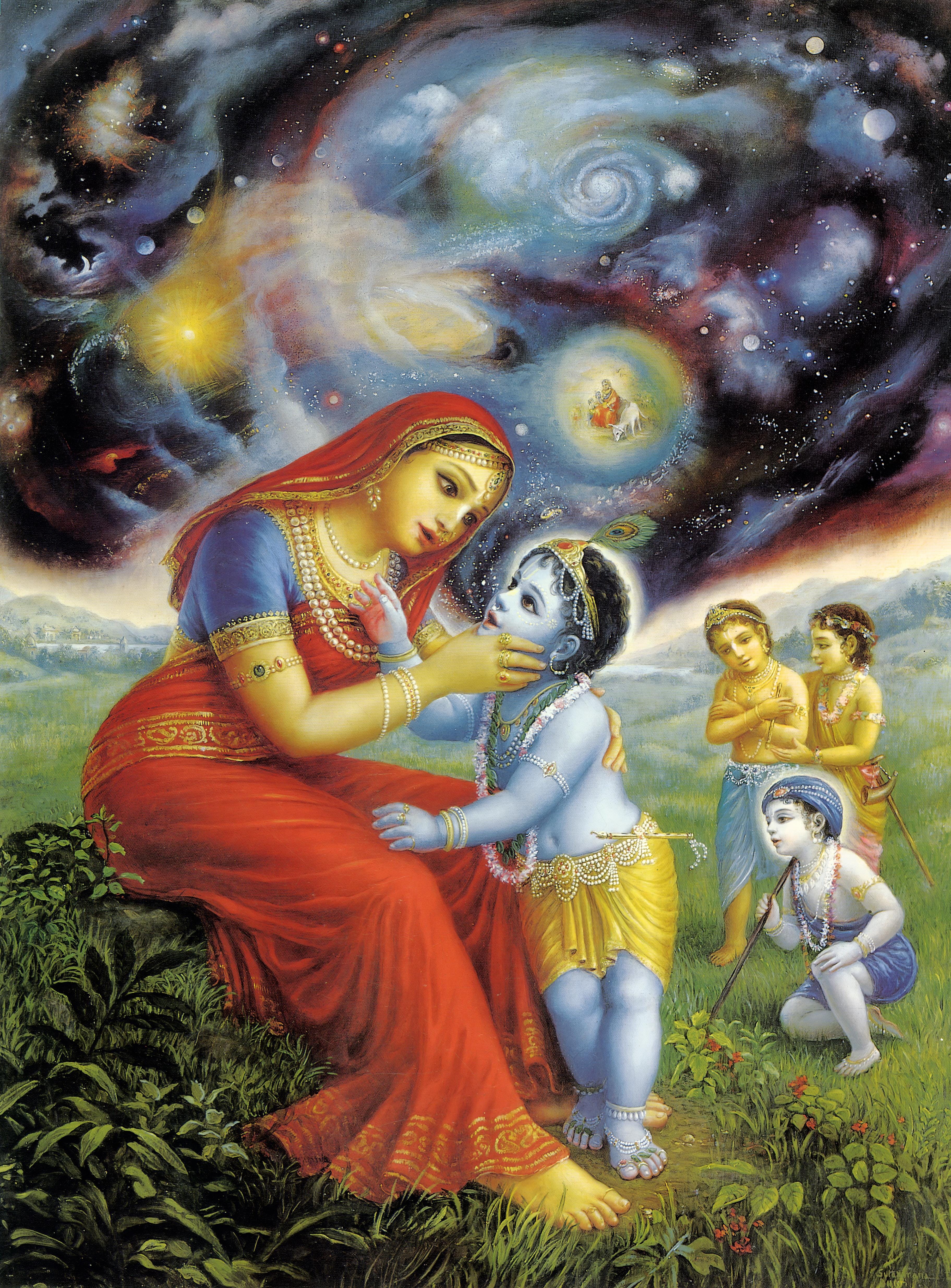
The Śrīmad-Bhāgavatam describes the pastime of Kṛṣṇa showing the Universal Form inside His mouth to mother Yaśodā. Playing the role of a small child, Kṛṣṇa had a small mouth, but at the same time, the whole universe was present inside of it:
“When Kṛṣṇa opened His mouth wide by the order of mother Yaśodā, she saw within His mouth all moving and nonmoving entities, outer space, and all directions, along with mountains, islands, oceans, the surface of the earth, the blowing wind, fire, the moon and the stars. She saw the planetary systems, water, light, air, sky, and creation by transformation of ahankāra. She also saw the senses, the mind, sense perception, and the three qualities, goodness, passion and ignorance. She saw the time allotted for the living entities, she saw natural instinct and the reactions of karma, and she saw desires and different varieties of bodies, moving and nonmoving. Seeing all these aspects of the cosmic manifestation, along with herself and Vṛndāvana-dhāma, she became doubtful and fearful of her son’s nature.” (SB 10.8.37-39)
Kṛṣṇa possesses three main energies: the internal potency, the external potency, and the marginal potency. The internal potency represents three quarters of the creation, including the spiritual sky and all the spiritual planets. The external potency corresponds to the material creation, including the different universes, and the marginal potency includes the innumerable jīvas who participate in either the spiritual or material creation. Kṛṣṇa’s energy is not different from Kṛṣṇa; therefore, there is nothing that exists outside of Kṛṣṇa. Although Kṛṣṇa may appear as a small boy walking around Vṛndāvana, which appears as a small tract of land on the surface of our planet, everything that exists is situated inside of Him.
Kṛṣṇa expands Himself in innumerable Viṣnu forms, one of which is Kṣīrodakaśāyī Viṣnu, who, although lying on the ocean of milk, permeates the whole universe, being situated inside the hearts of all, and even inside the individual atoms. The relationship of Kṛṣṇa with these different expansions is described as being similar to the relationship of a candle and innumerable other candles lit by the first one. Although all the candles are similarly bright, there is still an original candle that lit the others. Similarly, Kṛṣṇa and His expansions are equally powerful, although only as Kṛṣṇa does He display all His opulences in full.
Kṣīrodakaśāyī Viṣnu or Paramātmā is thus unlimitedly powerful, just like Kṛṣṇa is, and the whole creation is situated inside Him, although He may assume a small form to reside inside the heart. The dahara, or small sky inside the heart described in this passage, is thus nothing less than the abode of Paramātmā inside the heart, which includes everything that exists and everything desirable.
The passage describing the dahara from the Chāndogya Upaniṣad
This is the complete passage, which comes immediately after the dialogue of Nārada Muni and Sanat-kumāra. In this particular passage, an unnamed upaniṣadic teacher instructs his student.
atha yad idam asmin brahma-pure daharam puṇḍarīkam veśma daharo ’sminn antarākāśaḥ tasmin yad antas tad anveṣṭavyam tad vāva vijijñāsitavyam
“In the city of Brahman (the body), there is a small lotus-like abode (dahara puṇḍarīka veśma) where exists a small, subtle, inner sky (daharo ’sminn antarākāśaḥ). One should seek what is within that space. That is what must be sought out, that is what one must come to know in truth.” (Chāndogya Upaniṣad 8.1.1)
tañ cet brūyuḥ – yad idam asmin brahmapure daharam puṇḍarīkam veśma daharo ’sminn antarākāśaḥ, kim tad atra vidyate yad anveṣṭavyam yad vāva vijijñāsitavyam iti, sa brūyāt
“If a student were to ask: What exactly is to be sought and realized in this small ākāśa, or space inside the body?’ The teacher would answer as follows.” (Chāndogya Upaniṣad 8.1.2)
yāvān vā ayam ākāśas tāvān eṣo ’ntarhṛdaya ākāśaḥ ubhe asmin dyāvāpṛthivī antar eva samāhite ubhāv agniś ca vāyuśca sūryācandramasāv ubhau vidyun nakṣatrāṇi, yac cāsyehāsti yac ca nāsti, sarvam tad asmin samāhitam iti
“As immeasurable as the outer sky may be, the ākāśa inside the body is of the same measure. In this space inside the heart exist both heaven and earth, the vastness of both the fire and air elements, the sun and the moon, lightning and stars. Indeed, whatever exists in the universe, both manifest and unmanifest, is present in that space.” (Chāndogya Upaniṣad 8.1.3)
We often think of Paramātmā as some kind of fragmentary portion of the Lord. We may imagine that the Lord expands Himself into many forms to enter into the heart of all living entities, and that each form may not be so powerful. This passage of the Chāndogya Upaniṣad, however, shatters this misconception. The Lord is present in the heart of all living entities, not as some kind of partial manifestation, but in His full glory. As explained in the first verse of the Īśopaniṣad, although the Lord expands Himself into so many forms, each of these forms is complete, and the Lord remains complete even after producing so many complete expansions.
To help us understand this point, we can take into consideration that even in mundane mathematics, it’s accepted that if an infinite number is divided into infinite parts, each part will still be infinite. Thus, inconceivable as it may be, even when the Lord manifests so many expansions, each expansion still has full power and opulences.
Just as the Lord includes everything that exists (as He personally showed to mother Yaśodā by displaying the entire universe inside His mouth, and by displaying the universal form to Arjuna), the form of Paramātmā inside the heart includes everything. Therefore, the lotus-abode inside the heart includes everything that exists, inconceivably as it may be. All planetary systems, the totality of material elements, all living beings, etc., are present there, and this includes not just the present, but past and future as well.
The fact that everything exists simultaneously inside the heart of every living entity, however, should not be understood in the sense that there are multiple copies of each universe and each particular material object inside the heart of each entity. The Lord is one, and He contains everything that exists. The Lord, however, does not create copies of Himself; He just becomes present in many places simultaneously and performs many different pastimes. The concept of the Lord expanding Himself should not be taken in the sense of a process of division, like a brick being broken into different parts, or cells dividing.
tañ cet brūyuḥ – asmimś ced idam brahmapure sarvam samāhitam sarvāṇi ca bhūtāni sarve ca kāmāḥ, yadaitajjarāvāpnoti pradhvamsate vā kim tato ’tiśiṣyata iti
“The student could then ask: If everything that exists is contained within that city of Brahman, all beings and all desires, whatever can be imagined or desired, what happens when the body reaches old age and is destroyed? If the body, which is the abode of everything, is destroyed, what then could be left?” (Chāndogya Upaniṣad 8.1.4)
This is a really interesting philosophical question. The previous verse mentions that everything that exists is present in the dahara akāśa, the small sky inside the heart. After accepting this point, a natural question would be: since the body is temporary, what happens when it is finally destroyed? Does everything just stop existing after the destruction of the body?
sa brūyāt—nāsya jarayaitaj jīryati, na vadhenāsya hanyate, etat satyaṃ brahmapuram; asmin kāmāḥ samāhitāḥ, eṣa ātmāpahatapāpmā vijaro vimṛtyur viśoko vijighatso ’pipāsaḥ, satyakāmaḥ satyasankalpaḥ, yathā hy eva iha prajā anvāviśanti yathānuśāsanam, yaṃ yam antam abhikāmā bhavanti, yaṃ janapadaṃ yaṃ kṣetrabhāgaṃ taṃ tam evopajīvanti
“To this, the teacher would answer: This dahara akāśa, the small sky inside the heart, does not wither with the old age of the body, nor is it destroyed when the body is destroyed. This is the true city of Brahman, not the body. This is ātmā, the true Self, which is sinless, ageless, deathless, free from sorrow, hunger, and thirst. He doesn’t desire anything apart from His own eternal, transcendental desires, and all His desires are automatically satisfied. Just as, here on earth, people enter various communities and live in whatever region or field they desire, in that inner realm, each person attains whatever one is longing for.” (Chāndogya Upaniṣad 8.1.5)
In text 8.1.1, the expression brahma-pura refers to the body, because Paramātmā, together with the soul, is present inside the body. However, the real brahma-pura is independent of the body, being sinless, ageless, deathless, etc., the place where one can find the attainment of all one’s desires.
All these adjectives are applied to dahara akāśa, which is the city of Brahman itself. This is thus the passage that Vyāsadeva refers to when he mentions dahara uttarebhyaḥ (The Dahara is the Lord, because of the subsequent statements in the Upaniṣad).
tad yatheha karma-cito lokaḥ kṣīyate, evam evāmutra puṇya-cito lokaḥ kṣīyate, tad ya ihātmānam ananuvidya vrajanty etāmś ca satyān kāmān, teṣām sarveṣu lokeṣv akāmacāro bhavati, atha ya ihātmānam anuvidya vrajanty etāmś ca satyān kāmān, teṣām sarveṣu lokeṣu kāmacāro bhavati
“Just as in this world everything one achieves by past pious activities is destroyed (with death), whatever one may achieve in the next life by dint of current pious activities will also be destroyed. Therefore, those who end this life not knowing the Lord, who is the True Self with eternal auspicious qualities, remain bound in this world, without freedom of movement. On the other hand, those who leave their bodies knowing Him have freedom of movement and attain everything they desire.” (Chāndogya Upaniṣad 8.1.6)
Before, it was mentioned that the small sky inside the heart should be sought out and known in truth. Next, it was defined that this small sky is the Lord Himself, including His transcendental abode, the real abode of happiness. Now, the destination of those who are able to realize Him or not is contrasted. One who departs one’s body without attaining Kṛṣṇa Consciousness remains bound to the results of his karma, transmigrating through different material bodies. The ones who wisely use their time and understand the Lord, however, become free to wander as they please, both in the spiritual world and in the material universe. If one still has material desires, one can easily attain everything he or she hankers for.
In the next section, from verses 8.2.1 to 8.2.10, the Chāndogya Upaniṣad elaborates on that, describing many common material desires and how they are easily attained by a devotee of the Lord: If one desires to meet one’s departed ancestors, by his mere desire he not only meets with them, but is worshiped together with them. If one desires to see his departed mothers, not only of this life, but of any previous lives, or one’s brothers, sisters, or friends, the same happens. If one desires luxuries such as celestial perfumes and garlands, nectarian foods and drinks, delightful music played by celestial artists, or even association with celestial women, all of these one can easily achieve, different from conditioned souls imprisoned by karma.
Kṛṣṇa Consciousness is thus the solution for everyone, both souls who desire to attain the spiritual world, or who hanker for material happiness. Both can be easily achieved by one who knows the Lord.
Sūtra 1.3.15 - Additional support
gati-śabdābhyām tathā dṛṣṭam lingam ca
gati: going (to Brahman); śabdābhyām: because of the word (denoting Brahman); tathā hi: furthermore; dṛṣṭam: is seen; lingam: is hinted; ca: and.
And also because of the description of the soul going to the Lord, because of the word denoting Brahman, and because it is both directly stated and hinted at in the text.
Commentary: This sūtra gives additional support to the argument that the dahara is Lord Viṣnu inside the heart, and not the jīva, by hinting at a different passage from the Chāndogya Upaniṣad (8.3.2), where it is mentioned:
yathā hiraṇya-nidhim nihitam akṣetrajñā upari sañcaranto ‘pi na vidus tathemāḥ sarvāḥ prajā ahar-ahar gacchantya enam brahma-lokam na vidanty anṛtena hi pratyūḍhāḥ
“Just as ignorant people moving around a treasure of gold fail to see it, so too do all living beings, day after day, go to the realm of Brahman where they meet the Supreme Lord. Being obstructed by illusion, however, they fail to recognize Him.”
The word denoting Brahman mentioned in the sūtra (śabdābhyām) is the word “enam” of this verse, which points to Lord Viṣnu inside the heart, and the description of going (gati) refers to the description in the verse of the soul going day after day to the spiritual realm of Brahman without knowing it. Both the word and the description show that Lord Viṣnu is indeed the small sky inside the heart.
Other passages of the scriptures also describe this daily journey of the soul:
satā saumya tadā sampanno bhavati
“O gentle one, the living entities are again and again in contact with the Supreme.”
ya eṣo ‘ntar hṛdaya ākāśas tasmin śete
“Entering the sky of the heart, the soul sleeps.”
Just as described in the previous sūtra, the word “brahma-lokam” in this verse does not refer to the planet of Lord Brahmā, but to the spiritual sky. The passages should thus not be interpreted in the sense that the soul goes daily to Satyaloka, the planet of Brahmā (which would make absolutely no sense), but that the soul daily comes in contact with the Lord by entering this small space inside the heart.
How can we understand that the soul goes to the Lord at the end of each day? How can we regularly go to the Lord and return to this material world after it? And how do we not remember these encounters?
This is connected with the souls merging into the body of Mahā-Viṣnu, which happens at the end of each universal cycle. In his purport to SB 1.10.21, Śrīla Prabhupāda mentions:
“There are two types of dissolution of the manifested cosmos. At the end of every 4,320,000,000 solar years, when Brahmā, the lord of one particular universe, goes to sleep, there is one annihilation. And at the end of Lord Brahmā’s life, which takes place at the end of Brahmā’s one hundred years of age, in our calculation at the end of 8,640,000,000 × 30 × 12 × 100 solar years, there is complete annihilation of the entire universe, and in both the periods both the material energy called the mahat-tattva and the marginal energy called jīva-tattva merge in the person of the Supreme Lord. The living beings remain asleep within the body of the Lord until there is another creation of the material world, and that is the way of the creation, maintenance, and annihilation of the material manifestation.”
“The merging of the living beings into the body of Mahā-Viṣṇu takes place automatically at the end of Brahmā’s one hundred years. But that does not mean that the individual living being loses his identity. The identity is there, and as soon as there is another creation by the supreme will of the Lord, all the sleeping, inactive living beings are again let loose to begin their activities in the continuation of past different spheres of life. It is called suptotthita-nyāya, or awakening from sleep and again engaging in one’s respective continuous duty. When a man is asleep at night, he forgets himself, what he is, what his duty is, and everything of his waking state. But as soon as he awakens from slumber, he remembers all that he has to do and thus engages himself again in his prescribed activities. The living beings also remain merged in the body of Mahā-Viṣṇu during the period of annihilation, but as soon as there is another creation, they arise to take up their unfinished work. This is also confirmed in the Bhagavad-gītā (8.18-19).”
Just as the souls merge into the body of Lord Mahā-Viṣnu at the end of each day of Brahmā, and also after the final dissolution of the universe, the soul goes to the small space inside the heart (the abode of Paramātmā) at the end of each day, during deep sleep. Being the eternal part and parcel of the Lord, the soul can’t remain separated from the Lord. Thus, at the end of each cycle of material activity (at the end of each day, at the end of each day of Brahmā, and at the end of each Mahā-kalpa), the soul merges into the body of the Lord.
What makes this merging different from liberation is that during this encounter with the Lord in the conditioned state, the soul is forgetful of his eternal relationship with Him, and still contaminated by the false ego and material desires. The soul thus doesn’t associate with the Lord during these encounters, but just remains in an unconscious state, in a kind of deep slumber. When the soul wakes up at the beginning of the next cycle, one remembers one’s material desires and thus becomes again busy performing different material activities to try to satisfy them.
Going back to Godhead, on the other hand, means that the soul not only becomes free from all material desires, as well as the false ego, but also is able to awaken his real spiritual nature, including his spiritual body and senses, with which he can enter the spiritual planets and personally associate with the Lord.
These meetings with the Lord at the end of each day are also described in the Māṇḍūkya Upaniṣad, which describes the three stages of consciousness of the soul:
jāgarita-sthāno bahiḥ-prajñaḥ saptānga ekonavimśatimukhaḥ
sthūla-bhuk vaiśvānaraḥ prathamaḥ pādaḥ
“The first state is the waking state (viśva), where consciousness is directed outward, connected with the cosmic body of seven limbs, enjoyed through the nineteen faculties. In this state, the soul becomes the enjoyer of the objects of the senses that are part of this world. The Lord of this state is called Vaiśvānara, the universal person.” (Māṇḍūkya Upaniṣad 1.3)
The nineteen faculties means the five sense organs (hearing, touch, sight, taste, and smell), the five organs of action (speech, hands, feet, as well as the reproductive and excretory organs), the five vital airs (prāṇa, apāna, vyāna, udāna, and samāna), and the four internal senses (mind, intelligence, ego, and material consciousness). Through these, the soul enjoys the physical world.
svapna-sthāno’ntaḥ-prajñaḥ saptānga ekonavimśatimukhaḥ
praviviktabhuk taijaso dvitīyaḥ pādaḥ
“The second is the dreaming state, where consciousness is turned inwards. In this state, called taijasa, the seven limbs and nineteen faculties contact subtle sense objects in dreams. In this way, the jīva enjoys dreamy experiences, enabled by Taijasa, the luminous Lord.” (Māṇḍūkya Upaniṣad 1.4)
yatra supto na kancana kāmam kāmayate na kancana svapnam paśyati tat sushuptam
sushupta-sthāna ekībhūtaḥ prajñānaghana evānandamayo hy
ānandabhuk cetomukhaḥ prajñaḥ tritīyaḥ pādaḥ
“The third is the state of deep sleep, called prājña, where one does not desire anything nor see any dreams. In this state, the soul experiences a blissful state of union with the Prajñānaghana (the Lord, the undivided source of consciousness and enjoyer of bliss) through the gateway of pure consciousness.” (Māṇḍūkya Upaniṣad 1.5)
That’s the state of unconscious connection with the Lord, when both the external senses and the mind become inactive. The soul forgets its separate material identity and goes to the Lord. This is, however, different from liberation, because in this state one has not yet awakened one’s original Kṛṣṇa Consciousness, and thus one’s spiritual senses are still dormant. As a result, when the material senses and mind are deactivated, one falls into an unconscious state.
Sūtra 1.3.16 - The maintainer of the Universe
dhṛteś ca mahimno’syāsminn upalabdheḥ
dhṛteḥ: because of maintaining; ca: and; mahimnaḥ: of the glory; asya: of Him; asmin: in him; upalabdheḥ: because it is stated.
It refers to the Lord also because of the description of His glory in maintaining the Universe.
Commentary: The passage from the Chāndogya Upaniṣad describes the characteristics of the small sky inside the heart as “great as the sky”, “free from all sin”, etc., and also as the maintainer of everything. In this description, the use of the word “ātmā” makes it clear that the small space inside the heart is the Supreme Personality of Godhead.
This is also corroborated in the Bṛhad-āraṇyaka Upaniṣad (4.4.22), where it is stated:
atha ya ātmā sa setur vidhṛtir eṣām lokānām asambhedāya
“He is the Supreme Person, the bridge and sustaining support of all these worlds. He is the one who prevents them from collapsing and being destroyed.”
We can observe that both in the passage from the Chāndogya Upaniṣad and in this passage from the Bṛhad-āraṇyaka, the word “ātmā” is used to describe a being that has qualities impossible for anyone else apart from Lord Viṣnu to possess. Even Brahmā and Śiva don’t have the power to maintain all the planets. Brahmā creates and Śiva destroys, but the maintenance is done by Lord Viṣnu.
These passages confirm that the small sky has the glory of maintaining all the universes. Since no one else can make such a claim, these statements again indicate that the passages refer to Lord Viṣnu.
Sūtra 1.3.17 - The common usage of the word
prasiddheś ca
prasiddheḥ: because it is well-known, generally accepted; ca: and.
And because this is the well-known usage of the word.
Commentary: The verse from the Chāndogya Upaniṣad included at the beginning of this section (8.1.1) refers to the small space inside the heart by the words daharo antar ākāśas. As discussed in previous sūtras, the word “ākāśa” is usually translated as “sky”, “ether”, or “space”, but in a deeper sense, ākāśa in these verses means the Lord. The word “dahara” means “small”, and therefore “daharo antar ākāśas“ is translated as “the small sky”, but the real meaning is “the Lord present inside the heart in a minute form”.
Similarly, the Taittirīya Upaniṣad (2.7.1) mentions:
ko hy evānyat kaḥ prāṇyāt. yad eṣa ākāśa ānando na syāt, eṣa evānandayati
“Who could live without Him, the ākāśa who is filled with limitless bliss? This very Brahman makes all blissful.”
In the Śrīmad-Bhāgavatam (5.7.7), it is mentioned: antaḥ-hṛdaya-ākāśa-śarīre, “the ākāśa (Supersoul) within the heart, as meditated on by yogīs.”
We can see that in both passages, the word ākāśa (sky) is used to refer to the Supreme Personality of Godhead. He is the Lord inside the heart to which the jīva goes at the end of each day when entering into deep sleep. The same happens in many other passages. This is just the common usage of the word, as emphasized by Vyāsadeva in this sūtra.
The ākāśa mentioned here is thus the Lord inside the heart to Whom the jīva goes at the end of each day when entering into deep sleep, and not the ordinary element ether, as some may argue.
The expression “daharo antar ākāśas“ thus means the Lord, and not the jīva, or the element ether.
Next: There is a great gap between the qualities of the jīva and the Lord. »
You can also donate using Buy Me a Coffee, PayPal, Wise, Revolut, or bank transfers. There is a separate page with all the links. This helps me enormously to have time to write instead of doing other things to make a living. Thanks!
« Vedānta-sūtra: The Govinda-bhāṣya of Baladeva Vidyābhūṣaṇa