

« Vedānta-sūtra: The Govinda-bhāṣya of Baladeva Vidyābhūṣaṇa
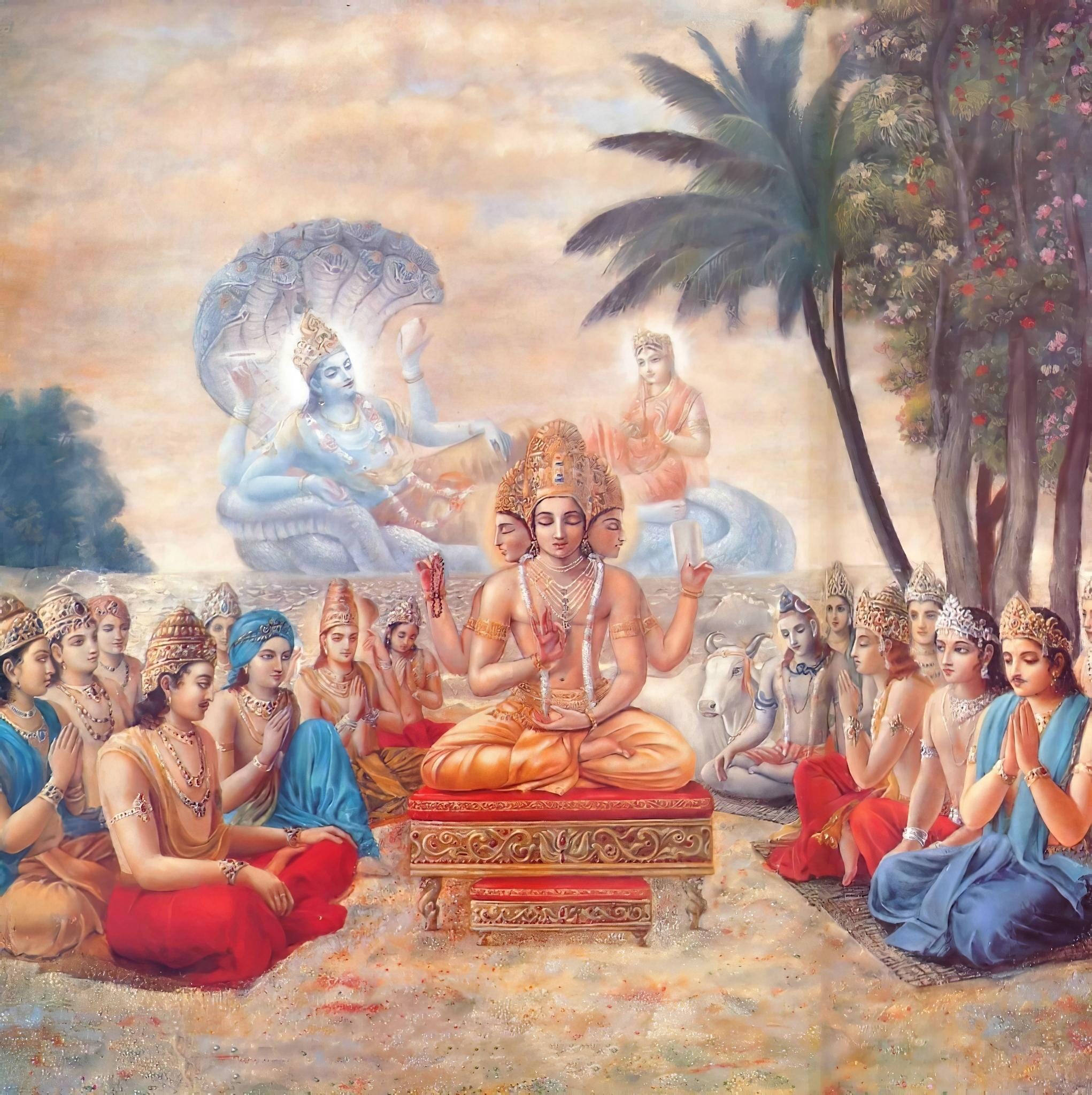
Topic 7: Devatādhikaraṇam - The devas also meditate on the Lord
Demigods possessing bodies and senses do not contradict the scriptures.
tad-upary api bādarāyaṇaḥ sambhavāt, virodha-karmaṇīti cen nāneka-pratipatter darśanāt, śabda iti cen nātaḥ prabhāvāt pratyakṣānumānābhyām, ata eva ca nityatvam, samāna-nāma-rūpatvāc cāvṛttāv apy avirodho darśanāt smṛteś ca, madhv-ādiṣv asambhavād anadhikāram jaiminiḥ, jyotiṣi bhāvāc ca, bhāvam tu bādarāyaṇo’sti hi
“The demigods, who are above men, also worship the Supreme Lord. That’s possible because they also have bodies. This is the opinion of Bādarāyaṇa (Vyasa). If one argues that this contradicts their activities, I say no, because it is seen that the demigods can manifest in many forms simultaneously.
If one argues that this contradicts the eternal nature of the words of the Vedas, I say no, because the demigods are created from eternal words. This is shown in statements of the śruti and smṛti. Therefore, the eternity of the Vedas is proved.
Indeed, because the names and forms remain the same in each new cycle of creation, there is no contradiction. This is confirmed in the śruti and smṛti. Jaimini is of the opinion that devas do not engage in the madhu-vidyā and other forms of Vedic meditation and duties because it is not possible for them to do so. The demigods can’t perform these types of worship because they meditate on the effulgence of the Lord, the supreme light, he argues. Vyāsadeva, however, maintains that the demigods perform the Vedic duties, but with a specific mentality.”
Sūtra 1.3.26 - The demigods also have material bodies
tad-upary api bādarāyaṇaḥ sambhavāt
tad: that; upari: above; api: also; bādarāyaṇaḥ: as Vyāsadeva maintains; sambhavāt: because of being possible.
The demigods, who are above men, also worship the Supreme Lord. That’s possible because they also have bodies. This is the opinion of Bādarāyaṇa (Vyasa).
Commentary: In the previous sūtra, it was stated that “manuṣyādhikāratvāt”: human beings are qualified to meditate on the form of the Lord inside the heart, and thus worship Him. This could lead to the belief that only human beings are capable of worshiping the Lord, and no one else. This sūtra rectifies this misunderstanding, stating that demigods and other higher beings can also worship the Lord and thus advance in the spiritual process.
The Vedas explain that there are 8,400,000 forms of life spread on the different planets of the universe. From these, 400,000 are intelligent beings, including humans. This is quite a high number, which shows that there is an enormous variety of intelligent species spread across the universe, most of them higher than us, including the demigods.
Some could argue that the demigods have no senses, having astral bodies created by mantra, and that therefore they are not capable of worshiping the Supreme Lord. One could then further conclude that since they have no senses, they also have no material desires nor desire for spiritual renunciation. This theory would lead to the conclusion that the demigods are some different type of soul, and that they live eternally in such astral bodies, without desires and without worshiping the Lord, a concept similar to the angels in Christianity, which are a class of intermediate beings between God and man. This is, however, just another mistaken idea one may develop when concluding things using his material intelligence instead of studying the conclusions of the scriptures.
The Bṛhad-āraṇyaka Upaniṣad (1.4.10), for example, states:
tad yo yo devanam pratyabudhyata sa eva tad abhavat tatharsinam tatha manusyanam
“Whoever among the devas meditated on the Supreme Personality of Godhead, attained the Supreme Personality of Godhead. Whoever among the sages meditated on Him attained Him, and similarly, whoever among the human beings meditated on Him, also attained Him.”
Another relevant verse of the Bṛhad-āraṇyaka is 4.4.16, which mentions:
tad deva jyotisam jyotir ayur hopasate ‘mrtam
“The devas meditate on the Supreme Personality of Godhead, who is the splendor of all splendors, and who is eternity and life.”
There are many other verses that could be quoted, like for example the Bṛhad-āraṇyaka Upaniṣad (5.2.1) that mentions that demigods also study the Vedic knowledge and learn to control their senses, just like we are supposed to do:
tatra yāḥ prājāpatyāḥ prajāpatau pitari brahmacaryam ūṣur devā manuṣyā asurāḥ
“The devas, humans, and asuras, who were all sons of Lord Brahmā, lived with their father as celibate students of spiritual knowledge.”
This is further confirmed in the Chāndogya Upaniṣad (8.11.3):
eka-śatam ha vai varṣāṇi maghavā prajāpatau brahmacaryam uvāsa
“King Indra lived as a celibate student of spiritual knowledge (brahmacārī) in the home of Lord Brahmā for a hundred years.”
Demigods and other higher beings have bodies and senses of a much higher grade compared to human beings, but the principle of embodiment applies to all. All beings living inside this material universe have bodies and senses, and thus have desires and perform different types and qualities of activities. Although they have different grades of bodies, they all possess senses and struggle to control their desires. In the Purāṇas, there are many stories of great demigods losing control over their lust and anger and committing mistakes.
Therefore, the idea that demigods don’t have senses and can’t meditate or worship the Lord is refuted in this sūtra with the words “tad-upary api“ (those above also meditate). Bādarāyaṇaḥ sambhavāt: Vyāsadeva maintains this conclusion on the basis of the śāstras, because it implies possibility. Demigods have bodies and senses, and therefore, they have the possibility of meditating and cultivating spiritual knowledge.
Another point connected with that is that although the demigods have a much higher standard of material comfort compared to us, their positions are still temporary and unstable. Sometimes they are attacked by demons, or killed in battle, they may lose their opulences due to curses, etc.
This is confirmed in the Viṣnu Purāna (6.5.50):
na kevalam dvija-crestha, narake duhkha-paddhatih
svarge ‘pi yata-bhitasya, ksayisnor nasti nirvrtih
“O best of the Brāhmaṇas, suffering does not exist only in hell. The residents of the heavenly planets, afraid that they may one day fall from heaven, have no happiness.”
From descriptions such as these, we can understand that the material happiness of the demigods (although of a higher grade) is as illusory as ours. Because the demigods study the śāstras, they hear about the eternal and unlimited spiritual bliss, and therefore, they desire to be promoted to a platform of devotional service to the Lord. For this purpose, they meditate, worship, observe vows of celibacy, and so on, to advance in the spiritual path.
The scriptures describe that birth as a human being on Earth offers the best possibilities for self-realization, but this doesn’t mean demigods can’t advance. The difference is that because of the many distractions available in the celestial planets, their advancement happens on a much larger scale of time. Human beings have the chance of going back to Godhead after just a short lifetime, while demigods usually take the same long path taken by yogis and jñanis, being first promoted to Maharloka, then ascending to Janaloka or higher at the end of the day of Brahmā, and living there until the end of the universe, only then having a chance of going back to Godhead together with Brahmā.
Sūtra 1.3.27 - The demigods manifest in many forms to attend sacrifices
virodha-karmaṇīti cen nāneka-pratipatter darśanāt
virodhaḥ: contradiction; karmaṇi: in activities; iti: thus; cet: if; na: not; aneka: many; pratipatteḥ: acquisition; darśanāt: because it is seen.
If one argues that this contradicts their activities, I say no, because it is seen that the demigods can manifest in many forms simultaneously.
Commentary: One could argue that it is not possible that the devas have material bodies because they become manifest at different places simultaneously whenever yajñas are performed. If the devas have material bodies and senses just like us, then how could it be possible for them to appear simultaneously in so many places?
To this argument, Vyāsadeva answers: āneka-pratipatter darśanāt. It is practically seen that demigods can expand themselves into many forms, and thus be present in many sacrifices at the same time.
This is possible because demigods are empowered by the Lord to perform their functions. The Lord can expand Himself into many forms (as he does with the different forms of Viṣnu), and thus He can empower others to do the same when needed. Part of the duty of the demigods is to be present at different sacrifices and ceremonies where they are invoked, and therefore, the Lord gives them the power to be present in many places simultaneously to fulfill it.
Actually, even ordinary yogis can attain the yogic perfection of expanding themselves into up to eight forms, like in the case of Saubhari Muni, who became eight in order to marry the eight daughters of the king. Kardama Muni, who was exceptionally powerful, was capable of expanding into nine forms to satisfy Devahūti. The Lord, however, can expand in an unlimited number of forms, just as He expanded Himself into 16,108 forms to be simultaneously with each of His queens in Dvārakā.
In fact, these mystic perfections displayed by yogis come from their connection with the Lord, as the fruit of their fixed meditation. If yogis can attain such powers by the practice of meditation, there is no reason to doubt that the Lord can give such powers to His administrative assistants.
Expanding themselves into many forms is not even the most amazing display of power we see in the demigods. Yamarāja, for example, receives the power of omniscience over human sinful activities, which is necessary for him to see the sins committed by all human beings and thus be able to punish them when appropriate. Brahmā receives the power of creating a universe from scratch, and so on.
The idea that demigods can’t have bodies because having a form would be contradictory to their powers and activities, follows the same flawed logic of concluding that God doesn’t have a form because it’s mentioned that He is everywhere. A gross body like ours certainly imposes various limitations on what we can do, but it doesn’t negate the existence of higher grades of bodies that don’t have such limitations.
Sūtra 1.3.28 - The temporality of the demigods does not contradict the eternality of the Vedas
śabda iti cen nātaḥ prabhāvāt pratyakṣānumānābhyām
śabdaḥ: the words of the Vedas; iti: thus; cet: if (objection); na: not; ataḥ: therefore; prabhavāt: because of creation; pratyakṣānumānābhyām: because of śruti and smṛti.
If one argues that this contradicts the eternal nature of the words of the Vedas, I say no, because the demigods are created from eternal words. This is shown in statements of the śruti and smṛti.
Commentary: Another possible argument in favor of the idea that demigods don’t have bodies and senses is that the knowledge of the Vedas is eternal, and the Vedas mention the names of different demigods. If demigods are created at a certain stage and destroyed at a certain stage, it means that they didn’t exist before their creation and will not exist after their destruction. There will thus be a period, before the birth of a demigod and after his death, that the name would have no meaning, and the words of the Vedas would thus become meaningless, like the sentence “the son of a barren woman“.
The Mīmāmsā-sūtra says: autpattikas tu śabdenārthasya sambandhaḥ: “In the Vedas, the relation between name and the object named is eternal.” One could thus argue that either the demigods are eternal representations of the mantras, and thus don’t have bodies, or the Vedas would not mention the names of the demigods at all.
It may sound like a strong argument, but Vyāsadeva disagrees with it by saying: nātaḥ prabhāvāt pratyakṣānumānābhyām. It is not so, because of the description of the creation of the universe mentioned in the Vedas, and also because of evidence from śruti and smṛti.
First of all, what is the description of creation that contradicts this argument?
The Purāṇas explain that the material creation happens in two stages, the primary creation and the secondary creation. In the Śrīmad-Bhāgavatam and other Purāṇas, we hear the description of the creation of the universe by Brahmā, as well as the work of the Prajāpatis and other highly elevated beings. However, this is actually the secondary creation that happens repeatedly in each and every universe.
The primary creation is done by Lord Mahā-Vishnu, who creates everything that exists in the numerous universes in a subtle form (like a project or an idea), including all the names, forms, and ideas that exist. Although the material universes are repeatedly created and destroyed, the primary creation of Mahā-Vishnu, including all the names and forms of the demigods, is actually eternal, and these are the names mentioned in the Vedas.
In the book of Viśvakarmā, for example, forms of demigods are described. Yamarāja has a mace in his hand, Varuṇa has a noose, and so on. These are not descriptions of specific persons, but actually descriptions of the eternal names and forms of these demigods, which are assumed by different souls at different Manvantaras. Just like words like “cow” and “horse” describe animals that exist in every creation, words like “Indra” or “Surya” describe posts of demigods that are occupied by different souls in each manvantara (the reign of a Manu). After the end of this period, the demigods are replaced by others who assume the same names and forms, and a new cycle is started. This happens in each and every material universe.
In this way, although the demigods are mortal living beings, the names and forms described in the Vedas are eternal.
The conclusion that the devas have material bodies, given in the previous sūtras, is thus not contradictory with the eternal nature of the Vedas. At the beginning of each cycle of creation, Brahmā creates the demigods from their eternal, archetypal forms, described in the Vedas. In this way, the fact that the demigods have material bodies doesn’t contradict the fact that the Vedas are genuine sources of knowledge and that the names and other descriptions included in the Vedas are eternal.
Apart from the argument based on the creation, Vyāsadeva also argues that “pratyakṣānumānābhyām”: there is also evidence from the śruti and smṛti.
In the Pañca-vaimśati Brāhmaṇa 6.9.13,22, for example, the following description is given:
eta iti ha vai prajāpatir devān asṛjat, asṛgram iti manuṣyān, indava iti pitṝn, tiraḥ-pavitram iti grahān, āsuva iti stotram, viśvān iti mantram, abhisaubhaga iti anyāḥ prajāḥ.
“Reciting the word ete from the Vedas, Lord Brahmā created the devas. Reciting the word asṛgram, he created the human beings. Reciting the word indava, he created the pitās. Reciting the word tiraḥ-pavitram, he created the planets. Reciting the word asuva, he created the stotras. Reciting the word viśvāni, he created mantras. Reciting the word abhisaubhaga, he created the other creatures.”
This shows how Brahmā creates the different species that populate the universe from the eternal words present in the Vedas.
This is corroborated by the Viṣṇu Purāṇa (1.5.64), which states:
nāma rūpam ca bhūtānām, kṛtyānām ca prapañcanam
veda-śabdebhya evādau, devādīnām cakāra saḥ
“By reciting the words of the Vedas, Lord Brahmā created the names and forms of the material elements, the rituals, the devas, and all other living entities in the beginning of creation.”
A more elaborate description of the nature of Vedic sound and how it is the basis for the whole material manifestation is found in the Eleventh Canto of Śrīmad-Bhāgavatam (11.21.36-40), where Kṛṣṇa describes to Uddhava:
“The transcendental sound of the Vedas is very difficult to comprehend and manifests on different levels within the prāṇa, senses and mind. This Vedic sound is unlimited, very deep and unfathomable, just like the ocean.
As the unlimited, unchanging and omnipotent Personality of Godhead dwelling within all living beings, I personally establish the Vedic sound vibration in the form of omkāra within all living entities. It is thus perceived subtly, just like a single strand of fiber on a lotus stalk.
Just as a spider brings forth from its heart its web and emits it through its mouth, the Supreme Personality of Godhead manifests Himself as the reverberating primeval vital air, comprising all sacred Vedic meters and full of transcendental pleasure. Thus the Lord, from the ethereal sky of His heart, creates the great and limitless Vedic sound by the agency of His mind, which conceives of variegated sounds such as the sparśas. The Vedic sound branches out in thousands of directions, adorned with the different letters expanded from the syllable om: the consonants, vowels, sibilants and semivowels. The Veda is then elaborated by many verbal varieties, expressed in different meters, each having four more syllables than the previous one. Ultimately the Lord again withdraws His manifestation of Vedic sound within Himself.”
You can also donate using Buy Me a Coffee, PayPal, Wise, Revolut, or bank transfers. There is a separate page with all the links. This helps me enormously to have time to write instead of doing other things to make a living. Thanks!
« Vedānta-sūtra: The Govinda-bhāṣya of Baladeva Vidyābhūṣaṇa