

Subscribe to receive new articles by e-mail. It’s free, but if you like, you can pledge a donation:
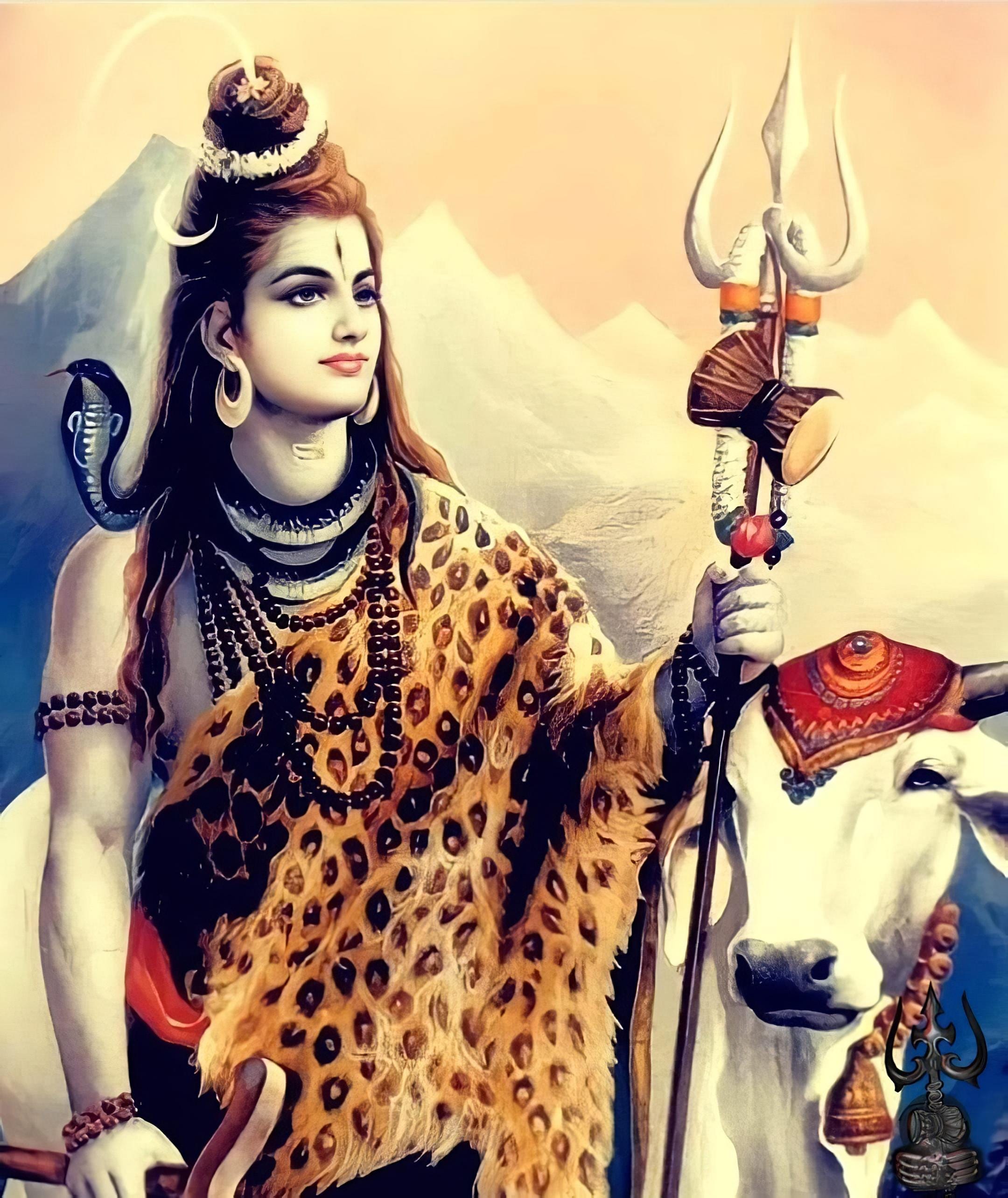
Lord Śiva has many worshipers. Not only on this planet, but also in the lower planetary systems, both humans and asuras, as well as ghosts and other beings, worship Lord Śiva in search of material benefit.
However, these worshipers don’t know who Lord Śiva really is. Behind all stereotypes and speculations of ghostly followers, Lord Śiva is a devotee of Lord Viṣnu the greatest Vaiṣnava.
However, apart from that, what are the qualities and glories of Lord Śiva? Where can we learn more about him?
In another passage of the 4th canto of Śrīmad Bhāgavatam, Brahmā takes the demigods to Kailāsa, in the Northern part of Jambūdvīpa.
This is the celestial abode of Lord Śiva. Although completely renounced, his wife is the personification of material energy, therefore their abode is extraordinarily opulent, not in terms of buildings and gold, but in terms of natural beauty, cleanliness, and auspiciousness, with many auspicious trees, mountains, rivers, waterfalls, flowers, animals, etc. Sati mentioned to her father, Daksa, that he could not even imagine the opulence of her husband and her, and that was not an exaggeration.
Since Lord Śiva is constantly engaged in meditation and prefers to live under a tree, his wife organizes the most perfect place for his meditation. Other fortunate beings live there, including many Kinnaras, Gandharvas, Apsaras, etc.
The demigods came from the higher planets in the direction of Jambūdvīpa, and on the way passed through the abode of Kuvera, which is situated between Svargaloka (the heavenly planetary system) and Bhū-loka (the intermediate planetary system). After observing the opulence of Kailāsa Hill, the demigods finally reached the great banyan tree that serves as the residence of Lord Śiva. This banyan tree is described as being 800 miles high, with the branches expanding for 600 miles around. In other words, this tree has a size on the scale of many countries.
The environment around the tree is perfectly peaceful. The temperature is stable, and there is absolutely no noise. Even birds did not make nests there, creating a perfect environment for meditation, all arrangements of the material energy for her husband.
At this particular time, however, Lord Śiva was not meditating; he was speaking to Nārada Muni, answering questions posed by him about devotional service. He was also accompanied by Kuvera, the four Kumaras, as well as other great personalities. Lord Śiva was in the sitting pose called vīrāsana, with his finger in the mode of argument. However, when he saw Lord Brahma approaching, together with all the demigods, Lord Śiva got up and offered him respects, followed by all the great sages present. This is compared to Lord Vāmanadeva offering respects to his father Kaśyapa Muni, although He is the Supreme Personality of Godhead himself. Similarly, Lord Śiva is in a higher position than Brahma, but he offers him respect in all humility because he appeared as his son. Kṛṣṇa Himself touched the feet of Mahārāja Yudhiṣṭhira because he was older than Him. By all these examples, the Lord teaches us to respect seniors.
From verse 4.6.42 to verse 4.6.53, Brahma offers prayers to Lord Śiva and requests him to kindly forgive the demigods and reverse the injuries done to them. These are the main points:
a) Brahma describes Lord Śiva as “the Supreme Brahman beyond the cosmic manifestation”. Lord Śiva comes originally from Mahā-Vishnu, but at the same time, part of his qualities are covered when he appears inside the many different universes and associates with material nature. Since material nature acts as his energy, he is defined as both the father and mother of the cosmic manifestation.
b) Ultimately, the Supreme Lord is the creator, maintainer, and destroyer of the material manifestation, but because Lord Śiva is empowered by Him, Brahma addresses Lord Śiva as such. Another reason is that Lord Śiva is an expansion of the Lord, and therefore in one sense they are non-different, although Lord Śiva plays a different role and shows different qualities. Lord Vishnu is like milk, and Lord Śiva is like yogurt. Yogurt comes from milk and is nothing but milk, but at the same time, it has different properties.
c) Brahma appears to address Lord Śiva as the Supreme Lord in his prayers. This has two reasons: one is because of the close relationship of Lord Śiva and the Supreme Lord. A second reason is given by Vyasadeva in the Vedanta-sutra 1.4.28: etena sarve vyākhyātā vyākhyātāḥ, “The Supreme Lord is the original cause of everything. All words of the scriptures should be interpreted according to this explanation.”
In many passages of the scriptures, names such as Indra, Vayu, Surya, and Śiva are used to address the Supreme Lord. In these cases, they are accepted as addressing Lord Viṣnu, and not as the respective demigods. In this way, the prayers of Lord Brahma mix glorification to Lord Śiva and to the Supreme Lord behind him.
d) The Lord created the varnāśrama system, and the four varnas are accepted as parts of His universal form. Everyone is supposed to follow the system, but Brahmanas are supposed to be especially strict. Daksa was entrusted withthe knowledge of the karma-kanda portion of the Vedas, the knowledge about fruitive sacrifices, which is also part of the system.
e) Everything exists on the energy of the Lord. The pious, who perform auspicious activities, culminating with devotional service, are elevated to the celestial planets, the impersonal Brahmajyoti or the spiritual planets, according to the quality of their activities, while the miscreants who reject the path of devotional service and disobey the injunctions of the scriptures are sent to the hellish planets. However, sometimes a pious person, like Daksa, is punished due to offenses to pure devotees, and sometimes a sinful person or demon is promoted to the impersonal Brahman or even the spiritual planets due to mercy (like in the case of Ajamila) or for being killed by Krsna, like in the case of many demons. The Lord is the ultimate judge, and no one can challenge His decision. Demons may protest the authority of the Lord, but pure devotees surrender fully unto Him, understand that his activities are all auspicious,
f) Pure devotees see the Lord in all bodies as Paramatma, together with the individual soul. They see thus everyone equally, different from the materialist who discriminates according to the body and social position. They also never become overwhelmed by anger, like animals and people who can’t control their senses, and they understand that both the blessings and anger of the Lord are auspicious, and thus they never find fault with Him.
g) Brahma argues that apart from pure devotees of the Lord, who attain eternal life, everyone is automatically killed by the influence of eternal time, or providence, which acts under the sanction of the Lord. This is especially true of materialistic, mean, and envious people who offend and pain others. Since they are already dead, there is no need for a great Vaiṣnava like Lord Śiva to personally kill them. Instead, a Vaiṣnava should try to revive their Krsna consciousness and push them out of the clutches of Maya, even if this means tolerating personal insults.
h) Materialists are overwhelmed by illusion, and due to this, they sometimes commit offenses to saintly persons. Although a Vaiṣnava should not tolerate offenses against the Supreme Lord or other Vaishnavas, he should, out of compassion, not take personal offenses very seriously and not use his power to retaliate, just as in the case of Pariksit Maharaja being cursed by the Brahmana boy. Vaishnavas are the only means of deliverance for fallen people, and therefore, they should take care of them instead of becoming angry at their offenses.
After offering all these points, Lord Brahma pleaded with Lord Śiva to reverse the damage done to the demigods and the sacrifice, allowing Daksa to return to life, the different demigods to regain their lost limbs, etc., so the yajña could be resumed, now with Lord Śiva accepting his proper share of the offerings.
In his purport, Srila Prabhupada makes the point that yajña means to work for the satisfaction of the Lord, instead of personal sense gratification. Activities to satisfy the Supreme Godhead are prescribed in the Vedic literature, and the aim of all our activities should be to satisfy the Lord. There are different activities prescribed as yajña for different classes of people and different ages. Demigods typically perform fire sacrifices, just as people in Treta-yuga, while sages on the higher planets usually perform meditation, just as people in Satya-yuga. In Dvāpara-yuga, these two activities are replaced by temple worship, and in Kali-yuga, the process of chanting is recommended. In the Bhagavad-gītā, Krsna also recommends the paths of karma-yoga, jñāna-yoga, sankhya, etc. These paths should not be seen as separate processes, but as different stages of the process of bhakti-yoga, leading to the same ultimate goal.
When a fire sacrifice is performed, all the oblations are offered to the Lord, and the prasāda is then shared between the different demigods who are attending the ceremony. Daksa deprived Lord Śiva of his share of the prasāda, but now Brahma reassured him that he would get it.
You can also donate using Buy Me a Coffee, PayPal, Wise, Revolut, or bank transfers. There is a separate page with all the links. This helps me enormously to have time to write instead of doing other things to make a living. Thanks!