

Subscribe to receive new articles by e-mail. It’s free, but if you like, you can pledge a donation:
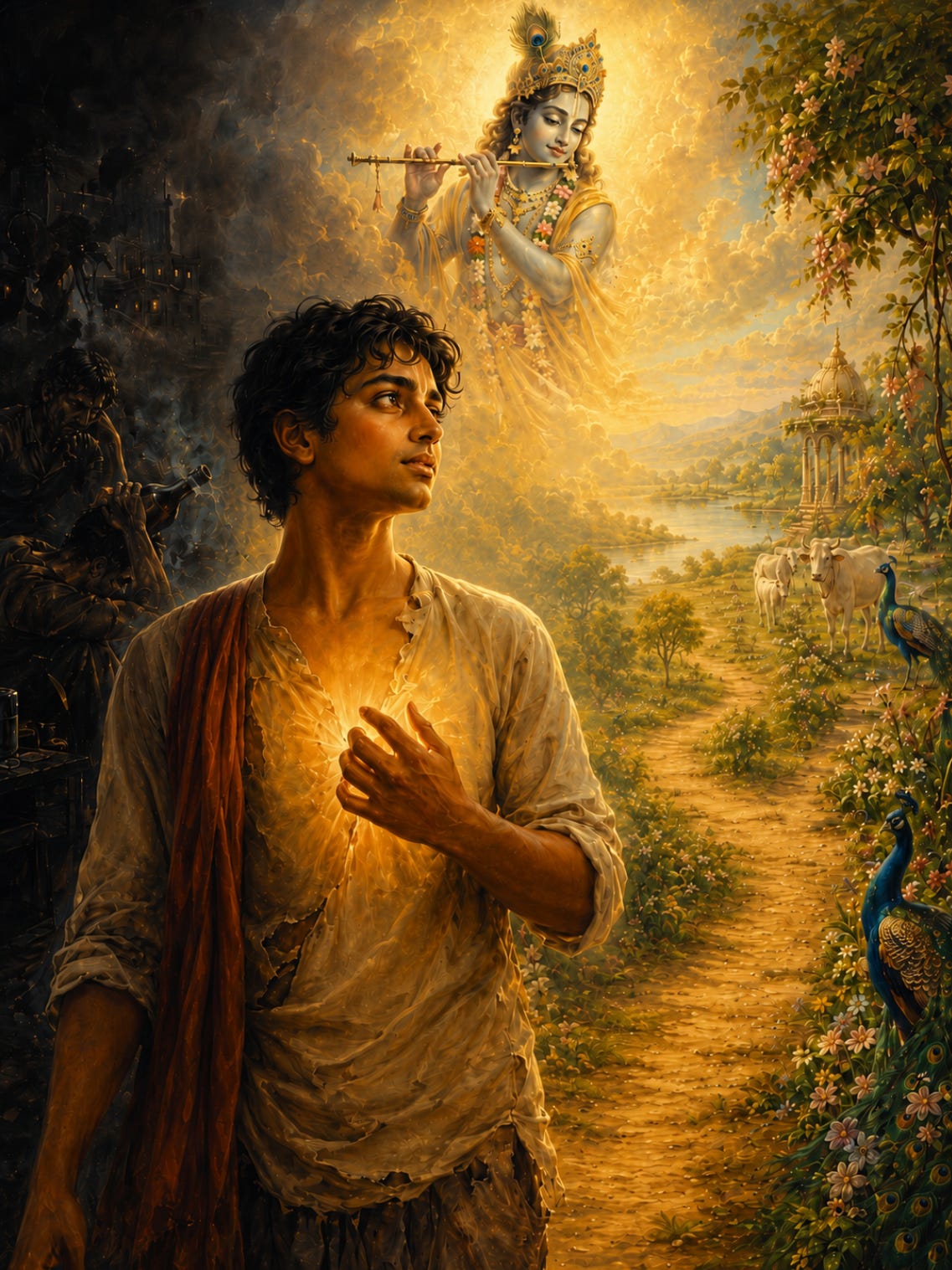
We can practically observe that sometimes people who come from quite bad families or negative situations and grow up in degraded environments, where people eat meat, smoke, drink, have promiscuous relationships, etc., become extremely serious in spiritual practice, while others who come from pious families, or even families of devotees, are not so serious. Why is this so? We understand that the current birth is not the first, that we are born in a certain situation according to our previous actions and consciousness. Therefore, one who is serious about spiritual practice now is supposed to have been serious in the past, and vice versa. If one was serious in the past, how can we explain a lower birth?
In the Bhagavad-gītā, Kṛṣṇa states that yogis and devotees who fail to complete the spiritual path are born into pious or well-to-do families and thus have an opportunity to continue their spiritual practice. Śrila Prabhupāda, however, comments that this is not a guarantee of success, since birth in a pious family gives one a better opportunity in life, and one can misuse it to just enjoy one’s senses. There is also the danger of one adopting a pious life but doing just the minimum, instead of being serious in the spiritual path.
We can conclude, thus, that our current spiritual direction is influenced by three factors:
a) The level of our previous spiritual practice, which we continue in this life.
b) The environment and education we received in this life.
c) The choices we are making in this life, and how serious we decide to be.
Birth is determined according to a multitude of factors. For example, it is said that devotees who go to live in Vṛndāvana or other holy places and commit serious sins there often take birth as monkeys or pigs in the same places. Why? The point is that they combine some sincerity in the spiritual process with a tendency to degradation. They thus have the opportunity to take an animal birth for one life to act on these lower tendencies, and from there they either go back to Godhead for living in the holy place, or have another opportunity of a human birth.
Similarly, a devotee who combines both tendencies may have the opportunity of taking birth in a degraded situation and act on these lower instincts for some time, coming to understand the shortcomings of this kind of lifestyle, and later come in contact with devotees and restart his or her spiritual practice. This is always a danger, because a life of meat-eating, intoxication, and promiscuous sex creates many impressions in the mind that are difficult to overcome, but we create it ourselves as the result of previous choices. We cannot change what was done in the past, but we can decide which path we want for the future. If we are serious now, we will not have to face the same situation again in the future.
Nārada Muni himself describes in the Śrīmad-Bhāgavatam that in his previous life he was the son of a maidservant, growing in poverty and without a father or an education. However, he had the opportunity of associating with pure devotees, and taking it seriously, he became liberated at the end of that life. This is one of the best examples of how association and determination can outweigh birth.
On the other hand, a good birth is capital, not realization. It means one did something good in the past, but it, again, brings a choice. One can choose to go in the current direction of piety, or look around and decide to imitate others in drinking, smoking, etc. It is just like taking birth in a rich family may determine how large one’s inheritance will be, but if one is not wise in using the money, one may just squander it and end up in poverty.
Yet another point is that nowadays the distinction between “degraded” and “favorable” families is not always clear-cut, because almost all families are degraded in one way or another. Even families of devotees are not always the best environment, because people bring bad habits from their previous backgrounds. The practical example of the parents is usually much more influential than their instructions. Families of devotees where the parents don’t have good personal habits or act in hypocritical ways, and especially families where the children are neglected or mistreated, can have a very negative influence over them. It is not uncommon to see devotees have quite toxic relationships with their spouses, immature attitudes toward family life, irresponsibility, etc., and this all affects the choice of the soul who takes birth there. The birth in such a family may end up being a worse position than birth in an ordinary family, and knowing this, Kṛṣṇa may send a soul accordingly. There is a difference between “devotee” in the sense of someone who genuinely develops the qualities of a Vaiṣnava and “devotee” in the sense of a religious designation.
Nowadays, often, a “good birth” is simply a place where we can have normal, affectionate parents and not suffer from serious trauma and neglect as we grow up, creating the foundation for later coming into contact with Kṛṣṇa consciousness and resuming our spiritual practice without serious hurdles.
We can observe that most of the early disciples of Śrīla Prabhupāda, who assisted him in his movement where born in middle-class families, who, although degraded in the sense of meat-eating and other regular bad habits, gave them basic emotional foundations and a good education by material standards, facilities that they used later in their service.
My personal understanding was that there was a particular time when Kṛṣṇa sent many great souls to ordinary (or maybe not so ordinary) families in the West so they could act as sleeping agents to quick-start our movement. They took their births and lived seemingly degraded lives until they met Śrila Prabhupāda and resumed their previous spiritual practice. It’s well known that Śrila Prabhupāda once commented that a number of his early disciples were brāhmanas, who were sent by his Guru Maharaja to assist him in spreading his mission.
In general, following what Kṛṣṇa mentions in the Gītā, there are usually three possibilities: One can take birth in a degraded family, one can take birth in a well-to-do or pious family (or in a family of neophyte devotees), or one can take birth in a family of pure devotees. From the three, birth in a degraded family is usually the one that offers more impediments and more risks, because trauma, abuse, addiction, etc., leave marks that can be difficult to overcome. One may not receive an education and thus have difficulty in understanding the philosophy of Kṛṣṇa consciousness, one may live in a financial situation too desperate to have the peace of mind to practice the spiritual process, and so on.
Birth in a pious family offers better possibilities. Surely, there is the risk of one becoming complacent and misusing the opportunity, but one who is serious, however, will have far fewer difficulties in progressing. Birth in a well-to-do family also removes part of the struggle, since one will at least have a stable financial situation, and thus fewer obstacles to start practicing later.
Finally, there is the possibility of taking birth in a family of pure devotees, and this is obviously the best opportunity. As Śrila Prabhupāda wrote (Bg 6.42): “By the grace of the Lord, there are still families that foster transcendentalists generation after generation. It is certainly very fortunate to take birth in such families. Fortunately, both our spiritual master, Om Visnupada Śrī Srimad Bhaktisiddhanta Sarasvati Gosvami Maharaja, and our humble self, had the opportunity to take birth in such families, by the grace of the Lord, and both of us were trained in the devotional service of the Lord from the very beginning of our lives. Later on we met by the order of the transcendental system.”
The point is that we always have free will. Kṛṣṇa always tries to help everyone to progress in the spiritual path (even ordinary people receive the opportunity of meeting devotees now and then; what to say about souls who have been practicing spiritual life in their previous lives), but still, it’s up to us to take the opportunity or not and accept the consequences of our choices. Kṛṣṇa does his part in giving us opportunities and trying to inspire us from inside the heart, but it’s up to us to decide where we want to go.
Every day we have the choice of living in Kṛṣṇa Consciousness or in material consciousness. Over time, the choices compound, and by the end of our lives, the resulting consciousness will carry us to our next body, where we will have to face the final result of our choices. We are already in the last of the four ages. If we don’t become serious now, we may end up not going to a good place, regardless of our current birth.
Read more:

You can also donate using Buy Me a Coffee, PayPal, Wise, Revolut, or bank transfers. There is a separate page with all the links. This helps me enormously to have time to write instead of doing other things to make a living. Thanks!