

Subscribe to receive new articles by e-mail. It’s free, but if you like, you can pledge a donation:
A crucial point when we study the model of the universe given in the Vedas is the distances. All the measurements of the universe given in the Puranas are based on a unit called yojana. This is a measure of distance based on the characteristics of the human body, much like the inches and feet used in the imperial system.
One definition is that a yojana equals 8,000 times the height of a man. Another is that it equals 32,000 sets of 24 finger widths. Yet another definition states that a yojana equals four times the maximum distance a healthy man can shout and still be heard. That’s one of the reasons the length of the yojana varies through different sources, sometimes as 5 miles, 8 miles, etc.
Even different scriptures use different values for the yojana. The Surya Siddhanta uses a yojana of slightly less than 5 miles, while the Śrimad Bhagavatam uses a yojana of 8 miles, for example. In his commentary, Śrīla Viśvanātha Cakravartī Ṭhākura warns that being attentive to the measure of the yojana is key to reconciling many apparent contradictions in the scriptures.
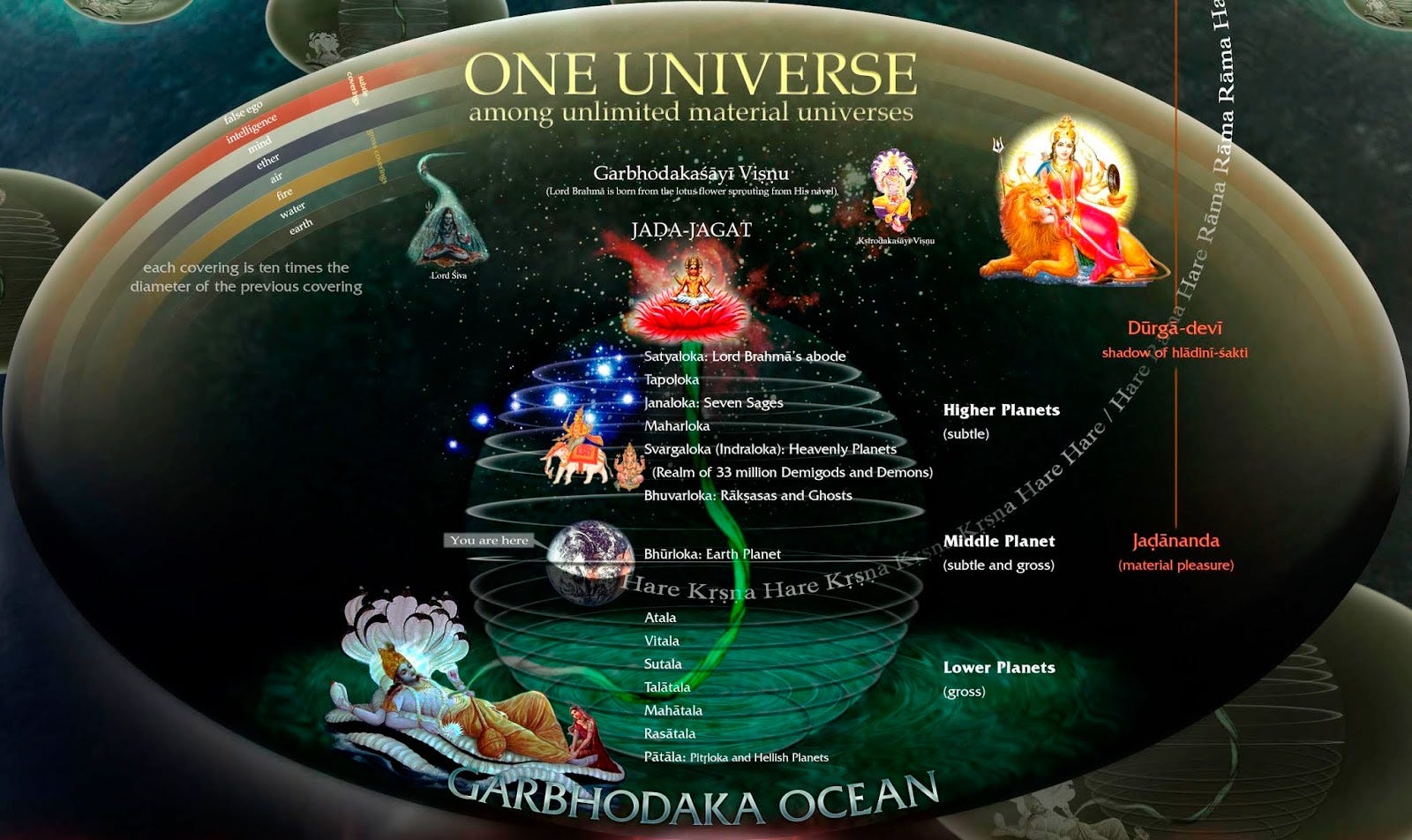
The difficulty with the Vedic model is that when the distances described in the Śrīmad Bhāgavatam are taken literally, the universe appears to be described as very small, with just 4 billion miles in diameter. When we take out the vast areas of Aloka-varṣa, the Golden land, and the Garbhodaka Ocean, which are uninhabited, the inhabited universe becomes even smaller, with just 656 million miles (two times 41,100,000 yojanas, the diameter of the inner border of the golden land) and about two billion miles in height (from Bhū-mandala to the upper covering). It is very difficult to imagine that everything we see in the sky could fit in such a small space.
To have an idea, taking the relative distances of the stars of our Galaxy, a universe of just four billion miles would result in each star having just a few dozen meters in diameter! If we fit what is believed to be the observable universe (with all the galaxies), then the size of each star would fall into the scale of microns!
Taking the idea of 4 billion miles literally, the only logical conclusion would be to take just our solar system as the Vedic universe and, from there, conclude that other solar systems are separate universes. This, however, results in many contradictions that just grow as we try to reconcile with different passages from the scriptures.
There is, however, another possible interpretation that perhaps makes more sense.
The Vedas describe that other species that live in our universe (like the celestial humans living in the other varṣas of Bhū-mandala, as well as demigods and great sages living in the upper planetary systems) have different physical characteristics. They are much larger than us, and can travel for much greater distances, apart from having different mystical perfections that allow them to perform feats impossible to us. 8,000 times their height, 32,000 sets of 24 of finger widths, or four times the maximum distance they can be heard would surely mean much more than it does in our case.
It is thus not completely implausible to believe that the effective scale of a yojana may correspond to different dimensional metrics in different planes. In other words, what is a yojana for us may be perceived differently by inhabitants of different planets, and, conversely, what is a yojana for them, in their abodes, may be very different from what it is for us.
How does it work?
Imagine a yogi traveling through the cosmos using the mystical process prescribed in the Vedas. Being an inhabitant of Satya-yuga, he starts from the higher-dimensional reality of Bhū-mandala that we study in the pages of Śrīmad Bhāgavatam (which is already much more refined than our gross reality). It is described that from this level, he has to traverse a vertical distance of 100,000 yojanas to reach Svargaloka, traveling using the rays of the sun, first reaching the sun itself, and from there reaching the desired planet in the celestial planetary system.
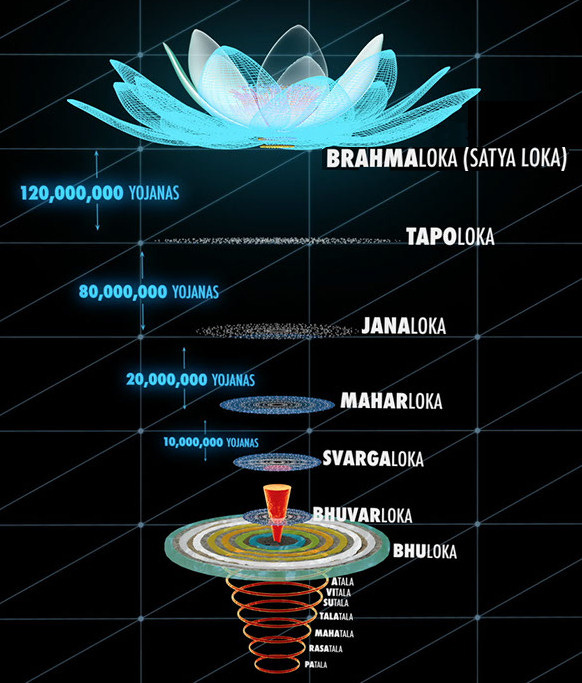
By the time he reaches there, he is free from all sinful reactions and has acquired a much more elevated state of consciousness, which makes him qualified to assume a celestial body that is larger, subtler, and much more powerful than the body he had while living in Bhū-mandala. Now, his perception of distance becomes different. What is now a yojana for him is much more than what is a yojana for the inhabitants of Bhū-mandala, and even more than what it is for us.
Now, imagine that he again sits in meditation, this time aiming to reach Maharloka, the next planetary system, which is 10,000,000 yojanas above, by what is now his measure. This time, he travels a distance that is inconceivable to an inhabitant of Bhū-mandala, and even more for us. For this trip, he elevates his consciousness even further, which leads him to acquire an even subtler and more powerful body. Now, the yojana, by his measure, is even larger, incalculable to us.
Now, imagine he continues traveling upwards, traveling the 20,000,000 yojanas (from his measure) to Janaloka, and then the 80,000,000 yojanas to Tapoloka, then the 120,000,000 yojanas to Satyaloka, then the 5,000,000,000 yojanas of the first covering, the 50,000,000,000 yojanas of the second covering, etc. How many miles is it for us?
If we see from this perspective, the universe described in the Vedas is even larger than what is believed in modern science, incalculable from our perspective. The only way to travel through it and reach the spiritual side is thus by following the process of purification described in the scriptures and not by building a spaceship. This is precisely the point made in the Śrīmad Bhāgavatam.
The main point is that although we are limited by such distances, higher beings are not. Inhabitants of Satyaloka can thus easily reach all regions of the cosmos, while we can travel only around our planet, or close by.
Therefore, when we study the model of the universe described in the Śrīmad Bhāgavatam, it makes more sense to try to understand it as a map of different levels of consciousness, a description of how each level is progressively harder to attain than the previous, and the process to achieve it, rather than a literal description of distances measured in earthly inches or meters.
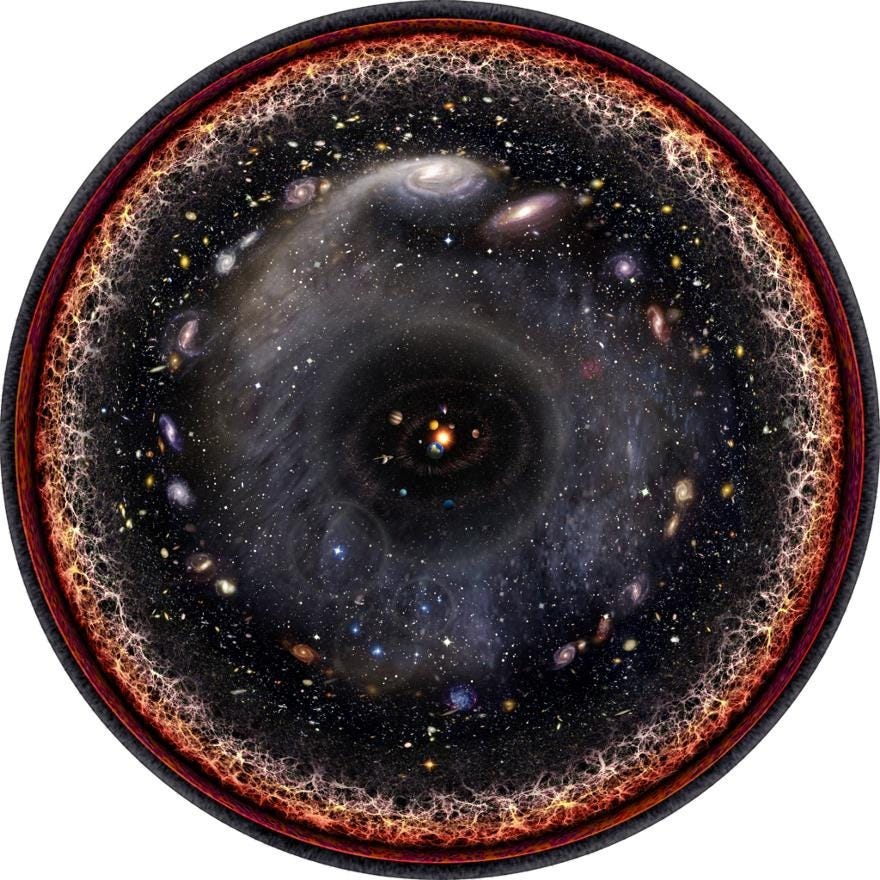
There is another illustration that may help to understand this concept:
What is it?
This image is an artistic representation of the modern understanding of the observable universe, with our solar system in the middle and the rest of the structures of our Milky Way galaxy, as well as other galaxies positioned around it, with the distances increasing at a logarithmic scale. This means that everything becomes exponentially smaller as we move away from the center of the image. In this way, we have our solar system in the center, surrounded by the other stars of the Milky Way galaxy and by other galaxies.
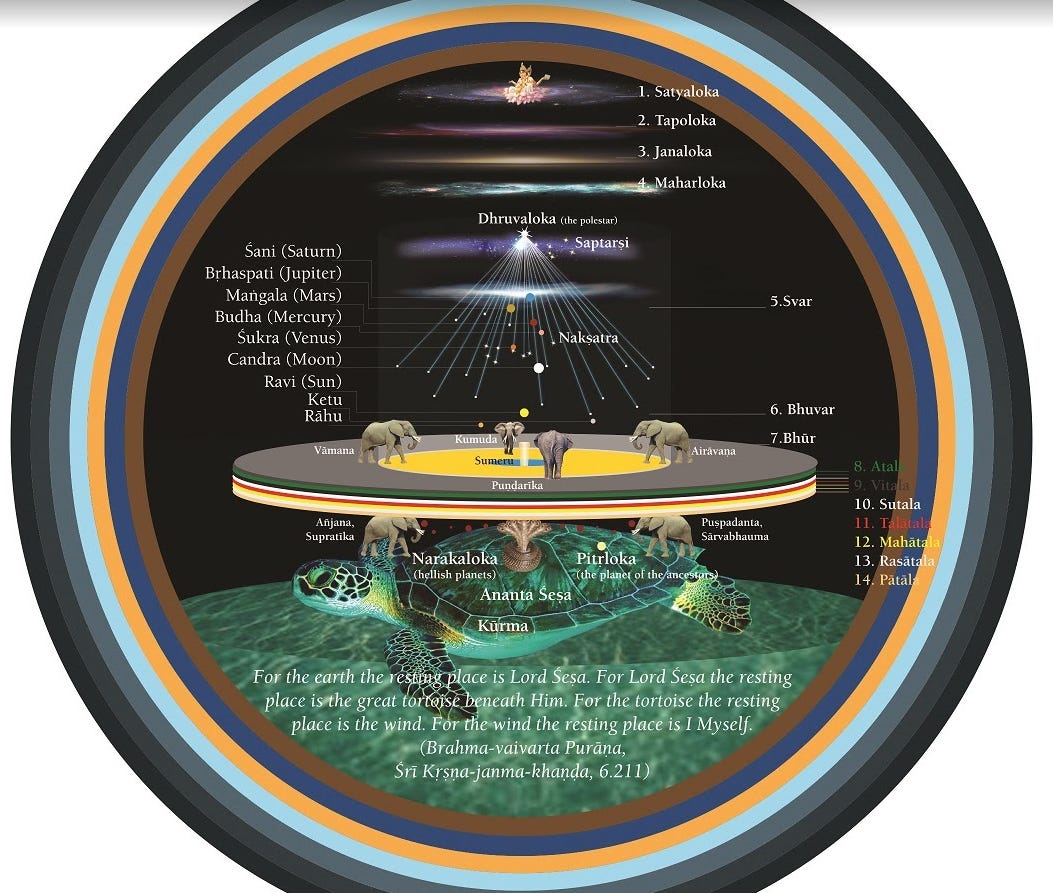
We can notice that it’s actually very similar to artistic representations of the Vedic Universe, where the seven coverings are also depicted on a logarithmic scale. In reality, each one of the coverings is 10 times the circumference of the previous, with the first covering being 10 times the circumference of the Universe itself. However, to keep things in a manageable size, these illustrations depict a big Universe and narrow coverings around it, similar to the previous illustration. When we see from this perspective, these two views of the Universe are actually not so different:
These are just a few points that I hope may serve as food for thought.
You can also donate using Buy Me a Coffee, PayPal, Wise, Revolut, or bank transfers. There is a separate page with all the links. This helps me enormously to have time to write instead of doing other things to make a living. Thanks! You can also receive the updates on Telegram.