

Subscribe to receive new articles by e-mail. It’s free, but if you like, you can pledge a donation:
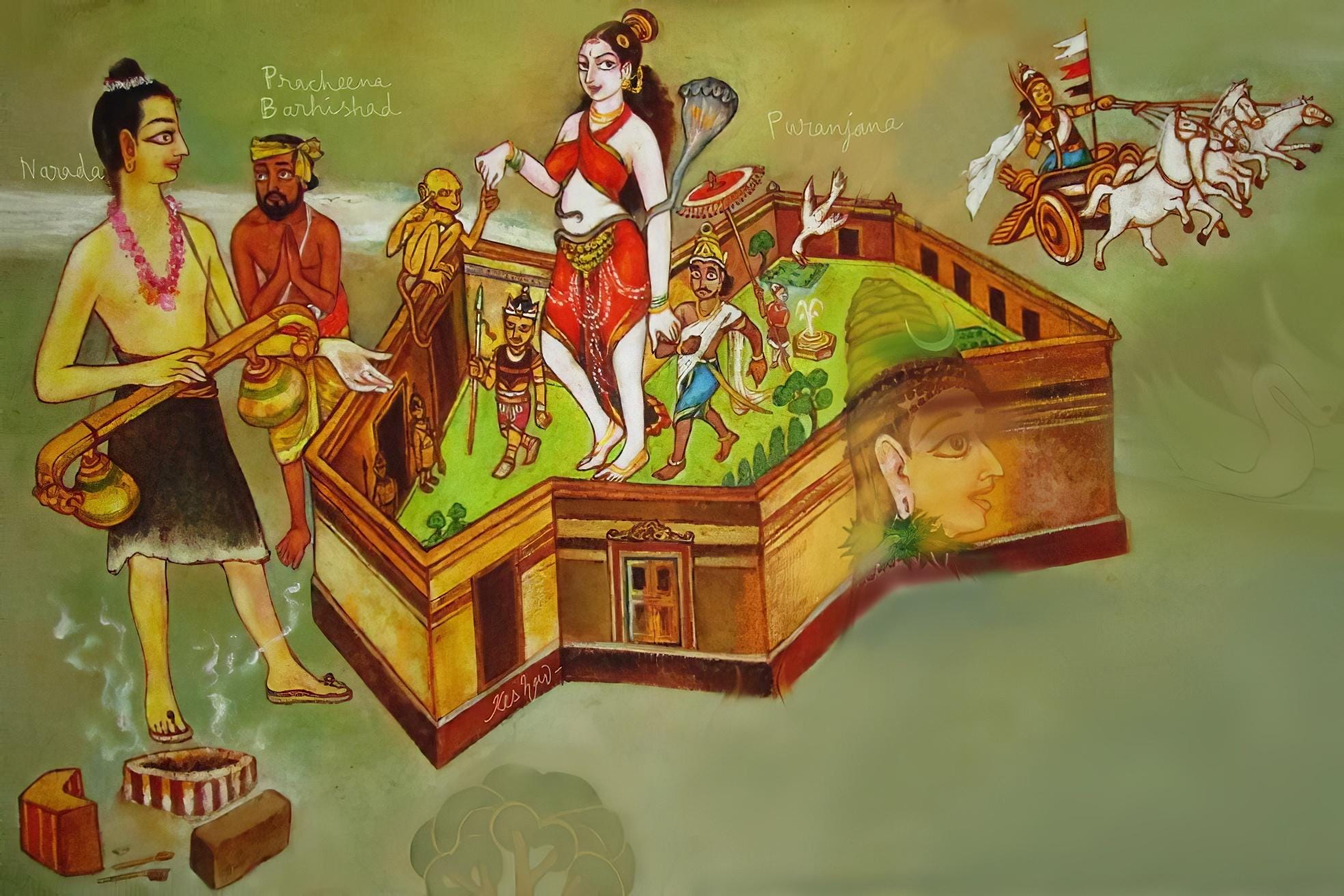
The allegory of King Purañjana occupies several chapters of the 4th canto of Śrīmad Bhāgavatam. The allegory is quite detailed, describing how the soul enters the body, identifies with the material intelligence, and performs activities under the control of the senses. Exactly because it has so many details, it is easy to get lost in the meaning.
We can see that King Prācīnabarhi becomes confused by the explanation and asks Nārada Muni to clarify it. That’s a situation similar to the second chapter of the Bhagavad-gītā, where Arjuna becomes confused by the meaning of the verses.
What does the allegory mean after all? Here are the main points:
a) Purañjana is the living entity who transmigrates through different types of bodies according to the results of his previous activities. He is always together with a friend called Avijñāta (the unknown). This is the Supreme Lord, as Paramātmā, who remains invisible for the conditioned soul, although present in everyone’s heart. The Lord remains present inside the subtle body, together with the soul, accompanying each of us from one body to the other.
b) Out of the many types of bodies available in the material creation, the soul prefers bodies with a human form (human or demigod), because this type of body offers better facilities. Animal bodies offer different types of facilities for sense gratification (some animals have a developed sense of smell, others have good vision, etc.), but in the human form one can enjoy using all senses. The trap is that if one uses the human form to just enjoy one’s senses, one falls back to the animal forms. The more we desire a degraded life, the more we fall into lower forms of life.
c) When Purañjana enters the city, he meets with a mysterious woman. This woman in the allegory is the material intelligence, which makes one identify with the material body, accepting the consciousness of “I” and “mine” and enjoying through one’s senses. When the intelligence becomes purified by the practice of Krsna Consciousness, it is called buddhi-yoga (or bhakti-yoga) and operates in a different way, dovetailing our actions with the desires of Krsna. The acceptance of material intelligence is the cause of our conditioning, but by the process of ceto-darpaṇa-mārjanam, our original, spiritual intelligence is awakened. We then understand that everything belongs to Krsna and should be used in His service.
d) The ten male servants of the woman are the five working senses and the five senses for acquiring knowledge. The many girlfriends of each are the different objects of the senses, and the five-hooded serpent represents the five vital airs that maintain the body. The mind is counted as Viṣūcīna, the 11th servant, who controls the others, just as a minister. If it is not carefully controlled, it can misuse its influence and misdirect us.
e) The body has nine gates: eyes, nostrils, ears, mouth, genital, and rectum, which allow us to enjoy the objects of the senses. When we are not awakened to our original spiritual position, we are misled by the mind to become absorbed in these sense objects, just as other conditioned souls.
f) In the allegory, the two eyes are called Khadyotā and Āvirmukhī; using them, we go to the town of Vibhrājita, or form. The two nostrils are called Nalinī and Nālinī; together with Avadhūta (smell), we go to the town called Saurabha (aroma). The mouth is called Mukhyā, and it has two faculties (speech and taste), described in the allegory as Vipaṇa and Rasajña. Using these two faculties, we visit the towns of Āpaṇa and Bahūdana, which correspond to social dealings and eating.
g) The right ear is called Pitṛhū, and through this ear we visit the town of Dakṣiṇa-pañcāla, which represents the Vedic process of karma-kanda, for fruitive activities and sense enjoyment. The left ear is called Devahū, and through this gate we visit the city of Uttara-pañcāla, which represents the scriptures that explain spiritual knowledge. By these two processes, one may be elevated to the celestial planets or go back to Godhead.
h) The genital is described as the Āsurī gate, and through it we go to the town of Grāmaka (sex life). The genital is called Āsurī because it is very much appreciated by the asuras, foolish men. Sex life has its proper use, but when used just for sense gratification, it causes degradation. In the allegory, it is said that Purañjana went to a place called Vaiśasa through the gate Nirṛti (the rectum). This means he went to hell because of his sins. When a sinful soul is pulled out of the body by the Yamadūtas, it leaves the body through the rectum, which is a very painful process.
i) The blind associates Purañjana spent most of his time with are the hands and legs. This means he spent most of his time going here and there and performing material activities, instead of hearing about self-realization.
j) Sometimes, Purañjana would go to Antaḥ-pura, the heart (the center of emotions), and stay with Viṣūcīna, the mind. The mind goes everywhere, and accompanying it, Purañjana would sometimes enjoy illusion, sometimes satisfaction, and sometimes jubilation, under the influence of the three material modes.
k) In the conditioned state, the jīva acts according to the material intelligence. The soul itself performs no material action, remaining an observer, but at the same time is forced to follow the plans of the intelligence, the movements of the mind, and the actions of the senses due to material identification.
l) The chariot, in which Purañjana goes to perform sinful activities, is the material body, pulled by the horses of the senses, and moving on the two wheels of pious and sinful activities. The three material modes are the flag, the mind is the rope, etc. The horses run without obstruction, enjoying matter, but they make no progress, since all this material enjoyment does not result in any tangible gain. This continues perpetually, until we finally come to the process of devotional service to the Lord. Real progress means to become free from material contamination.
m) Purañjana spent his time involved in sense gratification, and thus wasted his life. Gradually, his city was attacked by the soldiers of Caṇḍavega (time), and eventually by Kālakanyā (old age), who was accepted as the sister of Yavana-rāja (death). At the final stage, the city was torched by Prajvāra (the fever that precedes death). However, devotees who are engaged in Krsna Consciousness are not defeated by old-age. On the opposite, they conquer death.
You can also donate using Buy Me a Coffee, PayPal, Wise, Revolut, or bank transfers. There is a separate page with all the links. This helps me enormously to have time to write instead of doing other things to make a living. Thanks!