


You can receive new articles directly in your inbox. Subscription is free; donations are welcome.
There is a video that appeared in my feed today that I believe summarizes everything that is wrong about the discussion of the “Fall of the jīva” and causes so much animosity among devotees. The video is technically well produced and attractive, but there are a number of problems with the philosophical aspect. You can watch it first, and then we can discuss it point by point:
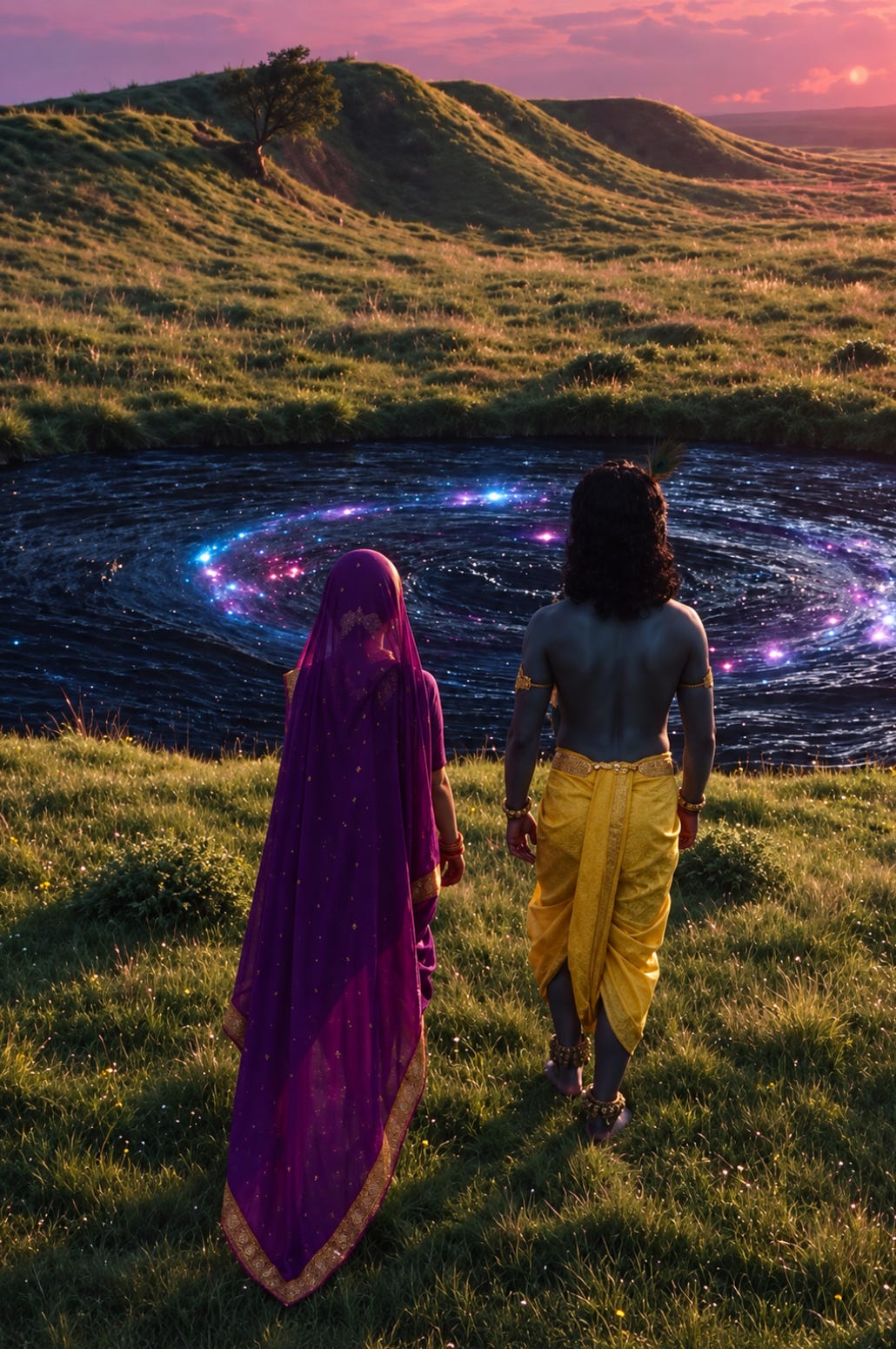
The video starts with Kṛṣṇa dancing with the Gopīs somewhere in Goloka Vrndāvana. This brings us to a very high level of spiritual rāsa. Kṛṣṇa dancing with the Gopīs is a reference to the rāsa dance, the ultimate expression of spiritual love. The scene shows souls who have achieved the highest level of love of Godhead and now relate to Kṛṣṇa in the most intimate way. It is not a joke. We can see in the talks of Lord Caitanya and Ramananda Raya how high it is.
Here the problems start. Kṛṣṇa looks to the side and sees one of the gopis a little farther away, engaged in her own thoughts. This is the first impossibility depicted in the video. The gopīs love Kṛṣṇa more than themselves; their love is so incomprehensibly enormous that they cannot think of anything separate from Kṛṣṇa. Imagine a woman with a very small baby. Multiply her concern and attention by an unlimited number, and you may start to have an idea.
The Gopī then reveals her thoughts: “Why are you the center, Kṛṣṇa? Why not me?” That’s where the problems really start.
The problem with most discussions on this topic is that they start from a very incorrect conclusion. Prabhupada mentioned that “Previously we were with Kṛṣṇa in His lila, or sport,” and many jump to the conclusion that we were originally Gopīs that somehow or other fell from Goloka. Many then see the need to answer this absurd proposition, and go to the diametrically opposite, quoting Prabhupāda saying that “No one falls from Vaikunta,” and therefore that we must have never been with Kṛṣṇa. They conclude then that we were never with Kṛṣṇa, that we are, somehow, a product of this material world and have never been outside. We have then one misconception against the other.
The video then depicts Kṛṣṇa showing the gopi the material world, and she deciding to go there just to take a look. The next scene shows her in an office, as a conditioned soul. The question is, is this what Prabhupāda was speaking about?
Were we all gopīs?
In the Gītā, Kṛṣṇa insists:
“After attaining Me, the great souls, who are yogīs in devotion, never return to this temporary world, which is full of miseries, because they have attained the highest perfection.”
There are many other passages that explain that attaining a personal relationship with Kṛṣṇa in one of the spiritual planets is fundamentally different from elevation to the celestial planets, or even the impersonal brahmajyoti. A soul falls from the celestial planets when his pious karma ends, and falls from the impersonal bramajyoti due to the lack of spiritual engagement. However, none of these conditions are present in the spiritual planets. There is no force there that can push a soul away, and there is no way Māyā can extend her hands there to drag down some screaming jīvas. The idea that we were all Gopīs and fell is completely absurd.
Prabhupāda said that “Previously we were with Kṛṣṇa in His lila, or sport,” but we jump the gun in concluding we were all Gopīs. This shows a profound misunderstanding of what a Gopī is.
If no one falls from Vaikuṇṭha, how could we have been with Kṛṣṇa?
Prabhupāda emphasizes the point of the eternal associates of the Lord not falling in his purport on the Third Canto, dealing with the “fall” of Jaya and Vijaya. He concludes that ultimately they didn’t fall, because they remained connected with the Lord even after taking birth as demons. Their pastime is thus not associates falling, but a reminder that the personal associates of the Lord cannot ever forget Him. Later, in ŚB 7.1.35, he concludes: “Otherwise it is a fact that no one falls from Vaikuṇṭha” (ŚB 7.1.35, purport). Their “fall” happened because of the Lord’s arrangement, not because they were conquered by Māyā.
Yet, Prabhupāda also writes, “We never had any occasion when we were separated from Krsna,” and compares our apparent separation to a dream. We can go to many places in a dream and perform so many activities, but ultimately, we never leave our bed. This calls our attention to a difference between the constitutional position of the soul, always with Kṛṣṇa, and the apparent, conditioned position.
Both statements must be taken seriously. The spiritual world is not a place where perfected devotees become envious and are expelled. At the same time, however, current illusion does not invalidate our eternal relationship with Kṛṣṇa. Both aspects are there.
Without reconciling these two points, the discussion degenerates into a geographical speculation: maybe we didn’t fall from Goloka, but from Vaikunta, which is equally absurd.
The real question is thus not from which geographical place in the spiritual sky we fell. The question is what exactly does separation from Kṛṣṇa mean when the soul is eternally His?
Does anādi mean we were never with Kṛṣṇa?
The conditioning of the soul is described in the scriptures as anādi, beginningless. Does it mean we were never with Kṛṣṇa? No, it just means we cannot put a date on it. That’s why Prabhupāda translates anādi as “since time immemorial.”
Our mistake here is to imagine it as a timeline: The jīva starts in Goloka, and then at some point travels to the material world. We can see that’s precisely what the video shows, and it is fundamentally wrong.
Material time cannot serve as a clock for the transcendental reality; it has no effect in the spiritual world, where everything is eternal and without change. Material conditioning has no first instant within material time. It cannot be reconstructed as an historical event. Here we reach the limits of our conditioned reasoning. From the material side, it appears that the soul is always here, and from the material side it appears the soul never left.
What exactly becomes conditioned?
This is a more relevant question, and that’s something we find an explanation for. In the teachings of Lord Kapila (SB 3.27), we find the explanation of how Kṛṣṇa enters the material creation without getting in contact with it. He explains with a simple example: the light of the sun enters a dark room through an opening and is reflected in a recipient of water and then again on the walls. Then, he immediately adds that the soul is similarly reflected in the false ego, body, and mind. In this way, the soul becomes present in the body without leaving his eternal spiritual nature, just as the Lord becomes present in the material cosmos without contacting the material energy.
Just as the sun does not enter the water, the soul does not become a material particle that moves here and there. The material nature provides the gross and subtle body, and the false ego makes the soul identify with it. As Kṛṣṇa mentions in the Gitā, the material nature performs the activities, and the bewildered soul imagines to be the doer.
It is not that there are two souls, one in Goloka and another on earth; that’s another mistaken idea. There is one eternal soul, whose identity remains spiritual but who experiences material existence through this reflection of consciousness in the body, mind and ego. “Fall” thus refers primarily to a mistaken identity or consciousness. Thus, when the consciousness is corrected, or, in other words, when we revive our Kṛṣṇa consciousness, we become immediately liberated. There is no need to become something else.
This is an essential point to understand, because it allows us to understand what material bondage is without falling into the mistake of trying to put it into a timeline.
Are conditioned souls products of the material world?
Some interpret “anādi” in the sense that we are somehow a product of this material world and were never outside of it. That’s another gross misconception. The soul is not matter; we come from outside.
Some descriptions connect the soul with Mahā-Viṣnu and the causal ocean, the frontier of the material creation. This is correct, but it does not mean this is the constitutional position of the soul.
Everyone has to pass through passport control to enter a country, but this does not mean they are born at the border. One can tell the story of a tourist visiting a country starting from his crossing the border, but this does not mean there was nothing before that, or that the border is his origin. We were all in the causal ocean before joining the material creation. This is, however, already a fallen position, just like the impersonal brahmajyoti.
Is love of Kṛṣṇa something we acquire, or something we awaken?
Mahāprabhu teaches:
nitya-siddha kṛṣṇa-prema ‘sādhya’ kabhu naya
śravaṇādi-śuddha-citte karaye udaya“Pure love for Kṛṣṇa is eternally established in the hearts of the living entities. It is not something to be gained from another source. When the heart is purified by hearing and chanting, this love naturally awakens.”
He does not say that our original spiritual identity is manufactured by practice. Love for Kṛṣṇa is eternally established; it is the very essence of the soul.
There is, however, another side to it: the eternal present of prema does not automatically imply that every jīva has it manifested to the highest level of mādhurya-rasa.
Things that are spiritual are eternally existing, and they never change. There is, however, a third characteristic: it grows.
When Kṛṣṇa sees the Gopīs, He becomes more beautiful, and in seeing Kṛṣṇa, the Gopīs become even more beautiful, and in seeing them, Kṛṣṇa becomes even more beautiful, and thus there is an eternal competition without limit.
Our love for Kṛṣṇa is eternally existing, and it never changes, but it is eternally increasing. Our eternal relationship is real; but it doesn’t mean it is fully awakened. Indeed, the awakening of this eternal relationship is the very goal of the process of devotional service.
A liberated soul never falls again. Does it mean they lose free will?
Kṛṣṇa promises that those who attain Him never return to this miserable material world. This, however, does not mean liberated souls have no free will. How can both be true?
Imagine someone decides to visit Afghanistan, curious to see how people live there. He crosses the border and is captured by some bad people who do terrible things to him, repeatedly. Twenty years later, without teeth and with three fingers less, he somehow escapes and returns to his country. He is a free man, but this doesn’t mean he will want to return. If even a material experience can awaken this kind of decision, what to say about fully awakened love for Kṛṣṇa, combined with perfect knowledge? Freedom does not have to imply eternally repeating the same bad choice.
How does Kṛṣṇa actually call us back?
In the final scene of the video, Kṛṣṇa appears on the window paying His flute to remind her. The scene is again wrong, but the general concept is true: Kṛṣṇa never abandons the conditioned soul. He accompanies each one of us as Paramātmā, giving both forgetfulness and remembrance, according to our desire.
He appears to us in the form of the scriptures and empowers His devotees to instruct us. He manifests personally as the holy names, to awaken our eternal relationship. He is waiting for us; we are the ones who are unwilling. This is very clearly described in the final chapters of the Fourth Canto, when Kṛṣṇa appears to Purañjana in the form of a brāhmana to remind him of their eternal relationship.
The final question
Once we understand our eternal position as souls, the question stops being “How did I fall?” This has no answer; not even Jīva Gosvāmī tries to answer that. Mahāprabhu phrases it perfectly: “Somehow or other.”
The right question is: “Who am I eternally?” or “What is my constitutional nature?”
What is your answer to this question? Are you the body? Maybe the mind or the ego? And if you answer that you are a soul, then what is your constitutional position? Are you a piece of matter or an eternal servant of Kṛṣṇa? Once we get it correctly, the question becomes how to revive this eternal identity, not how I came here.
Prabhupāda himself warned about not becoming trapped in trying to trace the chronology of the “fall.” In his article, “Crow and Tal-Fruit Logic”, he compares this debate with scholars uselessly arguing over whether a falling fruit dropped because of a crow or some other cause. His point is that a sick person should focus on the cure.
We have an entire book on this topic. If you are curious, you can read it to understand all the intricacies of the topic and how Prabhupāda solves it. It can take up to six hours to read it in full, but it is considerably less time you can waste trying to discuss this topic with others without knowing it beforehand. Apart from that, avoiding the wrong conclusion can be priceless.
The “Fall” of the Jīva, as Explained by Śrīla Prabhupāda

Prabhupāda explains that the Śrīmad-Bhāgavatam is the ripened fruit of spiritual knowledge. That’s the book Prabhupāda dedicated most of his literary efforts to, commenting in detail and explaining a…
This is a publication for thoughtful readers who want to go deeper into Kṛṣṇa consciousness. I publish daily, trying to offer high-quality spiritual content, and all posts are available to free subscribers. If you wish, you can support this work with a monthly contribution. When you subscribe, you can choose between a free subscription and a monthly contribution, and you can switch from a free subscriber to a supporter at any time.
You can also receive updates on WhatsApp or Telegram.
If you would like to contribute further, you can find the donation links here.