

Subscribe to receive new articles by e-mail. It’s free, but if you like, you can pledge a donation:
A very beautiful passage in the Śrīmad Bhāgavatam is the prayers of Lord Śiva recorded in the Fourth Canto. This is a long passage, but one especially inspiring segment is the second part, where he speaks about the transcendental form of the Lord. Hearing about the power and opulences of the Lord may help us to develop respect and appreciation for Him, but it is usually not enough to inspire an attitude of service. This comes when we hear about the form and personal qualities and attributes of the Lord. This meditation brings Him closer, and from this we develop an attitude of service to Him.
You can find these prayers in chapter 4.24, starting from text 44. What does Lord Śiva say?
The first point is that karmis see the Lord as their order supplier, jñānīs want to see the Lord in His impersonal form and merge unto Him, while yogis want to see His partial aspect as Paramātmā. Lord Śiva, however, wants to see the Lord in His personal form, just as devotees want to see Him. Amongst all forms of the Lord, the form in which He performs His pastimes with the Gopis is the most perfect.
What is the reason Lord Śiva wants to see the Lord in His personal form? What is the problem with the impersonal brahmajyoti or the localized form of Paramātmā? The difference is that only the personal form of the Lord inspires an attitude of service. Thus, only attraction to the personal form of the Lord, either as Gopīnātha or as Nārāyaṇa, can awaken us to our original position of devotion and service to the Supreme Lord. All other processes awaken one just partially.
The Lord is known as raso vai saḥ, the source of all rasas, or relishable relationships. The way to become free from the dictations of the mind and material senses is to become attracted to this Supreme Lord and to the blissful relationships that exist in the spiritual world. When we finally attain this transcendental service, all our desires are satisfied, for we attain our original position of bliss. For this, however, we need to become free from the false ego, which manifests in the form of many material designations.
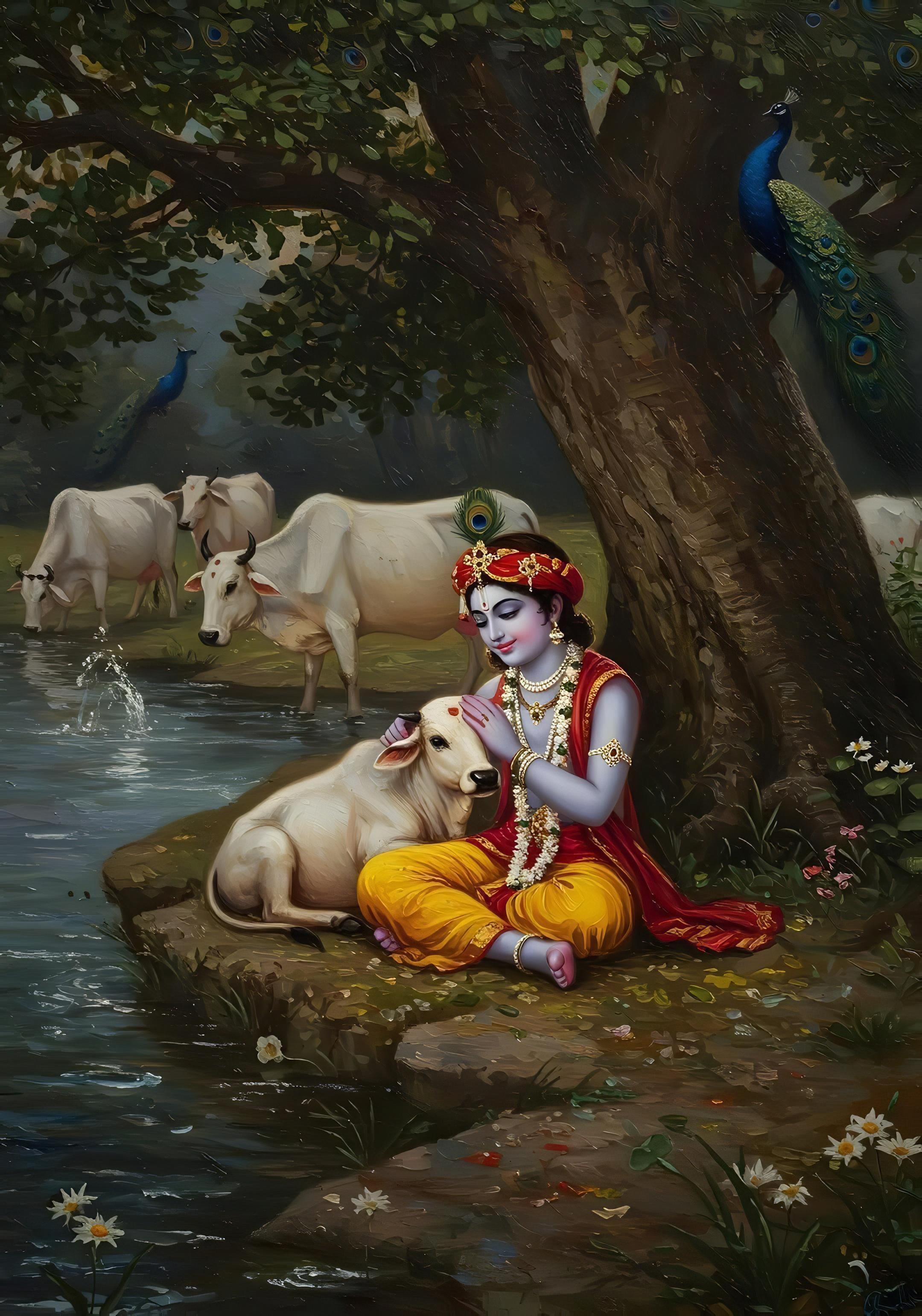
Krsna’s form is extraordinarily beautiful. In fact, He is the sum total of all beauty. The Lord shows this extraordinary beauty in all of His forms, but His original form with two hands is superexcellent.
Why does Lord Śiva pray to see the form of Lord Narāyana instead of directly seeing the form of Krsna? Prabhupāda answers that the worship of the Lord begins with the worship of Nārāyaṇa, whereas the worship of Rādhā and Kṛṣṇa is most confidential. The reason is that Nārāyaṇa is worshipable by the pāñcarātrika-vidhi, the path of regulative principles (vidhi-mārga), whereas Kṛṣṇa is worshipable by the bhāgavata-vidhi, the path of spontaneous attraction (or rāga-mārga). When we hear that, we automatically conclude we should follow the path of spontaneous attraction in order to quickly attain Krsna, but the question is that directly attaining spontaneous devotion is almost impossible, unless one already practiced it in previous lives. The general rule, as Prabhupāda explains, is that no one can worship the Lord in the bhāgavata-vidhi without first going through the regulations of the pāñcarātrika-vidhi. By practicing under rules and regulations, we learn to serve without offenses and gradually become purified. When we become pure, our heart becomes a fertile ground for spontaneous devotion to the Lord to sprout.
The form of Rādhā and Kṛṣṇa includes the form of Laksmi-Narāyana, and therefore we are advised to, in the beginning, worship Laksmi-Narāyana according to the path of rules and regulations, since Rādhā and Kṛṣṇa can’t be approached by neophytes. This means we should continue practicing the path of regulative principles until after the platform of liberation, when we achieve spontaneous devotion to the Lord, otherwise we risk just taking it as something mundane and becoming sahajiyās. In this way, Lord Śiva shows by his personal example that we should not try to approach Rādhā and Kṛṣṇa directly, but instead go through the appropriate process. If even Lord Śiva, who is the greatest Vaiṣnava don’t consider himself qualified, what to say about us?
He then makes a point about the Lord’s divine beauty. Lord Śiva meditates on Lord Viṣnu, with His curly black hair, dressed in yellow silk, a shining helmet and ornaments, and four arms, holding the conchshell, disc, club, and lotus flower. The Lord is smiling mercifully, casting sidelong glances. He wears the Kaustubha jewel on His chest, which, according to Śrīla Jīva Goswami, represents all jīvas, who are thus kept by the Lord close to his heart. This illustrates the intimate relationship all of us have with Him.
The different ornaments the Lord uses, such as His earrings, His shining helmet, bangles, garland, ankle bells, waist belt, etc., don’t cover the beauty of the Lord; rather, they are like a frame that enhances it.
The shoulders of the Lord are compared to a lion’s: powerful, noble, and graceful. The lion is considered the king of the animals and thus represents power and majesty. Because of these unique qualities, the lion is compared to the Lord in many passages. The comparison reminds us that the Lord protects His devotees with unlimited strength. Similarly, the chest of the Lord is compared to a gold-testing stone because of His black complexion marked with the golden hairs of the Śrīvatsa mark, the abode of the Goddess of fortune.
The abdomen of the Lord is marked by three ripples. These are not static marks, but alive, like the curves of a river. This is reinforced by the comparison of His abdomen with the leaf of a banyan tree (dala-udaram). Just as a banyan leaf trembles gently, the abdomen of the Lord dances in beauty. Just like the color of Krsna is always changing and one has difficulty in describing which tone it is exactly, the form of the Lord is also not static like the form of an ordinary person. How could it be different, considering that the Lord is the abode of the whole creation, of all opulences, all mystic powers, all bliss, and so on? It’s impossible to describe His full beauty in words, but by hearing the descriptions of perfect Vaiṣṇavas, we can learn to meditate in the beautiful form of the Lord, and one day we may be able to see Him.
The Lord is described as śyāma, blackish. However, this is not the same as the black we find in the material world. The Lord is like a bluish-black rain cloud, and the bright-yellow of His garments creates a contrast similar to the sunlight behind a thundercloud. Colors in the material world are mainly opaque, but in the spiritual world, all colors are dazzling, effulgent, alive, and incredibly beautiful. In fact, the whole experience of the spiritual world is in stark contrast to the dullness of our material experience.
The legs of the Lord are perfectly proportioned and beautifully shaped (sama-cāru), and his feet, calves, thighs, and knees are described as exquisite and extremely pleasing to see. The yellow dhoti of the Lord leaves his lotus feet and part of his legs exposed, allowing His devotees to have a glance of His beauty. The Lord’s form is described as strong and elegant. His body is well built, radiating strength, beauty, majesty, and sweetness all at once, and His form is fully transcendental, composed of eternity, knowledge, and bliss without any trace of material imperfection.
The feet of the Lord are compared to autumn lotuses (śarat-padma), which bloom in clean water after the muddy season is over. These flowers represent purity and beauty. The lotus feet of the Lord are the shelter of all devotees, and the first place we rest our mind when we meditate on the transcendental form of the Lord.
The whole form of the Lord is effulgent, but the nails of his lotus feet are especially brilliant. The effulgence of these jewel-like nails dissipates the darkness of the heart, extinguishing our conditioned life and bringing us to the platform of devotional service. One does not need the complicated intellectualism of the jñana path: the light of the Lord’s feet is enough to awaken the soul, and the vision of these transcendental feet is available to those who surrender.
These verses also connect the Lord with the spiritual master. The Lord is the supreme spiritual master, and He empowers the bona fide spiritual master to act on His behalf, and thus the two spiritual masters act simultaneously from within and without to pull us out of the mud of this material world. As Prabhupada mentions, “Only by thinking of the lotus feet of the Lord and always taking the spiritual master’s advice can one advance in spiritual life and understand Vedic knowledge.”
You can also donate using Buy Me a Coffee, PayPal, Wise, Revolut, or bank transfers. There is a separate page with all the links. This helps me enormously to have time to write instead of doing other things to make a living. Thanks!