

Subscribe to receive new articles by e-mail. It’s free, but if you like, you can pledge a donation:
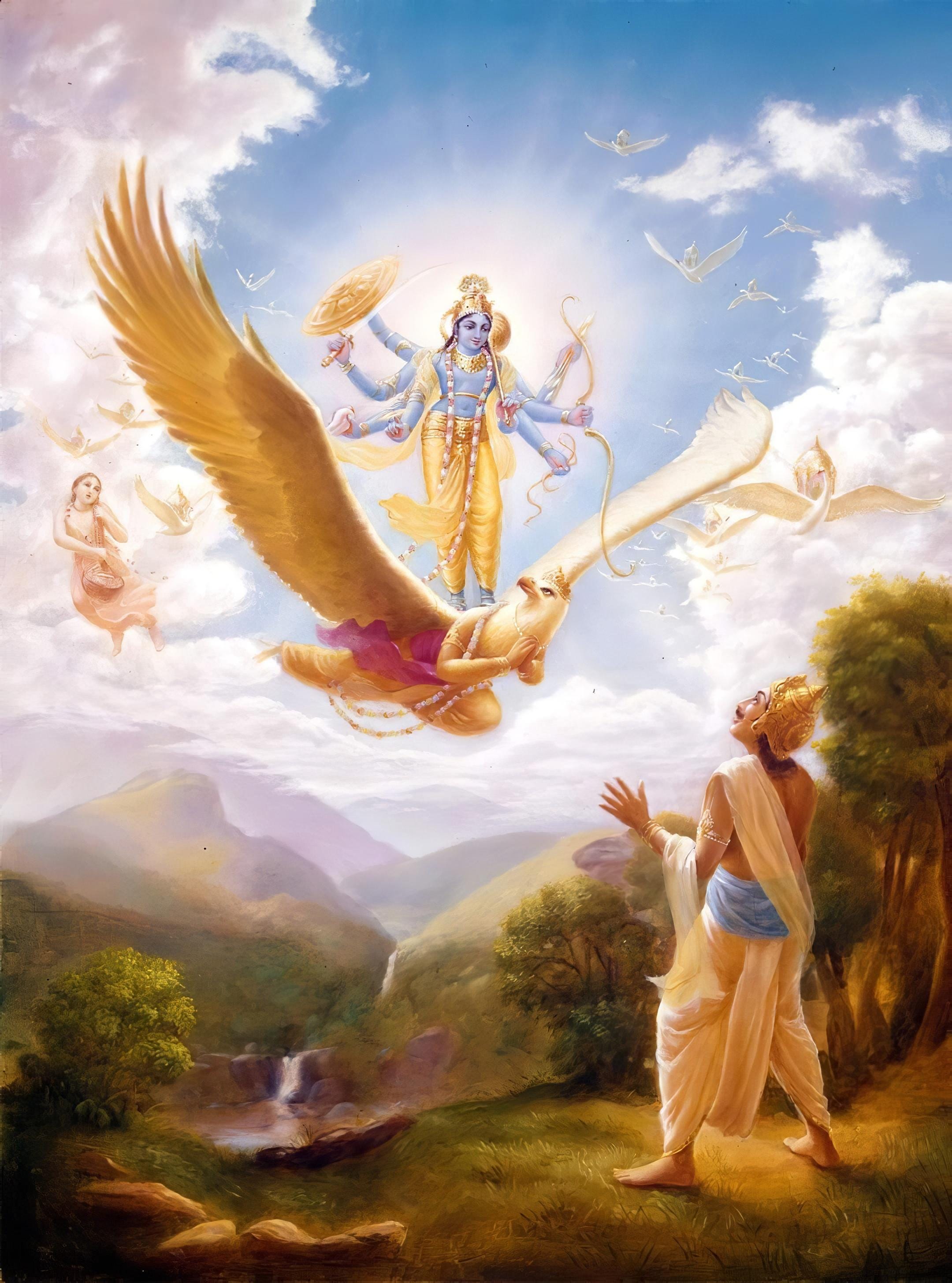
A very significant passage of the Śrīmad Bhāgavatam is the appearance of Lord Viṣnu in the sacrificial arena of Pṛthu Maharaja after the sacrifice had been repeatedly frustrated by Indra. We often associate the mercy of the Lord with success in our spiritual endeavors, but that’s a case where the opposite occurred: Pṛthu Maharaja was unsuccessful in his desire to perform 100 sacrifices, and despite this failure, the Lord appeared to him. Not exactly because he failed, but due to his attitude to this failure.
This emphasizes that the ultimate purpose in all our activities should be to satisfy the Lord, and not to merely obtain a certain material objective. In fruitive performances, as well as in ordinary material activities, an incomplete performance does not yield results. Demigods reward the performers of fruitive sacrifice for correctly executing the rituals, and ordinary business transactions generate profit only after concluded. One may bake a cake, but until it is delivered and paid for, one doesn’t get any money for it. Service to the Lord, however, operates in a different dynamic. The Lord sees not just the effort, but the intention. One can thus advance even without completing an activity. In fact, one can advance even without starting it, as long as his’s intention is positive. Even though not completing his 100 sacrifices, Pṛthu Maharaja satisfied the Lord, and that’s what counts.
Lord Viṣnu desired to give him spiritual instructions, helping him to remain situated in spiritual consciousness and forgive the offenses committed by the king of heaven wholeheartedly. These teachings go from text 4.20.3 to 4.20.16. Here are the main points in the verses and purports, revealing instructions that can be extremely useful in our spiritual practice:
a) A person advanced in consciousness understands that the body is different from the soul, and seeing everyone as part and parcel of the Lord, he is never malicious to others. On the contrary, he is eager to perform activities that will be beneficial. He understands that, in fact, the soul is transcendental and does not do anything, and that all material actions happen under the three modes of material nature. He thus forgives any offense committed by others. Forgiveness is a quality of those who are advancing in spiritual knowledge.
b) Perfect knowledge can be obtained only through the paramparā system, by following the instructions of previous ācāryas. When a person is properly trained in this line, he or she goes beyond the bodily conception of existence and becomes free from the bewilderment caused by the material energy, just like King Pṛthu. If, however, one remains under the influence of the three modes, this proves that his practice is not being effective.
c) This material body is produced from the material nature and is therefore created from ignorance. This ignorance covers the soul and makes us think we are the body and that we should satisfy the desires of the body through material actions. Some try to directly satisfy their senses, thinking this will bring them happiness, while others aim to obtain a higher grade of sense gratification in the celestial planets by performing Vedic rituals. Both are in illusion. Even philanthropic activities performed under the idea of making people happy by improving their political or economic situation are illusory, because no one can be happy in this way. Whatever we desire or perform under the bodily conception of life is illusory and can’t bring us to real happiness. On the opposite, real happiness can be found only in the spiritual platform and starts from understanding that we are not the body.
d) Becoming free from affinity to the material body cuts out all material affinity by the root, destroying the bodily conception of life based on attachment to family life, wealth, etc. This, in turn, eliminates the necessity of performing fruitive sacrifices. In reality, fruitive sacrifices are offered in the Vedas to attract materialists who are mad after sense gratification into following the path of the Vedas. This fruitive understanding is based on the three material modes, and thus called traiguṇya-viṣayā vedāḥ. A person who becomes advanced in spiritual knowledge loses attraction to such materialistic performances and instead becomes attracted to the higher duties connected with his eternal position as servitor of the Supreme Lord. Devotional service is called nistraiguṇya because it is transcendental to the three modes. In other words, the Lord reinforces the previous instruction, arguing that Pṛthu Maharaja should stop his performance of horse sacrifices and instead become fixed in his performance of loving devotional service.
e) Devotional service to the Lord can be ultimately performed only in the spiritual platform, which in turn means to see ourselves in our original position as souls instead of as the body and mind. When we attain this position, we realize the Supersoul, understanding that the Lord resides in all bodies and that we are never separated from Him.
In conditioned life, the soul is covered by material ignorance and sees himself as the cause of material actions. The Lord, however, remains always transcendental, living inside the heart as a neutral witness. When the soul becomes free from material contamination, he becomes transcendental, just like the Lord. The pure soul is described as asaṁsaktaḥ (without attachment) and budhaḥ (fully cognizant of everything). This means that in his original consciousness, the soul is pure and fully conscious of his original position as a servant of the Supreme Lord.
f) What is the practical symptom of a pure soul who attains this realization of the Supersoul? Even though residing in a material body, inside the material creation, he is never affected by the modes of material nature. Instead, he remains always situated in transcendental loving service, practiced without motive for material gain. In the Bhagavad-gītā, the Lord describes the process of karma-yoga, which is the practical process to be gradually elevated to this platform by working without being attached to the results. As we advance in this devotional practice, we gradually become very satisfied within.
g) In the conditioned stage of life, we see everything in terms of duality: pleasant and unpleasant, gain and loss, victory and defeat, etc. However, when the heart is cleansed from this material contamination through the linking process of devotional service, our consciousness becomes broader and our mind transparent, becoming a medium for the manifestation of our original spiritual consciousness, instead of blocking it. Free from material contamination, we see everything equally, without attachment or aversion. At this stage, there is peace, and we become situated in the spiritual platform, becoming sac-cid-ānanda, just like the Lord.
h) The material creation is always moving, and the body is always changing. The soul, however, is described as kūṭa-stham, fixed. In the Gītā, the soul is also defined as acalaḥ, immovable, like a mountain. Throughout all the movements of the material manifestation, the soul remains fixed in his original spiritual position, beyond the movements of the body and mind. The soul is just like the moon reflected in a pot of water. The reflection in the pot moves, following the movements of the water, but the moon is fixed in the sky. Ultimately, the soul simply observes the material manifestation, just like the Lord. The difference is that, due to the influence of Maya, we forget ourselves and identify with the material consciousness, the reflection on the water, while the Lord is always fully aware of His transcendental position. When this mistaken conception is removed, however, we become eligible to be liberated from material bondage.
i) Since the soul is completely different from the combination of gross and subtle material elements that form the material self, a devotee who is firmly connected with the Lord in friendship and affection, being completely in knowledge, is never agitated by material happiness and distress. As Prabhupāda mentions, those who are fully absorbed in devotional service do not care what is going on with the external body. That status is called samādhi.
How is it possible for anyone to be indifferent to the activities of the body? Prabhupāda gives the example of a businessman seated in a car, giving instructions to the driver. Although he understands how the car works and supervises the driver, he is more concerned with his business in the office. Similarly, a devotee remains absorbed in thoughts connected with his devotional service to the Lord. That’s how he can remain separate from the activities of the material body, in a position of neutrality.
j) The Lord concludes his instructions with practical advice for Pṛthu Maharaja in his reign: Be equipoised and treat people equally, even the ones considered lower than him. Not be disturbed by material happiness or distress, understanding both to be temporary, and control his mind and senses, and remain in a transcendental position while at the same time executing his duties as a king, as a service to the Lord.
These are characteristics we can also try to bring into our lives.
You can also donate using Buy Me a Coffee, PayPal, Wise, Revolut, or bank transfers. There is a separate page with all the links. This helps me enormously to have time to write instead of doing other things to make a living. Thanks!