

Subscribe to receive new articles by e-mail. It’s free, but if you like, you can pledge a donation:
Join the Telegram group if you would like to join the live lessons. This course is maintained with your donations. Click here to donate.
💬 Text of the lesson
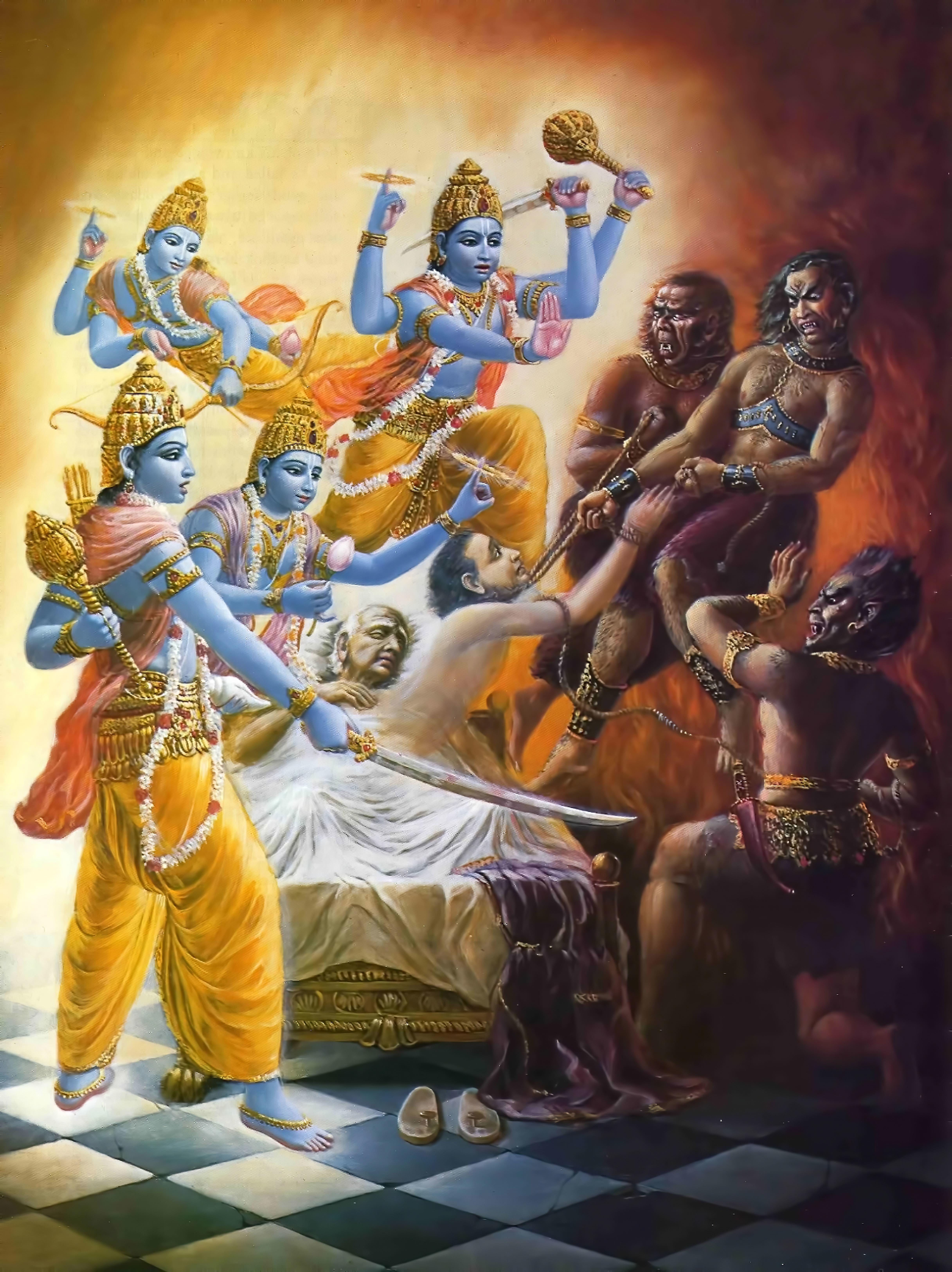
The Viṣṇudutas challenged the Yamadūtas to prove they were indeed representatives of Yamarāja by explaining religious principles. Despite their appearance, the Yamadūtas are versed in general dharmic codes that they study under Yamarāja. Just as a policeman has to know the laws to perform his job, Yamadūtas have to understand dharma to perform their work. We can see that they offered a sound explanation, including the proper conclusion: one has to surrender to Lord Viṣnu to become free from material entanglement.
Despite their understanding, however, the Yamadūtas failed to properly understand the position of Ajāmila. This is because they were ignorant of the potency of the holy names. This is a very confidential teaching inside the scriptures, and is thus overlooked by most of the students of the Vedas. We can see that in the beginning of the Śrīmad-Bhāgavatam, when Parīkṣit decides to fast until death, he enquired about religious principles at the end of life from the many sages present in the assembly, but none of them told him to chant the holy names.
The chanting of the holy names is the foundation for all true processes of self-realization not only in Kali-yuga but for all four ages. Meditation, as practiced in Satya-yuga, has its foundation in the chanting of the Omkāra, the sound incarnation of the Lord, which is non-different from the Hare Kṛṣṇa mahā-mantra. The elaborate Vedic sacrifices performed in Treta-yuga are based on the chanting of Vedic mantras, which is another process of kīrtana, including the names and qualities of the Supreme Lord. Similarly, the temple worship performed in Dvāpara-yuga is based on the chanting of mantras glorifying the Lord. In all four ages, however, people tend to become absorbed in the superficial aspects and forget the essence.
Parīkṣit Mahārāja, however, as an intelligent student, inquired about the highest religious principle, which can save even the most sinful man from hell, and Śukadeva Gosvāmi is now giving the answer.
Ajāmila is proven sinless
After hearing the explanation of the Yamadūtas, the servants of Lord Nārāyaṇa started to reply:
“Alas, how painful it is that irreligion is being introduced into an assembly where religion should be maintained. Indeed, those in charge of maintaining the religious principles are needlessly punishing a sinless, unpunishable person.” (SB 6.2.2)
“Ajāmila has already atoned for all his sinful actions. Indeed, he has atoned not only for sins performed in one life but for those performed in millions of lives, for in a helpless condition he chanted the holy name of Nārāyaṇa. Even though he did not chant purely, he chanted without offense, and therefore he is now pure and eligible for liberation.” (SB 6.2.7)
To the surprise of the Yamadūtas, the Viṣṇudutas reveal the reason for their appearance: they came to protect an innocent person from being unlawfully arrested. According to the religious principles the Yamadūtas themselves stated, only sinful persons who have not undergone atonement can be dragged to hell for punishment. Others, who are sinless, are outside the jurisdiction of Yamarāja. Ajāmila had chanted the name of Lord Nārāyaṇa offenselessly, and therefore all his great stock of sinful reactions was destroyed. What to say about hell, he was now completely purified, and eligible for liberation! As mentioned in the Bṛhad-viṣṇu Purāṇa, quoted by Prabhupāda, “Simply by chanting one holy name of Hari, a sinful man can counteract the reactions to more sins than he is able to commit.” This applies to someone who chants in full concentration, without committing offenses, just as in the case of Ajāmila.
This also explains the forceful way the Viṣṇudutas initially addressed the Yamadūtas. Śrīla Viśvanātha Cakravartī Ṭhākura mentions in his commentary that the Viṣṇudutas directly threatened the Yamadūtas, saying that “If you want to live, do not take him away!” In an inconceivable reversal, at that point the Yamadūtas were the criminals, not Ajāmila. If they were allowed to drag such an innocent person, the entire assembly of Yamarāja would become contaminated, just as modern governments.
This last verse also expands on the nature of material conditioning, discussed in the Third and Fourth Cantos. Although the soul is conditioned since time immemorial, this conditioning comes simply from the stubborn attachment of the soul to matter. Just as the Lord, the soul is never truly touched by matter, and therefore, as soon as a soul comes to the Lord, the bond with matter can be instantly broken. As it will be revealed, not only were all the sins of Ajāmila destroyed, but his consciousness was completely changed. After that, he completely abandoned his sinful life and fully dedicated himself to serving the Lord.
Principles for a dharmic government
Another topic, discussed in texts 6.2.3 to 6.2.6, is the nature of a dharmic government, which must impartially protect the innocent, punish criminals, and never betray the trust of the people under its protection. These characteristics are described in the verses and greatly expanded in Prabhupāda’s purports. There are two sides to these arguments. The first is that they serve as a critique of modern governments that fail to adequately protect their citizens. The other side is to give us guidelines for the establishment of better systems of governance that can be applied at all levels, starting from our own spiritual society.
These points are useful for our own progress, because they help us to understand where leaders may be erring, and learn to avoid the same mistakes when we come to the position of dealing with subordinates.
Prabhupāda’s arguments can be divided into five main points.
a) Justice must not be partial
Prabhupāda mentions that “if completely sinless people are punished, the entire assembly of Yamarāja is contaminated. This principle applies not only in the assembly of Yamarāja, but throughout human society also.”
Often devotees are punished, criticized, removed from their services, or even ostracized based on incorrect or incomplete information. Leaders may act on unsubstantiated accusations without properly examining them, and fail to give the accused sufficient opportunity to explain themselves. By doing so, they risk becoming instruments of injustice instead of protectors.
Another mistake is to allow favoritism, friendships and alliances, or the size of someone’s donations to influence decisions. A leader may be tempted to judge people based on their usefulness, but the real religious principle is that the same standards should be applied to everyone. This is indicated by the words samāḥ vaiṣamyaṁ in the verse: A leader should be equal to everyone.
b) Leaders are guardians, not proprietors
In 6.2.3, Prabhupāda compares the responsibility of rulers to that of parents. Their duty is to help their dependents to realize their relationship with Kṛṣṇa, guiding them without exploiting their position. He adds that this principle was followed by kings like Mahārāja Yudhiṣṭhira, Mahārāja Parīkṣit, Lord Rāmacandra, Mahārāja Ambarīṣa, and Prahlāda Mahārāja.
Temples and communities exist primarily to help devotees advance in their Kṛṣṇa consciousness. The expansion of the project should not become more important than the welfare of the devotees connected with it. We should use our project to benefit devotees, and not use devotees to benefit our project.
c) Leaders should teach through example
Leaders in religious communities are not just mere managers, but references whom people look up to. If the leaders become harsh, dishonest, or manipulative, these behaviors become normalized throughout the community, creating a toxic environment for everyone and undermining people’s faith in the process itself. As the Viṣṇudutas mention, “The mass of people follow the example of a leader in society and imitate his behavior.”
d) Authority must not be used to exploit
Prabhupāda strongly condemns viśvasta-ghāta, the betrayal of someone who has trusted another. We teach people that they should surrender unto Kṛṣṇa, and then present ourselves, as a group or institution, as the place where they should do so. This soul who is dear to Kṛṣṇa but who has been away from Him since time immemorial, then, somehow or other, agrees to give it a try. How unfortunate it is if such trust is betrayed?
This applies especially to vulnerable devotees, including women, children, the elderly, and devotees who have been serving full time and depend on the temple or community for their maintenance. The protection of devotees must take precedence over personal alliances, institutional reputation, etc.
Text 6.2.3 opens another connected point: “if such persons become polluted and exhibit partiality by punishing an innocent, blameless person, where will the citizens go to take shelter for their maintenance and security?”
If the same leadership controls the whole justice process, including the hearing of complaints, investigations, judgment, and application of disciplinary measures, a vulnerable devotee who has become the victim of an unjust decision may not have a place to go.
e) Authorities must remain under religious principles
One of the deepest points of the interaction is that although the Yamadūtas were appointed servants of Yamarāja, the Viṣṇudutas had to intervene because they were making a mistake. Similarly, the fact that a devotee holds a position of authority does not automatically make all his decisions and actions correct. One should thus be willing to recognize and correct mistakes, understanding that the true authority is Kṛṣṇa, represented by the whole succession of ācāryas. No matter how high we may be placed, we are just servants of the entire system. Placing ourselves beyond accountability is a recipe for disaster.
How Ajāmila became pure
As an additional argument, the Viṣṇudutas argue that even before chanting the holy name at the time of death, Ajāmila had already become purified by chanting the holy name of Nārāyaṇa repeatedly while calling his son during routine activities:
“The Viṣṇudūtas continued: Even previously, while eating and at other times, this Ajāmila would call his son, saying, “My dear Nārāyaṇa, please come here.” Although calling the name of his son, he nevertheless uttered the four syllables nā-rā-ya-ṇa. Simply by chanting the name of Nārāyaṇa in this way, he sufficiently atoned for the sinful reactions of millions of lives.”
At this stage, Ajāmila was still performing all types of sinful activities. Once we are initiated and start chanting, we must follow the disciplinary principles and stop all sinful activities, since it is an offense to perform sinful activities on the strength of the chanting of the holy names. So, how was that Ajāmila was becoming purified while doing precisely that?
His case was different. He was not chanting to counteract his sinful activities. He was simply calling his son. Therefore, his chanting was effective. Even though he was daily performing sinful activities, because he was daily calling his son, he would remain free from sinful reactions. Not only that, but he was imperceptibly advancing in devotional service.
This shows the importance of propagating the chanting of the holy names. They are so powerful that just by chanting, a person benefits, even without following other parts of the process.
How can the holy names be so powerful? Typically, a follower of the Vedas has to perform serious penances for up to twelve years to become free from serious sins. How is it that we are supposed to believe one can become free from all sins by simply indirectly chanting while calling for his son?
The Viṣṇudutas explain the principle in the next two verses:
“The chanting of the holy name of Lord Viṣṇu is the best process of atonement for a thief of gold or other valuables, for a drunkard, for one who betrays a friend or relative, for one who kills a brāhmaṇa, or for one who indulges in sex with the wife of his guru or another superior. It is also the best method of atonement for one who murders women, the king or his father, for one who slaughters cows, and for all other sinful men. Simply by chanting the holy name of Lord Viṣṇu, such sinful persons may attract the attention of the Supreme Lord, who therefore considers, “Because this man has chanted My holy name, My duty is to give him protection.”
The holy names are so powerful because they invoke the direct mercy of the Lord, who is all-powerful. In his purport to text 6.2.16, Prabhupāda brings up an example given by Śrīla Viśvanātha Cakravartī in his commentary: the marriage of Samba with the daughter of Duryodhana.
“Sāmba fell in love with the daughter of Duryodhana, and since according to kṣatriya custom one is not offered a kṣatriya’s daughter unless he displays his chivalrous valor, Sāmba abducted her. Consequently Sāmba was arrested by the Kauravas. Later, when Lord Balarāma came to rescue him, there was an argument about Sāmba’s release. Since the argument was not settled, Balarāma showed His power in such a way that all of Hastināpura trembled and would have been vanquished as if by a great earthquake. Then the matter was settled, and Sāmba married Duryodhana’s daughter.”
Duryodhana’s military power was certainly very great, and Sāmba was powerless against him, just as we may have difficulties in overcoming our material propensities. However, as soon as we sincerely take shelter in Kṛṣṇa and Balarāma, they can very easily remove all these limitations, just as Balarāma quickly settled the question of Samba’s imprisonment and marriage by dragging the whole city of Hastināpura and threatening to throw it into the Ganges. A poor person may have difficulty in paying a considerable debt, but if he takes shelter on an unlimitedly rich man, the problem can be settled instantly.
Ordinary processes of atonement can superficially clean one of the direct results of sinful reactions, but they do nothing to awaken the relationship of the soul with Kṛṣṇa. Therefore, the benefits are very limited. Even if a person can successfully nullify sinful reactions by this method, because it does nothing to clean the heart from sinful desire, one returns to his sinful life after the cleaning is complete, just like an elephant throwing dust all over its body after a bath. The chanting of the holy names, however, awakens the original propensity of the soul in serving Kṛṣṇa, and puts us in direct connection with Him.
As Prabhupāda explains in his purport to text 6.2.11:
“Śrīla Viśvanātha Cakravartī Ṭhākura comments that the chanting of the holy name of the Lord has special significance that distinguishes it from the Vedic ritualistic ceremonies of atonement for severe, more severe or most severe sinful actions. There are twenty types of religious scriptures called dharma-śāstras, beginning with the Manu-saṁhitā and Parāśara-saṁhitā, but herein it is stressed that although one may become free from the reactions of the most sinful activities by following the religious principles of these scriptures, this cannot promote a sinful man to the stage of loving service to the Lord. On the other hand, chanting the holy name of the Lord even once not only frees one immediately from the reactions of the greatest sins, but also raises one to the platform of rendering loving service to the Supreme Personality of Godhead, who is described as uttamaśloka because He is famous for His glorious activities. Thus one serves the Lord by remembering His form, His attributes and pastimes. Śrīla Viśvanātha Cakravartī Ṭhākura explains that this is all possible simply by chanting the Lord’s holy name because of the Lord’s omnipotence. What cannot be achieved through the performance of Vedic rituals can be easily achieved through the chanting of the Lord’s holy name.”
This explains the emphasis of Śrī Caitanya Mahāprabhu in the process of congregational chanting. Normally, it is very difficult for a sinful person to start the process of devotional service, especially meat-eaters.
In his teachings to His sons, Lord Ṛṣabhadeva mentioned that “One should engage in penance and austerity to attain the divine position of devotional service. By such activity, one’s heart is purified, and when one attains this position, he attains eternal, blissful life, which is transcendental to material happiness and which continues forever.” Without first becoming purified by the practice of austerities, it is very difficult for a sinful person to come to the platform of devotional service.
Practically no one in our age can follow a difficult process of penance or practice aṣtānga-yoga. However, if they are engaged in the chanting of the holy names, they can quickly become purified. Innocent people who spontaneously chant the holy names after meeting with devotees easily qualify as nāmābhāsa, just as in the case of Ajāmila. This chanting can quickly nullify their sinful reactions, bringing them to the stage where they can take up the devotional process. The history of Ajāmila is thus not just described as a way to prevent people from going to hell, but as the foundation for the practical process of bringing people to the spiritual platform even in the age we live. As Prabhupāda concludes, “The saṅkīrtana movement we have started offers the best process for becoming purified of all sinful reactions and coming immediately to the platform of spiritual life.”
The Viṣṇudutas reinforce their conclusion about the effectiveness of the holy names in the next two verses:
“One who chants the holy name of the Lord is immediately freed from the reactions of unlimited sins, even if he chants indirectly [to indicate something else], jokingly, for musical entertainment, or even neglectfully. This is accepted by all the learned scholars of the scriptures.
If one chants the holy name of Hari and then dies because of an accidental misfortune, such as falling from the top of a house, slipping and suffering broken bones while traveling on the road, being bitten by a serpent, being afflicted with pain and high fever, or being injured by a weapon, one is immediately absolved from having to enter hellish life, even though he is sinful.” (SB 6.2.14-15)
This, however, may sound contradictory to what we are taught while following the regulated process of Kṛṣṇa consciousness. We learn that we should make a conscious effort to chant attentively, as a deliberate prayer, and not simply as a process of musical entertainment. Here it may appear that the Viṣṇudutas are teaching the opposite.
The point is that there are two levels of chanting. The preliminary stage destroys the accumulated sinful results and brings us to the stage of liberation, in which we get a chance of adopting the proper devotional process and ascending to a platform of love of Godhead, which is the final goal. This is explained by Kṛṣṇa in the Gītā (18.54):
brahma-bhūtaḥ prasannātmā, na śocati na kāṅkṣati
samaḥ sarveṣu bhūteṣu, mad-bhaktiṁ labhate parām“One who is thus transcendentally situated at once realizes the Supreme Brahman and becomes fully joyful. He never laments or desires to have anything. He is equally disposed toward every living entity. In that state he attains pure devotional service unto Me.”
Chanting accidentally or for musical entertainment can bring one up to the platform of brahma-bhūta, the threshold of the transcendental platform. From there, however, one has to seriously adopt the spiritual process to continue progressing.
We can see this in practice in the history of Ajāmila. His accidental chanting while calling his son destroyed the sinful reactions of his past sins and prevented him from being dragged by the Yamadūtas. They also restored the original lifespan. He was supposed to live 98 years, but he was leaving his body earlier, at 88, because of his extensive sinful activities. After chanting the holy names, however, the reactions to these activities were eradicated, and thus his original lifespan was restored. More than that: his consciousness was also purified, and his previous devotion to Lord Viṣnu was restored. He thus immediately left his sinful life and dedicated his remaining years to serving the Lord.
This illustrates the point made by the Viṣṇudutas in text 6.2.17:
“Although one may neutralize the reactions of sinful life through austerity, charity, vows and other such methods, these pious activities cannot uproot the material desires in one’s heart. However, if one serves the lotus feet of the Personality of Godhead, he is immediately freed from all such contaminations.”
In his purport to text 6.2.19, Prabhupāda shares his own experience, proving that this point is not only relevant for the history of Ajāmila, but is a universal concept:
“Even a few years ago, such hippies did not know the Hare Kṛṣṇa mantra, but now they are chanting it and becoming pure Vaiṣṇavas. Thus they are becoming free from all sinful activities, such as illicit sex, intoxication, meat-eating and gambling. This is practical proof of the effectiveness of the Hare Kṛṣṇa movement, which is supported in this verse. One may or may not know the value of chanting the Hare Kṛṣṇa mantra, but if one somehow or other chants it, he will immediately be purified, just as one who takes a potent medicine will feel its effects, regardless of whether he takes it knowingly or unknowingly.”
Ajāmila receives a second chance
After this discussion, the Yamadūtas abandoned their attempt to seize Ajāmila and, feeling defeated, went back to Yamarāja to explain what had happened.
In the meantime, Ajāmila came back to his senses, but was still able to see the Viṣṇudutas, and offered obeisances to them. However, as he tried to speak something, they left the place. Why did they do that? Prabhupāda answers in his purport: “To increase his eagerness to glorify the Lord, they disappeared so that he would feel separation in their absence. In the mode of separation, glorification of the Lord is very intense.”
Seeing the Viṣṇudutas, Ajāmila could immediately understand the difference between pure spiritual association and his previous condition. This made him especially eager to resume his spiritual practice. The situation is similar to Nārada Muni briefly meeting the Lord in his previous life as the son of a maidservant.
Prabhupāda also makes another important connection:
“Vaiṣṇavas are also Viṣṇudūtas because they carry out the orders of Kṛṣṇa. Lord Kṛṣṇa is very eager for all the conditioned souls rotting in this material world to surrender to Him and be saved from material pangs in this life and punishment in hellish conditions after death. A Vaiṣṇava therefore tries to bring conditioned souls to their senses. Those who are fortunate like Ajāmila are saved by the Viṣṇudūtas, or Vaiṣṇavas, and thus they return back home, back to Godhead.”
What is the difference between an associate of Lord Nārāyaṇa coming to this material world to assist struggling souls like Ajāmila and a pure devotee walking over earth? Very little. Both are equally pure and fulfill the same mission. If we can come into the association of such pure devotees who travel the globe trying to reclaim conditioned souls, we can also be easily elevated to the platform of devotional service.
After the Viṣṇudutas left, Ajāmila could reflect on their discussion of religious principles and realize his past mistakes. This reflection on our previous actions, followed by a feeling of genuine repentance, is an essential stage of our spiritual progress. As Prabhupāda explains:
“When one is elevated to the platform of devotional service by the grace of the Lord and the spiritual master, one first regrets his past sinful activities. This helps one advance in spiritual life. The Viṣṇudūtas had given Ajāmila the chance to become a pure devotee, and the duty of a pure devotee is to regret his past sinful activities in illicit sex, intoxication, meat-eating and gambling. Not only should one give up his past bad habits, but he must always regret his past sinful acts. This is the standard of pure devotion.”
Admitting that we were not acting properly is the first step for genuine change. This leads us to give up our material pride, which gives us the opportunity to sincerely take shelter of the Lord, and chant His names in a humble state of mind. When we come to this stage, our progress becomes very fast.
Ajāmila exclaimed:
“Alas, being a servant of my senses, how degraded I became! I fell down from my position as a duly qualified brāhmaṇa and begot children in the womb of a prostitute. Alas, all condemnation upon me! I acted so sinfully that I degraded my family tradition. Indeed, I gave up my chaste and beautiful young wife to have sexual intercourse with a fallen prostitute accustomed to drinking wine. All condemnation upon me!
My father and mother were old and had no other son or friend to look after them. Because I did not take care of them, they lived with great difficulty. Alas, like an abominable lower-class man, I ungratefully left them in that condition. It is now clear that as a consequence of such activities, a sinful person like me must be thrown into hellish conditions meant for those who have broken religious principles and must there suffer extreme miseries.” (SB 6.2.26-29)
He didn’t consider that the Yamadūtas were at fault in trying to arrest him. He took full responsibility for his acts and accepted the intervention of the Viṣṇudutas as an extraordinary mercy. Similarly, despite all mistakes we may have committed not only in this life but also in unlimited previous lives, we have received the opportunity of becoming free from sinful life due to the intervention of Viṣṇudutas in the form of the devotees who introduced us to Kṛṣṇa consciousness, saving us from hell and a continuation of the cycle of birth and death.
Just as Ajāmila, we should take the opportunity seriously, breaking with our previous life and dedicating whatever time is left to diligently serve the Lord and revive our original relationship with Him. And, if we have associated with devotees at a certain point and later again fallen into worldly life, the same history can inspire us to come back to the process, finding like-minded devotees and practicing again in their association.
In his purport to text 6.2.33, Prabhupāda also reveals the protection of the Lord behind the whole pastime. Ajāmila naming his youngest son Nārāyaṇa and calling his name at the time of death was not accidental:
“In the beginning of his life Ajāmila was certainly very pure, and he associated with devotees and brāhmaṇas; because of that pious activity, even though he was fallen, he was inspired to name his son Nārāyaṇa. Certainly this was due to good counsel given from within by the Supreme Personality of Godhead. As the Lord says in Bhagavad-gītā (15.15), sarvasya cāhaṁ hṛdi sanniviṣṭo mattaḥ smṛtir jñānam apohanaṁ ca: “I am seated in everyone’s heart, and from Me come remembrance, knowledge and forgetfulness.” The Lord, who is situated in everyone’s heart, is so kind that if one has ever rendered service to Him, the Lord never forgets him. Thus the Lord, from within, gave Ajāmila the opportunity to name his youngest son Nārāyaṇa so that in affection he would constantly call “Nārāyaṇa! Nārāyaṇa!” and thus be saved from the most fearful and dangerous condition at the time of his death. Such is the mercy of Kṛṣṇa.”
There is another point that is very relevant for us. This is connected with what Ajāmila mentions in texts 34 and 35:
“Ajāmila continued: I am a shameless cheater who has killed his brahminical culture. Indeed, I am sin personified. Where am I in comparison to the all-auspicious chanting of the holy name of Lord Nārāyaṇa? I am such a sinful person, but since I have now gotten this opportunity, I must completely control my mind, life and senses and always engage in devotional service so that I may not fall again into the deep darkness and ignorance of material life.”
Often we chant and perform different services thinking we are doing a favor. This leads to negligence. Instead, we should value each opportunity, understanding our precarious situation in this material world, and valuing the opportunity of coming in contact with the mercy of the Lord. From this mentality, we can develop the eagerness that will push us forward in the devotional path. As Prabhupāda mentions:
“Every one of us should have this determination. We have been elevated to an exalted position by the mercy of Kṛṣṇa and the spiritual master, and if we remember that this is a great opportunity and pray to Kṛṣṇa that we will not fall again, our lives will be successful.”
In his purport to text 37, Prabhupāda raises another important point: we should not only be concerned with our own deliverance, but also try to help others to come to the platform of Kṛṣṇa consciousness. As he mentions,
“One who is interested in his own salvation is not as advanced in Kṛṣṇa consciousness as one who feels compassion for others and who therefore propagates the Kṛṣṇa consciousness movement.” This is the way to attract the protection of Kṛṣṇa, which is the only real protection we have against falling again into mundane life.”
Family life
One interesting detail in the saga of Ajāmila is the role of family life in one’s spiritual progression. Ajāmila was a brahmacārī in his young age, and later was married to a suitable girl from a good family. This girl shared the same brāhminical nature as he, and was ready to cooperate with him in his spiritual activities. Ajāmila did not become degraded by accepting a wife, but precisely by abandoning her:
“Alas, all condemnation upon me! I acted so sinfully that I degraded my family tradition. Indeed, I gave up my chaste and beautiful young wife to have sexual intercourse with a fallen prostitute accustomed to drinking wine. All condemnation upon me!” (SB 6.2.27)
Not only did he abandon his brāhmana wife, but also his elderly parents, who had no one else to look after them. Because of the negligence of Ajāmila, they lived the final stage of their lives in great difficulty. This shows how the attachment to the prostitute made Ajāmila abandon one duty after the other.
Devotees who are truly advanced can develop their devotional service while remaining celibates. This platform is recommended for advanced souls, for it allows one to directly focus on his relationship with Kṛṣṇa without distractions.
Ordinarily, however, a man needs the attention and validation of a woman, and similarly, a woman needs the care and protection of a man. When this need is not properly fulfilled in a religious marriage, both remain in a vulnerable situation. This unfulfilled need can either push us in the direction of mundane relationships with materialistic people, which can put us on a path similar to Ajāmila, or simply prevent us from fully concentrating on the spiritual path.
We practically observe that the average man walks around with his mind scattered, chasing validation, status, position, and other distractions connected with his need for validation. On this platform, it is difficult to fully focus on one’s spiritual practice.
If he finds a loyal wife who supports him and fulfills this need for validation, his mind suddenly clears up, and he can focus on what he needs to do. The need to impress others is greatly reduced, because now he is getting the validation he needs at home, and all the energy he was previously wasting on that can be properly directed. From this platform, a man can develop his Kṛṣṇa consciousness and perform all types of beneficial work. This dutiful action in Kṛṣṇa consciousness gives him the chance of attaining a genuine renounced platform later on.
The same applies to the wife. By supporting her husband in these endeavors, she benefits from having a qualified husband. With her basic needs fulfilled, she can then focus on developing her spiritual practice and beneficial activities, instead of wasting time and energy in seeking validation.
This formula, however, demands one to find a qualified spouse. As Prabhupāda mentions, the best form of compatibility is when both husband and wife are advanced in Kṛṣṇa consciousness, not simply in a superficial, fanatical way, but in terms of having developed true Vaiṣnava qualities and a similar desire of serving Kṛṣṇa.
On the other hand, becoming involved with materialistic people who simply want to use us to fulfill their material ambitions can put us on the same path as Ajāmila. This is another warning of the narration.
Ajāmila’s practice of devotional service
After meeting the Viṣṇudutas, Ajāmila immediately left for Hardwar, determined not to waste a single moment more without serving the Lord. Prabhupāda connects this with the opportunity of devotees who enter retired life to practice devotional service with determination in Vṛndāvana and Māyāpur, and achieve the highest perfection of life.
“Because of a moment’s association with devotees [the Viṣṇudūtas], Ajāmila detached himself from the material conception of life with determination. Thus freed from all material attraction, he immediately started for Hardwar.
In Hardwar, Ajāmila took shelter at a Viṣṇu temple, where he executed the process of bhakti-yoga. He controlled his senses and fully applied his mind in the service of the Lord.
Ajāmila fully engaged in devotional service. Thus he detached his mind from the process of sense gratification and became fully absorbed in thinking of the form of the Lord.
When his intelligence and mind were fixed upon the form of the Lord, the brāhmaṇa Ajāmila once again saw before him four celestial persons. He could understand that they were those he had seen previously, and thus he offered them his obeisances by bowing down before them.
Upon seeing the Viṣṇudūtas, Ajāmila gave up his material body at Hardwar on the bank of the Ganges. He regained his original spiritual body, which was a body appropriate for an associate of the Lord.
Accompanied by the order carriers of Lord Viṣṇu, Ajāmila boarded an airplane made of gold. Passing through the airways, he went directly to the abode of Lord Viṣṇu, the husband of the goddess of fortune.”(SB 6.2.39-44)
At the end of his life, the same Viṣṇudutas who had saved him came back, this time to take Ajāmila back home, back to Godhead. Before, Ajāmila had become freed from his past sins by simply chanting the name of Nārāyaṇa. He was thus elevated to the platform of liberation, but he was at the time not fixed in love of Godhead. Therefore, after their short encounter, the Viṣṇudutas left to give him the opportunity to practice for more time. Ten years later, Ajāmila was ready, and they came back to take him back home. He offered obeisances to them and joined them in his spiritual body, leaving his worn-out material body behind.
As Prabhupāda mentions,
“The result of perfection in Kṛṣṇa consciousness is that after giving up one’s material body, one is immediately transferred to the spiritual world in one’s original spiritual body to become an associate of the Supreme Personality of Godhead. Some devotees go to Vaikuṇṭhaloka, and others go to Goloka Vṛndāvana to become associates of Kṛṣṇa.
Current scientific theories conclude that no material object can travel faster than the speed of light. However, by definition, a spiritual body has no material mass; therefore, there is no obstacle to such a body moving at unlimited speed and quickly reaching the spiritual realm. In fact, even demigods and great sages who purify their material bodies can travel at astonishing speeds. Durvāsā Muni, for example, was able to travel all over the universe, and then all the way to the abode of Lord Viṣnu and back in a period of just a year.
This is a publication for thoughtful readers who want to go deeper into Kṛṣṇa consciousness. I publish daily, trying to offer high-quality spiritual content, and all posts are available to free subscribers. If you wish, you can support this work with a monthly contribution. When you subscribe, you can choose between a free subscription and a monthly contribution, and you can switch from a free subscriber to a supporter at any time.
If you would like to contribute further, you can find the donation links here.