

Subscribe to receive new articles by e-mail. It’s free, but if you like, you can pledge a donation:
Are pure devotees omniscient? Is a pure devotee capable of committing small mistakes, like misspelling words or quoting some partially incorrect information on some material topic, or using some supporting evidence from a material source that later may be proven incorrect, or are pure devotees supposed to be always completely perfect in all levels, in all they do?
The scriptures mention that pure devotees are not normal human beings. Being connected to the spiritual platform, they can describe spiritual science just as someone might describe a photograph they are seeing. Most of us think of philosophy as something we studied and memorized, but pure devotees can directly see the spiritual reality while describing it.
Some believe that pure devotees must be omniscient and completely aware of everything that is happening around them. They believe that a pure devotee can never commit any kind of mistake. According to this opinion, if it’s proved that someone committed a mistake, at any level, it means he or she is not a pure devotee.
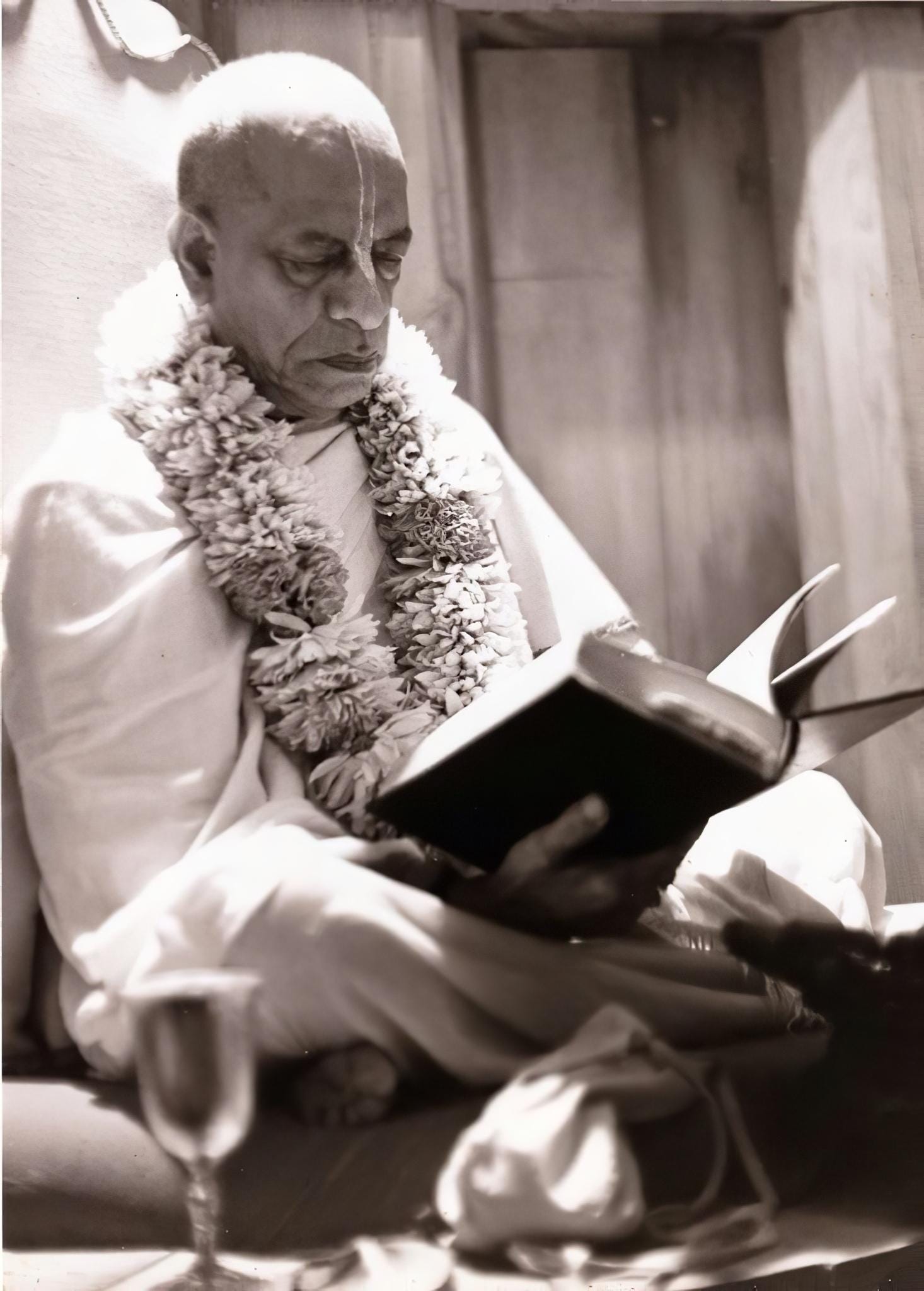
If this point of view is accepted, the next conclusion is that Śrila Prabhupāda was omniscient and infallible since he was not only a pure devotee of Krsna but also an empowered ācārya who came to realize the prophecy of Sri Caitanya Mahāprabhu that the holy names would be chanted in all villages and towns. Before Śrila Prabhupāda, no one had any idea of how Krsna Consciousness could take hold in the West. Most Vaiṣnavas of his time accepted this prophecy as just some poetic license. Even amongst other great ācāryas, Śrila Prabhupāda holds an exalted position.
The problem is that if we accept that Śrila Prabhupāda was omniscient and could not have committed any kind of mistake, at any level, we may have difficulty reconciling the idea of Prabhupāda being infallible with the perspective that some things he said in certain contexts may not be fully verifiable. If one depends on the ācārya being infallible and omniscient to be able to accept his instructions, one may have a crisis of faith if he sees any small detail that may not be fully correct.
For example, Śrila Prabhupāda mentioned a few times that women’s brains weigh just 34 ounces, while men’s brains weigh up to 64 ounces, quoting the conclusions of an English scientist he studied about while at the university. This information was accepted as scientific fact at some point, but it became outdated as more recent measurements put the female brains at about 90% of the size of male brains on average.
When the first Apollo mission landed, Śrila Prabhupāda concluded they had not gone to the moon, since the landscape they saw was just like a desert, without a trace of the gardens and lakes described in the scriptures. Later, however, he mentioned that they may have gone, but without an appropriate body, they were not able to interact with the demigods and other elevated beings who live there. In this case, we can see that Śrila Prabhupāda updated his viewpoint as more information became available.
Śrila Prabhupāda also said (BG 7.14, Hamburg, 18/09/1969) that people would have to go to live underground in the next 100 years, something that also didn’t yet happen.
So, taking this into consideration, in what sense is a pure devotee infallible?
The main point is that a pure devotee is a śāstra-cakṣu, someone who sees with the eyes of the sastras. A pure devotee understands the scriptures and fully accepts their conclusions, and from this platform, he explains the world around us.
A materialistic scientist may observe nature and, failing to see empirical proof of the existence of God, may come up with a theory that advocates that life comes from matter. A pure devotee, however, will instantly reject this theory because it doesn’t agree with the sastras. No amount of empirical evidence will change his understanding. He will automatically understand that the theory is mistaken even without having as much material knowledge as the scientist. He may even challenge the scientist, using arguments from the sastras and any other arguments he can come up with, and in the process employ references from different material sources that can help to support his argument. Some other scientist who has a rival theory (that directly or indirectly supports the view of the sastras) may be quoted, for example. Such material supportive evidence may be later proved outdated or incorrect, but the main point made, that there is a God, will remain.
A pure devotee is infallible in the sense that he will always be correct in the main conclusions derived from the sastras. There will be no mistake in this regard. Krsna is always God; he is always a person, we are His eternal parts and parcels, and we should surrender unto him by practicing the process of bhakti under the guidance of the previous ācāryas. However, some of the supporting arguments taken from material sources to sustain these conclusions may be later disproven.
Śrila Prabhupāda used this research of the female brain weighing 34 ounces as opposed to up to 64 as supportive evidence of his critique of the women’s liberation movement, which was and is still a pressing issue. The main point in the argument is the Vedic idea that families are the fabric of society, and families are only possible when there is cooperation between husband and wife. When women become excessively proud, they are not able to accept their role as wives and mothers, which is extremely dangerous to any society. This particular research on brain sizes he quoted was later proven outdated, but the main point remains.
When Prabhupāda mentioned that people would have to move under the ground in the next 100 years, he quoted a piece of information that was published in the World Almanac to call our attention to the perils of a consumeristic society, such as an artificial lifestyle and environmental degradation, and bring the discussion to the main point, that we should abandon such pursuits and surrender to Krsna. Again, we can see that the supporting evidence proved questionable, but the main point remains.
Similarly, when the first Apollo mission landed on the moon, Śrila Prabhupāda was immediately skeptical, since the moon is a celestial planet, and the sastras explain that it is not possible to go there through mechanical means. This was compounded by the fact that they didn’t find any gardens or palaces there; the footage was of a place similar to a desert. Later, as more information came on, Prabhupāda raised (in an interview) the point that they could have gone, but without an appropriate type of body, they could not have access to the celestial atmosphere, nor could they associate with the inhabitants. In other words, if they indeed visited the Earth’s satellite, they didn’t have access to the real moon, which is a celestial planet. We can see that in both situations, he supported the version of the sastras, although the supportive material evidence was adjusted as more evidence came into view.
We can see thus that although a pure devotee has perfect spiritual knowledge, he can adjust his presentation of this knowledge according to the situation and the material supportive evidence he may find. The explanation may change subtly to accommodate new information, as it becomes available, but the main spiritual point is always correct. A pure devotee will give the correct conclusion from the beginning, and it will never change. However, the way he explains and applies it may change according to the situation.
Similarly, a pure devotee may commit normal “human” mistakes like misspelling or mispronouncing words, making mistakes while calculating numbers, and so on. Pure devotion doesn’t automatically make a devotee a perfect linguist, mathematician, or dentist. A pure devotee may also not be able to perfectly understand situations if provided with incorrect or incomplete information.
Śrila Prabhupāda himself explains that the spiritual master is not omniscient. Rather, Krsna is omniscient, and He can reveal to the spiritual master what he needs to know to perform his service, according to His own discretion. The spiritual master is thus dependent on Krsna, and the level of revelation by Krsna may depend on several factors, including the level of sincerity of the disciples.
Ultimately, the spiritual is a soul surrendered to Krsna, and he plays the role Krsna wants him to play. If Krsna considers that a materially powerful and almost omniscient spiritual master is the best according to time, place, and circumstance, he can empower his pure devotee to perform many miracles, like in the story of Madhvācārya, for example. However, in other situations, Krsna may allow the spiritual master to commit a few “human mistakes” to be sure of the sincerity and maturity of his disciples. Just as the spiritual master may show a few so-called mistakes, Krsna himself may show some “imperfections” (by material calculation) in His activities, such as breaking His promise, stealing butter, or killing his so-called uncle. However, a sincere devotee is capable of understanding his divinity despite these, seeing how all these activities are ultimately perfect.
You can also donate using Buy Me a Coffee, PayPal, Wise, Revolut, or bank transfers. There is a separate page with all the links. This helps me enormously to have time to write instead of doing other things to make a living. Thanks!