

Subscribe to receive new articles by e-mail. It’s free, but if you like, you can pledge a donation:
Can devotees join the army and fight in wars if their country is attacked? What about if their country is the one invading another country? This question is becoming uncomfortably relevant for us. In fact, there were cases of devotees fighting in wars in the past decades, and at the present moment, there is a war where devotees are fighting on both sides. It’s quite possible that many of us will face this dilemma at some point in our lives, as our birth countries become involved in wars with neighbors or overseas.
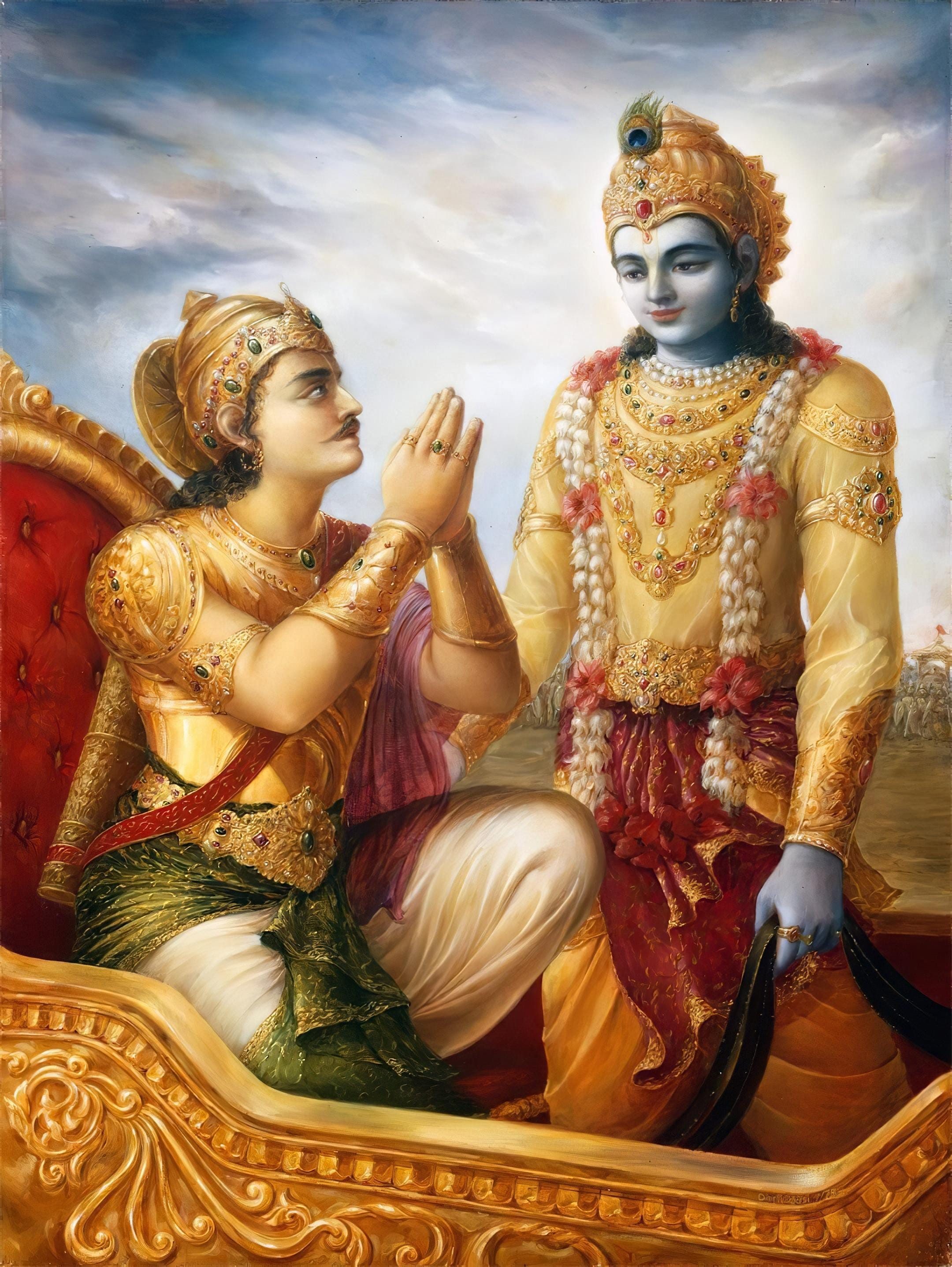
We read in the Bhagavad-Gita several verses where Krsna directly tells Arjuna that he should fight in a battle. Some try to connect the content of these verses with whatever war is going on, convincing themselves or others that they should join the battle on one of the belligerent sides. This is a dangerous misunderstanding.
When Krsna tells Arjuna that he should fight in the battle, He does that in the context that Arjuna should perform his duty. Arjuna is a kṣatriya, and thus his duty is to fight for the right cause under religious principles, for which he was trained since he was a child. The words of Krsna are universally applicable, but each one needs to apply these words in his or her particular context. For a family man, to fight in the battle means to perform his duty to maintain and protect his family. For a pregnant lady, to fight in the battle means to protect her child. For a teacher, it means to properly teach his students, and so on.
Krsna alerts that to abandon one’s duty and try to perform the duties of others is dangerous. Arjuna was a family man and a kṣatriya and wanted to go meditate in the forest, which is the duty of a brahmana or renounced person. The same would apply to a brahmana or vaiśya who would desire to abandon his occupation to fight in a battle. Krsna alerts that performing the duty of others is dangerous and does not lead to any positive outcome. Drona and Parasurama were Brahmanas who became kṣatriyas, but because they were great personalities, this did not degrade their consciousness. However, they are exceptions, not the rule.
As devotees, our primary duty is to practice and spread Krsna Consciousness. Under this primary duty, we have other secondary duties, such as taking care of our families, educating our children, working in our respective professions and services, serving other devotees, and so on. In this way, when Krsna says that we should perform our duty and fight in the battle, He is referring to all these different duties. Unless one was trained as a kṣatriya since childhood, like Arjuna, and entrusted with the protection of a kingdom or community, his duty is not to fight in a war. On the contrary, if he decides to abandon his duties to join the fight, he acts in an irreligious way, which leads to the degradation of his consciousness and sinful reactions.
It’s also important to mention that one of the reasons that only kṣatriyas are recommended to fight in the scriptures is that only kṣatriyas are trained in the science of fighting religious wars. Although the Vedas explain that wars are a necessity in certain circumstances, wars must be fought under very strict rules, starting with the fact that innocent persons (women, children, brahmanas, cows, as well as non-combatants) must not be harmed in any way. We can see that the battle of Kurukṣetra was fought in an isolated place, without harming anyone apart from the kṣatriyas who fought in it.
That’s the same reason why only trained and certified surgeons are allowed to perform surgeries. A nurse or the driver of an ambulance may have the best intentions, but if they try to operate on a patient, they will put their life at risk and may end up in prison. Similarly, someone who was not trained as a kṣatriya and tries to perform as one, by fighting in a war, becomes responsible for all the destruction and suffering he causes. Kṣatriyas who die in dharmic wars are rewarded with rebirth in the celestial planets, but amateurs who try to imitate and, as a result, harm innocent people risk just going to hell.
Being born in a certain country, we have a certain debt to it, just like we have a debt to our parents; however, it’s important to understand that this debt does not include fighting in wars created by the vanity of the leaders, especially when our religious duty, according to the scriptures, is something else. Not all laws passed by a congress or signed by a president or dictator are fair. One does not have any religious obligation to follow an unfair law (one may do it only up to the degree one is forced to), and obviously, no one has any moral obligation to join a war of conquest just because the executive leader says so.
A possible exception is the concept of the right to self-defense prescribed in the Vedas. If someone invades one’s house or attacks with mortal weapons, one has the right to defend oneself and, if necessary, even kill the aggressor. This applies to all social classes. Even a woman may fight and kill an assaulter to protect herself or her child, for example. We can see that in the Srimad Bhagavatam, it is mentioned that the cowherd men of Vrindavana carried bows for self-defense when they moved from Gokula.
This is, however, a mundane principle. Just because one does not incur karma for killing an aggressor, it does not necessarily mean one should do it. Vaiṣnavas will try to avoid violence as far as possible. There are cases of Vaiṣnavas fighting in wars, such as Hanuman, but they did so under the direct guidance of the Lord. This is probably not our case.
A devotee who decides to join the army because his country is being attacked is probably on his right according to the principle of self-defense, but even in such cases, this is a tricky decision, because the army may not always act according to religious principles. It’s not uncommon for shells addressed to the invading army to miss the target and end up destroying a house or school and killing innocent people, for example. Apart from that, by going to fight on the front, one abandons his primary duty in this sense, which is to protect his family and other devotees from his community. We should remember that although it is described that the vaiśyas led by Nanda Maharaja had bows, nowhere is it mentioned that they participated in any war. The bows were just to protect themselves and their families.
One of the problems with wars is that they invariably involve manipulation and false propaganda. One may be tempted to fight in a war because his government presents it as some kind of fight between good and evil, but in such a situation is often quite difficult to understand who the evil is. Nationalism is a very dangerous philosophy, and it can very easily cloud one’s judgment and pull him back to the mundane platform, where one becomes convinced that the piece of land where he took birth is more important than his life and his own spiritual progress.
The most problematic situation is when there is conscription and one is faced with the choice of joining the war or going to jail for several years. One example we have in this connection was the way Srila Prabhupada was advising his disciples at the time of the war in Vietnam. Instead of telling them to just accept their faith, he was encouraging them to try to find ways to avoid the draft as much as possible. There are always options, such as moving to another country, finding gaps in the laws with the help of lawyers, being excluded from the draft due to medical conditions, or simply hiding until it ends. Although we study that we are not the body, human life is important because it is our chance to understand Krsna. If someone tries to take this chance for us, we should try to protect ourselves using any tools we have at our disposal.
You can also donate using Buy Me a Coffee, PayPal, Wise, Revolut, or bank transfers. There is a separate page with all the links. This helps me enormously to have time to write instead of doing other things to make a living. Thanks!
Prabhu, what is your opinion about chatrapati Shivaji and his revolt against the Islamic invaders.