

Subscribe to receive new articles by e-mail. It’s free, but if you like, you can pledge a donation:
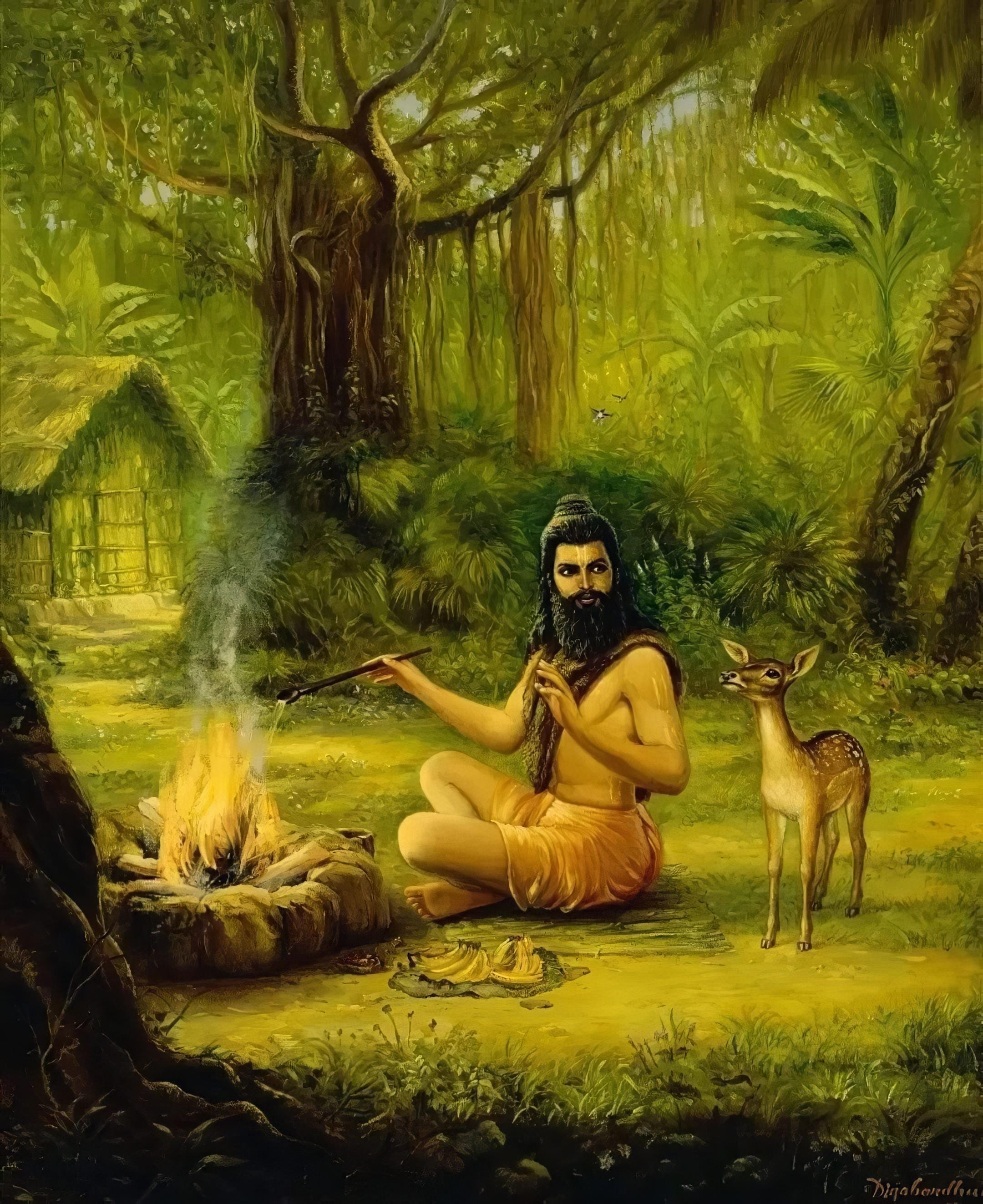
Bharata Maharaja was the king of the whole world. He had a very beautiful wife, good children, fame, all kinds of material opulence, and undisputed rulership. He had at his disposal everything that a person could desire in this world. Still, he renounced everything to meditate in the forest and attain the ultimate goal of life. In fact, by his daily worship, he got very close to a platform of pure love of Godhead. However, later in life, he fell down from this exalted platform, just because of his attachment to a small deer.
How is it possible that such an exalted person could abandon his spiritual practice and his goal of self-realization to be merely playing with an animal?
This surprising story reveals a formidable trap that appears later in spiritual life, and can send us back to another body, even when we are almost getting free.
Starting from the beginning, how did Bharata find this deer he got so attached to?
One day, during the early morning, Bharata Maharaja sat down on the bank of the river Gaṇḍakī after performing his ablutions to meditate, reciting his mantra. At this moment, a pregnant doe came there to drink water. However, hearing the roar of a lion, the doe became very distressed and jumped across the river to try to save itself. Such was her anxiety that she had a miscarriage, and the fawn fell into the river. Distressed, the mother lost direction, fell into a cave, and died. Seeing the situation, Bharata Maharaja was faced with the choice of saving the deer or letting it drown in the river. What did he do?
“The great King Bharata, while sitting on the bank of the river, saw the small deer, bereft of its mother, floating down the river. Seeing this, he felt great compassion. Like a sincere friend, he lifted the infant deer from the waves, and, knowing it to be motherless, brought it to his āśrama.
Gradually Mahārāja Bharata became very affectionate toward the deer. He began to raise it and maintain it by giving it grass. He was always careful to protect it from the attacks of tigers and other animals. When it itched, he petted it, and in this way he always tried to keep it in a comfortable condition. He sometimes kissed it out of love. Being attached to raising the deer, Mahārāja Bharata forgot the rules and regulations for the advancement of spiritual life, and he gradually forgot to worship the Supreme Personality of Godhead. After a few days, he forgot everything about his spiritual advancement.” (SB 5.8.7-8)
Compassion is a natural quality for a devotee, especially someone highly advanced, such as Bharata Maharaja. In principle, there was nothing wrong with his jumping into the river to save the deer, just as any kind-hearted person would get out of his way to help someone in an emergency. However, it was not his duty to become the babysitter of a deer, especially after it became clear that it was jeopardizing his spiritual practice.
True compassion is applied when we see the soul instead of the body, and act in ways that can help this soul come closer to Krsna. Saving the body can be part of it, since the body is the tool one can use to serve the Lord, but it is by itself insufficient. After saving the body, we need to find ways to engage one in Krsna Consciousness.
When Prabhupāda started his movement in New York, he was personally cooking and feeding his first visitors. Many of them were, in fact, very hungry, but this was not just a matter of mundane welfare. He was feeding them prasāda, in a deliberate attempt to purify their consciousness, so he could engage them in devotional service. In the case of a deer, however, the possibilities are very limited due to the animal body. Maybe Bharata could find ways to benefit it to a certain extent, but stopping his spiritual practice to take care of the material comforts of the deer was, however, a bad choice.
There are many rules and regulations to be followed by a sādhaka who is trying to advance in spiritual practice, starting with waking up early to chant and so on. These rules are the foundation of our spiritual strength. When we stop following this spiritual routine, we become vulnerable to being attracted again to the material energy, regardless of how far we may have gone in the process.
Another dimension is that, considering that true welfare means to elevate people to the platform of Kṛṣṇa Consciousness, our first priority must be to cultivate our own Kṛṣṇa Consciousness. If we are not Kṛṣṇa-conscious ourselves, we will not be able to help anyone else, just as a person who is bound can’t free others, or one who is struggling in the ocean can’t pull anyone out. If we give up our own spiritual activities and simply become concerned with the bodily comforts of others, we will fall into a dangerous position.
Here we come to the trap in which we can also fall. This is an important lesson we can learn:
“The great King Mahārāja Bharata began to think: Alas, this helpless young deer, by the force of time, an agent of the Supreme Personality of Godhead, has now lost its relatives and friends and has taken shelter of me. It does not know anyone but me, as I have become its father, mother, brother and relatives. This deer is thinking in this way, and it has full faith in me. It does not know anyone but me; therefore I should not be envious and think that for the deer my own welfare will be destroyed. I should certainly raise, protect, gratify and fondle it. When it has taken shelter with me, how can I neglect it? Even though the deer is disturbing my spiritual life, I realize that a helpless person who has taken shelter cannot be neglected. That would be a great fault.” (SB 5.8.9)
At the beginning of the process, the challenges we experience are usually more connected with lust, bad habits, vices, and so on. At this level, entering into family life, becoming attached to one’s children and spouse, and working to maintain them is a progression, since it helps us to progress from a selfish consciousness to a platform of care for others. Attachment to one’s dependents in this case becomes positive, because it works as a tool in this process of reducing our selfishness.
In later stages of spiritual life, however, this material attachment to dependents can become a serious obstacle. The idea of being the shelter and maintainer of others is very attractive to a conditioned soul. That’s a position that originally belongs to Krsna, but we try to imitate in conditioned life. We can practically see that everyone aspires to have some sphere of influence, having others who are dependent on them. People try to achieve that by constituting a family, maintaining a business, holding some kind of public leadership position, doing some mundane welfare, and so on. When everything else fails, one gets a cat or dog and becomes satisfied taking care of the animal.
This tendency can be applied in Krsna Consciousness, where there are certainly many opportunities for serving others. There is, however, a thin line between caring about others with the idea of pleasing Krsna, by helping them to advance in spiritual realization, and maintaining others with the idea of satisfying our ego. Even if externally it may appear the same, there is a gulf of difference. In the former, Krsna is the center, while in the latter, we become the center.
This is a trap in which we can fall, even in very advanced stages of spiritual advancement. Because the line between sacrificing ourselves for helping others and becoming distracted from our spiritual practice in order to obtain dependents that satisfy our ego is tenuous, it is easy to confuse. We can see that at first Bharata Maharaja thought petting the deer was the right thing to do, thinking that “I should not be envious and think that for the deer my own welfare will be destroyed. I should certainly raise, protect, gratify and fondle it. When it has taken shelter with me, how can I neglect it?”
Similarly, a senior man may at first think that it is his duty to support a younger lady who faces difficulties, only to be forced to admit later on that he is becoming attracted to her. One may get involved in different political goals out of a repressed need for power and prestige, and so on. There are certainly many ways to get distracted from our spiritual practice by doing something that may appear to be right at first.
We can see that even after renouncing his family and kingdom and attaining a very advanced stage of spiritual realization, Bharata Maharaja became again attracted to the idea of being the shelter and the maintainer, and absorbed in this mood, he forgot about his spiritual practice.
One may accept all kinds of difficulties and inconveniences to help others to advance, especially souls who have surrendered to him, such as students or disciples. However, this must be done with the proper mentality, for the satisfaction of the Lord. We should always see ourselves as servants of our spiritual master, connecting our dependents with the chain that goes all the way to Krsna. As we do that, Kṛṣṇa remains in the center. Otherwise, we may become attached to our dependents, thinking we are elevating them out of our own power. In this case, we put ourselves in the center and fall into the same mistake as Bharata Maharaja.
The sign of material attachment is attachment to the body, which manifests in terms of concern about the comforts of the body. There is a great difference between offering basic material necessities so that one may be peaceful and be able to maintain his or her spiritual practice, and becoming concerned about offering material comforts because we are attracted to the material body and mind.
When Prabhupāda decided to accept women in the temples, in the early days of our movement, he certainly made arrangements for them to get accommodations, prasāda, and so on, but all of this out of compassion, with the idea of giving these souls an opportunity of practicing Krsna Consciousness, despite personal inconveniences. An ordinary man taking care of a group of young ladies, however, would inevitably get attracted to them, and in this meditation, become concerned about their material comforts, seeing himself as their maintainer and shelter. We can see that there is a huge difference between these two platforms. Even if one does not become attracted to women, there is the chance of becoming attracted to other forms of material activity, as in the case of Bharata Maharaja.
You can also donate using Buy Me a Coffee, PayPal, Wise, Revolut, or bank transfers. There is a separate page with all the links. This helps me enormously to have time to write instead of doing other things to make a living. Thanks!