

« Things I Wish Someone Had Taught Me When I Started Krishna Consciousness
Avoiding burnout in our spiritual practice
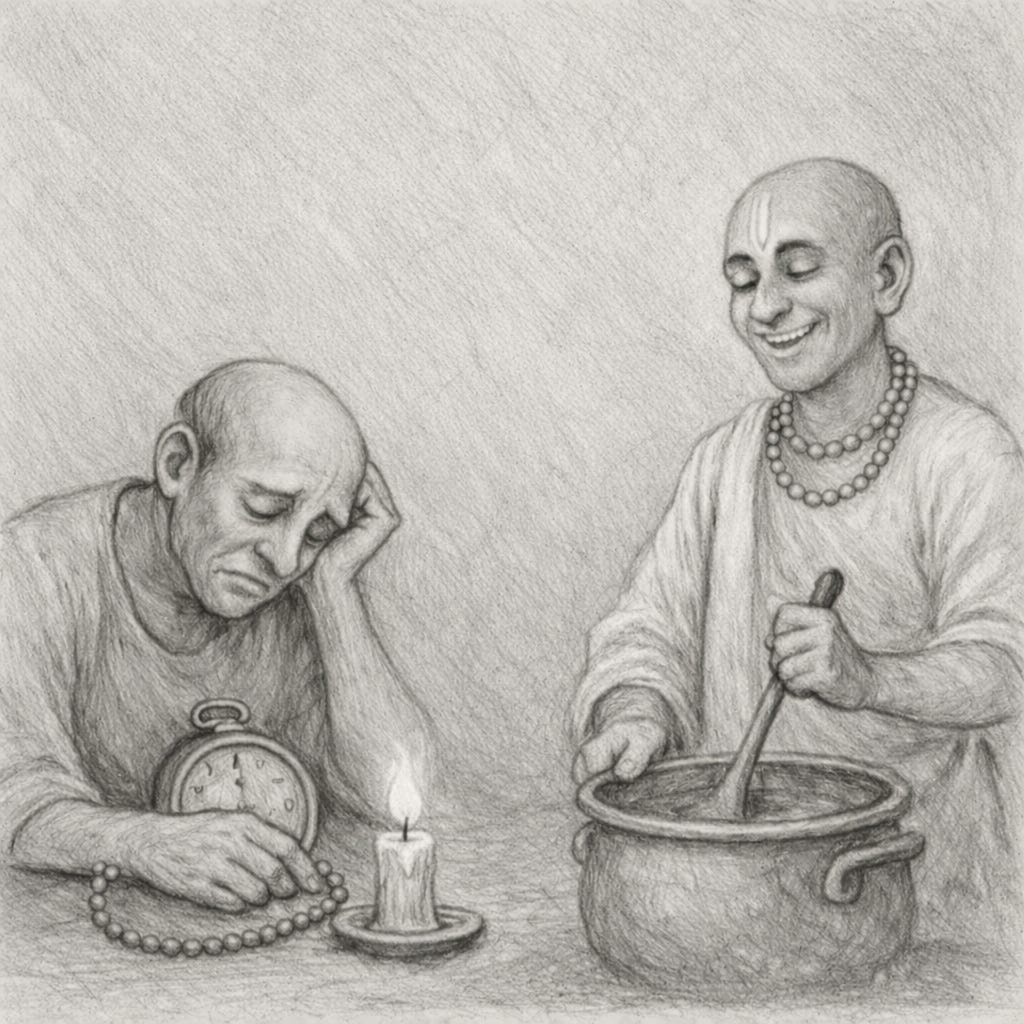
One of the symptoms of the bhāva platform is that one becomes very active in the service of the Lord and does not like to waste any time in other activities. In this platform, one develops a taste for devotional service, and combined with attachment to the Lord and other spiritual emotions, this makes one tireless in serving the Lord, impervious to the needs of the material body. A devotee in this stage can perform activities that seem to defy the laws of physics, sleeping very little, and sometimes serving even while seriously sick.
Many devotees around us may be on this platform, and often, by associating with them, we get a shadow of their taste for serving the Lord, and start serving the Lord tirelessly, almost like they do, allowing us to advance quickly in spiritual life. When this happens, we should make the most of it, just keep close to them and go as far as possible. By doing that, we can often make in months advancement that would otherwise take a lifetime.
This ride can affect us both individually and collectively. One prominent example is that our whole institution was able to operate at a much higher level when Prabhupāda was on the planet due to his potency. After he left, there was a period of adjustment, when we had to (both individually and collectively) deal with our limits and imperfections. Expectedly, this resulted in many difficulties, falls, etc.
Some are capable of keeping themselves at the feet of such exalted souls and keep serving under their energy until they themselves become free from the material energy, but for most of us, that’s a temporary stunt. We will stay for some time performing on a higher level, and later come back to our regular selves, and continue doing things more slowly.
This is expected. What is important is to distinguish this shadow of bhāva that we receive from the association of a pure devotee, and our normal standard of service, which may not be so stellar. Often, we may believe that we can act at such a level because of our own strength, which can lead to a few negative symptoms:
a) We may not properly value the association of the senior who is giving us this potency, believing we can do fine by ourselves. By not valuing it, we soon cut ourselves off from the spiritual current and again become a mouse.
b) Believing we are acting out of our own strength, the false ego grows when we are active, thinking we are now advanced devotees, just to crash later when we go back to our regular selves and find we can’t operate at the same level.
When this happens, we push ourselves, thinking that it is just some temporary tama-guna, and keep trying to serve at the same level we were previously doing. However, over time, it proves unsustainable. Soon, we become exhausted, going into burnout. Some, at this stage, come to understand their limits and maturely decide to take a step down, recover, and later continue to serve in a more realistic standard, according to their capacity. Others, however, may insist on trying to artificially maintain an artificial standard (often out of pride), which just increases the burnout, up to the point they crash, becoming sick, depressed, and so on, which can be dangerous for both their physical and spiritual health.
We can see that the problem is not the surge of enthusiasm that comes from associating with an advanced devotee. The problem is how the false ego interprets it, taking it not as mercy, but as a result of our own achievements. This leads to the pendulum of first thinking oneself as great, and then as the worst, when the previous position becomes unattainable.
Another problem of artificially trying to maintain unrealistic standards is that we can become fanatical about it, trying to push it into others, believing that this is the best and everyone should be like us (which again, comes from the false ego), and then trying to maintain it past our limits to sustain the social position as self-appointed leaders or religious reformers we ourselves created. This eventually leads us to fall or crash (often spectacularly) when the result finally comes. This is dangerous not only for ourselves, but also for the unfortunate souls who may be attracted to our stunts, since our fall or break-up will often affect their faith in the process. We then become another role model that falls and breaks people’s faith, just as many leaders did in the past, often due to the same process.
This is a mechanism that should be well understood, so we can differentiate between the healthy enthusiasm that comes from the association with a genuinely advanced devotee and the toxic pressure for unrealistic standards coming from peer pressure, or often from our own minds.
These two situations can be easily distinguished by their symptoms. Groups or individual devotees acting under the first principle show happiness. Even if tired, they are enthusiastic and foster genuine spiritual qualities, such as compassion, friendship, humility, etc. Devotees under the toxic artificial version, however, often show stress, harshness, depression, and so on.
When we learn to differentiate the two, we can take the best of the opportunity of receiving the shadow of bhāva from a pure devotee when it becomes available, but at the same time avoid all the traps connected with the artificial, material version, as well as all the problems coming from the unrealistic assumptions of the false ego. Enthusiasm is a very important factor in spiritual life, but it should come from the right source.
« Things I Wish Someone Had Taught Me When I Started Krishna Consciousness
You can also donate using Buy Me a Coffee, PayPal, Wise, Revolut, or bank transfers. There is a separate page with all the links. This helps me enormously to have time to write instead of doing other things to make a living. Thanks!