

« Things I Wish Someone Had Taught Me When I Started Krishna Consciousness
Balancing self-care and determination
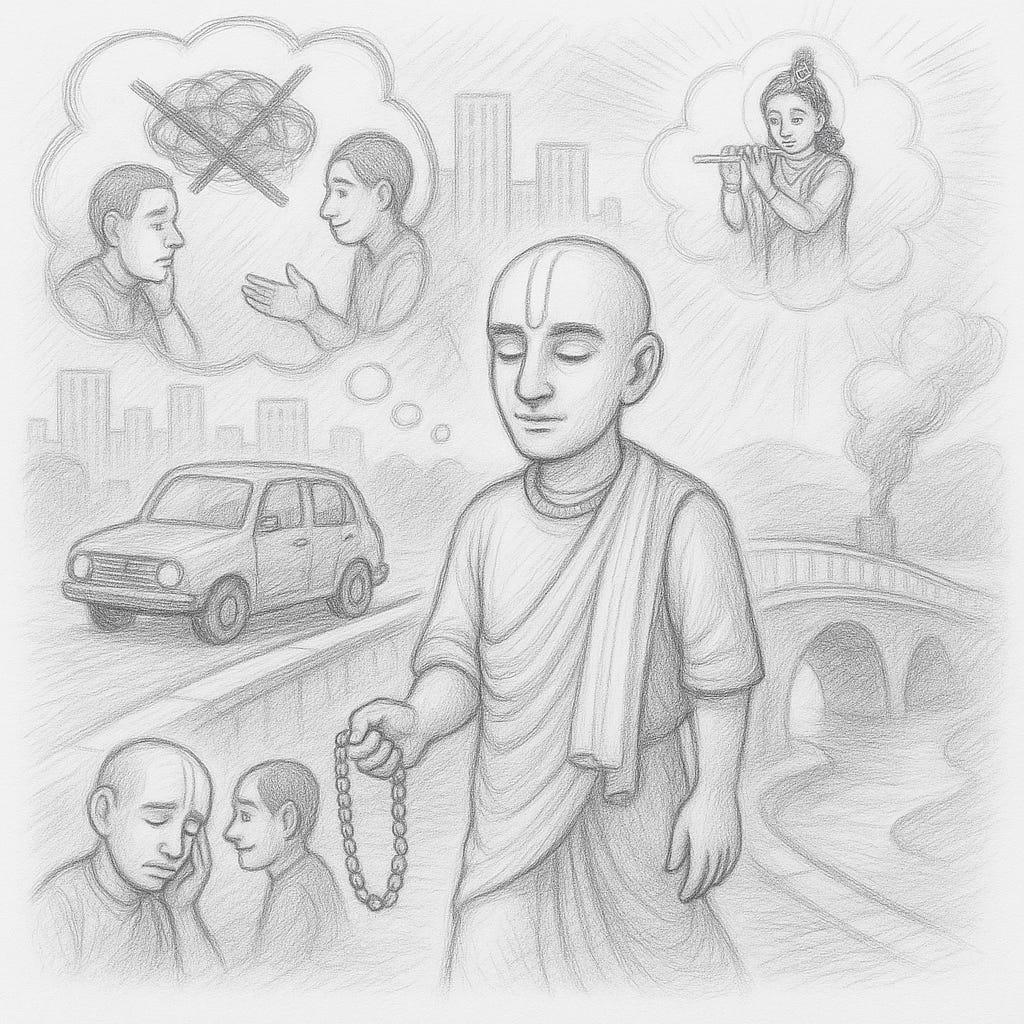
As we have been discussing, it would not be an exaggeration to say that most of us have psychological issues due to traumas and different unfulfilled needs faced at some stage of life. A perfectly healthy person can be formed only by loving parents and other relatives, as well as a whole social structure we don’t have nowadays. As a result, by the time we reach adulthood, we are usually badly scarred by all the neglect, violence, scarcity, and abuse we suffered as we were growing up.
What happened has already happened, and we can’t do anything to change it. The question is what to do from now on.
Often, traumas and other mental issues hold us back in spiritual life, preventing us from being stable in our practice, and we may not be able to overcome the hurdle with spiritual practice and friendly talks alone. In such cases, it makes sense to take time to deal with the issue by searching for a counselor, a devotee psychologist, or any other form of help that is necessary.
There is, however, another side to the question, which is to go overdrive and become too fixed in our issues, letting it distract us from our spiritual practice. There is often a thin line between dealing with issues to remove obstacles in our spiritual practice and allowing the mind to just dwell and churn past problems endlessly without a solution. As previously mentioned, the mind is attracted to strong emotions, pleasant or unpleasant, and delving into past issues, especially painful experiences, can create a certain rasa that attracts the mind. That’s not where we want to go.
Just as there are serious issues we need to take time to deal with, there are also cases in which these issues may be manageable. We need thus to use introspection to sort out what are serious issues that hold us back in our spiritual practice, and issues that are fundamentally just discomforts. The first group demands attention, since our spiritual practice can collapse if we don’t take the time to treat them, while tolerance may be the best option for the second group.
There is a story connected with that. It may look now like something very distant from our reality, but there was a time when Germany was separated into two different countries. East Germany was part of the Soviet Union, while West Germany was integrated into Europe. The division between the two countries was symbolized by the Berlin Wall, which divided the city into two.
When the Soviet Union collapsed, the wall was quickly dismantled, and people from East Germany suddenly became free to go to the other side. Many were so fed up with life in the Soviet Union that they just took their Trabant cars, drove to the other side, and abandoned them, starting a new life, never to return.
The Trabant was even worse than the Ladas people were driving in other parts of the Soviet Union. It was a tiny and uncomfortable car and propense to many mechanical problems. It was practically impossible to keep a Trabant in perfect working condition. However, good or bad, these were the only cars people had, and as long as they were running, people would use them. When the opportunity arose to get out, they just drove the cars they had, without caring much about the discomfort. When they would get to the other side, they would just abandon their Trabants and start their new lives.
Similarly, there is a clear division between the material world and the spiritual world, and life here is not very comfortable. We also have very uncomfortable cars (the material body), and they give us lots of problems. However, these are the vehicles we have. Therefore, when the opportunity of getting out appears, we should take it, using the vehicles we have now to practice Kṛṣṇa Consciousness and get out of material conditioning.
If we want to first fix all the problems before the trip, we may never go: there is always going to be something wrong. The more we try to reach a comfortable situation in this life, solving all the numerous issues, the more we become entangled, because the situation is not solvable. For each issue we can solve, two new problems appear. We can imagine that if someone in East Germany were to first try to somehow transform his Trabant into a comfortable car, he would probably still be there!
Thus, our approach to solving material problems should be multifaceted. On the one hand, we should take time to solve serious problems and mental issues that can jeopardize our practice, solving them before they have the chance to grow, but on the other hand we should exert tolerance in dealing with the different small problems and discomforts we face daily, that although annoying, don’t prevent us from performing our duties and advancing in spiritual practice.
The idea of Kṛṣṇa Consciousness is to use the current body and the current situation we have now as a vehicle to go to the other side, despite all the limitations, since if we first try to come to a perfect situation, chances are that we will become distracted and lose the opportunity.
We hear that there are two types of karma: prārabdha karma (the karma that is already giving fruits) and aprārabdha karma (the karma that is stored in the form of a seed). When we start practicing Kṛṣṇa Consciousness, and especially after we are initiated by a bona fide guru, all the vast stocks of aprārabdha karma are very quickly destroyed. However, the prārabdha karma, the karma that is already giving fruits, continues. Therefore, we continue with the same material body, with the same imperfections, and often in the same material conditions, without much change.
We may question why it is so, and the answer is actually quite simple: If Kṛṣṇa were to take all our prārabdha karma from us, together with the aprārabdha karma, there would be nothing to maintain the material body, and it would just drop dead. The problem is that we are not ready to just drop dead; we still have a trip to do, and for this, we need a vehicle. In this way, Kṛṣṇa allows us to temporarily keep the vehicle we have, be it good or bad, so we can go through the lessons we still have to learn and complete our trip back to Godhead. Therefore, it doesn’t matter much if the engine is smoking or if the windows don’t open: it’s just for a short while.
In one sense, we need to be practical and maintain the body and mind in working condition, since if it breaks, it will not reach our destination. On the other hand, however, we need to understand that it is just for a little while and thus not become distracted from our final goal. The secret of success is in balancing these two acts.
The point about spiritual life is thus not about completely fixing our current situation, but just dealing with the pressing issues that hold us back in our spiritual practice. Once this is reached, we can advance further by just using whatever resources we have now (be it money, intelligence, attention, or whatever else we may have) to serve Kṛṣṇa and thus use the opportunity to purify ourselves and conclude our journey.
« Things I Wish Someone Had Taught Me When I Started Krishna Consciousness
You can also donate using Buy Me a Coffee, PayPal, Wise, Revolut, or bank transfers. There is a separate page with all the links. This helps me enormously to have time to write instead of doing other things to make a living. Thanks!