

« Things I Wish Someone Had Taught Me When I Started Krishna Consciousness
Beware of personality cults
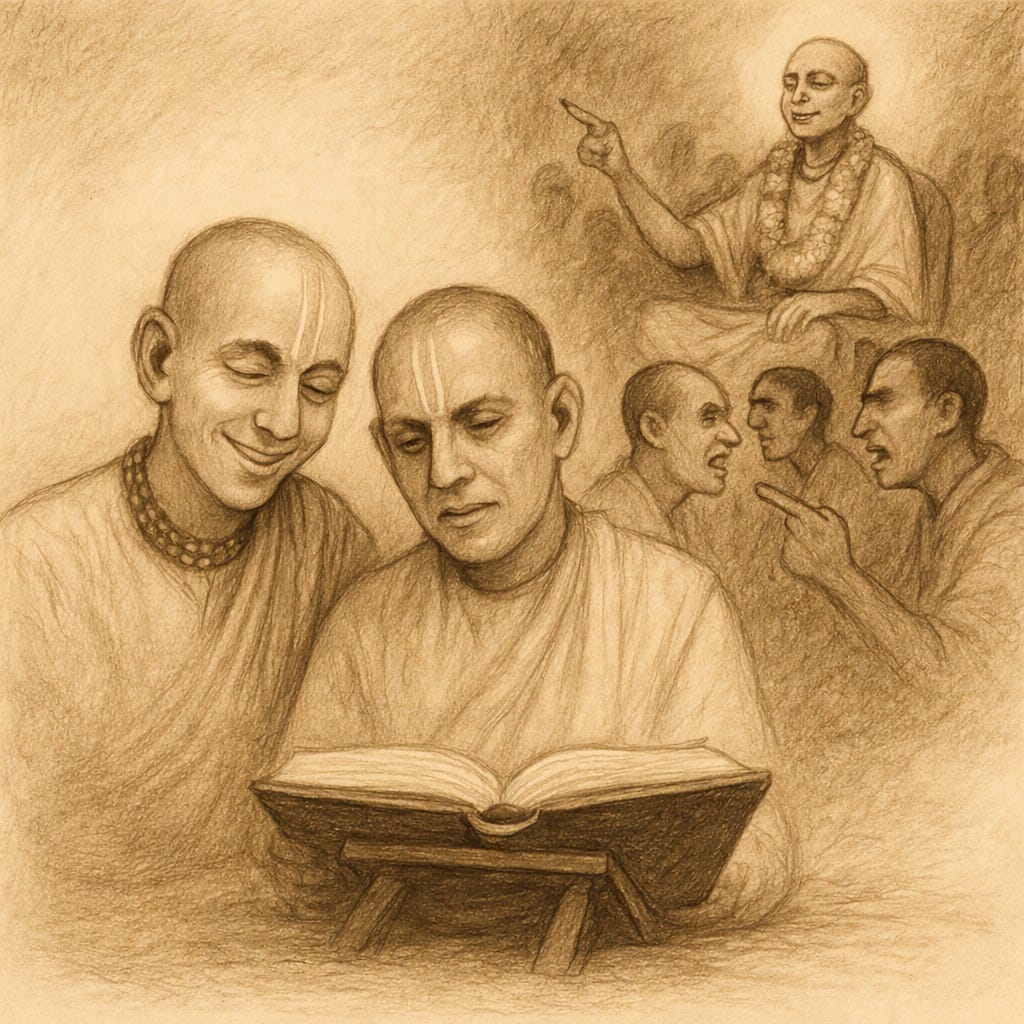
Sometimes Kṛṣṇa Consciousness is presented in a dogmatic way, based on the idea that we should follow a certain charismatic leader, accepted by his followers as a pure devotee, or that we should blindly follow institutional authorities.
On the one hand, our philosophy is based on following higher authorities, starting with Kṛṣṇa Himself. Without learning from superior persons, we can’t achieve anything in life, what to say about attaining self-realization. This process of following and learning starts with our parents, then school teachers, and continues in adulthood. It is not surprising that in spiritual life, the most complicated science, this process of learning is also supposed to take place.
On the other hand, in his purport to Bg 4.34, Śrila Prabhupāda explains that blind following is dangerous: “In this verse, both blind following and absurd inquiries are condemned. One should not only hear submissively from the spiritual master; but one must also get a clear understanding from him, in submission and service and inquiries.”
On another occasion, he said that “you are supposed to surrender using your intelligence, not to surrender your intelligence”. To surrender one’s intelligence and follow someone blindly is not recommended.
There is a pseudo-Vaiṣnava sect called Kartābhajā, described by Śrila Bhaktivinoda Thākura, where the followers blindly follow the guru, whom they worship as God incarnated. The problem is that more often than not, the leaders of this sect deviate, doing seriously immoral acts. Still, the followers continue to worship them as God, even when the situation is clear.
As Śrila Prabhupāda explains, we should not be blind followers. We should always use our intelligence and understand what we are doing. Prabhupāda made it easier for us by describing the process of Kṛṣṇa Consciousness in his books, setting the golden standard. If we can properly understand the spiritual process he explained and the standards he set, we can find devotees from whom we can learn. A leader should not be followed for the simple fact of being in a high position, but for being the embodiment of the ideals and qualities described by Prabhupāda in his books. When, however, we discard all this knowledge and blindly follow a charismatic leader, problems start.
One problem with personality cults is that they often concentrate the most toxic people. The reason is that personality cults are usually not transcendental, but based on a principle that is very present in the material world: People surround famous people hoping to get something out of it, not out of love. Followers feel that being close to such a powerful person makes them important, especially when they can become close to him or control access to him. Reinforcing the image of the leader as a pure devotee thus becomes part of one’s ego, since increasing the importance of the head of the sect increases the importance of one as a prominent follower. In such an environment of egos, clashes are inevitable, and quickly, the predominant mentality becomes to exploit, instead of giving.
We learn from the people who are around us, and thus, when we are sucked into an environment where toxic people fight for positions in the hierarchy, using manipulation, coercion, and humiliation as tools for controlling others, we end up learning these patterns and later also practicing them, thinking that this is how Kṛṣṇa Consciousness is supposed to be. We may then spend several years practicing a process and studying a version of the philosophy that is not exactly what was envisioned by our previous acaryas, which can create lasting misconceptions that are difficult to rectify.
Another problem is that receiving something else in place of Kṛṣṇa Consciousness can lead us to lose faith in the process, or lose our faith in Prabhupāda or in Kṛṣṇa Himself, which is the greatest tragedy. One who gets an adulterated, foul-tasting white liquid in place of milk may not want to taste milk again, even if later he gets the real thing.
Personality cults can also be formed around genuine pure devotees, but there is a great difference in these cases. A genuine pure devotee will understand the shortcomings of his followers and work to rectify them by giving the right instructions and engaging them in spiritual activities. As a result, the followers will gradually become purified, and gradually the cultish aspects will give way to genuine devotion. The group may be caustic in the beginning, but it will become better as the influence of the pure devotee wins over the materialistic tendencies of the followers.
Cults formed around imperfect individuals, however, tend to become worse over time, because the materialistic aspects gradually become more prominent. Having absolute power over followers can also lead the leader to secretly cultivate questionable habits, which are, in turn, ignored by followers who were trained to obey without questioning. Over time, the problem may grow until it becomes a scandal. Many of the worst episodes of our movement followed this pattern. If the personal behaviour of the leader does not match the image of purity that the followers try to promote, that’s a big red light.
Blindly following a charismatic leader, especially when there are signs of wrongdoings, puts us on the path of the Kartābhajā. That’s not where we want to go. The problem is that we often go to the other extreme, completely rejecting the concept of authority, and this can be even more disastrous.
In political systems, there is authoritarianism, which is quite problematic, but there is also anarchy, which is worse. Any good form of government has to stay clear of both extremes. In one sense, we need to learn to recognize and reject fallen or deviant spiritual leaders, but on the other hand, we need to learn to trust and follow true leaders. Only one who is balanced on this matter will be able to find the right path in the midst of all confusion.
We then come to the idea of the GBC, which was created by Prabhupāda as the collective head of our institution. There are historical cases when the GBC made problematic decisions, like in the introduction of the Zonal Ācārya system, but on the other hand, they also protected our society in many situations where the right answer was not clear. Maybe we would not need a GBC if we were a society of pure devotees, but unfortunately, that’s not the case. Speculations appear, quarrels manifest, cases of abuse happen, and there must be some authority with sufficient power to deal with such cases.
Any kind of organized society requires a leader. This leader may be a single person or a group of individuals who share decisions. When a single perfect person is available, an absolutist system is more efficient, since a perfect leader can use this absolute power to do good. However, absolute power corrupts absolutely, and a corrupted leader can use this absolute power to do absolute evil. History proves that in Kali-yuga, perfect leaders are rare. Even in the history of our movement, there were cases of leaders who were accepted as perfect by their followers, just to be caught in grossly immoral acts later on.
Śrila Bhaktivinoda Thākura could identify this problem, and therefore, he developed the concept of a governing body as the head of a spiritual institution, instead of the traditional system of a single ācārya. When Śrila Bhaktisiddhānta Sarasvatī Thākura was about to pass away, he told his disciples to organize a governing body to take care of the Gauḍīya Maṭha in his absence. He made clear his desire that there should not be a single ācārya. They tried, but the problems in putting together such a governing body proved too hard to solve at the time, and they ended up electing a single ācārya. Not very long afterward, the so-called ācārya fell down, paving the way for the problems that followed. The Gauḍīya Maṭha fragmented into many smaller institutions, and the infighting took a heavy toll.
When Śrila Prabhupāda passed away, he left a similar instruction to his disciples, creating a GBC to collectively make important decisions in his absence. The reasoning is simple to understand: although a group of senior Vaiṣnavas may still commit mistakes, the frequency and severity of such mistakes tend to be lower than the mistakes that a single imperfect individual with absolute power would commit. Considering the times we live in, this is the only acceptable system for a worldwide community like ours.
One could question the necessity of such a system since we can have small communities with local leaders making decisions. This is actually another side of the question that is often overlooked. Śrila Prabhupāda actually wanted our movement to be based on semi-autonomous communities with local leaders taking care of things. The idea of a centralized institution came later from some followers. Prabhupāda himself protested the idea.
At the same time, however, he envisioned the GBC as a higher authority that could oversee things and have the power to correct the situation when things go wrong. Local leaders usually do better, since they are in touch with the needs of local devotees. Still, there should also be a higher authority to which devotees can go in cases of problems, and that can act as a unifying force when the inevitable disagreements appear. We can see that there are two sides to the question, and we get into problems when we are not able to balance both.
In other words, our movement should be based on semi-autonomous communities, with local devotees being empowered to make decisions and improve things, but at the same time, there must be a higher authority to oversee things and correct problems when they appear. There should not be a central power interfering too much with local affairs, but there must also not be anarchy.
Many of the problems we saw in the past in our society came from going too much to one side or the other. However, it seems we are gradually coming closer to finding the right balance, which will allow our movement to continue working as a unified society for the next 10,000 years.
« Things I Wish Someone Had Taught Me When I Started Krishna Consciousness
You can also donate using Buy Me a Coffee, PayPal, Wise, Revolut, or bank transfers. There is a separate page with all the links. This helps me enormously to have time to write instead of doing other things to make a living. Thanks!