

Subscribe to receive new articles by e-mail. It’s free, but if you like, you can pledge a donation:
🔉 Audio of the lesson »
🎙Podcast (Search for “Mysteries of the Vedas” on Spotify, iTunes, etc. to hear all the lessons
Join the Telegram group if you would like to join the live lessons. This course is maintained with your donations. Click here to donate.
💬 Text of the lesson
Bharata Maharaja becomes attached to a deer
Bharata Maharaja worships the Lord in the forest
“That most exalted devotee, Mahārāja Bharata, in this way engaged constantly in the devotional service of the Lord. Naturally his love for Vāsudeva, Kṛṣṇa, increased more and more and melted his heart. Consequently he gradually lost all attachment for regulative duties. The hairs of his body stood on end, and all the ecstatic bodily symptoms were manifest. Tears flowed from his eyes, so much so that he could not see anything. Thus he constantly meditated on the reddish lotus feet of the Lord. At that time, his heart, which was like a lake, was filled with the water of ecstatic love. When his mind was immersed in that lake, he even forgot the regulative service to the Lord.” (SB 5.7.12)
This description shows clearly that Bharata Maharaja was very advanced in the platform of devotional service. This is confirmed by Śrīla Prabhupāda in his purport: “When one is actually advanced in ecstatic love for Kṛṣṇa, eight transcendental, blissful symptoms are manifest in the body. Those are the symptoms of perfection arising from loving service to the Supreme Personality of Godhead. Since Mahārāja Bharata was constantly engaged in devotional service, all the symptoms of ecstatic love were manifest in his body.”
At the same time, however, he somehow became attracted to a deer and fell from this platform. This is also mentioned by Prabhupāda in his purport to text 5.8.7: “Mahārāja Bharata was a great king very advanced in devotional service. He had almost reached the point of loving service to the Supreme Lord, but even from that platform he could fall down onto the material platform.”
In his Bṛhad-bhāgavatāmṛta, Sanātana Goswami explains that great personalities, like Bharata Maharaja and others, sometimes appear to fall in order to give us important lessons, showing traps we can also face in our spiritual development. Here are the relevant verses and commentaries:
“2.3.170: The great souls who spontaneously serve the names of Lord Hari fear to reveal the vast treasure of His confidential devotional service. So they behave in peculiar ways to show their own faults and unhappiness.
COMMENTARY: What about advanced worshipers like Bharata Maharaja whose impending sinful reactions apparently kept going on? We should understand that when saintly devotees like Bharata, deeply absorbed in the moods of loving service to the Lord, seem to exhibit material attachment (as when Bharata became obsessed with the care of a fawn), and when they seem to fall into bad association and miserable conditions (as when Bharata took his next birth as an animal), they are only pretending to be materially affected in order to keep the confidential moods of devotional service hidden from public view. Such devotees would rather be treated with undeserved contempt than honored and worshiped.
2.3.171: All the devotees of the Lord are freed from contamination and misery simply by the saṅkīrtana of His names. Yet some devotees, as disturbed by compassion as the Lord Himself, act in these ways to teach people civilized behavior.
COMMENTARY: Shouldn’t advanced devotees, in order to deliver the world from ignorance, let everyone see their greatness? Yes, but the so-called anomalous behavior of Vaiṣnavas like Bharata Maharaja is in fact their way of teaching sad-ācāra, civilized human behavior. By the examples of their own lives they show the consequences of violating the laws of God and material nature, for if people fail to learn how to act according to civilized standards their hearts will remain contaminated by sinful desires and they will never become inclined toward the Lord’s devotional service.
2.3.172: As Bharata and others showed the fault of bad association, Yudhiṣṭhira and others the fault of gambling, and Nṛga and others the fear caused by taking a brāhmana’s property, pure souls generally use their own behavior to teach the people.
COMMENTARY: Bharata Maharaja showed by his own life the danger of wrong association. Although almost perfectly devoted and renounced, he was distracted into caring for a newborn deer and therefore had to suffer birth as a deer. A similar case is that of Saubhari Ṛṣi, who was deviated from meditation by seeing two fish engaged in sex. In the opinion of the Vaikuṇṭha-dūtas, however, in reality these elevated souls were faultless.”
This passage puts these pastimes into perspective. Although these are standard case-studies that show us how even advanced devotees can become bewildered, we should focus on studying the actions and consequences, and not on blaming these great personalities. Prabhupāda supports this version in his purport to text 5.8.10, mentioning that, “For our instruction, Bharata Mahārāja acted in such a way.”
We just studied another similar case in the story of Priyavrata, who also apparently fell into mundane life after attaining a very advanced spiritual platform, being trained by Nārada Muni himself. As explained, devotional service can’t be lost; it can only be temporarily covered. Just as Priyavrata returned to his previous platform of renunciation later in life, Bharata Maharaja will remember his Krsna Consciousness even in the body of a deer and will complete his practice in his next life as Jaḍa Bharata. This episode can also be taken as similar to the situation of Arjuna, who became illusioned by the internal potency of the Lord at the beginning of the Bhagavad-gītā, just to be instructed by Kṛṣṇa and regain his transcendental consciousness.
This shows another characteristic of pure devotees: they are fully surrendered to the plan of the Lord. If the Lord wants His pure devotee to play the role of a materialist – or a deer – to teach some important lesson, the devotee is ready to cooperate. Other, external causes may be pointed out, such as karma or offenses, but the ultimate factor is the will of the Lord, which just manifests through such external causes.
We should thus concentrate on the lessons we can learn from these pastimes and how these lessons can be applied in our own spiritual path. Unlike Priyavrata, Arjuna, Jaya and Vijaya, or Bharata, we have truly become fallen, having somehow or other forgotten Krsna.
“Mahārāja Bharata appeared very beautiful. He had a wealth of curly hair on his head, which was wet from bathing three times daily. He dressed in a deerskin. He worshiped Lord Nārāyaṇa, whose body was composed of golden effulgence and who resided within the sun. Mahārāja Bharata worshiped Lord Nārāyaṇa by chanting the hymns given in the Ṛg Veda, and he recited the following verse as the sun rose.”
Just like meditation on the Lord, meditation on His pure devotees also increases our Krsna Consciousness; therefore, many parts of the Śrīmad Bhāgavatam offer detailed descriptions of the forms of pure devotees and empowered incarnations, as in the coronation of Pṛthu Maharaja, helping us to form a mental image of them and their pastimes. This is not just an empty description, but something that can help us to increase our Krsna Consciousness.
When we chant the Gāyatrī mantra, we meditate on the Lord as the source of the effulgence of the Sun. Apart from the demigod, the Lord resides in the Sun as Hiraṇmaya, or Surya-Nārāyaṇa, and that’s a common process of meditation.
The specific verse recited by Bharata Maharaja, in which he would meditate daily as the sun rose, is mentioned in the last verse of the chapter:
paro-rajaḥ savitur jāta-vedo
devasya bhargo manasedaṁ jajāna
suretasādaḥ punar āviśya caṣṭe
haṁsaṁ gṛdhrāṇaṁ nṛṣad-riṅgirām imaḥ“The Supreme Personality of Godhead is situated in pure goodness. He illuminates the entire universe and bestows all benedictions upon His devotees. The Lord has created this universe from His own spiritual potency. According to His desire, the Lord entered this universe as the Supersoul, and by virtue of His different potencies He is maintaining all living entities desiring material enjoyment. Let me offer my respectful obeisances unto the Lord, who is the giver of intelligence.”
Prabhupāda explains this process in his purport: “As the Supersoul, the Lord enters the hearts of all living entities. As stated in Brahma-saṁhitā (5.35), aṇḍāntara-stha-paramāṇu-cayāntara-stham: “He enters the universe and the atom as well.” In the Ṛg Veda, the predominating Deity of the sun is worshiped by this mantra: dhyeyaḥ sadā savitṛ-maṇḍala-madhya-vartī nārāyaṇaḥ sarasijāsana-sanniviṣṭaḥ. Nārāyaṇa sits on His lotus flower within the sun. By reciting this mantra, every living entity should take shelter of Nārāyaṇa just as the sun rises.”
Why was Bharata Maharaja meditating on Lord Narāyana and reciting mantras from the Ṛg Veda? Śrīla Viśvanātha Cakravartī suggests he was afraid that his ecstatic symptoms could cover his intelligence, and thus kept worshiping the Lord using the Ṛg mantras to keep his intelligence steady.
Bharata Maharaja becomes attached to a deer
In previous passages, it was already established that Kṛṣṇa is supremely merciful and that He protects His devotees. Parīkṣit was just a defenseless embryo when he was attacked by a nuclear weapon invoked by Aśvatthāmā, and the Lord manifested His transcendental form inside the womb of His mother to protect Him. The Lord also makes arrangements for His devotees to receive transcendental knowledge and thus find their way back to Him. When Dhruva Maharaja left the castle to look for the Lord in the forest, He inspired Nārada Muni from inside the heart to meet him and give Him transcendental knowledge. The Lord can also protect His devotees from accidental mistakes and offenses. When Jaya and Vijaya accidentally offended the four Kumāras, the Lord organized things so that they would not forget Him even while living for three lives as demons in the material world.
However, how does the Lord protect a devotee from himself? How does He display His mercy when a devotee intentionally neglects his or her spiritual practice, choosing to fix his mind in material objects when there is no external cause pressing him? Does the Lord allow the devotee to reap the karmic results of his actions without any support, or is he protected in some way? The pastime of Bharata Maharaja becoming a deer answers this question.
How did it happen?
One day, during the early morning, Bharata Maharaja sat down on the bank of the river Gaṇḍakī after performing his ablutions to meditate, reciting his mantra. At this moment, a pregnant doe came there to drink water. However, hearing the roar of a lion, the doe became very distressed and jumped across the river to try to save itself. Such was her anxiety that she had a miscarriage, and the fawn fell into the river. Distressed, the mother lost direction, fell into a cave, and died. Seeing the situation, Bharata Maharaja was faced with the choice of saving the deer or letting it drown in the river. What did he do?
“The great King Bharata, while sitting on the bank of the river, saw the small deer, bereft of its mother, floating down the river. Seeing this, he felt great compassion. Like a sincere friend, he lifted the infant deer from the waves, and, knowing it to be motherless, brought it to his āśrama.
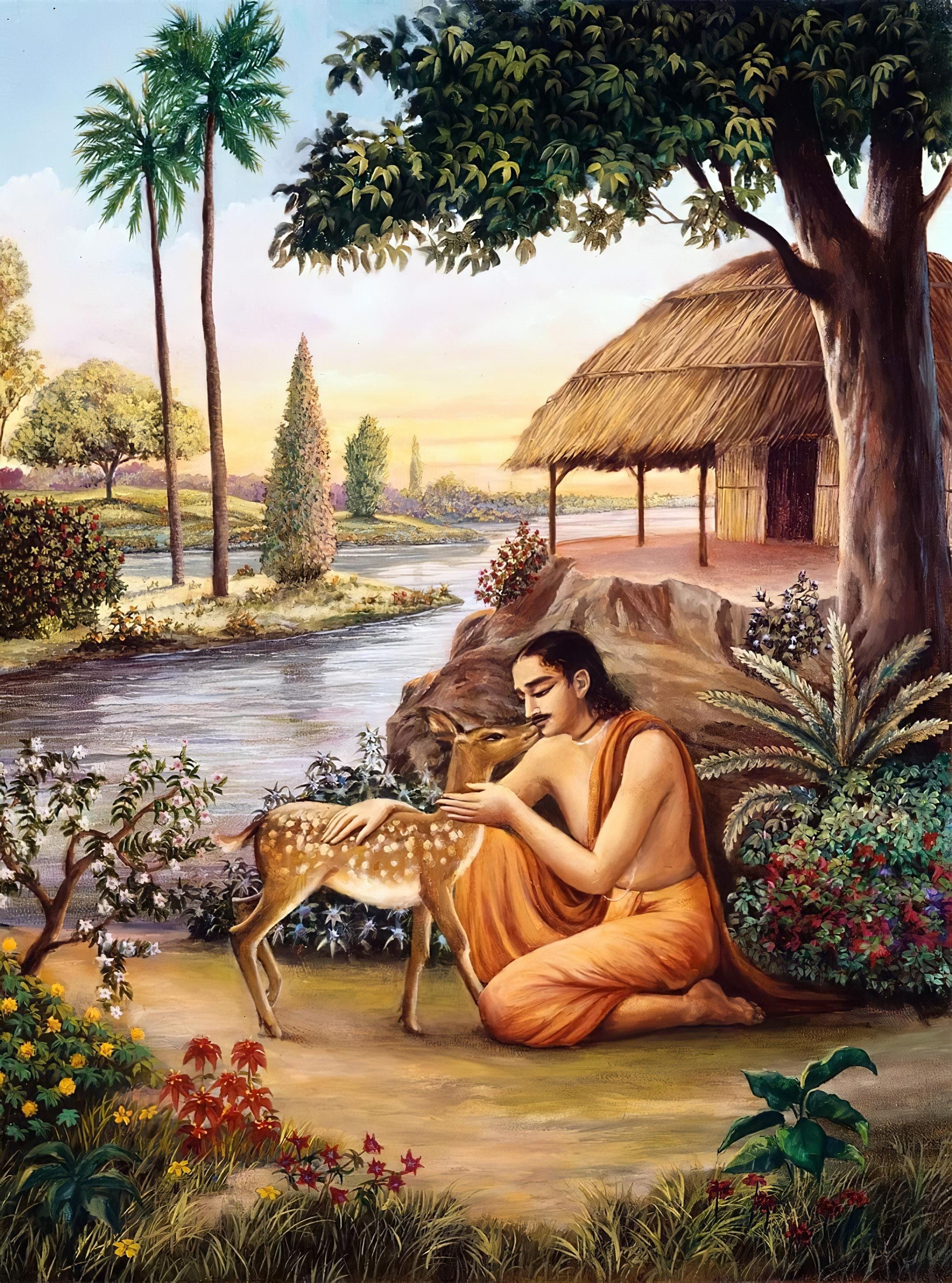
Gradually Mahārāja Bharata became very affectionate toward the deer. He began to raise it and maintain it by giving it grass. He was always careful to protect it from the attacks of tigers and other animals. When it itched, he petted it, and in this way he always tried to keep it in a comfortable condition. He sometimes kissed it out of love. Being attached to raising the deer, Mahārāja Bharata forgot the rules and regulations for the advancement of spiritual life, and he gradually forgot to worship the Supreme Personality of Godhead. After a few days, he forgot everything about his spiritual advancement.” (SB 5.8.7-8)
Compassion is a natural quality for a devotee, especially someone highly advanced, such as Bharata Maharaja. In principle, there was nothing wrong with his jumping into the river to save the deer, just as any kind-hearted person would get out of his way to help someone in an emergency. However, it was not his duty to become the babysitter of a deer, especially after it became clear that it was jeopardizing his spiritual practice.
In his purport, Prabhupāda makes a point that is essential to understand the whole episode:
“Spiritual salvation and liberation from material bondage must be worked out with great caution, otherwise a little discrepancy will cause one to fall down again into material existence. By studying the activities of Mahārāja Bharata, we can learn the art of becoming completely freed from all material attachment. As it will be revealed in later verses, Bharata Mahārāja had to accept the body of a deer due to being overly compassionate for this infant deer. We should be compassionate by raising one from the material platform to the spiritual platform; otherwise at any moment our spiritual advancement may be spoiled, and we may fall down onto the material platform. Mahārāja Bharata’s compassion for the deer was the beginning of his falldown into the material world.”
This is further clarified in his purport to text nine:
“When a person is advanced in spiritual consciousness or Kṛṣṇa consciousness, he naturally becomes very sympathetic toward all living entities suffering in the material world. Naturally such an advanced person thinks of the suffering of the people in general. However, if one does not know of the material sufferings of fallen souls and becomes sympathetic because of bodily comforts, as in the case of Bharata Mahārāja, such sympathy or compassion is the cause of one’s downfall. If one is actually sympathetic to fallen, suffering humanity, he should try to elevate people from material consciousness to spiritual consciousness. “
True compassion is applied when we see the soul instead of the body, and act in ways that can help this soul come closer to Krsna. Saving the body can be part of it, since the body is the tool one can use to serve the Lord, but it is by itself insufficient. After saving the body, we need to find ways to engage one in Krsna Consciousness.
When Prabhupāda started his movement in New York, he was personally cooking and feeding his first visitors. Many of them were, in fact, very hungry, but this was not just a matter of mundane welfare. He was feeding them prasāda, in a deliberate attempt to purify their consciousness, so he could engage them in devotional service. In the case of a deer, however, the possibilities are very limited due to the animal body. Maybe Bharata could find ways to benefit it to a certain extent, but stopping his spiritual practice to take care of the material comforts of the deer was, however, a bad choice.
In his purport to text eight, Prabhupāda raises another essential point:
“From this we can understand how we have to be very cautious in executing our spiritual duties by observing the rules and regulations and regularly chanting the Hare Kṛṣṇa mahā-mantra. If we neglect doing this, we will eventually fall down. We must rise early in the morning, bathe, attend maṅgala-ārati, worship the Deities, chant the Hare Kṛṣṇa mantra, study the Vedic literatures and follow all the rules prescribed by the ācāryas and the spiritual master. If we deviate from this process, we may fall down, even though we may be very highly advanced.”
“Even if one is in the renounced order, he should never give up the regulative principles. He should worship the Deity and give his time and life to the service of Kṛṣṇa. He should also continue following the rules and regulations of austerity and penance. These things cannot be given up. One should not think oneself very advanced simply because one has accepted the sannyāsa order. The activities of Bharata Mahārāja should be carefully studied for one’s spiritual advancement.”
There are many rules and regulations to be followed by a sādhaka who is trying to advance in spiritual practice, starting with waking up early to chant and so on. These rules are the foundation of our spiritual strength. When we stop following this spiritual routine, we become vulnerable to being attracted again to the material energy, regardless of how far we may have gone in the process. In general, one accepts the sannyāsa as a solemn vow after losing attraction to the material world. However, if one becomes careless, one can fall even from this platform, as in many historical cases.
Another dimension is that, considering that true welfare means to elevate people to the platform of Kṛṣṇa Consciousness, our first priority must be to cultivate our own Kṛṣṇa Consciousness. If we are not Kṛṣṇa-conscious ourselves, we will not be able to help anyone else, just as a person who is bound can’t free others, or one who is struggling in the ocean can’t pull anyone out.
Prabhupāda also raises this point in his purport to text nine, stating that “we may raise a person to spiritual consciousness if we ourselves follow the rules and regulations. If we give up our own spiritual activities and simply become concerned with the bodily comforts of others, we will fall into a dangerous position.”
Attachment to dependents
“The great King Mahārāja Bharata began to think: Alas, this helpless young deer, by the force of time, an agent of the Supreme Personality of Godhead, has now lost its relatives and friends and has taken shelter of me. It does not know anyone but me, as I have become its father, mother, brother and relatives. This deer is thinking in this way, and it has full faith in me. It does not know anyone but me; therefore I should not be envious and think that for the deer my own welfare will be destroyed. I should certainly raise, protect, gratify and fondle it. When it has taken shelter with me, how can I neglect it? Even though the deer is disturbing my spiritual life, I realize that a helpless person who has taken shelter cannot be neglected. That would be a great fault.” (SB 5.8.9)
At the beginning of the process, the challenges we experience are usually more connected with lust, bad habits, vices, and so on. At this level, entering into family life, becoming attached to one’s children and spouse, and working to maintain them is considered a progression, since it helps us to progress from a selfish consciousness to a platform of care for others. Attachment to one’s dependents in this case becomes positive, because it works as a tool in this process of reducing our selfishness.
In later stages of spiritual life, however, this material attachment to dependents can become a serious obstacle. The idea of being the shelter and maintainer of others is very attractive to a conditioned soul. That’s a position that originally belongs to Krsna, but we try to imitate in conditioned life. We can practically see that everyone aspires to have some sphere of influence, having others who are dependent on them. People try to achieve that by constituting a family, maintaining a business, holding some kind of public leadership position, doing some mundane welfare, and so on. When everything else fails, one gets a cat or dog and becomes satisfied taking care of the animal.
This tendency can be applied in Krsna Consciousness, where there are certainly many opportunities for serving others. There is, however, a thin line between caring about others with the idea of pleasing Krsna, by helping them to advance in spiritual realization, and maintaining others with the idea of satisfying our ego. Even if externally it may appear the same, there is a gulf of difference. In the former, Krsna is the center, while in the latter, we become the center.
This is a trap in which we can fall, even in very advanced stages of spiritual advancement. Because the line between sacrificing ourselves for helping others and becoming distracted from our spiritual practice in order to obtain dependents that satisfy our ego is tenuous, it is easy to confuse. We can see that at first Bharata Maharaja thought petting the deer was the right thing to do, thinking that “I should not be envious and think that for the deer my own welfare will be destroyed. I should certainly raise, protect, gratify and fondle it. When it has taken shelter with me, how can I neglect it?”
Similarly, a senior man may at first think that it is his duty to support a younger lady who faces difficulties, only to be forced to admit later on that he is becoming attracted to her. One may get involved in different political goals out of a repressed need for power and prestige, and so on. There are certainly many ways to get distracted from our spiritual practice by doing something that may appear to be right at first.
We can see that even after renouncing his family and kingdom and attaining a very advanced stage of spiritual realization, Bharata Maharaja became again attracted to the idea of being the shelter and the maintainer, and absorbed in this mood, he forgot about his spiritual practice.
This point is made clear in the next two verses:
“Even though one is in the renounced order, one who is advanced certainly feels compassion for suffering living entities. One should certainly neglect his own personal interests, although they may be very important, to protect one who has surrendered.
Due to attachment for the deer, Mahārāja Bharata lay down with it, walked about with it, bathed with it and even ate with it. Thus his heart became bound to the deer in affection.”(SB 5.8.10-11)
One may accept all kinds of difficulties and inconveniences to help others to advance, especially souls who have surrendered to him, such as students or disciples. However, this must be done with the proper mentality, for the satisfaction of the Lord. We should always see ourselves as servants of our spiritual master, connecting our dependents with the chain that goes all the way to Krsna. As we do that, Kṛṣṇa remains in the center. Otherwise, we may become attached to our dependents, thinking we are elevating them out of our own power. In this case, we put ourselves in the center and fall into the same mistake as Bharata Maharaja.
“When Mahārāja Bharata wanted to enter the forest to collect kuśa grass, flowers, wood, leaves, fruits, roots and water, he would fear that dogs, jackals, tigers and other ferocious animals might kill the deer. He would therefore always take the deer with him when entering the forest.
When entering the forest, the animal would appear very attractive to Mahārāja Bharata due to its childish behavior. Mahārāja Bharata would even take the deer on his shoulders and carry it due to affection. His heart was so filled with great love for the deer that he would sometimes keep it on his lap or, when sleeping, on his chest. In this way he felt great pleasure in fondling the animal.” (SB 5.8.12-13)
The sign of material attachment is attachment to the body, which manifests in terms of concern about the comforts of the body. There is a great difference between offering basic material necessities so that one may be peaceful and be able to maintain his or her spiritual practice, and becoming concerned about offering material comforts because we are attracted to the material body and mind.
When Prabhupāda decided to accept women in the temples, in the early days of our movement, he certainly made arrangements for them to get accommodations, prasāda, and so on, but all of this out of compassion, with the idea of giving these souls an opportunity of practicing Krsna Consciousness, despite personal inconveniences. An ordinary man taking care of a group of young ladies, however, would inevitably get attracted to them, and in this meditation, become concerned about their material comforts, seeing himself as their maintainer and shelter. We can see that there is a huge difference between these two platforms. Even if one does not become attracted to women, there is the chance of becoming attracted to other forms of material activity. As Prabhupāda mentions:
“Mahārāja Bharata left his home, wife, children, kingdom and everything else to advance his spiritual life in the forest, but again he fell victim to material affection due to his attachment to an insignificant pet deer. What, then, was the use of his renouncing his family? One who is serious in advancing his spiritual life should be very cautious not to become attached to anything but Kṛṣṇa. Sometimes, in order to preach, we have to accept many material activities, but we should remember that everything is for Kṛṣṇa. If we remember this, there is no chance of our being victimized by material activities.”
Another problem Maharaja Bharata faced as a result of his attachment was inattention in his spiritual practice. He was spending most of his time taking care of the deer, and when he would try to finally perform some spiritual practice, he couldn’t concentrate, as described in text 14:
“When Mahārāja Bharata was actually worshiping the Lord or was engaged in some ritualistic ceremony, although his activities were unfinished, he would still, at intervals, get up and see where the deer was. In this way he would look for it, and when he could see that the deer was comfortably situated, his mind and heart would be very satisfied, and he would bestow his blessings upon the deer, saying, “My dear calf, may you be happy in all respects.”
This verse illustrates how material attachment can hamper our spiritual practice. Unfortunately, things we do don’t just go to the background when we want to chant or worship. The mind keeps bringing them to our attention, just like a mental carousel that keeps distracting us from our practice. Before, Bharata Maharaja was able to fully concentrate on his practice and was thus collecting the fruits, but now, because of his attachment to the deer, he could barely concentrate for more than a few minutes, just as many of us do. His story thus serves as an alert of where this can lead us.
The mind does not even distinguish between serious attachments, such as children, and unimportant things, such as short videos from social networks. Everything we see and have an emotional impact on us, is absorbed by the mind and keeps coming when we want to practice. In most cases, we may not be able to renounce all material attachments, especially as long as we are in family life, but we can at least reduce them by trying to avoid non-essential distractions, such as social networks. Viral content, such as short videos, is especially damaging because it is especially created to invoke an emotional response, and that’s precisely what gets imprinted in the mind and keeps coming back, undermining our spiritual practice.
Most types of entertainment we have nowadays are “free” in the sense that we don’t have to pay any money for them, just like Bharata Maharaja didn’t have to pay anything for the company of the deer. However, they carry a hidden price tag, which is a potential string of several additional births in this material world.
Most of us have our personal deer already in the form of the phone, which keeps distracting us in our spiritual practice and can be hard to give up. The whole pastime of Bharata Maharaja serves thus as an illustration of our own struggles, and a warning of where wrong choices can take us.
Traditionally, Vaiṣnavas would go to live in Vṛndāvana or other holy places, making a small cottage or other simple habitation and having very simple lives, chanting most of the time, meeting other Vaiṣnavas to have discussions about Krsna Consciousness. Their social connections would be limited to going out once a day to beg alms. By such a simple life, free of distractions, they would be able to remain fixed. This style of life is not possible or even recommended for most of us, but it makes the point of how we should be attentive to our practice and to the importance of reducing distractions.
“If Bharata Mahārāja sometimes could not see the deer, his mind would be very agitated. He would become like a miser, who, having obtained some riches, had lost them and had then become very unhappy. When the deer was gone, he would be filled with anxiety and would lament due to separation. Thus he would become illusioned and speak as follows.” (SB 5.8.15)
Ultimately, all material attachments lead to suffering, because sooner or later we have to part from the object of our attachment due to different circumstances. We thus suffer from anxiety from the anticipation of loss, and eventually from experiencing the loss itself. We experience this cycle many times during our lives, connected with different objects of attraction. However, this verse also hint to a solution, revealed by Prabhupāda in his purport.
It’s very difficult to destroy all attachments, just as it is to stop all thoughts, but attachment can be transferred. As Prabhupāda explains: “Śrīla Rūpa Gosvāmī prayed to the Lord that he would be as naturally attracted to the Lord’s service as young men and young women are naturally attracted to each other. Śrī Caitanya Mahāprabhu exhibited such attachment to the Lord when He jumped into the ocean or cried at night in separation. However, if our attachment is diverted to material things instead of to the Lord, we will fall down from the spiritual platform.”
Sometimes, the deer would disappear for some time, revealing the deep attachment Bharata Maharaja had developed to it.
The Six Gosvāmīs and Śrī Caitanya Mahāprabhu Himself taught us this mood of always looking for Kṛṣṇa and hankering for His company. If by serving and chanting the holy names we can gradually develop this mood of always looking for the Lord, it can save us from all kinds of material attachments and distractions.
The madness of Bharata Maharaja looking for the deer
The next verses, from 5.8.16 to 5.8.25, describe the madness of Bharata Maharaja in looking for the deer. This illustrates the two paths created by these two different types of attraction. We can become mad after Krsna, or we can become mad after sense gratification. Although the symptoms of both types of “madness” can appear similar externally, they lead to very different results.
“Bharata Mahārāja would think: Alas, the deer is now helpless. I am now very unfortunate, and my mind is like a cunning hunter, for it is always filled with cheating propensities and cruelty. The deer has put its faith in me, just as a good man who has a natural interest in good behavior forgets the misbehavior of a cunning friend and puts his faith in him. Although I have proved faithless, will this deer return and place its faith in me?
Alas, is it possible that I shall again see this animal protected by the Lord and fearless of tigers and other animals? Shall I again see him wandering in the garden eating soft grass?
I do not know, but the deer might have been eaten by a wolf or a dog or by the boars that flock together or the tiger who travels alone.” (SB 5.8.16-18)
Because Bharata was very noble and exalted, it was natural for him to presume that others were similar. He thought thus that, being very exalted, the deer could have left for the protection of a demigod. This illustrates the concept of ātmavan manyate jagat (everyone thinks of others according to his own position). If a person is envious, he will presume everyone else is envious, and if one is a great soul, he will presume all others are similar. We can see that having a pure heart and presuming all others are the same is a good quality, but because of the excessive attachment of Bharata Maharaja, this ended up being misapplied.
“Alas, when the sun rises, all auspicious things begin. Unfortunately, they have not begun for me. The sun-god is the Vedas personified, but I am bereft of all Vedic principles. That sun-god is now setting, yet the poor animal who trusted in me since its mother died has not returned.
That deer is exactly like a prince. When will it return? When will it again display its personal activities, which are so pleasing? When will it again pacify a wounded heart like mine? I certainly must have no pious assets, otherwise the deer would have returned by now.” (SB 5.8.19-20)
Before, it was described that Bharata was constantly engaged in the devotional service of the Lord. All the ecstatic bodily symptoms would manifest, and tears constantly flowed from his eyes. This shows how he had attained a platform of ecstatic love. Now, however, due to material attraction, this shifted to a single-minded focus on the object of his attachment. This shows how the same way of attention and attachment can be directed to Kṛṣṇa; it can be captured back by the objects of the senses if we are not careful. As long as one hasn’t reached a platform of pure love of Godhead, there is always the possibility of falling back. That’s why Ṛṣabhadeva preferred not use the mystic powers He manifested, not trusting the mind.
Bharata had just one object of the senses competing for his attention, the deer, and we can see that was already sufficient to completely cover his spiritual consciousness. We deal daily with hundreds, if not thousands, of objects of the senses, and this shows how we must put a conscious effort into avoiding distractions and being concentrated in our spiritual practice.
“Alas, the small deer, while playing with me and seeing me feigning meditation with closed eyes, would circumambulate me due to anger arising from love, and it would fearfully touch me with the points of its soft horns, which felt like drops of water.
When I placed all the sacrificial ingredients on the kuśa grass, the deer, when playing, would touch the grass with its teeth and thus pollute it. When I chastised the deer by pushing it away, it would immediately become fearful and sit down motionless, exactly like the son of a saintly person. Thus it would stop its play.” (SB 5.8.21-22)
In the later stages, he was no longer able to concentrate on his practice at all. When the deer would disappear, he would start remembering all these episodes. We can notice that he was not lamenting for his lax spiritual practice but for having lost the opportunity of achieving perfection, once having come so close. Instead, he is remembering the small pleasures of his daily association with the deer, idealizing these moments and hankering to see the animal again.
Prabhupāda comments that the King was affected by moha (illusion). These descriptions illustrate how material illusion can cloud our judgment and twist our remembrance. Under the influence of illusion, the ecstasy he experienced in his devotional service appeared insignificant, and the insignificant sensation of being touched by the horns of a small deer appeared to be true happiness. When we become materially attached, this can make us completely forget our spiritual practice and become absorbed in something else. That’s precisely how the illusory potency can keep us under control for such a long time.
In the Kṛṣṇa book, Prabhupāda comments on many episodes where the gopis and other inhabitants of Vṛndāvana would become mad in tough of Kṛṣṇa and would speak in incomprehensible ways. When reflected in the material potency, these transcendental emotions are perverted into the feelings of attachment and loss we experience in this material world. Because we don’t have access to the real thing, our minds become attracted to these material imitations, but the taste and results of these two types of emotion are completely different.
We can see these emotions being experienced by Bharata Maharaja in the next verses, and we may be able to connect them with material emotions we experienced at different stages of our lives.
“After speaking like a madman in this way, Mahārāja Bharata got up and went outside. Seeing the footprints of the deer on the ground, he praised the footprints out of love, saying: O unfortunate Bharata, your austerities and penances are very insignificant compared to the penance and austerity undergone by this earth planet. Due to the earth’s severe penances, the footprints of this deer, which are small, beautiful, most auspicious and soft, are imprinted on the surface of this fortunate planet. This series of footprints show a person like me, who am bereaved due to loss of the deer, how the animal has passed through the forest and how I can regain my lost wealth. By these footprints, this land has become a proper place for brāhmaṇas who desire heavenly planets or liberation to execute sacrifices to the demigods.
Mahārāja Bharata continued to speak like a madman. Seeing above his head the dark marks on the rising moon, which resembled a deer, he said: Can it be that the moon, who is so kind to an unhappy man, might also be kind upon my deer, knowing that it has strayed from home and has become motherless? This moon has given the deer shelter near itself just to protect it from the fearful attacks of a lion.
After perceiving the moonshine, Mahārāja Bharata continued speaking like a crazy person. He said: The deer’s son was so submissive and dear to me that due to its separation I am feeling separation from my own son. Due to the burning fever of this separation, I am suffering as if inflamed by a forest fire. My heart, which is like the lily of the land, is now burning. Seeing me so distressed, the moon is certainly splashing its shining nectar upon me — just as a friend throws water on another friend who has a high fever. In this way, the moon is bringing me happiness.” (SB 5.8.23-25)
Our next body is defined by a combination of desire and piety. In general, we assume a body connected with what we are attracted to, and our piety determines the opportunities we will have in such a body. Purañjana became excessively attracted to women, and, therefore, he assumed the body of a woman, but because he had practiced devotional service and many pious activities, he was born in a high-class family as a princess. Similarly, if a woman becomes attracted to her husband or children, she will assume another human body. However, if one becomes attracted to animals or animalistic activities, one will assume an animal body. We can see that this rule applies even to a great personality like Bharata Maharaja. As Prabhupāda questions in his purport to text 12: “Since this was the case with Bharata Mahārāja, what can we say of those who are not advanced in spiritual life but who become attached to cats and dogs?”
Better to focus our minds on Kṛṣṇa and His devotees.
You can also donate using Buy Me a Coffee, PayPal, Wise, Revolut, or bank transfers. There is a separate page with all the links. This helps me enormously to have time to write instead of doing other things to make a living. Thanks!