

Subscribe to receive new articles by e-mail. It’s free, but if you like, you can pledge a donation:
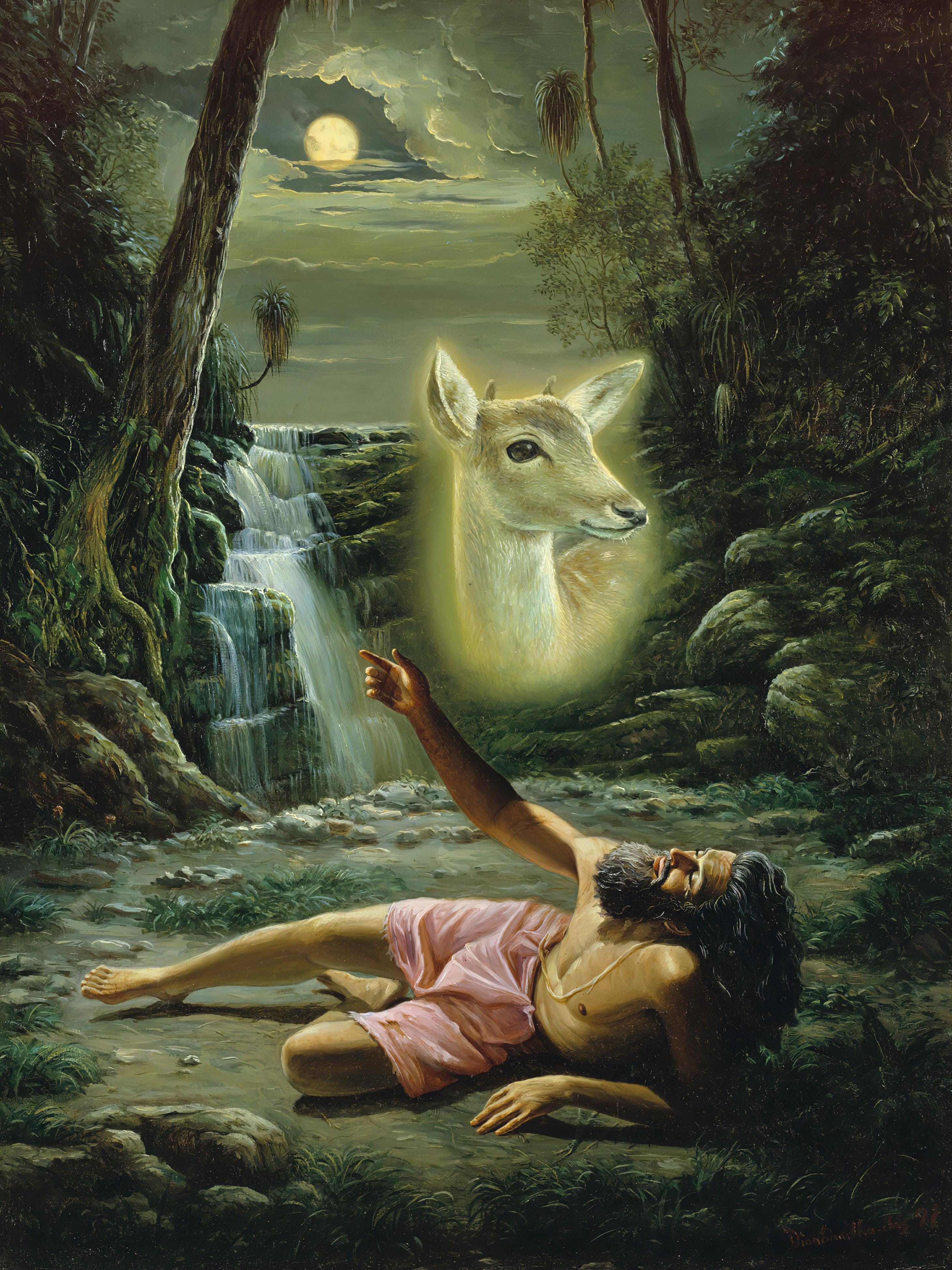
Bharata Maharaja goes mad out of attachment for the deer
The story of Bharata Maharaja becoming attached to the deer and falling from the path of self-realization, even though he was already very close to perfection, teaches us a few valuable lessons about material attachment. We try to become mad after Kṛṣṇa, but he ended up becoming mad after a dear instead, which led him to another material body.
This illustrates the two paths created by these two different types of attraction. We can become mad after Krsna, or we can become mad after sense gratification. Although the symptoms of both types of “madness” can appear similar externally, they lead to very different results.
Before, Bharata was fully engaged in the devotional service of the Lord. All the ecstatic bodily symptoms would manifest, and tears constantly flowed from his eyes. This shows how he had attained a platform of ecstatic love. After meeting the deer, however, this shifted to a single-minded focus on the object of his attachment. This shows how the same way of attention and attachment can be directed to Kṛṣṇa; it can be captured back by the objects of the senses if we are not careful. As long as one hasn’t reached a platform of pure love of Godhead, there is always the possibility of falling back.
Bharata had just one object of the senses competing for his attention, the deer, and we can see that was already sufficient to completely cover his spiritual consciousness. We deal daily with hundreds, if not thousands, of objects of the senses, and this shows how we must put a conscious effort into avoiding distractions and being concentrated in our spiritual practice.
His mentality is described in the Śrīmad Bhāgavatam:
“Alas, the small deer, while playing with me and seeing me feigning meditation with closed eyes, would circumambulate me due to anger arising from love, and it would fearfully touch me with the points of its soft horns, which felt like drops of water. When I placed all the sacrificial ingredients on the kuśa grass, the deer, when playing, would touch the grass with its teeth and thus pollute it. When I chastised the deer by pushing it away, it would immediately become fearful and sit down motionless, exactly like the son of a saintly person. Thus it would stop its play.” (SB 5.8.21-22)
In the later stages, he was no longer able to concentrate on his practice at all. When the deer would disappear, he would start remembering all these episodes. We can notice that he was not lamenting for his lax spiritual practice but for having lost the opportunity of achieving perfection, once having come so close. Instead, he is remembering the small pleasures of his daily association with the deer, idealizing these moments and hankering to see the animal again.
Prabhupāda comments that the King was affected by moha (illusion). These descriptions illustrate how material illusion can cloud our judgment and twist our remembrance. Under the influence of illusion, the ecstasy he experienced in his devotional service appeared insignificant, and the insignificant sensation of being touched by the horns of a small deer appeared to be true happiness. When we become materially attached, this can make us completely forget our spiritual practice and become absorbed in something else. That’s precisely how the illusory potency can keep us under control for such a long time.
In the Kṛṣṇa book, Prabhupāda comments on many episodes where the gopis and other inhabitants of Vṛndāvana would become mad in tough of Kṛṣṇa and would speak in incomprehensible ways. When reflected in the material potency, these transcendental emotions are perverted into the feelings of attachment and loss we experience in this material world. Because we don’t have access to the real thing, our minds become attracted to these material imitations, but the taste and results of these two types of emotion are completely different.
Our next body is defined by a combination of desire and piety. In general, we assume a body connected with what we are attracted to, and our piety determines the opportunities we will have in such a body. Purañjana, for example, became excessively attracted to women, and, therefore, he assumed the body of a woman, but because he had practiced devotional service and many pious activities, he was born in a high-class family as a princess. Similarly, if a woman becomes attracted to her husband or children, she will assume another human body. However, if one becomes attracted to animals or animalistic activities, one will assume an animal body. We can see that this rule applies even to a great personality like Bharata Maharaja. Better to focus our minds on Kṛṣṇa and His devotees.
One may think that he can do anything during his life, and just think about Kṛṣṇa at the time of death, but it doesn’t work in this way. At death, a person always thinks about things he was attached to in this life. To be able to think about Kṛṣṇa at the time of death, we need to practice by remembering him constantly during our lifetime. Bharata Maharaja was on this path, but he got distracted and ended up concentrating on the deer in the last part of his life. Thus, following the general karmic rules, he assumed the body of a deer. As Kṛṣṇa explains in the Gītā (8.6): “Whatever state of being one remembers when he quits his body, that state he will attain without fail.”
However, because of his past devotional service, He was protected by the Lord, who kept his remembrance intact, even in the body of a deer. This made Bharata again determined to finish his devotional service and go back home, back to godhead. The Lord could have protected him from the natural result of his activities, but seeing that receiving the body of a deer would be favorable in the long run, the Lord decided to keep this result, but at the same time kept his memory, giving him the conditions for realizing his mistake and quickly coming back to the path. This is yet another example of how a devotee is always protected by the Lord, even when one willingly abandons his spiritual practice.
Prabhupāda connects the situation of Bharata Maharaja with our practical reality. Even though a devotee is generally protected from the results of karma, the Lord can allow a devotee to face difficulties, so one can be corrected and return to his spiritual practice. In he gives one example in this direction: devotees who willingly commit sinful activities while living in Vṛndāvana often are reborn as dogs, monkeys, and tortoises there. In such a birth, they can live in the holy land without the possibility of committing new sinful activities, and in this way return home, back to Godhead.
Such a punishment is thus also a form of mercy, just as in the case of Bharata Maharaja, but this doesn’t make the immediate results any less unpleasant. We are thus urged to just take the direct path and practice without deviation. As Prabhupāda explains, the secure position for someone wanting to go back home, back to Godhead in this lifetime is to see that every moment is used for rendering some form of service to the Lord.
How is this full concentration possible? We can achieve this position by connecting all our actions with Kṛṣṇa, as He explains in the Bhagavad-gītā. There are nine limbs of devotional service, starting with śravaṇam kīrtanam. Sometimes we may do some practical service, other times we may hear about Kṛṣṇa, chant, describe his glories, pray, etc., or simply remember Him. In the beginning, there may be many distractions, but if we get a little bit of taste, we can be caught in the devotional flow of just doing one devotional activity after another, day after day.
However, as this pastime of Bharata Maharaja illustrates, we should not become careless. As long as we are under the influence of material illusion, we need to always put a conscious effort to continue progressing, just as a person cast into the ocean has to make a continuous effort to stay afloat.
What happened to him after assuming the body of a deer?
Remembering the devotional practice of his previous life and lamenting having been demoted to the body of a deer, Bharata returned to the same Pulaha-āśrama, where he was practicing in his first life, and practiced austerities, remaining alone and eating dry leaves only. In this way, he passed the time allotted to him in that animal form, remembering the Supreme Lord.
So elevated was the consciousness of Bharata Maharaja that even in the body of a deer, he could remember and offer prayers to the Lord while leaving his body, as revealed in text 5.14.45:
“Even though in the body of a deer, Mahārāja Bharata did not forget the Supreme Personality of Godhead; therefore when he was giving up the body of a deer, he loudly uttered the following prayer: “The Supreme Personality of Godhead is sacrifice personified. He gives the results of ritualistic activity. He is the protector of religious systems, the personification of mystic yoga, the source of all knowledge, the controller of the entire creation, and the Supersoul in every living entity. He is beautiful and attractive. I am quitting this body offering obeisances unto Him and hoping that I may perpetually engage in His transcendental loving service.” Uttering this, Mahārāja Bharata left his body.”
You can also donate using Buy Me a Coffee, PayPal, Wise, Revolut, or bank transfers. There is a separate page with all the links. This helps me enormously to have time to write instead of doing other things to make a living. Thanks!