

Subscribe to receive new articles by e-mail. It’s free, but if you like, you can pledge a donation:
Jambūdvīpa, the central island of Bhū-mandala, is composed of several celestial places where pious souls reap the results of their past karma.
Bhārata-varṣa, however, is different from these other varṣas. It is the place where those who have exhausted their past karma, coming either from the other varṣas or animal species, take birth to perform a new set of work that will decide where they will go next.
Because Bhārata-varṣa is a crossroads from where all kinds of souls take birth, it’s possible to encounter people influenced by all three modes of nature, some taking birth as exalted persons, ordinary men or women, or degraded personalities. These births are not by chance but according to their past work. Lord Kapila mentions in the 3rd canto that when a human being acts sinfully and goes to hell, he takes his next human birth (after passing through the animal species) in a similar situation to that of his previous human birth and then has the opportunity of doing differently. Similarly, souls coming back from the celestial planets take births according to their natures.
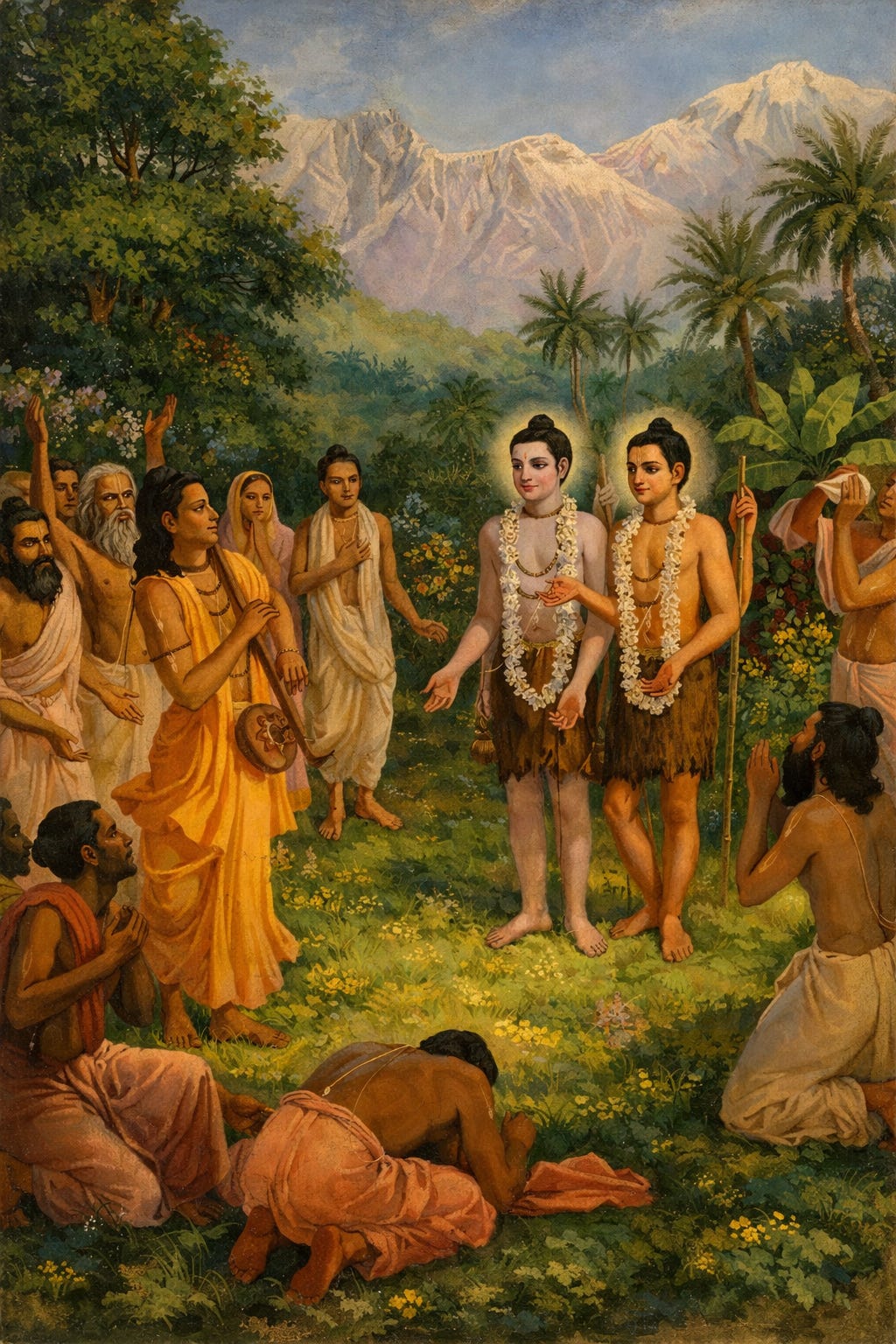
The predominant deities for Bhārata-varṣa are Nara-Nārāyaṇa, the twin sages, who perform austerities in Badarīkāśrama to give example to all human beings on how to attain the perfection of life. Who exactly are they? In his purport to SB 4.1.59, Prabhupāda reveals that they are none other than Kṛṣṇa and Arjuna.
Nara-Nārāyaṇa Ṛṣi lives accompanied by many other great sages, including Vyāsadeva himself, in the high-dimensional Himalayas, in an āśrama that is accessible only for highly qualified persons. From there, they instructed many great sages over the ages, including Nārada Muni.
In the 11th canto (11.29.41-44), it is described that Kṛṣṇa sent Uddhava to Badarīkāśrama to give instructions to the many great sages living there. These sages had no opportunity to personally associate with Him, and thus Kṛṣṇa sent His representative to meet with them.
In the 5th canto of Śrīmad Bhāgavatam, Nārada Muni instructs the inhabitants of Bhārata-varṣa to worship the Lord by performing their prescribed duties according to the varnāśrama system. Of course, in Kali-yuga, the system is gradually forgotten, but it used to be followed strictly in the previous areas.
Kṛṣṇa explains in the Gītā that material energy is very difficult to overcome, but those who surrender to Him can easily cross beyond it. Because the jīva is very small, we can be very easily overpowered by the illusory energy, but when we become again connected with Kṛṣṇa, it suddenly appears to not be any larger than the water contained in the hoofprint of a calf. This connection with Kṛṣṇa, which allows us to overcome all material conditioning, including the material desires of the mind, sinful habits, and so on, is the ultimate goal of the process of mystic yoga taught by Nara-Nārāyaṇa Ṛṣi.
In conditioned life, material attachment is the norm. Even lower animals, such as insects and fish, run away when they are threatened. This indicates that even in such primitive forms, the soul is attached to the body. As soon as consciousness is present, material attachment becomes prominent.
Kṛṣṇa Consciousness is the natural antidote for material attachment, and therefore, we can measure our advancement by simply measuring how attached we are to our bodies, the objects of the senses, and the whole idea of enjoying the world. Ideally, we should develop detachment while still engaged in our material duties and become externally renounced only after completing this process of internal renunciation. As Kṛṣṇa explains in the Gītā, “One who restrains the senses of action but whose mind dwells on sense objects certainly deludes himself and is called a pretender.”
One of the most reliable ways to measure attachment is by reflecting on how much we are afraid of death. A genuinely detached person doesn’t fear death, understanding that he is serving Kṛṣṇa now and will simply continue serving Kṛṣṇa in a different situation. Fear of death means attachment to the body; therefore, if we are practicing for a long time, but are still afraid of death, it means we are not reaping the results of all this spiritual practice.
However, even detachment is not the final goal. Becoming free from material attachment means being elevated to the platform of liberation. From there, there is still a way to go until we attain the ultimate goal, which is pure devotional service to the Lord.
Prabhupāda uses the word “liberation” in a few different senses in his purports. One of them is in the sense of being free from the influence of the material modes. One can be free from the material modes while still living in a material body and trying to perfect one’s Kṛṣṇa Consciousness. Another sense is in going back to Godhead. Living without attachment means attaining the first type of liberation, and by continuing to practice on this platform, we attain perfection and attain the second type of liberation, joining Kṛṣṇa in his pastimes.
In this way, devotional service is the most elevated process of self-realization. All other processes, including karma and jñana, are effective only to the extent they are combined with bhakti. Bharata-varṣa is considered the ideal place for practicing devotional service, and thus, although a human birth may not be as glamorous as a birth as a demigod, it gives us the opportunity to not take birth again in this material world.
You can also donate using Buy Me a Coffee, PayPal, Wise, Revolut, or bank transfers. There is a separate page with all the links. This helps me enormously to have time to write instead of doing other things to make a living. Thanks! You can also receive the updates on Telegram.