


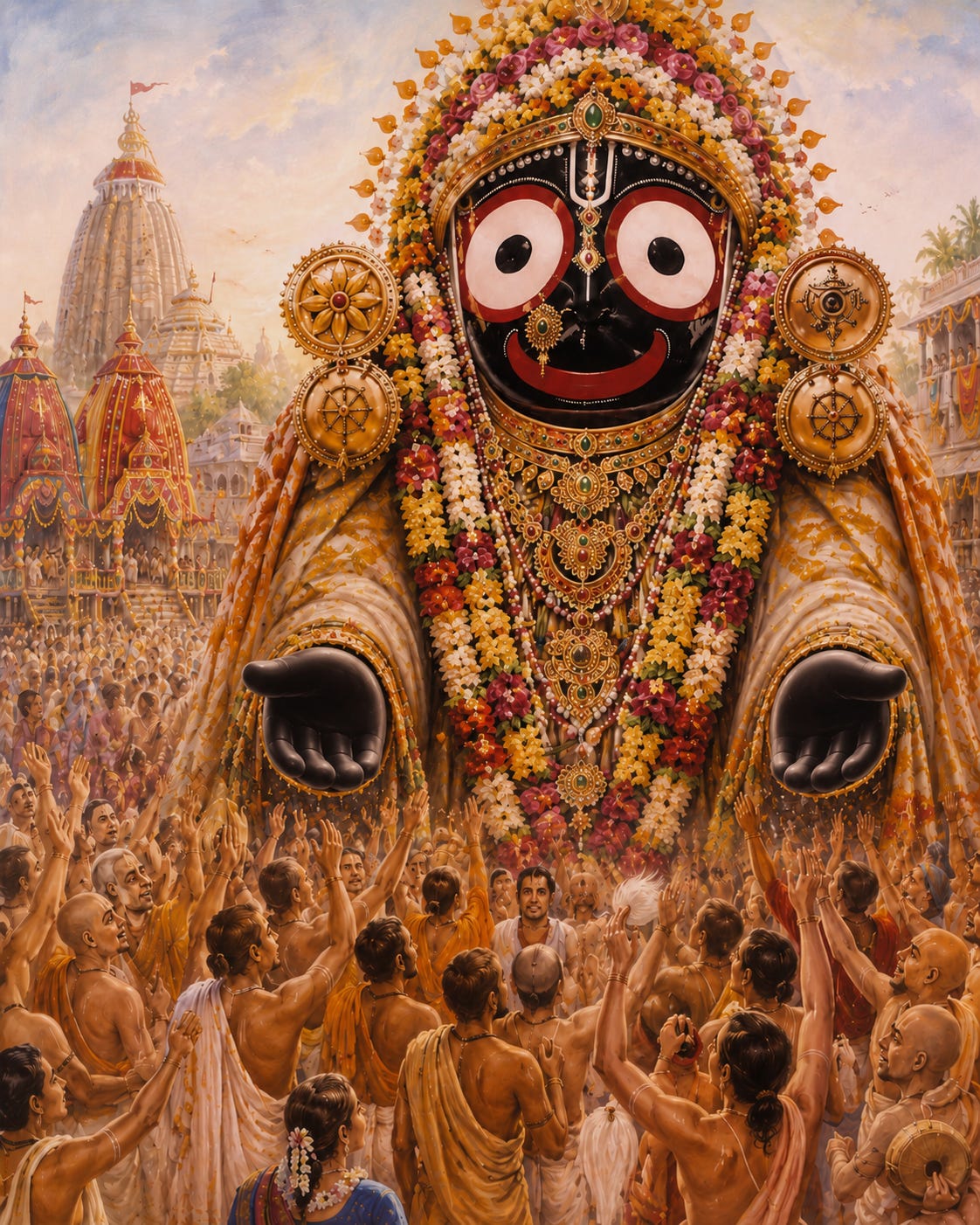
A few months ago, I published an article entitled ‘Learning Krsna Consciousness in the age of AI’, where I discussed the proper usage of AI in Kṛṣṇa consciousness and whether it should be used at all.
This article is a continuation, where we discuss potential bona fide uses for it, in which AI may improve our service, instead of becoming just a tool for producing slop, what the limits are, and where it should definitely not be used.
The main problem with AI is that many see it as some kind of miraculous oracle. They ask questions and believe the answers. This is the most dangerous situation because in this case, the chatbot is essentially put in the position of a guru. Genuine spiritual realization is then replaced by a computer using algorithms to formulate answers based on the probability of words appearing together in certain contexts. It’s well documented how AI often makes mistakes even in simple applications, so what to say in discussing complicated spiritual topics? We can’t replace spiritual realization with algorithmic probability.
Prabhupāda warned us about relying on inferior sources for spiritual knowledge, such as mental speculation or material research, and relying instead on the chain of paramparā for receiving perfect knowledge. A chatbot is essentially an artificial mind that works by churning material produced by imperfect human minds (the whole content of the internet) and processing it using algorithms. It can’t be trusted as a source of perfect knowledge. There is an enormous difference between a computer operating in terms of statistical probability and a self-realized soul instructing based on transcendental insight.
Instead, a chatbot should be seen as an evolution of another tool we are all very familiar with: a search engine. In essence, that’s what a chatbot does when we ask a question. It researches and creates an answer mixing components of different references, according to the algorithm. We should be able to see beyond it, recognizing the fragments of information and understanding how they are being put together by the computer. It works better if, instead of asking a direct question, we ask it to collect different sides of the argument and give us a list of points with references we can check and come up with an answer, instead of a finished text.
For example, instead of asking, “Was the soul previously with Kṛṣṇa?” (which allows the AI to speculate and give an unpredictable answer)
We may instruct: “Run research on Śrīla Prabhupāda’s statements about the original, constitutional position of the soul. Give me a set of points. Add a reference to each point. Compare it with statements from previous Vaiṣnava ācāryas with references for the direct quotes.”
The type of information we get in the two is very different. The first will return AI slop; the second will return material we can use as the beginning of a research, a set of references we can verify and cross-check. This makes all the difference. Instead of taking a passive role, accepting whatever the AI feeds us, we use it as a tool for researching and exercising our brains.
Similarly, when we try to write something, we can use the AI as an intern to perform repetitive or time-intensive tasks, or as a tool to brainstorm and test ideas, instead of an electronic oracle or as a replacement for our brains.
You can use a prompt to get a list of points and references on almost anything and use it as a start for a research, and then further use it for researching information while composing our article. It can help to find verses and other references when we don’t remember the exact words, research historical usage of different terms and concepts, and so on. And, of course, it can also be used to revise the text. Grammarly and other similar tools also use AI to find grammatical errors. The main point is to use it to give a list of suggestions that we may check and then decide what to use or not, and not allow it to directly edit the text.
In other words, AI is useful when we use it to find information, just as we would use a search engine, or to give suggestions and clear up repetitive tasks, not to do the work for us. That’s the important line that must not be crossed.
What about images? AI can produce terrible pictures that are wrong in many ways. But so is a human artist. The main point is to use it as a tool. We can describe a scene and see what will come out of the prompt, and we will have to judge if what comes out of it properly describes a certain scene or not, and if it is acceptable or not.
AI will never produce art in the same capacity as a self-realized painter because it has no spiritual vision to internally see a certain spiritual scene and depict it in a painting. On the other hand, AI, when fed with a detailed description, can often create passable illustrations that may be suitable for certain applications after careful supervision. It can be compared with working with an artist who is not a devotee. He will have no spiritual vision to understand what to do, but if properly guided and corrected, he may be able to sometimes produce some passable work. The main point is that frequently, we can understand how a scene is supposed to be composed, but we don’t have the technical means to produce an illustration from this idea. In such cases, AI may be used as a tool to come to something close to what we envisioned. In this case, it is not merely slop, but a form of creation.
In summary, AI can be used to collect information as an evolution of a search engine. For spiritual texts, this can be very useful because it can deal with a lot of information, and the context can be narrowed or expanded as needed. AI can also be used for brainstorming, helping to see different possibilities of arguments that we can use as a starting point for the research of our thesis. However, AI must not be used for final philosophical interpretations. It can help with the research, but the conclusion must come from a devotee and be based on spiritual realization.
AI can thus be used as a tool, but not as a replacement for study, philosophical introspection, authentic spiritual realization, and personal guidance from self-realized devotees. AI is a tool, a thing, and not a spiritual authority for any topic. It can’t be used as a substitute for our brain, as a guru, or even as a friend.
This is a publication for thoughtful readers who want to go deeper into Kṛṣṇa consciousness. I publish daily, trying to offer high-quality spiritual content, and all posts are available to free subscribers. If you wish, you can also choose a paid subscription to support this work.
You can also receive the updates on WhatsApp or Telegram.
If you would like to contribute further, you can find the donation links here.