

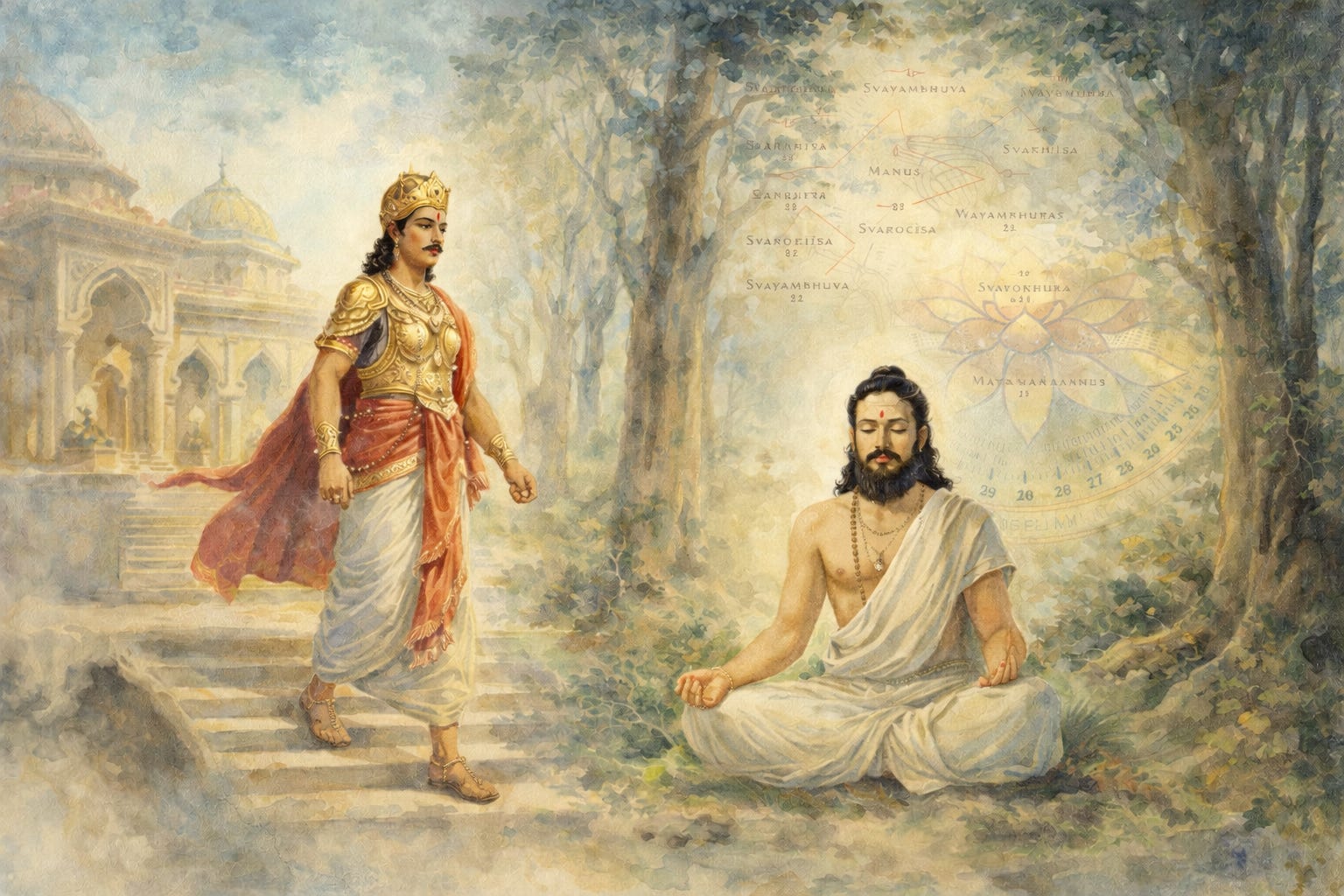
The third canto of Śrīmad-Bhāgavatam mixes narrations of events that happened in the first, sixth, and seventh Manvantaras. There are 14 Manus in each day of Brahmā, and they rule for 306.72 million years each.
The description of Vidura approaching Uddhava and Maitreya, which is the background for the discussions of the 3rd and 4th cantos of the Śrīmad-Bhāgavatam, happened recently, after the disappearance of Krsna. These are events from the current Manvantara (the 7th). The descriptions of Diti and Kaśyapa Muni begetting children at the prohibited time, the birth of Hiraṇyākṣa and Hiraṇyakaśipu, and the fight of Lord Varāha fighting Hiraṇyākṣa all happened in the 6th Manvantara, while the descriptions of the creation of Brahma and the pastimes of Devahūti, Kardama Muni, and Lord Kapila, Drhuva Maharaja, the three lives of Bharata, etc., happened in the first Manvantara, following the main narration of the creation starting from Brahma.
Two personalities, however, challenge our understanding by appearing both in the description of events from the first Manvantara and from the sixth: Daksa (in his second birth) and Cākṣuṣa.
We studied the life of Daksa in a number of previous articles. He offended Lord Śiva in the first Manvantara, and for that, he ended up receiving the head of a goat. The latter left that body and was reborn as the son of the Pracetas, a life he used to practice great austerities to regain his post as the principal prajapati.
Cākṣuṣa also appeared as a descendant of Dhruva Maharaja. While he was reigning as a king, Dhruva had two sons: Utkala and Vatsara. Both were extremely qualified, but Utkala was a mahā-bhāgavata from birth and thus not interested in managing a kingdom. To avoid becoming entangled in politics and material activities, he hid his true qualifications by acting externally like a foolish, blind, and dumb person, while internally remaining fixed in the worship of the Lord. This led the ministers and elders to consider him mad and appoint his younger brother, Vatsara, as the successor to the throne. It’s described that Utkala remained like fire covered with ashes, remaining as a bhajanānandī for life, without ever showing his real qualification. In this way, he avoided all material relationships and lived free from botheration and unfavorable situations created by materialistic persons.
Vatsara married Svarvīthi and had six sons: Puṣpārṇa, Tigmaketu, Iṣa, Ūrja, Vasu, and Jaya. From these, the oldest, Puṣpārṇa, became the next king. He had two wives, Prabhā and Doṣā. The first became the mother of Prātar, Madhyandinam, and Sāyam, and the second of Pradoṣa, Niśitha, and Vyuṣṭa. In this way, Puṣpārṇa had six sons. Vyuṣṭa became the next in the line and was married to Puṣkariṇī. Their son, Sarvatejā, got married to Ākūti (different from the daughter of Svāyambhuva Manu) and gave birth to Cākṣuṣa.
Cākṣuṣa married Naḍvalā and begot 12 sons: Puru, Kutsa, Trita, Dyumna, Satyavān, Ṛta, Vrata, Agniṣṭoma, Atīrātra, Pradyumna, Śibi, and Ulmuka. Ulmuka married Puṣkariṇī and begot six sons: Aṅga, Sumanā, Khyāti, Kratu, Aṅgirā, and Gaya. Aṅga became the next in the succession line and married Sunīthā. Their son was Vena, who is the center of the narration that leads to the appearance of Pṛthu Maharaja.
The same Cākṣuṣa, however, later became the 6th Manu. This means he lived for billions of years more after being a king, just like Daksa after being reborn as the son of the Pracetas.
Contemporaneous commentators of the Purāṇas often come to contradictory conclusions about their lives and lineage, since they can’t conceive that they could live for so long, but the Śrīmad-Bhāgavatam and the commentary of Śrila Prabhupada reveal the true accounts. Both Daksa (after his rebirth) and Cākṣuṣa lived all the way from the first to the sixth Manvantara when they finally assumed their posts. This happened because both were able to attain extremely long lifespans through the practice of austerities.
Although generally, people from Satya-yuga live for up to 100,000 years, people from Treta-yuga for 10,000 years, demigods for 306.72 million years (a Manvantara), etc., great sages who practice austerities can often attain much longer lifespans. In fact, inhabitants of the highest planetary systems (Satyaloka, Tapoloka, and Janaloka) can live up to the end of the life of Brahma. Mortality is something that exists only in the lower planetary systems, where people are involved in fruitive activities. Great sages and devotees who reach an advanced level of renunciation and mental control become free from the effects of karma and can thus achieve very long lifespans even while living in the earthly planetary system, like in the case of Daksa and Cākṣuṣa, as well as other personalities mentioned in the Śrīmad-Bhāgavatam, such as Mārkaṇḍeya Ṛṣi, Aśvatthāmā, Bali Maharaja, Vyasadeva, Hanuman, Kripacarya, and Parashurama. We can thus see some of them becoming involved in pastimes that happened in different Manvantaras.
Often, these personalities who attain these platforms are engaged in assuming the post of Manu, taking positions among the seven great sages, or even becoming important demigods or Prajāpatis due to their elevated level of qualification, performing these functions out of duty instead of attachment. Bali Maharaja will become Indra in the next Manvantara. Aśvatthāmā, Vyasadeva, Kripacarya, and Parashurama will assume posts among the Saptarṣis, and so on.
Daksa was reborn in the first Manvantara as the son of the Pracetās, while Cākṣuṣa appeared a little earlier, also in the lineage of Dhruva Maharaja. Daksa went to the mountains to practice austerities before generating descendants, but Cākṣuṣa got married, lived like a king, and begot children who continued his line before retiring into his practice of austerities. Later, Cākṣuṣa assumed the post of the 6th Manu, and Daksa resumed his service as the main Prajāpati, also in the 6th Manvantara.
Daksa had 16 daughters in his first birth and then 60 more daughters in his second birth. He also had a number of sons during the 6th Manvantara, but they all became renunciants after being instructed by Nārada Muni, without leaving descendants. Cākṣuṣa, in turn, had 12 sons in the first Manvantara. It’s not described if he had more sons, like Manu, in the 6th Manvantara, but we know that Satyavrata, the current Manu (the 7th in the sequence), is not his descendant, being born in the 6th Manvantara as the son of Vivasvān and the grandson of Kaśyapa and Diti.
One may suggest that both Daksa and Cākṣuṣa could have been born much later, at the end of the 5th Manvantara, which certainly would make the narration much easier to explain from a chronological perspective. Although that’s the conclusion of some commentators, it is not supported by the text of the Śrīmad-Bhāgavatam, which describes Cākṣuṣa as a descendant of Dhruva Maharaja and ancestor of the Pracetās, and Priyavrata assuming the throne still in the first Manvantara after the second birth of Daksa.
This is a publication for thoughtful readers who want to go deeper into Kṛṣṇa consciousness. I publish daily, and all posts are available to free subscribers. If you wish, you can also choose a paid subscription to support this work.
If you would like to contribute further, you can find the donation links here.
Thank you perhaps you can help me understand Bharata’s age of renunciation.
Śrīmad Bhāgavatam 5.7.8 says it happened after 10 million years and
Śrīmad Bhāgavatam 5.14.43 says it happened in yuva, youth.
Śrīla Prabhupāda mentions in a lecture, at the age of 24.