

You can receive new articles directly in your inbox. Subscription is free; donations are welcome.
One problem we have in our movement (and in modern society in general) is that it is difficult for women to find a proper husband and become settled in family life. There are, of course, many men interested in associating with ladies, but when it comes the time to accept responsibilities, most of them shy away. We see that even qualified women frequently find it difficult to get married. Another issue is that getting married is also not a guarantee of anything, since divorces are also very common. Even if a lady does find a husband, there is no guarantee that this man will stay her whole life with her.
In traditional societies, association with ladies is conditioned to marriage. If a man wants a woman, he has to get a wife and accept responsibility for maintaining a family. In modern societies, however, men and women associate freely, and this reduces the number of people interested in entering into a stable relationship. As Prabhupāda concedes, one will not want to maintain a cow if he can just get milk from the market. This is just how human psychology works.
We come, then, to how things work within our spiritual movement. Theoretically, we are supposed to be traditional in our movement, with marriage being the only acceptable way of having a loving relationship, but we can see that in practice we more or less follow the general culture, with people dating and entering into relationships without necessarily having the intention of getting married. In this way, the problem ends up affecting us more or less in the same way it affects the general society.
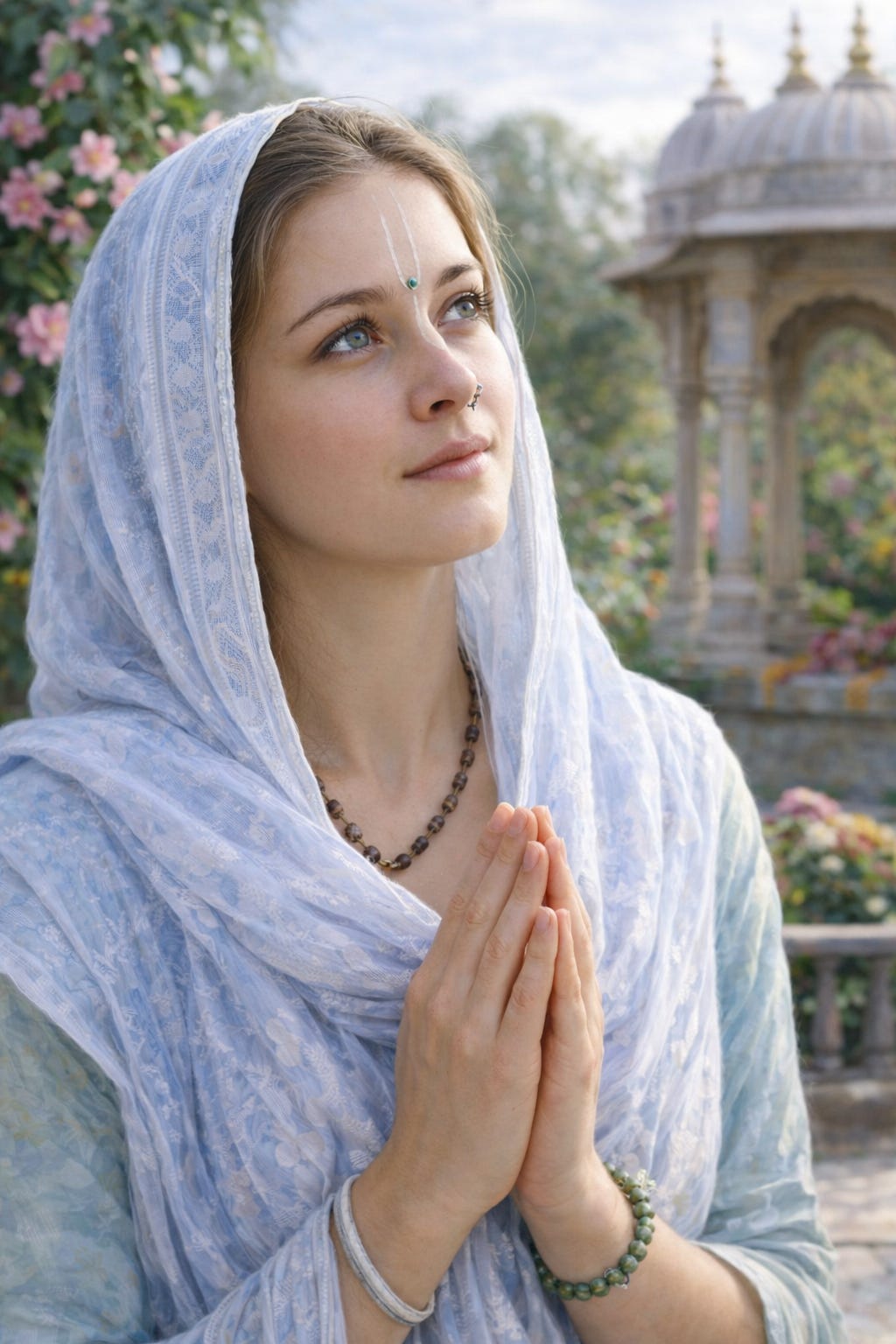
Another problem is that nowadays we have more women than men coming to our movement. In some countries, the proportion may still be more or less the same, but when we take it globally, especially in countries like China and Russia, there are definitely more women than men. Ideally, devotees should marry devotees, and a lady should try to marry a man who is more mature and more spiritually advanced than herself, who can support her on the path back to Godhead. However, we can see that nowadays this is quite rare. Many ladies in our movement have to choose between marrying whatever devotee man is available, marrying someone from the outside, or risking remaining single for life.
In such a situation, many end up marrying men who are not devotees. I used to think of this as a terrible thing, but over the years, I saw a few cases that changed my opinion to a certain extent.
We frequently think of the division between “devotees” and “non-devotees” as a black-and-white distinction, but in reality, it is more like a multitude of gradations of gray. Not all “devotees” are very pious or devotional, and not all “non-devotees” are completely atheistic. We can frequently see that devotees often show quite negative qualities, while many “non-devotees” are actually quite pious and good-natured. Usually, these are people who are not atheists, but “spiritual but not religious” people who have some faith in God, but don’t identify with any particular religious process, or who are non-practicing Christians or Muslims. Such men often value having a wife who is serious about practicing a spiritual process, even if they themselves are not practicing. This can often lead to workable marriages, where the husband supports the lady in her practice and is favorable to the children receiving spiritual education, even while he is not directly practicing. The tendency in such families, however, is that gradually the husband also becomes a devotee over time, due to association.
The secret here is maturity. A woman who is fanatic and attached to externals will not work in this situation, but someone who is more mature in her spiritual practice and can understand the difference between primary and secondary principles may find ways to adjust. Many are nowadays vegetarian, and many will also not be against avoiding alcohol and drugs, as well as gambling, but of course, the fourth principle may be a problem in such cases. One will have to be flexible in this regard and try to find some compromise, operating under the principle of being attentive to the partner’s needs instead of strictly following a fixed set of rules.
Some argue that polygamy could be a solution to this problem of having more ladies than men in our movement, but as we discussed in a previous article, I believe this can cause more problems than it can solve. We can see that the final decision of Prabhupāda was against it, and by studying the pros and cons we can easily understand why he decided so. I don’t believe that we would still have an organized movement nowadays, in any shape or form, if polygamy were allowed. We can imagine all the scandals from the 1980s and 1990s with polygamy on top. It would have been madness.
More ladies than men in our movement also leads to serial polygamy (men abandoning their families and then remarrying), which is, in many senses, even worse than regular polygamy, because it leads to abandoned women and neglected children. Devotee ladies marrying pious men from the outside and gradually making them devotees sounds like a better idea to me. Even if there is a shortage of men in our movement, there are about 4 billion men outside, and some of them are pious. I believe this is a possibility that could be better discussed.
Married life is always a compromise anyway, with even the most serious devotees having difficulties following a path of complete, pure devotion in family life. In many cases, it may be easier to practice spiritual life with a partner who is supportive, although not practicing very seriously, than with a judgmental or abusive “devotee” husband.
This is a publication for thoughtful readers who want to go deeper into Kṛṣṇa consciousness. I publish daily, trying to offer high-quality spiritual content, and all posts are available to free subscribers. If you wish, you can also choose a paid subscription to support this work.
You can also receive the updates on WhatsApp or Telegram.
If you would like to contribute further, you can find the donation links here.
Hare Krishna prabhuji, PAMHO. I had a question different from today's essay.
While I just began reading Bhagavad Gita, one claim of Srila Prabhupada was confusing to me. In the Introduction of BG, he says "atleast theoretically accept Krishna as SPOG". The thing confusing about this is, there is no formal proof given, this is just a proposition, which is satisfied in the verses ahead in which Krishna says he is the SPOG. Isn't this kind of a circular logic? There is no formal proof given, just a claim and a verse confirming the claim.
I come from a devotee family, so it's easy for me to accept, but when I shared this with my friends, they said that "why should I even assume this proposition? Before this proposition, there must be a formal proof given that God must exist, then God is not some light, and then Krishna is God. How can you make claims just off a book?" I was actually very bewildered at that time, so can you please tell me how to approach KC in a formal way, which will make everything logical, in a more formal way, beginning from proof of God's existence to this SPOG claim to a formal proof?