


You can receive new articles directly in your inbox. Subscription is free; donations are welcome.
Most of our dreams are just creations of the mind. Different fragments of memories are put together, creating different images we see in dreams. Nothing of it is really original, even if we may at first think so. For example, one may see a mountain and see gold, and in a dream the mind may combine both into a golden mountain. One may hear about Africa and lions, and then have a nightmare of being chased by a lion in an African savanna. Just as an AI chatbot can create images based on fragments of other images available on the internet, our mind creates this types of scenes we see in dreams.
However, what about cases of people receiving information in dreams about things and facts they never experienced before?
According to the Vedas, this is also a real possibility. The point is that what we consciously know is limited to just a subsection of what we experienced in this life, not even all of it. We may not remember many things that happened when we were children, but this information is still stored somewhere in the subconscious mind. Even more interesting is the explanation that the mind is independent of the body, and thus memories from past lives are carried from one body to the other. In fact, we have memories from thousands of past lives stored in our subconscious, and this affects the way we think and behave; it shapes our fears and so on. Some of these memories can even be uncovered through past-life regression, which often can bring interesting answers.
There is, however, something above even that, which is the presence of the Supersoul inside the heart. While we, the soul, have memory of our individual experiences, part of it in the conscious mind, and most in the unconscious, the Supersoul witnesses the experiences of everyone, and knows everything. This Supersoul is also present in our heart, and can give us knowledge when necessary. This is explained in the Bhagavad-gītā:
The living entity carries his conceptions of life from one body to another, just as the air carries fragrances from their source. In this way, he accepts and abandons different bodies. (Bg 15.8)
Accepting another set of senses — ears, eyes, the sense of touch, tongue and nose, centered around the mind — the living entity experiences their respective objects. (Bg 15.9)
Within this body there is another transcendental person, the Supreme Lord, who is the witness, permitter, maintainer and supreme enjoyer. He is known as Paramātmā, the Supersoul. (13.23)
O Arjuna, I know all living beings and everything that has happened in the past, is happening in the present and will happen in the future. Yet no one knows Me. (Bg 7.26)
I am situated in everyone’s heart, and from Me arise remembrance, knowledge and forgetfulness. I am the object of knowledge in all the Vedas, the compiler of Vedānta and the knower of the Vedas. (Bg 15.15)
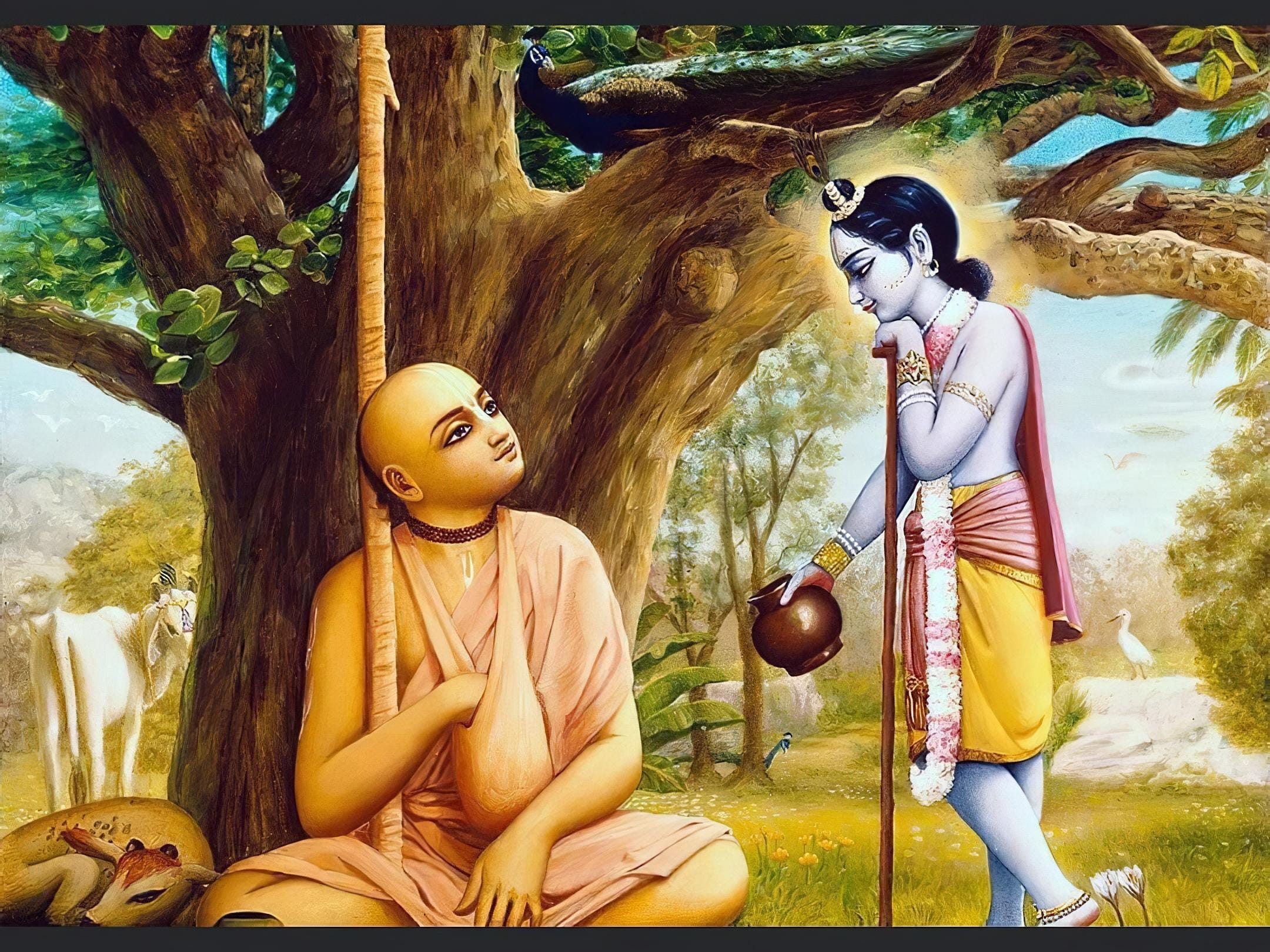
There is a particularly interesting example of this in the Caitanya-caritāmṛta, where Mādhavendra Purī sees the Supreme Lord directly in a dream and receives instructions from him.
While visiting Vṛndāvana, Mādhavendra Purī spent a night under a tree, near Govardhana Hill. This was common at the time. Sannyasis were used to sleep in the open while traveling, sometimes under trees, in courtyards, etc. A sannyāsi would carry only a waterpot, a quilt, and a staff, and would beg food once per day from householders, depending only on the protection of the Lord. That day, however, Mādhavendra Purī received his daily meal from a very special visitor:
“Once, Śrī Mādhavendra Purī traveled to Vṛndāvana, where he came upon the hill known as Govardhana.
Mādhavendra Purī was almost mad in his ecstasy of love of Godhead, and he did not know whether it was day or night. Sometimes he stood up, and sometimes he fell to the ground. He could not discriminate whether he was in a proper place or not.
After circumambulating the hill, Mādhavendra Purī went to Govinda-kuṇḍa and took his bath. He then sat beneath a tree to take his evening rest.
While he was sitting beneath a tree, an unknown cowherd boy came with a pot of milk, placed it before Mādhavendra Purī and, smiling, addressed him as follows.
“O Mādhavendra Purī, please drink the milk I have brought. Why don’t you beg some food to eat? What kind of meditation are you undergoing?”
When he saw the beauty of that boy, Mādhavendra Purī became very satisfied. Hearing His sweet words, he forgot all hunger and thirst.
Mādhavendra Purī said, “Who are You? Where do You reside? And how did You know that I was fasting?”
The boy replied, “Sir, I am a cowherd boy, and I reside in this village. In My village, no one fasts.
“In this village a person can beg food from others and thus eat. Some people drink only milk, but if a person does not ask anyone for food, I supply him all his eatables.
“The women who come here to take water saw you, and they supplied Me with this milk and sent Me to you.”
The boy continued, “I must go very soon to milk the cows, but I shall return and take back this milk pot from you.”
Saying this, the boy left the place. Indeed, He suddenly could be seen no more, and Mādhavendra Purī’s heart was filled with wonder.
After drinking the milk, Mādhavendra Purī washed the pot and put it aside. He looked toward the path, but the boy never returned.” (CC Madhya 4.21-33)
This, however, was not all. That night, the same boy appeared in a dream with an important message:
“Mādhavendra Purī could not sleep. He sat and chanted the Hare Kṛṣṇa mahā-mantra, and at the end of the night he dozed a little, and his external activities stopped.
In a dream Mādhavendra Purī saw the very same boy. The boy came before him and, holding his hand, took him to a bush in the jungle.
The boy showed Mādhavendra Purī the bush and said, “I reside in this bush, and because of this I suffer very much from severe cold, rain showers, winds, and scorching heat.
“Please bring the people of the village and get them to take Me out of this bush. Then have them situate Me nicely on top of the hill.
“Please construct a temple on top of that hill,” the boy continued, “and install Me in that temple. After this, wash Me with large quantities of cold water so that My body may be cleansed.
“For many days I have been observing you, and I have been wondering, ‘When will Mādhavendra Purī come here to serve Me?’
“I have accepted your service due to your ecstatic love for Me. Thus I shall appear, and by My audience all fallen souls will be delivered.
“My name is Gopāla. I am the lifter of Govardhana Hill. I was installed by Vajra, and here I am the authority.
“When the Muslims attacked, the priest who was serving Me hid Me in this bush in the jungle. Then he ran away out of fear of the attack.
“Since the priest went away, I have been staying in this bush. It is very good that you have come here. Now just remove Me with care.”
After saying this, the boy disappeared. Then Mādhavendra Purī woke up and began to consider his dream.” (CC Madhya 4.34-44)
The Deity had been hidden in the bushes when Muslims had attacked Vṛndāvana, but somehow the priest was never able to return and recover Him. As a result, He remained for many years in the bush, until Mādhavendra Purī appeared. At that point, no one knew about the Deity; therefore, the information was transmitted through a dream.
Later, after the deity had been properly installed and the worship was going on, the Lord appeared to Mādhavendra Purī with another mission:
“In this way the Deity worship in the temple was very gorgeously performed for two years. Then one day Mādhavendra Purī had a dream.
In his dream, Mādhavendra Purī saw Gopāla, who said, “My bodily temperature still has not decreased. Please bring sandalwood from the Malaya province and smear the pulp over My body to cool Me.
“Bring sandalwood pulp from Jagannātha Purī. Kindly go quickly. Since no one else can do it, you must.”
After having this dream, Mādhavendra Purī Gosvāmī became very glad due to ecstasy of love of Godhead, and in order to execute the command of the Lord, he started east toward Bengal.
Before leaving, Mādhavendra Purī made all arrangements for regular Deity worship, and he engaged different people in various duties. Then, taking up the order of Gopāla, he started for Bengal.”(CC Madhya 4.105-109)
Later, during the trip, Mādhavendra Purī desired to taste some of the sweet rice offered to the deity of Gopīnātha, situated in Remuṇā, Odisha, with the idea of understanding the recipe, so he could cook the same for Gopāla back home. Again, the Lord orchestrated things through a dream, this time appearing to the pūjāri responsible for the offerings:
“Mādhavendra Purī left the temple and sat down in the village marketplace, which was vacant. Sitting there, he began to chant. In the meantime, the temple priest laid the Deity down to rest.
Finishing his daily duties, the priest went to take rest. In a dream he saw the Gopīnātha Deity come to talk to him, and He spoke as follows.
“O priest, please get up and open the door of the temple. I have kept one pot of sweet rice for the sannyāsī Mādhavendra Purī.
“This pot of sweet rice is just behind My cloth curtain. You did not see it because of My tricks.
“A sannyāsī named Mādhavendra Purī is sitting in the vacant marketplace. Please take this pot of sweet rice from behind Me and deliver it to him.”
Awaking from the dream, the priest immediately rose from bed and thought it wise to take a bath before entering the Deity’s room. He then opened the temple door.
According to the Deity’s directions, the priest found the pot of sweet rice behind the cloth curtain. He removed the pot and mopped up the place where it had been kept. He then went out of the temple.
Closing the door of the temple, he went to the village with the pot of sweet rice. He called out in every stall in search of Mādhavendra Purī.
Holding the pot of sweet rice, the priest called, “Will he whose name is Mādhavendra Purī please come and take this pot! Gopīnātha has stolen this pot of sweet rice for you!”
The priest continued, “Would the sannyāsī whose name is Mādhavendra Purī please come and take this pot of sweet rice and enjoy the prasādam with great happiness! You are the most fortunate person within these three worlds!”
Hearing this invitation, Mādhavendra Purī came out and identified himself. The priest then delivered the pot of sweet rice and offered his obeisances, falling flat before him.
When the story about the pot of sweet rice was explained to him in detail, Śrī Mādhavendra Purī at once became absorbed in ecstatic love of Kṛṣṇa.” (CC Madhya 4.125-136)
In his purport to text 135, Prabhupāda makes an interesting point: “Had the brāhmaṇa priest been an ordinary brāhmaṇa, Gopīnātha would not have spoken with him in a dream.”
Kṛṣṇa is everywhere and can speak with everyone. He doesn’t even depend on being seen by our eyes or heard through our ears to transmit knowledge to us; He can do it directly through the heart. In fact, He guides everyone continuously, both human beings and animals. When we see a bird making a nest, without ever being taught how to do so, we call it “instinct,” but, in fact, this is the guidance of the Supersoul from within, giving this bird the information it needs to continue living. In the case of human beings, this guidance appears as intuition, or conscience. Human beings, however, have free will to accept or not this guidance.
One point, however, is that the fact that the Supersoul is present in everyone’s heart does not mean that everything that comes to our minds comes from Him. Most of the time we are simply dealing with our desires, memories, and concoctions. However, when correct advice appears, we can understand it comes from Him. We then have the choice of accepting it or not,
However, Kṛṣṇa appearing directly to someone to give instructions, like in the case of Mādhavendra Purī and the brāhmana, is something rarer.
In any case, we spend much of our lives trying to obtain knowledge from external sources, without realizing that there is someone in our hearts who has been traveling with us for many lives, and already has all knowledge. As we develop our relationship with Him and become more connected with Him, this unlimited source of all knowledge may start directly speaking to us, like in the case of Mādhavendra Purī.
Read more:


This is a publication for thoughtful readers who want to go deeper into Kṛṣṇa consciousness. I publish daily, trying to offer high-quality spiritual content, and all posts are available to free subscribers. If you wish, you can support this work with a monthly contribution. When you subscribe, you can choose between a free subscription and a monthly contribution, and you can switch from a free subscriber to a supporter at any time.
You can also receive updates on WhatsApp or Telegram.
If you would like to contribute further, you can find the donation links here.