


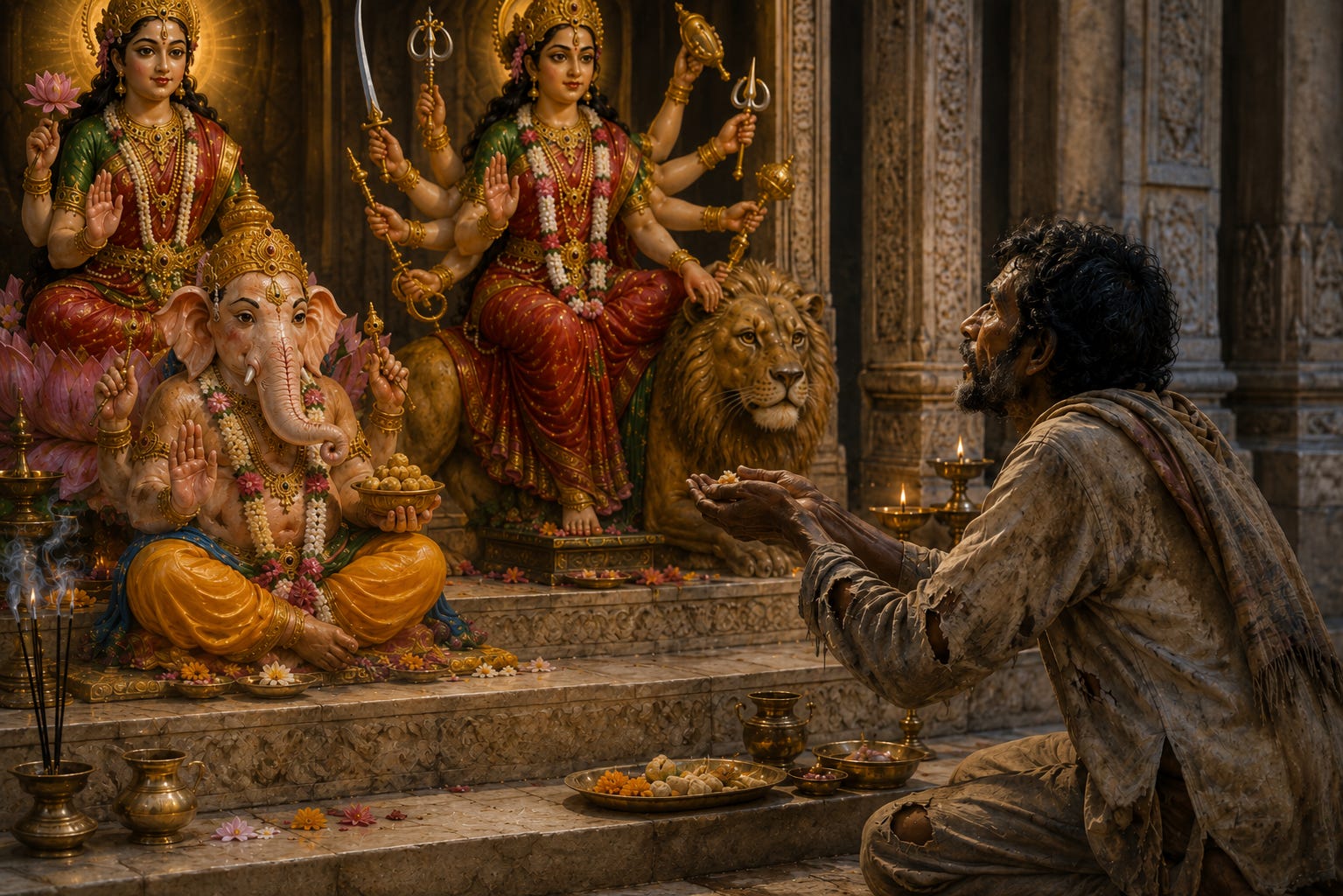
We can observe that in India, many worship demigods. Images of Laksmi, Durgā, and Gaṇeśa are almost universally worshiped by Hindus. People believe that by worshiping them, they can achieve material wealth. Often, we can definitely see the correlation: many Hindus are absurdly rich, especially many living abroad. We will also hear many anecdotal accounts: people being promoted at work, growing their businesses, solving family problems, having their visas approved, etc.
Philosophically, however, this worship can be a confusing topic.
First, can demigods really make their worshipers rich? Kṛṣṇa Himself mentions this in the Gītā (4.12):
“Men in this world desire success in fruitive activities, and therefore they worship the demigods. Quickly, of course, men get results from fruitive work in this world.”
This, however, brings us a philosophical problem: We are supposed to live according to the results of our karma. What we get is supposed to be determined by our past pious and impious activities, as well as the type of activities we perform in this life. Therefore, how to understand that some may cut the line by worshiping demigods?
Firstly, it’s important to define what kind of results worshipers of demigods attain. We tend to see material wealth as something permanent, and this is even reflected in our language. We say “he is rich” as if the “rich” state is something permanent, while in reality, it is just a temporary state. He was not rich in the past, and he will not be rich in the future. His wealth is restricted to the present. “He is rich” is, therefore, practically speaking, like saying “he is dressed in blue”. It is a temporary state. Unless he acts piously in this life, this status will not continue in the future or in the next lives.
Kṛṣṇa also explains that in the Bhagavad-gītā, when He mentions:
antavat tu phalaṁ teṣāṁ, tad bhavaty alpa-medhasām
devān deva-yajo yānti, mad-bhaktā yānti mām api
Prabhupāda translates this verse as follows:
“Men of small intelligence worship the demigods, and their fruits are limited and temporary. Those who worship the demigods go to the planets of the demigods, but My devotees ultimately reach My supreme planet.”
The key words in our context are antavat tu phalaṁ teṣāṁ, tad bhavaty alpa-medhasām. The fruits (phalam) of the worship of demigods are perishable (anta-vat). Their benefit is only temporary, and therefore, they are pursued only by people of small intelligence (alpa-medhasām).
Different from what many believe, demigods are not separate deities. The Absolute Truth is just one, which is understood in three aspects: Brahman, Paramātmā, and Bhagavān. There are not three concurrent aspects, but three aspects of the same person. The ultimate aspect is Kṛṣṇa Himself, who manifests in many other forms, such as Viṣnu. The same person manifests in different forms. Paramātmā is Kṛṣṇa’s partial manifestation, His localized aspect, while Brahman is just His personal effulgence that permeates everything. These three aspects are worshipped by different classes of transcendentalists.
Demigods, however, are part of the material creation. They are jīvas, souls like you and me, who receive higher posts due to their piety. They are like ministers, who are in charge of managing the universe. They are thus just part of the cosmic governmental apparatus, and not separate controllers.
There are two forms of worship of demigods. The first is the proper way to worship them, as described in the Vedas. This involves careful sacrifices, where ghee, grains, and other items are offered to Viṣnu, and then the prasāda is offered to the demigods. This form of sacrifice is actually a form of worship of Viṣnu. The demigods are only secondary beneficiaries, worshiped in relation to Him. In this case, Lord Viṣnu is worshiped, and the material results are delivered through the demigods.
This is called karma-kanda. It is not a form of karmic bypass. It is just a form of pious transaction within the system. A person performs a pious action by performing the sacrifice and thus receives a certain material result.
Nowadays, however, it is very rare to find people who follow this proper process. What most do is to follow some irregular process, where they offer some form of worship, approaching a particular demigod and directly asking for material favors. This process is irregular; it is not prescribed in the Vedas at all. It is like approaching governmental officers directly with bribes to secure favors. Sometimes it may work, sometimes not, but the point is that it is not the proper process.
Just as a proper state maintains all its citizens, everyone receives their means of subsistence according to their past karma. One who properly pays their taxes and acts lawfully is protected by the state, while others who are criminals may go to jail and face a hard time. Jail, however, is also a form of care, for one is being reformed from this criminal behavior so he may become a lawful citizen in the future.
Everyone is supposed to pay their taxes. This part of the analogy is compared to general formal worship of God as prescribed in the Vedas, accepting Him as the ultimate proprietor, just as Kṛṣṇa declares in the Gītā (10.8): “I am the source of all spiritual and material worlds. Everything emanates from Me. The wise who perfectly know this engage in My devotional service and worship Me with all their hearts.”
Demigods may also be honored in this lawful system through proper Vedic ceremonies, just as ministers and others may be offered respect by citizens and hear their complaints in the context of their work for the state. Directly approaching demigods, however, is not part of this system.
How then can we explain that people who do so still often get results? The point is that although this process is irregular, Kṛṣṇa still allows it to a certain extent because this can benefit ordinary people, making them at least accept the existence of superior authorities and submit to them. It is better for a person to worship demigods, even if in an irregular and sentimental way, than to become a plain atheist. A worshiper of demigods may eventually become a devotee of Kṛṣṇa when he receives proper knowledge, but for an atheist, it is more difficult. A worshiper of demigods will also be more prone to follow basic moral rules, such as leading an honest life, giving charity, being vegetarian, etc., understanding that breaking these rules will dissatisfy their deity and potentially bring misfortune. Even though materialistic, a worshiper of demigods is thus more prone to lead a pious life than a gross materialist. The system is thus beneficial to ordinary people, and Kṛṣṇa understands this.
In karmic terms, this is like a form of karmic begging. A poor materialist approaches a demigod through an irregular channel, begging something from him. The demigods have heaps of pious karma to spend; therefore, it is not difficult for them to give something to this poor beggar out of their own pious stocks. It’s just like a poor person approaching a minister with half a samosa, asking for money to repair the roof of his house. As a bribe attempt, the situation is ridiculous, but the minister may just laugh and give some small money out of his own pocket out of pity.
Kṛṣṇa knows about everything. As He declares in the Gītā, He is the creator of the whole universal machine, with all its systems and subsystems. He knows everything, to the smallest detail. Every possibility that exists in the system has a certain purpose, and exists only because He allows it: “As all surrender unto Me, I reward them accordingly. Everyone follows My path in all respects, O son of Pṛthā.”
The point is that worship of demigods for material rewards results only in very temporary benefits. As one comes to a platform of knowledge, he or she understands that this system is ultimately useless and comes to the worship of Kṛṣṇa, the only one who can give permanent benefits. Even if one worships Kṛṣṇa for material rewards, this is fundamentally different from demigod worship. Kṛṣṇa takes more time to give the desired blessings, because He works first in eliminating the causes of the material desire (by giving one spiritual realization), and finally, when one is ready, He gives the desired blessing in a way that it solves the problem for good. We can see the example of Dhruva Maharaja, for example. He approached Lord Viṣnu desiring to obtain a kingdom greater than his father’s, and Lord Viṣnu gave him something much better than what he desired: the eternal rulership of a Vaikuṇṭha planet (Dhruvaloka), which is never destroyed and serves as the central pivot for the whole universe.
Worship of demigods is thus like a hungry person begging coins from random people to buy his next meal. This just solves the immediate problem; it does nothing to help him escape poverty. Tomorrow he will have to do the same again. Worshipping Kṛṣṇa, on the other hand, is just like approaching a trillionaire. When He gives, He will give enough to solve the problem of material struggle for good.
This is a publication for thoughtful readers who want to go deeper into Kṛṣṇa consciousness. I publish daily, trying to offer high-quality spiritual content, and all posts are available to free subscribers. If you wish, you can also choose a paid subscription to support this work.
You can also receive the updates on WhatsApp or Telegram.
If you would like to contribute further, you can find the donation links here.