


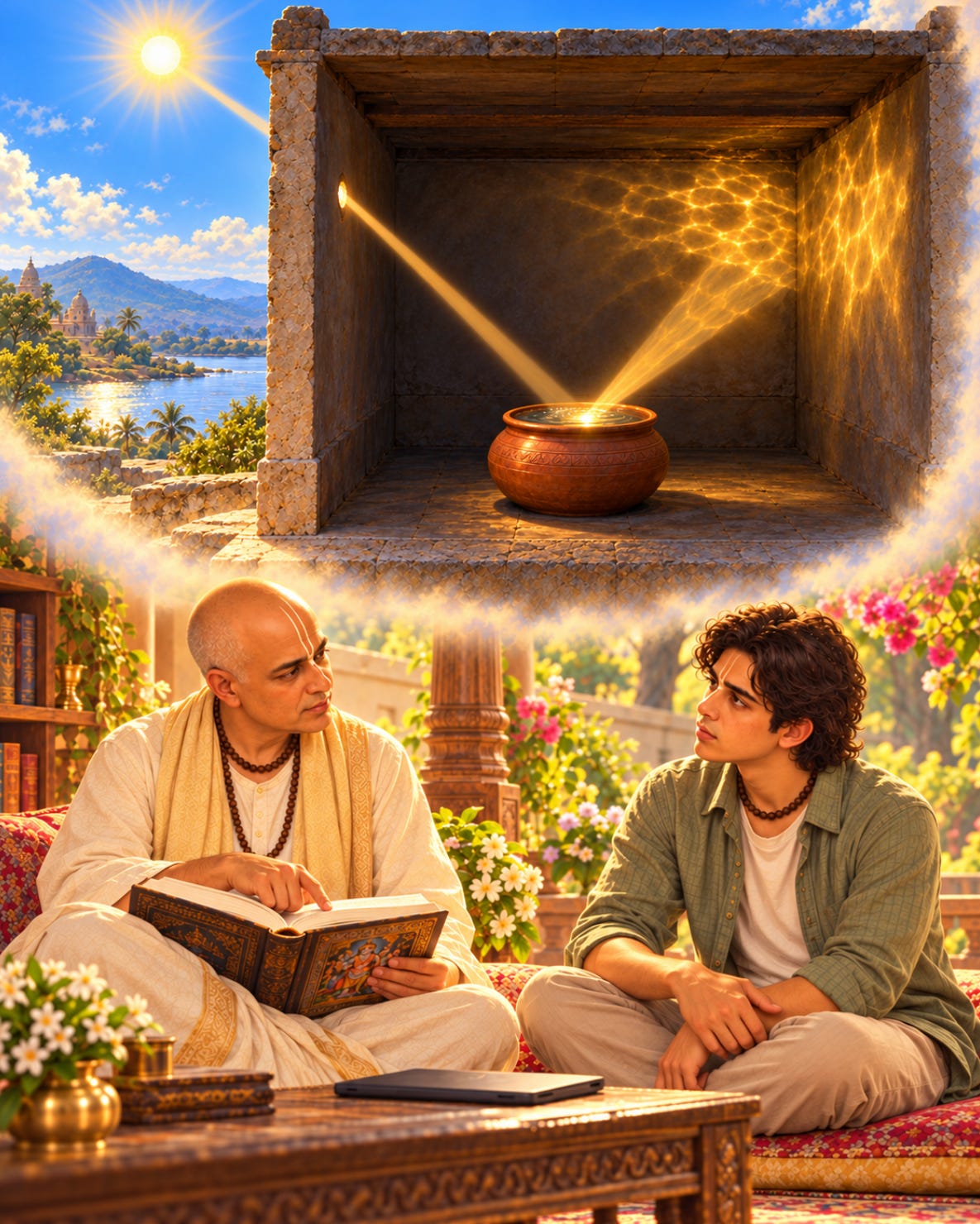
You can receive new articles directly in your inbox. Subscription is free; donations are welcome.
The sixth chapter of The Friend Who Never Left, a novel on the “Fall” of the jīva. Gaurāṅga Dāsa and Mādhava examine the teachings of Lord Kapila to find out how the soul remains transcendental while at the same time interacting with the material world.
Chapter Six: The Reflection of Consciousness
The next morning, Mādhava returned to Gaurāṅga’s house, bringing the Third Canto. He had spent most of the previous evening studying Lord Kapila’s teachings in Chapter Twenty-seven. The first time he read the Śrīmad-Bhāgavatam, he just skimmed through this part, without making much of an effort to understand it. Now that he was really trying, he started seeing how thick the philosophy is.
Gaurāṅga Dāsa was sitting on the veranda chanting on his rounds. Mādhava offered his obeisances and sat down close to him.
Gaurāṅga Dāsa: So, what do you think of Lord Kapila’s teachings?
Mādhava Dāsa: It’s quite complicated. Objectively, it is more difficult than the other book I was reading. The first time I read Śrīmad-Bhāgavatam, I didn’t really try to understand it.
Gaurāṅga Dāsa: Many read the Śrīmad-Bhāgavatam as a book of stories. They read the pastimes but more or less skip the philosophical parts. That’s where all the complicated questions are answered.
Mādhava Dāsa: There are a few parts I could not truly understand. For example, at the beginning of the chapter, Lord Kapila describes the liberated soul, who remains unaffected by the modes of material nature, just as the sun remains unaffected by its reflection on water. He then describes the conditioned soul, who remains bewildered by the false ego and is forced to transmigrate from one body to another.
The question is that these are two souls of the same nature, both living in a material body and walking in this world. How can one be completely unaffected by matter, while the other is completely entangled? And what about this example of the sun? It is used twice in the chapter.
Gaurāṅga Dāsa: We normally think of liberation as leaving this material body and moving to the spiritual sky. However, a devotee can be liberated even while living in a material body. This is called jīvan-mukta, liberated while living.
Mādhava Dāsa: How can he be liberated if he is still living in a material body?
Gaurāṅga Dāsa: That’s the point. Imagine tomorrow you become a pure devotee. Do you think your material body will suddenly drop dead?
Mādhava Dāsa: Eventually it will, but not on the same day. I will continue living until the end of my life.
Gaurāṅga smiles
Gaurāṅga Dāsa: And what will happen to your body during this time? Will it still become old like everyone else? Will it become sick?
Mādhava Dāsa: Of course it will. We know that even Prabhupāda’s body became sick. He went through the normal stages, like everyone else. But we also know he is not the body.
Gaurāṅga Dāsa: Exactly. The body is a material machine. Just because a car is driven by a pure devotee, it does not mean it will not burn fuel or rust. Similarly, all the bodily functions and sensations are present in the body of a pure devotee. It needs food and rest; eventually it becomes old, etc. The question is that a pure devotee does not identify himself with these conditions. He identifies with His eternal nature as an eternal servant of Kṛṣṇa.
The conditioned soul, on the other hand, identifies with the body. When the body is young, he sees himself as young; when the body becomes old, he sees himself as old. When the body is hungry, he thinks he is hungry and so on.
Mādhava Dāsa: So a pure devotee does not feel hunger?
Gaurāṅga Dāsa: He understands the body needs food and feeds it. He takes care of the instrument. The difference is that he does not identify with it. The sensation is present, but he does not identify with it in the way a conditioned soul does. Hunger for him is more like a light lighting up in the panel of the car. He observes it and decides what to do according to the situation.
Mādhava Dāsa: So liberation is primarily a matter of identification, instead of being physically outside the material world?
Gaurāṅga Dāsa: That’s why Prabhupāda makes an important point in his purport to the first verse. Take a look at the last paragraph, starting with the word avikāra.
Mādhava Dāsa: “Avikāra means “without change.” It is confirmed in Bhagavad-gītā that each and every living entity is part and parcel of the Supreme Lord, and thus his eternal position is to cooperate or to dovetail his energy with the Supreme Lord. That is his unchanging position. As soon as he employs his energy and activities for sense gratification, this change of position is called vikāra. Similarly, even in this material body, when he practices devotional service under the direction of the spiritual master, he comes to the position which is without change because that is his natural duty. As stated in the Śrīmad-Bhāgavatam, liberation means reinstatement in one’s original position. The original position is one of rendering service to the Lord (bhakti-yogena, bhaktyā). When one becomes detached from material attraction and engages fully in devotional service, that is changlessness.”
Gaurāṅga Dāsa: The eternal position of the soul is to serve Kṛṣṇa. This is the soul’s constitutional position; it never changes. In conditioned life, we act for sense gratification, and the position changes, as we go from one body to the other. Then, when we decide to serve Kṛṣṇa, we come back to the unchanging original position, even while still living in the body. This is called liberation.
You can see that Prabhupāda is not speaking about some form of physical transformation. It is about a change in consciousness that leads to a change in activities. It means going back to the unchanging position of serving Kṛṣṇa.
And then we have the example of the sun that Lord Kapila uses to illustrate this concept.
Imagine the sun shining in the sky. We look to a lake, and we see the sun reflected on it, the reflection moving with the waters of the lake. What happens to the original sun?
Mādhava Dāsa: Nothing. The sun remains in the sky.
Gaurāṅga Dāsa: Exactly. The sun does not move with the water. It does not become broken or distorted. This applies to the reflection only. Similarly, the soul is spiritual by nature. The soul does not become material because consciousness is reflected in matter. What changes is only the reflection. This is what Prabhupāda explains as the changing and unchanging natures.
Mādhava Dāsa: I understand the example. But if in any case the soul does not come directly in contact with matter, remaining transcendental, like the sun, then why do we suffer at all?
Gaurāṅga Dāsa: The difference is identification. Both the liberated soul and the conditioned soul are transcendental. The difference is that the conditioned soul becomes attached to the reflection. Accepting the body and mind as the self. The liberated devotee does not make this mistake.
Imagine that you park your car in the street, and a truck crashes into it. You will become very distressed. Anger, anxiety, shock. It may feel like physical pain. But if you see the same happening with a stranger’s car, the reaction would be very different. What changed?
Mādhava Dāsa: My relation to the two cars is different. I identify with one but not the other.
Gaurāṅga Dāsa: Yes. In any case, the damage happens to a car, not to you, but when you identify with the car as yours, you suffer. The more your identity is tied to the car, the more you suffer. When we apply the same concept to the body and mind, it is easy to understand how everything that happens to them becomes part of our experience. You become happy or distressed according to what happens with this material personality.
This connection is made by the false ego. It makes us identify with something we are not: the body and mind, life after life.
Mādhava Dāsa: So even though the two souls are of the same nature, their experiences are very different because one identifies with the reflection and the other not.
Gaurāṅga Dāsa: Yes. You can also see how this connects with what we were discussing yesterday. The soul does not have to become something different; the original nature is already there eternally. What has to be changed is the identification.
Mādhava remained thoughtful for a moment. Just a few years ago he was a teenager, and before that a child, and before that he could not even remember. It is not just the physical body that changes, but our idea of self changes with it. Our emotions change. Our desires change. But this is all due to the changes in the reflection. The part that never changes is the eternal nature of the soul. Now he could understand what Prabhupāda meant by “Back to Godhead”.
Mādhava Dāsa: Now I understand the first example. But what about the second? Later in the chapter, Kapila mentions this example of the sun again. This time there is a dark room, a pot of water, and light being reflected on the walls. This time it becomes much more elaborate.
Gaurāṅga Dāsa: Yes, this second example goes much deeper. The first analogy explains the difference between the conditioned and liberated soul. The second example explains how spirit becomes present in the material creation without becoming material. Let’s examine the verses. You can start with text 11:
Mādhava Dāsa: “A liberated soul realizes the Absolute Personality of Godhead, who is transcendental and who is manifest as a reflection even in the false ego. He is the support of the material cause and He enters into everything. He is absolute, one without a second, and He is the eyes of the illusory energy.”
Gaurāṅga Dāsa: This one describes Paramātmā. As the Supersoul, the Lord is present everywhere and in everything. He enters into all material elements and even into the false ego, which is the most subtle material manifestation, and a pure devotee can see Him. At the same time, however, He does not enter into matter. He becomes present in the heart and in the material elements as a reflection. Now, read text 12.
Mādhava Dāsa: “The presence of the Supreme Lord can be realized just as the sun is realized first as a reflection on water, and again as a second reflection on the wall of a room, although the sun itself is situated in the sky.”
Gaurāṅga Dāsa: This is the second example that explains the exact mechanism. We know that Kṛṣṇa resides eternally in Goloka Vṛndāvana, which is never affected by the material potency. At the same time, He is present in every universe, in the heart of everyone, and even inside the material elements. How can we reconcile these two?
Mādhava Dāsa: He becomes present through His expansions?
Gaurāṅga Dāsa: Exactly. He becomes Mahā-Viṣnu and creates the whole cosmic manifestation repeatedly. Mahā-Viṣnu is like the sun; He resides eternally on the Causal Ocean; He never enters the material universes.
Then, we have the dark room. This represents our material universe. There is a small opening through which the sun enters. Just a ray of light, which is reflected on a pot of water. If you are inside the room, you look into the water and see the sun there, even though the sun is not literally present inside the room. But you see the reflection. The reflection is just like the sun, same form, and also brilliant. This is Garbhodakaśāyī Viṣnu, the father of Brahmā.
Then, this reflection on the water creates another reflection on the walls, illuminating the whole room. This is Kṣīrodakaśāyī Viṣṇu, the Supersoul, entering everything. He is present everywhere simultaneously, and in this way is aware of everything that happens in the entire universe. Apart from ours, there are millions of other universes, each one a separate dark room. The same phenomenon happens in all of them, simultaneously.
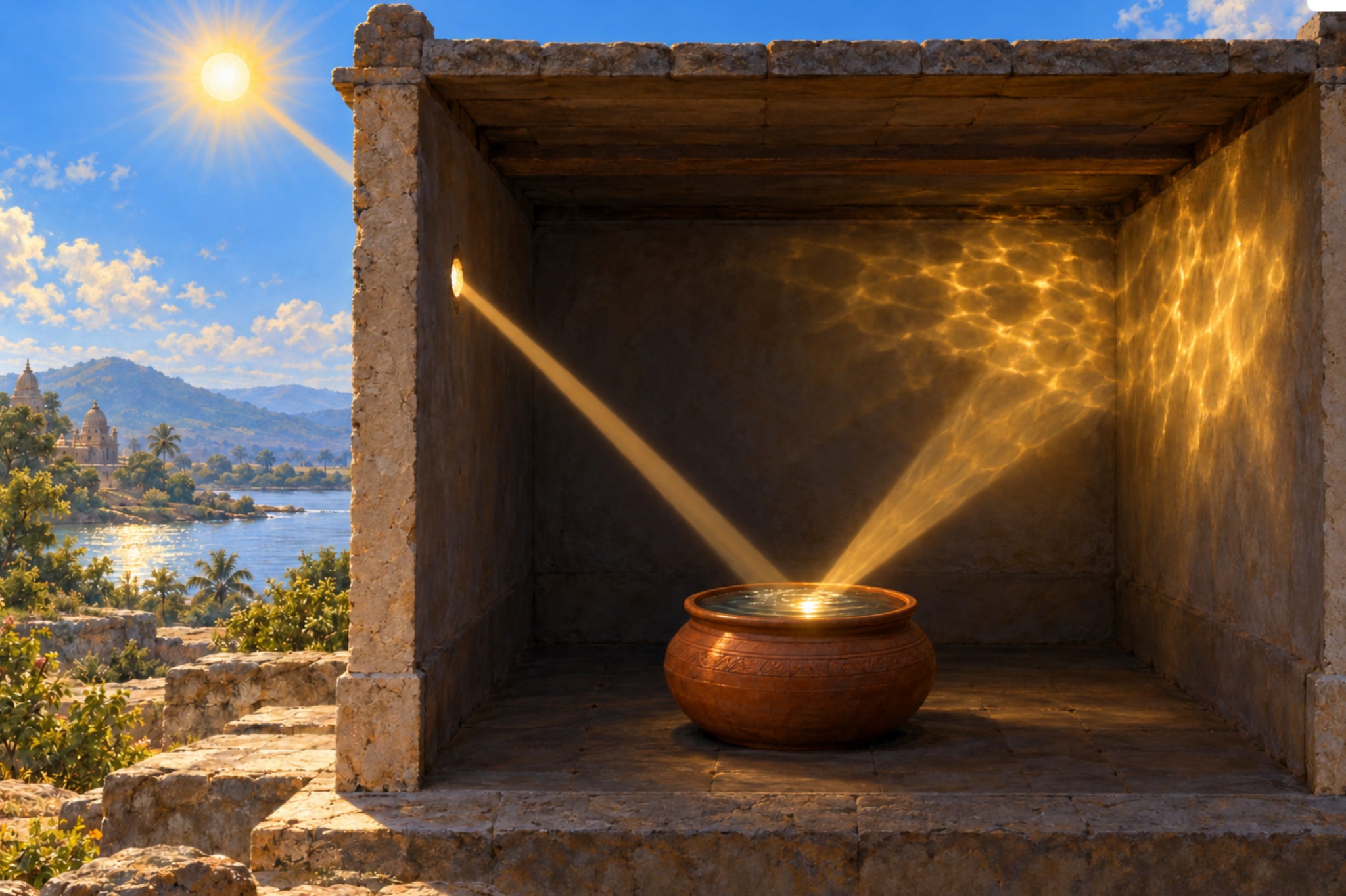
One point here is that we should understand the analogy without trying to extend it beyond its intended purpose. Garbhodakaśāyī Viṣnu and Kṣīrodakaśāyī Viṣṇu are not material reflections or illusions; they are fully powerful expansions of the Lord.
The example explains how He can remain in His transcendental position while at the same time entering every atom of the material creation.
Mādhava Dāsa: This is why Kṛṣṇa says that He enters into the entire cosmic manifestation with just a fragment of His power in the Gītā!
Gaurāṅga Dāsa: Yes, that’s Kṛṣṇa. Unlimitedly powerful.
Then we have text 13. This is where the analogy is extended to the individual soul.
Mādhava Dāsa: evaṁ trivṛd-ahaṅkāro, bhūtendriya-manomayaiḥ, svābhāsair lakṣito ’nena, sad-ābhāsena satya-dṛk
“The self-realized soul is thus reflected first in the threefold ego and then in the body, senses and mind.”
Gaurāṅga Dāsa: Notice the connection. Mahā-Viṣnu always remains transcendental to the material creation, but at the same time He enters the material universes.
Similarly, the individual soul is transcendental to matter, but our consciousness becomes manifested through the material body. In our case, the first reflection is in the false ego, ahaṅkāra. That’s how we enter the material creation. This is the reflection on the pot of water in our case. Through the false ego, we identify with the body, senses, and mind: bhūta-indriya-manaḥ-mayaiḥ. In this way, we enter into them. This is the second reflection in our case, the second reflection on the walls of the room. In this way, our consciousness enters the body, and we become aware of it.
There are two other words that are very important: svābhāsair and sad-ābhāsena.
Svābhāsair comes from sva-ābhāsaiḥ. Two words. Sva means “its own,” and “ābhāsa” means reflection. That’s how the soul enters the false ego and then the body. By its own reflection.
Then, we have sad-ābhāsena. Sat and ābhāsa. This confirms the same idea: ābhāsa, reflection. But the “sat” part reveals an important detail. What exactly is reflected? Brahman, the eternal soul, the eternal reality. The real identity that never changes. This sends us back to Bhagavad-gītā 2.16: nāsato vidyate bhāvo, nābhāvo vidyate sataḥ: That which is sat is real; it never changes. That’s the soul. The soul never changes; it is part and parcel of Kṛṣṇa. What moves is the reflection, the subtle body going from one body to the other and experiencing so many material changes.
Mādhava Dāsa: Now you started sounding like the authors of the other book!
Gaurāṅga Dāsa: They are not the only ones who know a little bit of Sanskrit… And Prabhupāda knew more than any of us. He just didn’t need to flaunt it.
Anyway, because Kṛṣṇa is so powerful, He illuminates many giant rooms, the many material universes, all of it simultaneously and with just a fragment of His potency! We illuminate just a single room, very small, the material body.
Kṛṣṇa is like the sun; we are like a small source of light, like a flashlight, or a star, or a small particle of the sun. In any case, our relationship with matter is similar. We don’t enter the room; our consciousness enters. And from inside we see ourselves as the reflection and think we are the body and mind. A pure devotee, however, does not make this mistake. He sees the reflection but does not identify with it. In this way, he remains awake in His original, eternal identity as a soul, eternal servant of Kṛṣṇa. This is text 14.
Mādhava Dāsa: “Although a devotee appears to be merged in the five material elements, the objects of material enjoyment, the material senses and material mind and intelligence, he is understood to be awake and to be freed from the false ego.”
Gaurāṅga Dāsa: Yes, exactly. This brings us back to the dream analogy. The conditioned soul is sleeping. He is still on his bed, but the consciousness is somewhere else. He is in Africa, being attacked by a tiger. The pure devotee, on the other hand, is awake. He understands well the difference between dream and reality.
But there is something else you should notice. These two examples together help us to understand why Prabhupāda says that the soul never leaves his constitutional position, while at the same time describing the soul as conditioned by matter.
The source and the reflection exist simultaneously, but the reflection has no separate existence. It is simply a matter of what we identify with. It is thus not about becoming something but returning to what we really are.
Mādhava Dāsa: Now I understand better what Prabhupāda meant when he said that we never leave our original position. We can forget our original identity without losing it. This example of the sun explains it clearly. But this brings us to another question. We have been discussing how the soul forgets his original identity; this is now clear. The question is, what exactly is this original identity? I understand that we are eternal servants of Kṛṣṇa, but does that mean we have an actual personal relationship with Him, or just that we are part of His energy?
Gaurāṅga Dāsa: That’s an important point. We should examine it next. Do you have classes this afternoon?
Mādhava Dāsa: No, today I’m free.
Gaurāṅga Dāsa: Very good. Then you can read Madhya-līlā, chapter 22. Pay special attention to texts 10 to 15, where Mahāprabhu explains the difference between eternally liberated and eternally conditioned souls, and then 104 to 107, where He explains that love for Kṛṣṇa is eternally established in the heart. Don’t forget the purports.
Mādhava Dāsa: The whole chapter?
Gaurāṅga Dāsa: Do you want to find out the answer or not? If you are satisfied with knowing how to get out, you can just chant Hare Kṛṣṇa. If you want to ask about the fall of the jīva, you need to study. Remember, that’s the most difficult philosophical question.
But that’s not all.
There is an interesting question I want you to think about. Mahāprabhu says that some souls are eternally conditioned, but at the same time He says that love for Kṛṣṇa is eternally established in the heart. How can we reconcile both statements, accepting both as true? And what exactly does it mean for this love to be awakened in the context of Bhagavad-gītā 2.16, where Kṛṣṇa mentions that only things that are illusory change?
Mādhava Dāsa: I see. This directly faces the question of whether our relationship with Kṛṣṇa is something we possess eternally or something we develop for the first time.
Gaurāṅga Dāsa: Precisely. That’s exactly where many get lost. Many cannot think in this way; they take just one passage or even just one word and want to organize everything around it. That’s the fastest way to come to a wrong answer.
Imagine you never saw a car. One passage says that a car has four wheels, and another that it has an engine. Another says that you can sit inside it. Another says that you need a key to use it, and yet another says that some cars are red. All true. Only if you can fit everything together, you can start understanding what a car is.
Mādhava thanked Gaurāṅga Dāsa and offered his obeisances. He didn’t have the Śrī Caitanya-caritāmṛta, but that was not a problem; he could just read it on his tablet. He started to think about how people in previous centuries had to travel to obtain books and copy them by hand on palm leaves. He had practically all scriptures available to him, but still he complained about reading just one chapter.
Soon the next part…
If you want to study the philosophical basis of this story, here is the book:

This is a publication for thoughtful readers who want to go deeper into Kṛṣṇa consciousness. I publish daily, trying to offer high-quality spiritual content, and all posts are available to free subscribers. If you wish, you can support this work with a monthly contribution. When you subscribe, you can choose between a free subscription and a monthly contribution, and you can switch from a free subscriber to a supporter at any time.
You can also receive updates on WhatsApp or Telegram.
If you would like to contribute further, you can find the donation links here.