


You can receive new articles directly in your inbox. Subscription is free; donations are welcome.
This is the second chapter of The Friend Who Never Left, a novel on the “Fall” of the jīva. With the beginning of the conversation between Mādhava and his mentor Gaurāṅga Dāsa:
Chapter Two: Contradictory Teachings
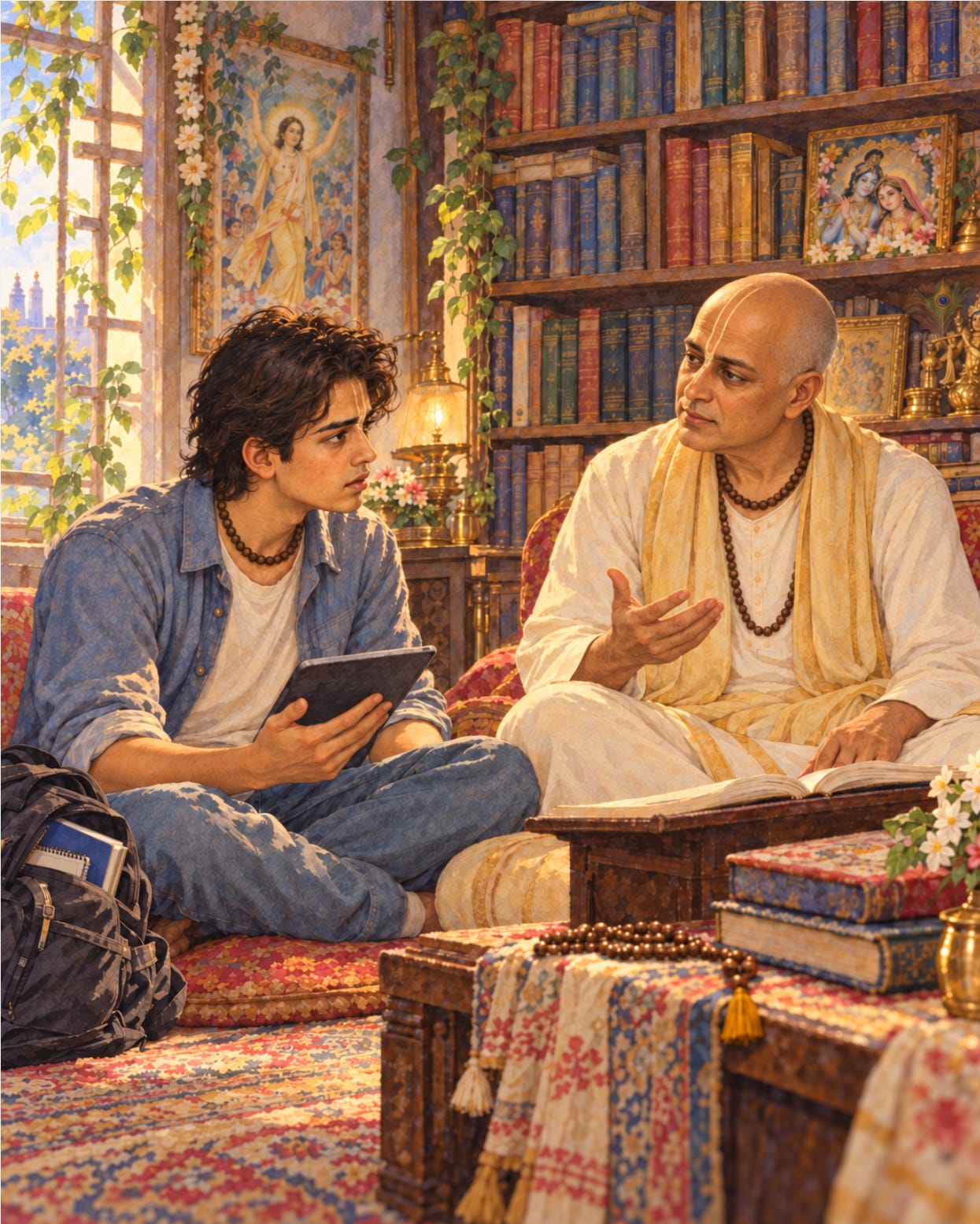
When Mādhava arrived, Gaurāṅga Dāsa was sitting in front of Tulasi, reading the Śrīmad-Bhāgavatam. The door was open; Mādhava just entered after knocking. He offered obeisances and started opening his backpack.
Gaurāṅga Dāsa was surprised to see him so early and with such a worried expression. He asked: What happened, Mādhava? Is everything all right?
Mādhava Dāsa: Prabhu, I have been reading a book that left me confused. The authors say that we were never with Kṛṣṇa, because no one can fall from the spiritual world. We have therefore always been conditioned by Māyā.
They quote several passages from previous ācāryas to support their arguments; it seems quite scholarly written. I don’t know what to think anymore. I have always understood from Prabhupāda that we were originally with Kṛṣṇa, but somehow we forgot Him and became entangled in the material world, but He continues to follow us as Paramātmā to get us back. With this understanding, I was chanting daily, meditating on Kṛṣṇa as my eternal friend, and I was getting a lot of taste in it. Now, however, I feel like a stranger intruding in a place I don’t belong to.
Gaurāṅga Dāsa appeared distant at first, like remembering something from the past. I see... he finally said. I know the book you are speaking about. I know the argument. But first, tell me, what do the authors say about our eternal relationship with Kṛṣṇa?
Mādhava Dāsa: They accept that we are eternally His servants in nature, but they argue that no one ever falls from Vaikuṇṭha because there is no Māyā there, and thus they conclude that we were never personally with Him. They say that the conditioned souls have always been conditioned, while the liberated souls have always been liberated, and from there argue that Prabhupāda’s explanations of our forgotten relationship should not be taken literally.
Gaurāṅga Dāsa: Yes, Prabhupāda himself teaches that perfect devotees in Vaikuṇṭha never fall or are overcome by Māyā. But he also tells us that we are Kṛṣṇa’s eternal servants and that we have forgotten Him. What are we to do with these statements? We cannot accept one and dismiss the other.
We are Kṛṣṇa’s eternal servants, true, but at the same time we have forgotten Him. Prabhupāda explains that our original consciousness is Kṛṣṇa consciousness, and that we must revive it. He speaks of returning to our original position, of going back to Kṛṣṇa. How can we return to Him if we were never with Him in the first place? Still, Prabhupāda also mentions that no one falls from Vaikuṇṭha. And consider another point: bhakti is eternally established in the heart, but at the same time we receive it from the spiritual master.
Think about it. All of these statements are simultaneously true. We cannot discard some of them simply because they are difficult to reconcile. We should not be so quick to conclude that one passage contradicts another.
The philosophy of Kṛṣṇa consciousness is simple for the simple, but if you want details, there are unlimited sides to consider. We are dealing with the transcendental reality here; it doesn’t easily fit the human mind.
Mādhava Dāsa: That’s exactly my problem. Prabhupāda repeatedly explains that we have forgotten Kṛṣṇa. Mahāprabhu says that love for Kṛṣṇa is eternally present in the heart and can be awakened by hearing and chanting: nitya-siddha kṛṣṇa-prema ‘sādhya’ kabhu naya, śravaṇādi-śuddha-citte karaye udaya. We were studying this verse the other day. But if we are eternally conditioned and were never with Kṛṣṇa, then what is there to awaken? I always understood that devotional service means reviving our original relationship with Kṛṣṇa, but now I am not even sure if there is a relationship at all, or what it means.
Gaurāṅga Dāsa: There is no need to despair. Your questions are reasonable, but you are jumping to conclusions. First of all, we have to be careful not to imagine the spiritual world as if it were another material place filled with imperfections. Sahajiyas do that; we are not planning to join them.
When we hear that a soul was with Kṛṣṇa and forgot him, we often imagine a person in Vaikuṇṭha becoming dissatisfied and leaving, or a gopī forgetting Kṛṣṇa. But is that what Prabhupāda was teaching? We should study his explanations carefully before attaching such conceptions to his teachings. The eternal relationship of the soul and Kṛṣṇa exists as part of a transcendental reality; we should not assume that it must operate under the same faults and conditions we experience in this world.
Mādhava considered this for a moment. Indeed, he had imagined the conditioning of the soul as something that happened at a particular time, some millions, or billions of years ago. He had never thought much about such philosophical details. But then he remembered something else.
Mādhava Dāsa: The main point is that the book says that our bondage is anādi, without beginning. If that’s true, how could there have ever been a time when we were not conditioned? Transcendental or not, if we were never with Kṛṣṇa, how could them any relationship exist at all? This seems to contradict everything Prabhupāda says about our original position. The authors give Sanskrit explanations from Jīva Gosvāmī and Viśvanātha Cakravartī Ṭhākura, and I don’t know enough Sanskrit to argue with them.
Gaurāṅga Dāsa: There is a difference between understanding what a word means and understanding all its philosophical implications inside the text. According to the dictionary, anādi means beginningless; that’s true, the question is what its implication is inside the passage.
A scholar may translate a Sanskrit passage correctly but still get an incorrect conclusion out of it. We have to study the context and consider how the passage fits with the rest of the teachings and not take an isolated word and make everything else fit it. The scriptures do not contradict themselves, and neither do the previous ācāryas. If something appears contradictory, we should first of all consider that our understanding may be incomplete.
Baladeva Vidyābhūṣaṇa deals with many examples of passages that are frequently misinterpreted in his Govinda-bhāṣya. He explains that by examining discrepancies between earlier and later parts of a text, we should find what meaning is intended, resolving apparent contradictions. He warns us that dry logic and speculation, śuṣka-tarka, should be avoided.
Mādhava Dāsa: That’s a good point. But there is something even more disturbing. The authors argue that Prabhupāda’s explanations of we having been with Kṛṣṇa are just a preaching strategy. They say he spoke like that to make the philosophy more appealing for beginners, but that the actual siddhānta is different. From there, they imply that we need to study the previous ācāryas to understand what Prabhupāda really meant. This is the point that is bothering me most. If Prabhupāda is teaching something different from the actual conclusion, then why are we studying his books at all?
Gaurāṅga Dāsa seemed pained. He again paused for a moment and put his Bhāgavatam aside.
Gaurāṅga Dāsa: Now I understand why you are so disturbed. There is nothing wrong with asking questions. This is part of what makes us advance in spiritual life. There is also nothing wrong with studying the previous ācāryas. On the contrary, their conclusions are invaluable. However, we must be very careful with the way we approach them.
Prabhupāda is the ācārya through whom we received Kṛṣṇa consciousness. He is the link in the paramparā that connects us with the previous links. If we accept him as our spiritual authority, then the process is that his conclusions must guide our study. We cannot jump over him, build an understanding based on our interpretation of the writings of the previous ācāryas, and then come back to decide which parts of Prabhupāda’s teachings should be accepted and which should be rejected. That would place our own interpretation above the ācārya. If our interpretation becomes the final authority, paramparā loses its meaning. In this case, the mind becomes the guru.
Mādhava Dāsa: But what if the previous ācāryas really say something different? We cannot dismiss their authority either.
Gaurāṅga Dāsa: Of course not. But why should we assume that they contradict Prabhupāda? If we accept all of them as links in the same disciplic succession coming from Kṛṣṇa, then they must all be speaking the same siddhānta. If we find something difficult to reconcile, we should study more carefully, examine the context, and try to understand how both teachings can be true.
Do you remember Śrīmad-Bhāgavatam 1.3.28?
Mādhava Dāsa: ete cāṁśa-kalāḥ puṁsaḥ, kṛṣṇas tu bhagavān svayam, indrāri-vyākulaṁ lokaṁ, mṛḍayanti yuge yuge—“All of the above-mentioned incarnations are either plenary portions or portions of the plenary portions of the Lord, but Lord Śrī Kṛṣṇa is the original Personality of Godhead. All of them appear on planets whenever there is a disturbance created by the atheists. The Lord incarnates to protect the theists.”
Good! Gaurāṅga Dāsa exclaimed. He then got up to get a volume that was high on his shelf. Now read this one:
Mādhava Dāsa: etau bhagavataḥ sākṣād, dharer nārāyaṇasya hi, avatīrṇāv ihāṁśena, vasudevasya veśmani—“[The people said:] These two boys are certainly expansions of the Supreme Lord Nārāyaṇa who have descended to this world in the home of Vasudeva.”
Gaurāṅga Dāsa: How do you explain it? Same Śrīmad-Bhāgavatam. One verse says Kṛṣṇa is the original Personality of Godhead, the other says He is the expansion of Viṣnu. This is from the later chapters of the Tenth Canto; Prabhupāda did not have an opportunity to comment on it.
Mādhava Dāsa thought about it, but he did not know what to say.
Gaurāṅga Dāsa continued: The first verse is the paribhāṣā-sūtra, the governing conclusion of the Śrīmad-Bhāgavatam. In the second verse, the common people of Mathurā are struggling to understand who these two powerful personalities in front of them are. Some of them, repeating rumors they heard, conclude that they must be expansions of Lord Nārāyaṇa who have descended to this world as the sons of Vasudeva.
But I have another question for you: The Bhāgavatam is described as the spotless Purāṇa; therefore, if the second verse gives an incorrect conclusion, how can it be part of the Śrīmad-Bhāgavatam? Maybe Śukadeva Gosvāmi was using preaching strategies?
Mādhava hesitated. He could understand Gaurāṅga’s main point, but he was puzzled about how the two verses could possibly fit together.
After a few seconds, Gaurāṅga Dāsa continued:
Jīva Gosvāmi explains that although the statement comes from nātividvaj-jana (people who are not very learned), their words are sarasvatī-preritatayā, inspired by Sarasvatī. This indicates that the verse is not incorrect but that there is a deeper level of meaning in it.
The key is the word aṁśena. The dictionary meaning is “as a portion,” and this leads to the translation you just read. Jīva Gosvāmi, however, examines the context of the preceding verses and reveals that in this context, aṁśena means “with all their expansions.” Therefore, although the common people referred to Kṛṣṇa and Balarāma as the expansions of Nārāyaṇa, the real meaning of their words is that Kṛṣṇa, together with Balarāma, has descended to this material world accompanied by all their plenary expansions, appearing in the home of Vasudeva.
This is an example of how apparent contradictions come from our limited understanding of a subject. Another possibility is that one may add assumptions that are not actually present in the original statements. Sanskrit and logic are very useful in this process; Baladeva mentioned they should be used, but they must help us to understand the teachings of the ācāryas and not become instruments for rejecting them. This is the difference between bhakti and jñāna. In bhakti, the right conclusions are received through the paramparā instead of independent study.
Mādhava looked again at the book in his hand. If he had read the second verse in isolation, without considering the governing conclusion of the Bhāgavatam, he might have accepted that Kṛṣṇa was an expansion of Nārāyaṇa. The Sanskrit would have seemed to support it. He was struck by how Jīva Gosvāmī had explained the passage by drawing attention to its context. With this, Mādhava began to see that quoting scripture and establishing its meaning were not necessarily the same thing.
Mādhava Dāsa: I see. The mistake is to take a particular interpretation of a passage as the final conclusion and use it to dismiss other teachings. Thinking about it, that is what troubled me in this book. Whenever Prabhupāda’s words did not fit into the explanation being woven by the authors, they classified them as a preaching strategy. Perhaps it is their explanation that needs to be reconsidered.
Gaurāṅga Dāsa: Yes. Calling something a preaching strategy to dismiss a teaching does not solve the problem. Our duty is to establish what the ācārya explains and how these explanations fit together with other explanations. As you have seen, a passage can contain much more than what we can presume in a first reading. The question is that this meaning must be uncovered through the guidance of the ācāryas, following their conclusions, and not by independent speculation. We should have this same care with Prabhupāda’s teachings, instead of assuming that we are so learned that we can judge what to accept and what to put aside.
Mādhava Dāsa: I can understand now. But when I read a book, how can I understand what comes from the previous ācāryas and what is the author’s interpretation?
Gaurāṅga Dāsa: First, you need to understand how your study should be guided. You accepted Prabhupāda as your teacher and began practicing according to his instructions. This brought you so far in spiritual life; therefore, by the result, you can understand that the process given by him is genuine. We can start by examining his place in our spiritual life, how we receive knowledge from the paramparā through him, and how this knowledge is further explained by his disciples and followers who guide us. This will give us the foundation for examining the arguments that have disturbed you.
Mādhava kept the Bhāgavatam open before him. He still wanted to understand how beginningless bondage could coexist with a forgotten relationship, but the example of the two verses had given him a reason to be patient. Now he was ready to listen.
Soon the next part…
If you want to study the philosophical basis of this story, here is the book:

This is a publication for thoughtful readers who want to go deeper into Kṛṣṇa consciousness. I publish daily, trying to offer high-quality spiritual content, and all posts are available to free subscribers. If you wish, you can support this work with a monthly contribution. When you subscribe, you can choose between a free subscription and a monthly contribution, and you can switch from a free subscriber to a supporter at any time.
You can also receive updates on WhatsApp or Telegram.
If you would like to contribute further, you can find the donation links here.
Hare Krishna 🙇🏾♂️! Most wonderful! I am eagerly waiting to understand this. And Dhanyavaad for reminding us and showing us the mood in which we should study prabhupada's work and that of the previous acaryas.