

« Things I Wish Someone Had Taught Me When I Started Krishna Consciousness
Dealing with different opinions in spiritual life without becoming bewildered
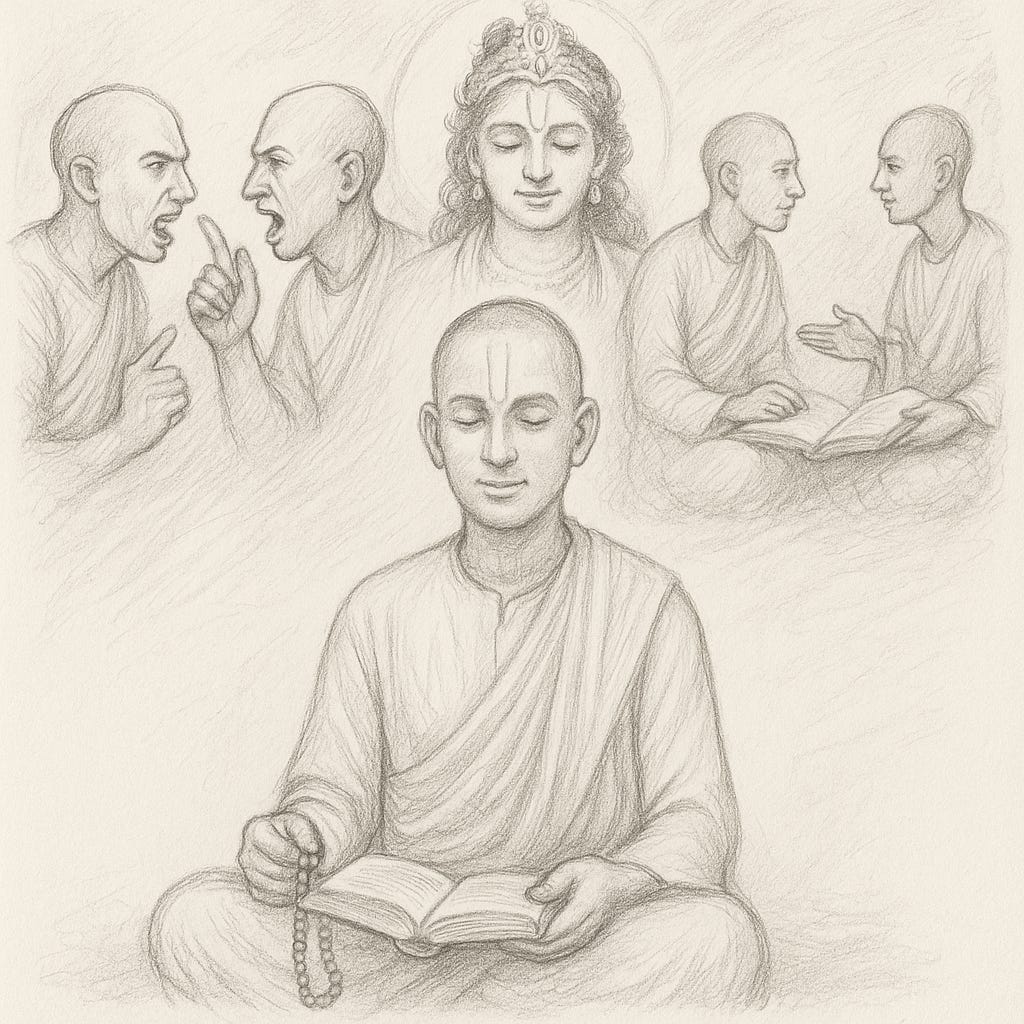
One essential quality we have to develop in order to be able to peacefully live inside a spiritual society is the capacity to hear different opinions without becoming disturbed or bewildered. Looks straightforward, but it’s actually much harder than it seems.
Nowadays, see that, in general society, many are capable of doing so. They talk with everyone, hear everything, and don’t become disturbed by different opinions. However, this usually doesn’t come from being genuinely tolerant, but from just believing that everyone can have their own truth. This is a form of impersonalism, which comes from the idea that truth is relative, and thus there is ultimately no truth. People can just live the way they want and do whatever makes them happy.
This, however, doesn’t work for devotees, since we understand that the world doesn’t function like that. There is right and wrong, there is higher and lower. We are supposed to do certain things and avoid certain things. It’s not just a matter of each one having his or her own truth. Certain things, like animal killing, drugs, and promiscuous sex, are intrinsically wrong and should be avoided by all sane people.
Once we start accepting that there is indeed right and wrong and it’s not just a matter of doing whatever feels good, we automatically start having some trouble dealing with opposite opinions, which can create intolerance, fanaticism, and other problems. How to reconcile both?
The point is that there are points that are more important than others, and there are also different levels of relationships. When we focus on details, it becomes very easy to disagree with other people, since even inside the most close-knit groups, we will never find people who think exactly the same. If, however, we focus on the most important principles and become tolerant about details, it becomes much easier to find like-minded people and cooperate with them.
Another point is that it may not be possible to keep a very close relationship with someone who thinks radically differently from us, but it may be possible to maintain a cordial relationship if we keep a healthy distance. When we learn the art of correctly ascertaining what kind of relationship we can have with different people according to the level of affinity we have with them, our lives become much easier.
One more factor that can influence our capacity to deal with different opinions is our level of knowledge. When we have just a poor fund of knowledge, our view will tend to be black and white. This is right, that is wrong, and there is nothing in between. However, as our knowledge grows, our view becomes more nuanced, and we can see that there are different angles of view and different degrees of truth. We can thus better understand and categorize what we hear from other people, understanding that often these concepts and ideas are also valid, although different from what we believe.
Ego is also a very important factor. Śrila Jīva Goswami explains that there are three types of discussion: vāda, jalpa, and vitandā.
The lowest type is vitandā, where one just wants to convince others about his or her opinion. In this type of discussion, there is little interest in finding the real truth, and one may use all kinds of dishonest tricks just to win the discussion. Vitandā is thus mainly a dispute of egos. One just wants his opinion to prevail. This type of discussion is in the mode of ignorance since the participants are attached to their own limited truths and have little interest or capacity to understand what is real or not. Emotional debates centered around conspiracy theories are a good example of this type of discussion.
The second type is jalpa, which is in the mode of passion. In this type of discussion, one comes to the argument already convinced that he is right and the other is wrong, and thus just focuses on proving that his point of view is correct. Different from the emotional vitandā discussions, jalpa is usually centered around more solid arguments, but the essence is still the same: there is little interest in finding the truth; one just wants to prove his point. A good example of jalpa is the unlimited battles of quotes we often see.
Vāda, on the other hand, is based on the mode of goodness. In this type of discussion, the goal is to find the truth. It doesn’t matter who is right or wrong. If my opponent is right, I will be happy to learn from him. We can see many examples of this type of discussion in the Caitanya Caritāmṛta, where opponents of Lord Caitanya would be happy to become His followers once defeated by Him. These were people who were looking for the truth and would be glad to admit defeat when confronted with an opponent with a higher level of realization. The difficulty of course is that this type of debate can be conducted only between people in the mode of goodness, something that is in short supply nowadays.
In the Bhagavad-gītā, Kṛṣṇa says that “among logicians I am the conclusive truth.” The word used in this verse is “vadaḥ”, which shows how this type of enlightened, fruitful argument is a manifestation of Kṛṣṇa.
Apart from being able to respect and tolerate other opinions, there is another side to it, that is to have conviction in what we are doing and not becoming bewildered by other opinions. This can also be a challenge because it demands deep philosophical understanding and deep commitment to the path we are following.
In his writings, Śrila Bhaktivinoda Thākura emphasizes the path of sambandha (philosophical understanding), abhidheya (practice), and prayojana (the ultimate goal). The normal progression is that one would first inquire about spiritual knowledge from an enlightened soul, ask questions, present arguments, and, when firmly convinced, adopt the process and continue practicing until achieving the ultimate goal. The problem is that nowadays we frequently adopt the process on a sentimental basis, just because someone told us so, and thus we are often internally very insecure about what we are doing. We thus try to protect ourselves by being fanatical and closing ourselves off to external opinions, or we become bewildered when we hear people advocating other points of view, thinking that we may not be on the best path.
We can see that leaders and spiritual teachers sometimes try to restrict devotees to this level by training them to just shut up and follow what they say instead of training them to understand and counteract different ideas and philosophies that are not entirely correct. This may work in the short term, but it creates many hurdles later.
Śrila Prabhupāda gives a very good foundation in his books, teaching us about many different ideas and philosophies, and gradually training us to differentiate right and wrong. Taking time to deeply study his books and getting connected with spiritual teachers who can help us to deepen our understanding of his teachings can give us very solid foundations (sambandha) in our spiritual life, which can in turn allow us to deal with maturity with different opinions, respecting different valid points of view, but at the same time not falling to point out misconceptions and not becoming bewildered when faced with opposite ideas.
In an environment of abundance of information and facility of communication, as we have nowadays, I believe this is the only viable way to navigate the onslaught of misconceptions and conspiracy theories and be able to find our way back to Kṛṣṇa. Without a solid philosophical understanding, it’s very difficult to be stable in our spiritual practice, and without this stability, it’s very improbable that we will be able to reach the ultimate goal by the end of this life.
« Things I Wish Someone Had Taught Me When I Started Krishna Consciousness
You can also donate using Buy Me a Coffee, PayPal, Wise, Revolut, or bank transfers. There is a separate page with all the links. This helps me enormously to have time to write instead of doing other things to make a living. Thanks!