


You can receive new articles directly in your inbox. Subscription is free; donations are welcome.
This is the second in a series of articles where I will be elaborating on the discussion of the legitimate path of rāgānugā-bhakti as explained by the previous ācāryas and Śrīla Prabhupāda in his books. If you are already practicing for many years and wondering where to go in your practice of Kṛṣṇa consciousness, or simply curious, this may answer a few questions.
Rāgātmikā-bhakti is the spontaneous devotion that the eternal associates of Kṛṣṇa in Vṛndāvana have for Him. This is the style of spontaneous devotion that we ultimately aim to awaken. What is the foundation of this spontaneous attachment? It is deep meditation on Kṛṣṇa’s names, form, pastimes, etc. that is awakened in a pure heart by continued practice. The process that aims to develop this natural attraction is called sādhana-bhakti, and is divided into two stages: vaidhī-bhakti and rāgānugā-bhakti. We begin by following the regulations of the process of vaidhī-bhakti, and as our heart becomes purified, we gradually awaken the spontaneous attachment for Kṛṣṇa that becomes the foundation for the stage of rāgānugā-bhakti. As this spontaneous attachment matures, we progress toward the perfection of spontaneous loving service, following in the footsteps of Kṛṣṇa’s eternal associates in Vṛndāvana.
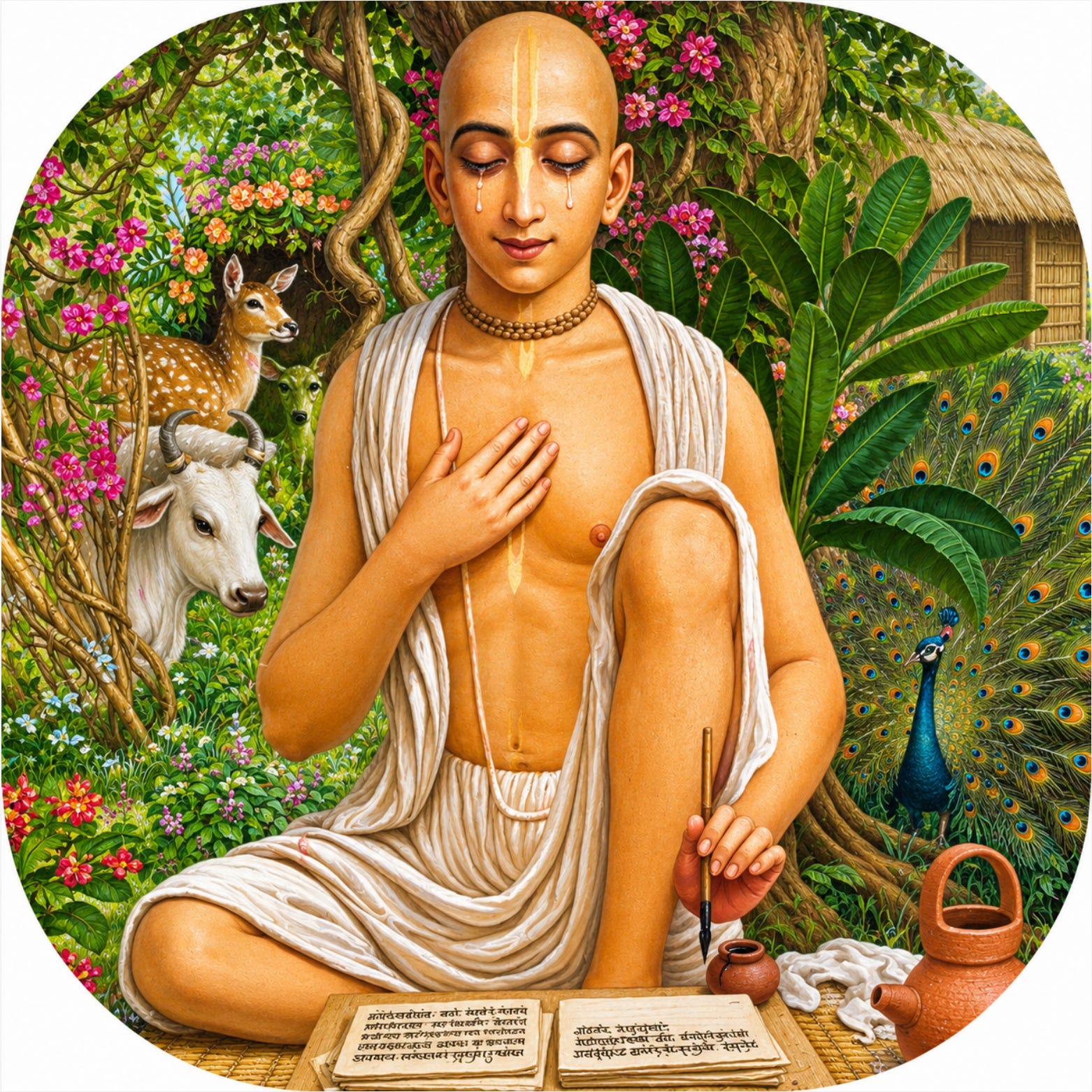
As we advance in devotional service, we become increasingly absorbed in internal meditation. Most devotees continue manifesting their devotion through practical activities, just as they have done since the beginning, while a few develop a greater inclination toward serving Kṛṣṇa internally, through deep meditation. This brings us to another aspect of devotional practice that is often mentioned: mānasika-sevā, or devotional service performed within the mind. As discussed, deep devotional meditation is the goal for everyone, but as a devotee advances, it may be expressed in either of the two ways.
Mānasika-sevā
An advanced devotee practicing mānasika-sevā stops most of the external activities and serves Kṛṣṇa in deep meditation. A great example is the brāhmana who burned his finger while mentally cooking sweet rice for the Deity. Prabhupāda narrates this history in his purport to SB 4.30.28:
“In this connection there is a story about a brāhmaṇa who was offering sweet rice to the Lord within his mind. The brāhmaṇa had no money nor any means of worshiping the Deity, but within his mind he arranged everything nicely. He had gold pots to bring water from the sacred rivers to wash the Deity, and he offered the Deity very sumptuous food, including sweet rice. Once, before he offered the sweet rice, he thought that it was too hot, and he thought, “Oh, let me test it. My, it is very hot.” When he put his finger in the sweet rice to test it, his finger was burned and his meditation broken. Although he was offering food to the Lord within his mind, the Lord accepted it nonetheless. Consequently, the Lord in Vaikuṇṭha immediately sent a chariot to bring the brāhmaṇa back home, back to Godhead. Thus it is the duty of every sincere devotee to accept the arcā-vigraha at home or in the temple and worship the form of the Lord as advised in authorized scriptures and directed by the spiritual master.”
Kṛṣṇa organized this small exchange to show him that although he was performing his service mentally, Kṛṣṇa was accepting it fully. We may think that what the brāhmana was doing was imaginary, but Kṛṣṇa saw it as completely real. As this pastime makes clear, Kṛṣṇa accepts both styles of worship. We can serve Him with our hands, or inside our minds. The main point is the devotion.
The question is that it is much easier to concentrate when doing physical services than when serving mentally, and without being fully absorbed, there is no question of mānasika-sevā.
In the Bhakti-sandarbha (273-278), Jīva Gosvāmi makes the point that this process of meditation is very difficult and requires purification of the heart. It should also not replace chanting, which is the universal process, practiced by both neophyte and advanced devotees. He also explains that this this fixed meditation is practiced in stages, evolving from ordinary remembrance of Kṛṣṇa’s glories, form and activities, all the way into fixed meditation, as in the case of the brāhmana who burned his finger.
In section 275, for example, he mentions:
“If a person has a pure heart, engages in the devotional activities that begin with surrender, and does not abandoning the process of chanting the Lord’s holy name (Śrīmad-Bhāgavatam 2.1.11), he will find himself engaged in smaranam (meditation) which his mind is fixed on the Supreme Lord. Meditation has many forms, beginning with meditation of the Lord’s holy names.”
What exactly does “a pure heart” mean? Later in the same Bhakti-sandarbha (312), he mentions that those who have not yet progressed to at least the stage of ruci (genuine spontaneous taste) should continue to practice the regulated activities of vaidhī-bhakti while developing their meditation on the Lord. This makes clear what level he is speaking about. “Pure heart” in this case does not mean simply being sincere.
The levels of spiritual development are described as:
śraddhā → sādhu-saṅga → bhajana-kriyā → anartha-nivṛtti → niṣṭhā → ruci → āsakti → bhāva → prema.
Most of us are generally at the stage of anartha-nivṛtti, where we are still battling bad habits and general material attachments. After we complete this stage, there is the stage of niṣthā, where one becomes steady in the spiritual practice, without being disturbed by changing material conditions, and ruci comes still further.
Mānasika-sevā is usually practiced in solitude, as the level of concentration needed cannot be maintained with others around. It is thus strongly connected with nirjana-bhajana, devotional practice in solitude. This brings us to other passages.
In his Vaiṣṇava Ke?, Śrīla Bhaktisiddhānta Sarasvatī Ṭhākura explains:
kīrtana-prabhāve, smaraṇa haibe
se kāle bhajana-nirjana sambhava“By the power of kīrtana, firm remembrance will arise. At that time, solitary bhajana becomes possible.”
The danger here is imitation: to retire from the practice of practical service and from the disciplined process before developing this genuine taste. This puts us on the same path as the sahajiyās, trying to imitate the superficial aspects while immersed in mundane desires.
Here we come to the many warnings from our ācāryas of the danger of such imitation. One of the most forceful comes from Prabhupāda in his purport to SB 4.28.33, where he explains that nirjana-bhajana is supposed to be practiced by the spiritual master at the last stage of his life, not by neophytes. As he explains:
“This nirjana-bhajana, which is the silent worship of the Supreme Lord, is not possible for a neophyte devotee. Śrīla Bhaktisiddhānta Sarasvatī Ṭhākura never advised a neophyte devotee to go to a solitary place to engage in devotional service. Indeed, he has written a song in this connection: duṣṭa mana, tumi kisera vaiṣṇava? pratiṣṭhāra tare, nirjanera ghare, tava hari-nāma kevala kaitava
“My dear mind, what kind of devotee are you? Simply for cheap adoration you sit in a solitary place and pretend to chant the Hare Kṛṣṇa mahā-mantra, but this is all cheating.” Thus Bhaktisiddhānta Sarasvatī Ṭhākura advocated that every devotee, under the guidance of an expert spiritual master, preach the bhakti cult, Kṛṣṇa consciousness, all over the world. Only when one is mature can he sit in a solitary place and retire from preaching all over the world. Following this example, the devotees of the International Society for Krishna Consciousness now render service as preachers in various parts of the world.”
This process of solitary meditation is possible only for advanced devotees who have developed a genuine attraction for Kṛṣṇa and are able to fully control their minds. For them, stopping other activities and focusing on their meditation and solitary chanting is a way to perfect their meditation on Kṛṣṇa. For a neophyte, however, the same process is highly ineffective, because his disturbed mind will not allow him to successfully meditate in this way. He will then eventually just go back to his previous habits, or become some kind of sahajiyā or bogus guru, pretending to be a sādhu while secretly doing all kinds of sinful activities.
Prabhupāda mentions this point in his purport to SB 4.29.41:
“Nirjana-bhajana—cultivating Kṛṣṇa consciousness in a solitary place—is not possible for the neophyte, for he will be disturbed by the bodily necessities (eating, sleeping, mating and defending). Being so disturbed, one cannot cultivate Kṛṣṇa consciousness. We therefore see that devotees known as sahajiyā, who make everything very easy, do not associate with advanced devotees. Such persons, in the name of devotional activities, are addicted to all kinds of sinful acts—illicit sex, intoxication, gambling and meat-eating. There are many so-called devotees passing themselves off as devotees while engaging in these sinful activities. In other words, one who is influenced by sinful activity cannot be accepted as a person in Kṛṣṇa consciousness. A person addicted to sinful life cannot develop Kṛṣṇa consciousness, as indicated in this verse.”
Until one develops true attachment, meditation on the Lord must be practiced together with the rules and regulations of devotional service. The reason advanced devotees may later cease depending on these rules and regulations is that, at this stage, they have no propensity to do anything sinful and have a genuine attraction for the Lord; therefore, the purpose of the regulations is attained automatically, without the need of them having to consciously follow them.
Developing rāgātmikā-bhakti, spontaneous attachment to Kṛṣṇa
Solitary meditation should be attempted only at an advanced stage. However, the process of deep meditation on the Lord, practiced in the context of sādhana-bhakti, is recommended for everyone. Sādhana-bhakti is not the ultimate goal in itself; it is precisely the foundation that allows us to purify ourselves and gradually develop this deep meditation. We can say that sādhana is the container inside which rāgātmikā-bhakti, spontaneous attachment to Kṛṣṇa, becomes manifested.
Passages from our ācāryas that appear to criticize the process of sādhana-bhakti are not critiques of the process per se, but of the propensity to reduce it to external rituals. Regulated practice should lead to the gradual awakening of absorption and attachment to the Lord.
The next question is: How can we develop this deep absorption?
This process is explained both by Jīva Gosvāmi and Śrīla Prabhupāda. Jīva gives the foundation, and Prabhupāda often elaborates on it.
Jīva Gosvāmi starts by laying the philosophical basis in the Tattva-sandarbha, Bhagavat-sandarbha, and Paramātma-sandarbha, and then goes deeper into the philosophical understanding of the transcendental and supreme nature of Kṛṣṇa’s pastimes, as well as our eternal relationship with Him in the Kṛṣṇa-sandarbha. We get a very good foundation on these topics by studying Śrīla Prabhupāda’s books, especially the Śrīmad-Bhāgavatam.
This solid philosophical basis is also essential, because without the right understanding, the process of meditation will not be correct. If one thinks that Kṛṣṇa’s pastimes are performed under the material modes, as Māyāvādīs tend to understand, for example, or if one tries to enter into them with an attitude of enjoyment instead of service, as sahajiyās often do, then there is no question of proper meditation.
After developing the philosophical basis, he develops the process of absorption in the Lord in the Bhakti-sandarbha. The center of the explanation is found in sections 272 to 312, and he then elaborates further in the following sections.
Hearing and chanting
In sections 272 to 277, Jīva Gosvāmi establishes hearing and chanting as the foundation of the whole process of meditating on the Lord. That’s the point all our spiritual masters emphasize. Without this foundation, there is no question of going further. Everything else serves to deepen this process, not to replace it.
Here are the main conclusions he gives in these sections:
a) Kīrtana can produce the highest spiritual realization. By the performance of kīrtana, one attains greater faith in the Lord than by meditation or other forms of spiritual practice. (272)
b) Kīrtana is universally powerful; it can be practiced by all regardless of previous qualifications and is the only way of deliverance in the age of Kali. All other devotional activities should be accompanied by kīrtana. (273)
c) Although the holy names can deliver even a person who chants accidentally, one must avoid offenses to the holy name to be promoted to the sphere of devotional service. (274)
d) Kīrtana is more than just chanting. It also includes offering prayers, presenting one’s desires before the Deity, reciting the glories of the Lord, and so on. Surrendering to the Lord and engaging in devotional service, without abandoning the chanting of the holy names, leads to smaranam (meditation), in which a devotees mind becomes fixed on the Supreme Lord. This meditation has many forms, starting with meditation in the holy names themselves. The qualification for this is a pure heart, which is developed by regularly chanting and following the devotional process itself. (275)
e) In section 277, Jīva Gosvāmi explains the extraordinary value of fixed smaranam, explaining that the Lord may give Himself to a devotee who always remembers His lotus feet. At the same time, however, in section 276 he mentions that such a fixed meditation requires a pure heart, which brings us back to the continuous chanting of the holy names.
f) Previously, in section 256, he makes a connection between hearing and chanting and this platform of fixed smaraṇa. The mechanism is that by hearing and chanting we purify the heart, then by hearing of His form, qualities etc. with such a pure heart, we become aware of the Lord, and by hearing His pastimes we develop deep meditation on the Lord. Prabhupāda also makes this point in several purports, emphasizing the combination of hearing and chanting while following the regulated process, combined with hearing about Kṛṣṇa from pure devotees. This comes from Jīva Gosvāmi.
Prabhupāda summarizes these conclusions in the second item of his purport to SB 7.5.23-24. This is a very long and important purport, where he summarizes Jīva Gosvāmi’s progression of the process of devotional service in his Bhakti-sandarbha, covering much of the material he explores in the second part of the book.
Here is Prabhupāda’s explanation of the process of Kīrtana:
“(2) Kīrtanam. The hearing of the holy name has been described above. Now let us try to understand the chanting of the holy name, which is the second item in the consecutive order. It is recommended that such chanting be performed very loudly. In Śrīmad-Bhāgavatam, Nārada Muni says that without shame he began traveling all over the world, chanting the holy name of the Lord. Similarly, Śrī Caitanya Mahāprabhu has advised: tṛṇād api sunīcena, taror api sahiṣṇunā, amāninā mānadena, kīrtanīyaḥ sadā hariḥ
A devotee can very peacefully chant the holy name of the Lord by behaving more humbly than the grass, being tolerant like a tree and offering respects to everyone, without expecting honor from anyone else. Such qualifications make it easier to chant the holy name of the Lord. The process of transcendental chanting can be easily performed by anyone. Even if one is physically unfit, classified lower than others, devoid of material qualifications or not at all elevated in terms of pious activities, the chanting of the holy name is beneficial. An aristocratic birth, an advanced education, beautiful bodily features, wealth and similar results of pious activities are all unnecessary for advancement in spiritual life, for one can very easily advance simply by chanting the holy name. It is understood from the authoritative source of Vedic literature that especially in this age, Kali-yuga, people are generally short-living, extremely bad in their habits, and inclined to accept methods of devotional service that are not bona fide. Moreover, they are always disturbed by material conditions, and they are mostly unfortunate. Under the circumstances, the performance of other processes, such as yajña, dāna, tapaḥ and kriyā — sacrifices, charity and so on — are not at all possible. Therefore it is recommended: harer nāma harer nāma, harer nāmaiva kevalam, kalau nāsty eva nāsty eva, nāsty eva gatir anyathā
“In this age of quarrel and hypocrisy the only means of deliverance is chanting of the holy name of the Lord. There is no other way. There is no other way. There is no other way.” Simply by chanting the holy name of the Lord, one advances perfectly in spiritual life. This is the best process for success in life. In other ages, the chanting of the holy name is equally powerful, but especially in this age, Kali-yuga, it is most powerful. Kīrtanād eva kṛṣṇasya mukta-saṅgaḥ paraṁ vrajet: simply by chanting the holy name of Kṛṣṇa, one is liberated and returns home, back to Godhead. Therefore, even if one is able to perform other processes of devotional service, one must adopt the chanting of the holy name as the principal method of advancing in spiritual life. Yajñaiḥ saṅkīrtana-prāyair yajanti hi sumedhasaḥ: those who are very sharp in their intelligence should adopt this process of chanting the holy names of the Lord. One should not, however, manufacture different types of chanting. One should adhere seriously to the chanting of the holy name as recommended in the scriptures: Hare Kṛṣṇa, Hare Kṛṣṇa, Kṛṣṇa Kṛṣṇa, Hare Hare/ Hare Rāma, Hare Rāma, Rāma Rāma, Hare Hare.
While chanting the holy name of the Lord, one should be careful to avoid ten offenses. From Sanat-kumāra it is understood that even if a person is a severe offender in many ways, he is freed from offensive life if he takes shelter of the Lord’s holy name. Indeed, even if a human being is no better than a two-legged animal, he will be liberated if he takes shelter of the holy name of the Lord. One should therefore be very careful not to commit offenses at the lotus feet of the Lord’s holy name. The offenses are described as follows: (a) to blaspheme a devotee, especially a devotee engaged in broadcasting the glories of the holy name, (b) to consider the name of Lord Śiva or any other demigod to be equally as powerful as the holy name of the Supreme Personality of Godhead (no one is equal to the Supreme Personality of Godhead, nor is anyone superior to Him), (c) to disobey the instructions of the spiritual master, (d) to blaspheme the Vedic literatures and literatures compiled in pursuance of the Vedic literatures, (e) to comment that the glories of the holy name of the Lord are exaggerated, (f) to interpret the holy name in a deviant way, (g) to commit sinful activities on the strength of chanting the holy name, (h) to compare the chanting of the holy name to pious activities, (i) to instruct the glories of the holy name to a person who has no understanding of the chanting of the holy name, (j) not to awaken in transcendental attachment for the chanting of the holy name, even after hearing all these scriptural injunctions.
There is no way to atone for any of these offenses. It is therefore recommended that an offender at the feet of the holy name continue to chant the holy name twenty-four hours a day. Constant chanting of the holy name will make one free of offenses, and then he will gradually be elevated to the transcendental platform on which he can chant the pure holy name and thus become a lover of the Supreme Personality of Godhead.
It is recommended that even if one commits offenses, one should continue chanting the holy name. In other words, the chanting of the holy name makes one offenseless. In the book Nāma-kaumudī it is recommended that if one is an offender at the lotus feet of a Vaiṣṇava, he should submit to that Vaiṣṇava and be excused; similarly, if one is an offender in chanting the holy name, he should submit to the holy name and thus be freed from his offenses. In this connection there is the following statement, spoken by Dakṣa to Lord Śiva: “I did not know the glories of your personality, and therefore I committed an offense at your lotus feet in the open assembly. You are so kind, however, that you did not accept my offense. Instead, when I was falling down because of accusing you, you saved me by your merciful glance. You are most great. Kindly excuse me and be satisfied with your own exalted qualities.”
One should be very humble and meek to offer one’s desires and chant prayers composed in glorification of the holy name, such as ayi mukta-kulair upāsya mānam and nivṛtta-tarṣair upagīyamānād. One should chant such prayers to become free from offenses at the lotus feet of the holy name.”
These points are well-known. In general, anyone who has been practicing Kṛṣṇa consciousness for some time has heard about the glories of the holy names and the importance of avoiding offenses. How seriously we take it is another consideration, but at least intellectually we usually know it well.
In fact, the six sandarbhas form a set of treatises that clarify the conclusions of the Śrīmad-Bhāgavatam. In these six books, Jīva Gosvāmi gives the foundations of our whole philosophy. These are books that all the subsequent ācāryas studied in detail, and that Prabhupāda extensively used in his purports, as we can see in SB 7.5.23-24.
In the next part, we will study the next stages that we are supposed to reach as our heart becomes purified by this process of hearing and chanting.
Tune in tomorrow for the next part…
This is a publication for thoughtful readers who want to go deeper into Kṛṣṇa consciousness. We are developing a systematic presentation of the entire Gauḍīya Vaiṣnava philosophy through the teachings of Śrīla Prabhupāda, and all posts are available to free subscribers.
If you wish, you can support this work with a monthly contribution. When you subscribe, you can choose between a free subscription and a monthly contribution, and you can switch from a free subscriber to a supporter at any time.
If you would like to contribute further, you can find the donation links here.
You can also receive the updates on WhatsApp or Telegram.