

Subscribe to receive new articles by e-mail. It’s free, but if you like, you can pledge a donation:
We read in the Śrīmad Bhāgavatam and other Puranas about the hellish planets, where the sinful go to pay for their excessive sins and thus become relieved of their karmic debts before going into another body. Many may tend to discard this description as something allegorical, close to the idea of eternal hell from Christianity, which is well known as an ecclesiastical tactic used by the church over the centuries to keep the followers in line.
There are, however, many differences in the concept of hell described in Vedic literature. The first is that the hell described in the Vedas is not eternal. It is simply a place where souls go to get relieved from excessive karmic loads by facing punishment similar to the pain they caused others, a kind of universal prison where one remains for a fixed amount of time. The second is that this punishment is not given by a revengeful God but is simply the result of the mechanical laws of karma, overseen by Yamarāja, who makes sure there are no injustices in the process. The third is that it is part of a system of universal justice that ensures that even those who escape punishment from police and other mundane spheres of law can face punishment for their acts. Fourth is that it has not only the goal of punishing but also of correcting such criminals. One of the reasons many genocidal leaders cling to power so aggressively, trying to protect themselves from death, is the unconscious remembrance of such punishment in the past. Unconsciously, they know where they are going after death and thus desperately try to delay it as much as possible. Others, however, are wiser and decide to live a pious life after being punished in such a way.
We also read that devotees who sincerely chant the holy names are saved from these torments, even if they had committed serious mistakes in the past, like in the case of Ajāmila, who came to the point of killing and kidnapping to maintain his extravagant lifestyle with the prostitute.
From this, it is clear that materialistic atheists have to face the judgment of Yamarāja, while pure devotees are saved by the Viṣṇudutas. What about the ones who are in the middle, who have some faith in Kṛṣṇa and practice to a certain degree, but are not pure devotees? What exactly is the threshold that determines who goes to Yamarāja or not?
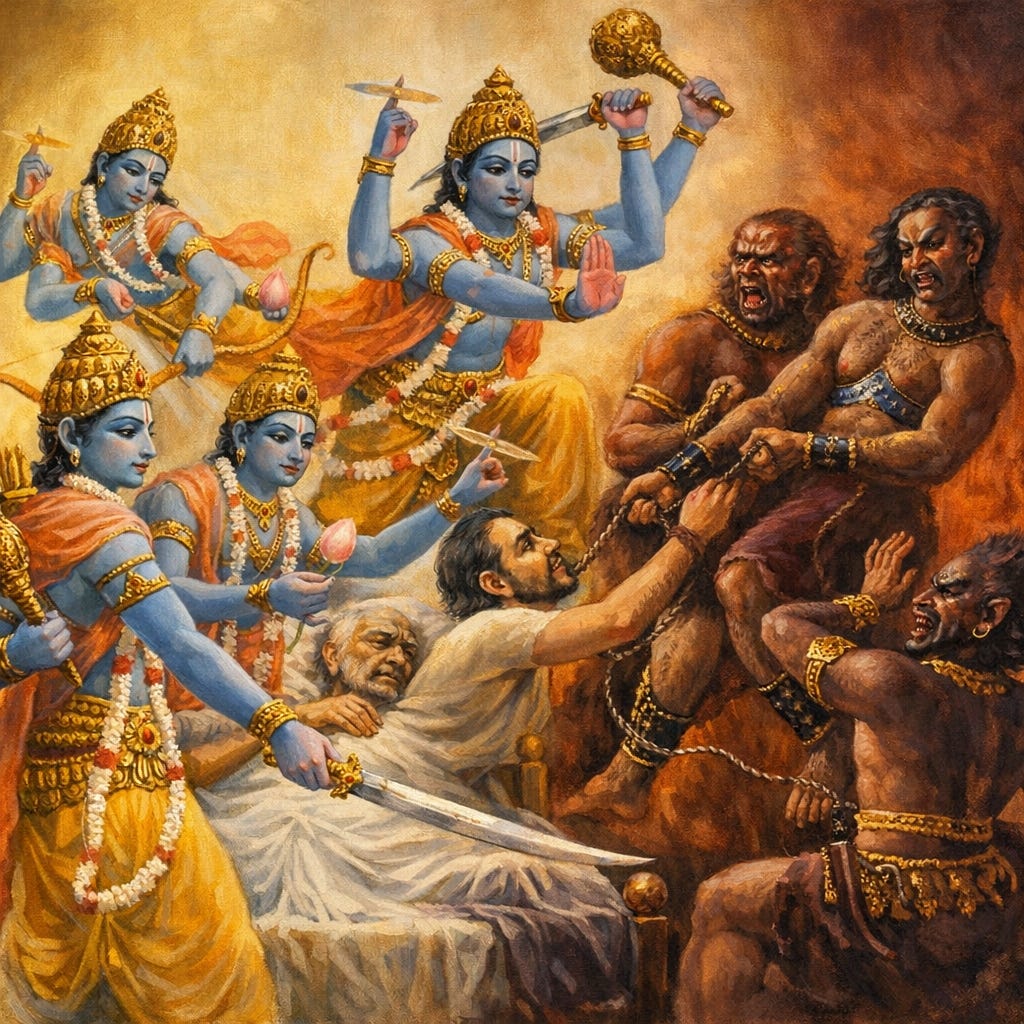
The first clue is given in the story of Ajāmila himself. Although he had served the Lord as a pure brahmacārī during his youth, he had later fallen with this prostitute and led a life of vices and crime. The Yamadūtas were thus prepared to take him to hell. This shows that what determines whether one is taken or not is the fact of having a load of sins at the time of death.
As Prabhupāda explains in his purports to the passage of Ajāmila, chanting the holy names free us from all past sins, but if one comes back to perform sinful activities after chanting, it is like the bath of an elephant, a daily ritual in which one becomes clean after chanting the holy names in the morning, just to become contaminated again by sins committed during the rest of the day.
After being initiated by the spiritual master, it is considered that one’s previous karmic debts are destroyed. This, however, is conditioned on one’s effectively surrendering to the spiritual master and following his instructions for a pure life, starting from following the four principles and chanting sixteen rounds of the mahā-mantra daily. If one continues following both the restrictions and the chanting until the end, there is no question of meeting the Yamadūtas. The difficulty is that we tend to become lax in our practice, relapsing into our past bad habits with time, or even stopping chanting altogether. This makes it complicated, since it puts us in a situation similar to Ajāmila, who became pure at a certain point but then relapsed into sinful life.
Another point is that the purifying potency of the holy names is manifested in proportion to our sincerity in chanting. Pure chanting of the holy names can give us love of Godhead, and even nāmābhāsa (chanting where we do not chant in full purity but at least chant attentively and without offenses) is sufficient to destroy all our previous karma and bring us to the platform of liberation. We can see that Ajāmila chanted in this platform, calling his son in a desperate position, in full concentration, while not committing any of the ten offenses. He did not chant the name in a platform of love of Godhead, but it counted as nāmābhāsa, and thus all his karma was destroyed at the last moment. As a result, the Viṣṇudutas immediately appeared on the scene, stopping the Yamadūtas from taking him, since now he had become an innocent man, free from all sinful reactions.
We can thus see the pattern. Because Ajāmila left his devotional service and became sinful again, he became eligible to be taken by the Yamadūtas. At the same time, however, his past devotional service led the Lord to make an arrangement for him to name his son Narāyana and chant his name at the last moment. If it were not for this divine intervention, Ajāmila would have been taken.
We can thus examine our current situation and ask ourselves to what extent these same conditions apply to us:
a) Did I perform devotional service seriously at any point in my life? Did I take initiation with surrender and so on?
b) In case of an affirmative, did I continue to follow the principles and chant regularly up to now? Am I following it now? Did I chant sincerely today?
c) Do I chant the holy names at least in the platform of nāmābhāsa, or am I still in the offensive stage, offending other devotees, and so on?
d) If death were to come suddenly, right now, what would be my state of consciousness? Would I be able to easily fix my attention on Kṛṣṇa? Would I be able to chant sincerely?
From these answers, we ourselves can ascertain whether we are in danger or not.
There are indeed accounts of devotees who face near-death experiences and are greeted by the Yamadūtas, which can be a true waking call.
I, personally, had a friend who revealed he met the Yamadūtas after coming very close to death due to an accident. His story is that he joined when he was young, was a brahmacārī for some time, got initiated, etc., but later went astray, coming to a life of drugs and other vices. At a certain point, when he was at his lowest, he suffered a serious car accident. He described vividly how he became desperate in being dragged out of the body by the Yamadūtas and brought to a very tall, celestial figure (Yamarāja). At this critical moment, he described, his guru appeared, chastised him, and ordered him to go back to his body and this time act differently. After that, he woke up in a hospital bed.
From there, he started again trying to practice while recovering from his injuries. His life was not free from mistakes; he got involved with drugs again on a few occasions, stole money, and did other things, but at least he kept chanting. Eventually, he married a devotee lady and lived with her for the last years of his life. Later, he left his body for good, but this time he was surrounded by a few devotees, and there is no description that he faced the same difficulties.
Mother Devakī describes a similar account from Bangladesh. Once, one of the brahmacārīs stole money and ornaments from the deities. To not make it obvious, he continued living in the temple and acting as if nothing had happened. Meanwhile, the authorities of the temple conducted an investigation and discovered he was the culprit. Confronted, he brought them to his room, promising to give the money back, but instead, he quickly drank a fatal dose of poison he had already prepared for this situation. He quickly lost consciousness and was rushed to the hospital, where the doctors admitted not being able to save him. As he was dying, the two devotees who brought him decided to do a short kīrtana, praying to Lord Nṛsiṁhadeva and chanting the mahā-mantra. To the surprise of all, he survived.
Later, he personally told Mother Devakī of what happened that day. In her words:
“Some days later, upon his return to the temple, I regularly spent some time in his room to encourage him, as everyone else had condemned him to be a thief. Once he felt a little better, he personally shared with me how he had received the darshan of the Yamadutas. Judging from the intensity and bewilderment in which he described them, I knew it was a true story he had encountered - he was not inventing it to be sensational. He related how two Yamadutas were standing at his head, and two at his feet - black and fiercely looking, with frightening horns on their heads. Describing them he became overwhelmed by emotions of fear and horror, sobbing in despair. They had come three times to try and pull him out of his body; but since the two brahmacharis had taken shelter of Lord Nrsimhadeva by singing His prayers, the Yamadutas were not successful in taking him.”
Another famous account is described by bhn. Subhadrā. Her story is that after practicing for three years with her father, she decided to leave her own life. She stopped practicing, started taking drugs, got into depression, etc. In the midst of this suffering, she at some point tried to take her own life. As she describes:
“This year, on May 10, 2009 - I don’t even remember that day - I climbed over the balcony of my Prague flat and, strongly influenced by ignorance and despair, I jumped down from the 6th floor (7th in U.S. counting).
For a week I remained in an artificial sleep. During that time I experienced in my subtle body a difficult-to-describe story full of suffering, pain, torture and unavoidable violence from creatures appointed to that task. It was an endless trip to hell...
After seven days devotees organized a sacrifice in Germany and prayed to Lord Nrsimhadeva on my behalf. After the kirtan ended, I “woke up” and started to communicate. By the Lord’s mercy I survived.
I had undergone demanding surgeries, having had open fractures of my limbs, smashed ankles, crushed pelvis and one hand, 13 ribs and a bone next to my head broken. I lost one kidney and the spleen. My liver burst and I had many other injuries. In terrible pains I spent several more weeks. Further surgeries of legs followed. I was lying in bed, immobile.
Finally I had time to think why it had happened and what to do now. It was not sure whether I would be able to walk and get fully cured. Fortunately, my father provided me a great support. He was always positive and ready to help me both physically and spiritually.
We also contacted Cittesvara prabhu from India who treated me through successful sacrifices. My health and inner state got improved. After three months I was released from the hospital. Now I’m living at Govinda’s with my father, serving and integrating myself into devotee association.”
A fourth account comes from the Gaudiya Matha, describing the story of a disciple of Śrila Bhaktisiddhānta Sarasvatī Thākura who later abandoned his vows and was dragged to the presence of Yamarāja, where he was saved at the last moment by Śrila Bhaktisiddhānta himself, who ordered him to go back to his body, take initiation again from one of his Godbrothers, and this time don’t abandon his devotional practice:
“This is an incident that happened in the 1930s. There was a disciple of Śrila Prabhupāda Bhakti Siddhanta Sarasvatī Thākura who got initiated in 1933. He was from Guwahati, Assam. He followed all the principles of devotion and chanted Harināma on the chanting beads given to him by Śrila Prabhupāda. Śrila Prabhupāda Bhakti Siddhanta Sarasvatī Thākura disappeared from this world on 1st January 1937.
After the disappearance of Śrila Prabhupāda, the disciple started to deteriorate in his devotional practices until he got engaged in anti-devotional activities of consuming meat. It was his downfall that he even stopped chanting Harināma. But the laws of karma had some other plan for him, and within a few years he had fallen sick and died. As per Hindu-Indian tradition, the dead body is burnt in the cremation ground. Hence, the body of this person was also lying in the cremation ground within the wooden logs, which were supposed to be set to fire.
Suddenly, the dead man came to life and started shouting his beloved Gurudeva’s name, “Prabhupāda! Prabhupāda! Prabhupāda!” People present there were astonished to see this unnatural incident and started to flee, thinking him to be a ghost. He went to his home immediately and told his family that he was renouncing material life to serve his Gurudeva’s words.
Life after death had changed him completely. He shared his amazing experience of life after death. He shared his story as follows.
When he died he saw two gigantic and horrifying figures (Yamadūtas) who came and took him away from this world to another unknown world, Yama-purī. On the way to Yama-purī, he felt thirsty because the way to Yama-purī was deserted and with the scorching sun on his head. When he asked for water from the Yamadūtas, they showed him a pond to quench his thirst. But when he went near to the pond then he found it full of vomit, blood, and pus. On complaining to them about how he could ever drink such filthy things, they replied that he could get only vomit to drink on his way to Yama-purī and nothing else due to his past karmas. Feeling depressed, he moved on with them to Yama-purī.
After reaching Yama-purī, he was made to stand in a queue where Citragupta, the assistant of Yamarāja, was opening the accounts of karmas for all standing in the queue. He was horrified to see that every other person standing in before him was immediately sent to hell by Citragupta upon seeing their accounts. At last, when it was his turn, he was sent to Yamarāja as a special case. He was astonished. When he was brought to Yamarāja, the devata of death, he asked him if he had ever performed any good deed in his life that he could recollect. He answered that he got initiated by Śrila Prabhupāda. Upon hearing Śrila Prabhupāda’s name, Yamarāja closed His eyes and remembered Śrila Prabhupāda, and the most amazing thing happened that Śrila Prabhupāda appeared in Yama-purī even for such a disciple who had betrayed Him by not following His instructions. Yamarāja asked Śrila Prabhupāda for the next course of action to be taken for His disciple. Before answering to Yamarāja, Śrila Prabhupāda directly chastised His disciple for ignoring Harināma and getting involved with anti-devotional activities of consuming restricted things. Upon hearing Śrila Prabhupāda’s chastisement, he asked for forgiveness. His Grace Śrila Prabhupāda showed mercy to his disciple upon asking forgiveness and ordered him to go back to earth and again accept Harināma from His beloved disciple Śrīla Bhakti Dayita Mādhava Gosvāmī Maharaja in Kolkātā.
As soon as Śrila Prabhupāda asked to take re-initiation, he came and didn’t remember what happened after that, and he got up in the cremation ground shouting Prabhupāda! Prabhupāda! Prabhupāda! After that, he renounced his worldly life and immediately went to Kolkātā to see Śrīla Bhakti Dayita Mādhava Gosvāmī ji for accepting Harināma from Him. When he went into the room where Śrīla Bhakti Dayita Mādhava Gosvāmī ji was present and started to narrate his story of life after death, Śrīla Bhakti Dayita Mādhava Gosvāmī ji stopped him from narration, saying that He was already aware of what had happened and gave him Harināma mala (chanting beads) to chant. He stayed in the math after that and kept chanting Harināma always for 8 years until he again left this world.”
We can draw some parallels from these four descriptions. In all four cases, we have devotees who left their bodies in states of debt after having performed sinful activities. However, similar to the case of Ajāmila, because of their previous devotional service, they were still saved and received a second chance.
These are sobering accounts. Yamadūtas are real, and sinful souls indeed face judgment and potential punishment by Yamarāja. We should thus be serious in our spiritual practice. Christians believe that just by accepting Christ, one is automatically saved, but we can see that it is not so easy. We need to become serious in our spiritual practice and continue practicing until the end of our lives. If we become lax and forget about Kṛṣṇa, our karmic debts start again to accumulate, and we may end up receiving a visit from the Yamadūtas when death unexpectedly comes.
A last question: What happens with devotees who are not able to attain a platform of love of Godhead and are thus not eligible to go back to Godhead, but at the same time are not sinful and thus not eligible to be dragged by the Yamadūtas? In the Bṛhad-bhāgavatāmṛta, Śrila Sanātana Goswami describes that the Viṣṇudutas are constantly busy, traveling through different material universes and helping devotees in all kinds of situations of difficulties. One doesn’t need to be a pure devotee to be helped by them. Any sincere devotee can be helped in situations of danger, and indeed, this happens frequently, each time a devotee sincerely calls for the Lord in a desperate situation. We may not be able to see them, but the Viṣṇudutas always answer these calls, just as in the case of Ajāmila. Similarly, at the time of death, they help devotees to chant the holy names and remember Kṛṣṇa, and if that’s the case, help them to transmigrate to their next body.
Devotees who were with Sudhāmā Prabhu, a disciple of Prabhupāda who came back to spiritual practice at the end of his life, after living a life of vices for many years, describe his account of meeting the Viṣṇudutas on the day before his passing away. He described that they appeared to him and told him to chant, but he couldn't, and thus they left. Apparently, they returned the next day, and this time he was able to chant and remember Kṛṣṇa, making him eligible to return home, back to Godhead.
You can also donate using Buy Me a Coffee, PayPal, Wise, Revolut, or bank transfers. There is a separate page with all the links. This helps me enormously to have time to write instead of doing other things to make a living. Thanks! You can also receive the updates on Telegram.