

You can receive new articles directly in your inbox. Subscription is free; donations are welcome.
Maharaja Uttānapāda left for the forest before organizing the marriage of Dhruva. He thought that achieving self-realization was more urgent than taking care of such family matters. Dhruva was still five years old when he was installed on the throne. In other words, Dhruva became the king shortly after returning from the forest, since now, despite being a child, he was perfectly qualified for the post. Since he had already received all transcendental knowledge from the Lord and achieved perfection, there was no need for him to go to the gurukula. Despite having been attached to Suruci, Uttānapāda was a saintly king, and his ultimate goal was self-realization. Different from ordinary materialists, who want to cling to power until their last breath, Rājarṣis like Uttānapāda rule out of duty and are anxious to leave the throne to dedicate themselves to self-realization as soon as a qualified son is present.
Even though Dhruva was a pure devotee at this point, ruling a kingdom demands having a wife since the duties of a king include not only begetting children to continue his lineage but performing many different types of sacrifices where the wife should be present, apart from other duties. As an exemplary king, Dhruva fulfilled all these duties perfectly, by later marrying two qualified ladies from respectable lineages and begetting four children. Nowadays, if a man thinks about having more than one wife, he will do so with the idea of enjoyment, but in previous eras, qualified men would often marry more than one wife to beget more qualified children. Even Śrila Bhaktivinoda Thākura married a second time after his first wife passed away because he desired to beget more children, out of his desire to bring a ray of Viṣnu to this planet. Ultimately, begetting qualified children is the duty of every man who enters family life. As Krsna explains in the Bhagavad-gītā, He is the sexual life that follows the principles of the scriptures, performed to bring enlightened children to this world and properly educate them in Krsna Consciousness.
Dhruva first married Bhrami, the wife of Prajāpati Śiśumāra, and begot two sons: Kalpa and Vatsara. Later, he married Ilā, the daughter of the demigod Vāyu, and begot a son named Utkala and a beautiful daughter.
Uttama, the half-brother of Dhruva, didn’t inherit the throne as his mother desired, but he was living comfortably in the palace, performing his duties as a Kṣatriya. Once, he went on a hunting excursion to the north and was killed by a powerful Yakṣa in the Himālaya Mountains. Suruci went in search of her son when he didn’t return, and perished in a forest fire, just as predicted by the Lord. This didn’t happen due to divine interference, but simply due to the results of her own actions.
Dhruva and his brother lived in Bhārata-varṣa, in the southern part of Jambūdvīpa, the central island of Bhū-mandala. Nowadays, often the Indian subcontinent is referred to as “Bhārata-varṣa”, but in the higher-dimensional Bhū-mandala, Bhārata-varṣa is a much larger structure, which is connected to the other portions of Jambūdvīpa. This structure is somehow represented in the gross dimension as our spherical planet, but it is not exactly the same, just as a two-dimensional projection of a three-dimensional object is not exactly the same as the original object being represented.
There is a large chain of mountains in the center of Jambūdvīpa, just like the Himalayas are the center of the South Asian region, but the Himālaya Mountains in the central part of Jambūdvīpa are much larger and include other features not present on our planet, such as Mount Sumeru. It’s difficult to conclude how these features of Bhū-mandala are represented in our gross dimension, but this is ultimately a futile exercise since even if they are present as part of other planets of our galaxy, we would not be able to go there by mechanical means.
Alakāpurī, in turn, is the capital of Kuvera, which is surrounded by beautiful gardens and lakes. The Mahabharata describes that the Pandavas visited the place during their exile, while Arjuna visited the celestial planets to collect weapons. Alakāpurī is situated in the northern part of Jambūdvīpa, north of Mount Sumeru, close to Mount Kailāsa, the abode of Lord Śiva.
The Yakṣas and Rākṣasas are the supernatural followers of Kuvera, who inhabit Alakāpurī and are present in the whole region of the higher-dimensional Himalaya mountains of Jambūdvīpa. Śrīla Prabhupāda also connects them to Himālayan tribes like the Tibetans. Uttama was killed by the Yakṣas, and this was a challenge to the authority of the king. Dhruva had authority over the whole Bhū-mandala, and killing his brother was a serious challenge to his rule; therefore, it was his duty to avenge his brother and restore order. Dhruva took his chariot and weapons and went north to the Himalayas to meet the challenge. A great battle ensued, where both Dhruva and the Yakṣas employed different types of mystical weapons. Kuvera is the treasurer of the demigods, and his abode is extremely opulent. The soldiers were also richly ornamented with earrings, turbans, golden bracelets, and armlets, etc.
The army of the Yakṣas was 130,000 strong, and jointly they shot so many arrows and other weapons at Dhruva that they covered Dhruva with an incessant shower of weapons, just like a mountain covered by rain. For a moment, the Yakṣas thought they had won, but quickly, Dhruva’s chariot emerged, just as the sun appearing from the fog. Their attempt just served to make him even sharper and determined to fight.
From this point, Dhruva regained the initiative and used his bow to cut through their army: “Dhruva Mahārāja’s bow and arrows twanged and hissed, causing lamentation in the hearts of his enemies. He began to shoot incessant arrows, shattering all their different weapons, just as the blasting wind scatters the assembled clouds in the sky. The sharp arrows released from the bow of Dhruva Mahārāja pierced the shields and bodies of the enemy, like the thunderbolts released by the King of heaven, which dismantle the bodies of the mountains.” (SB 4.10.16-17)
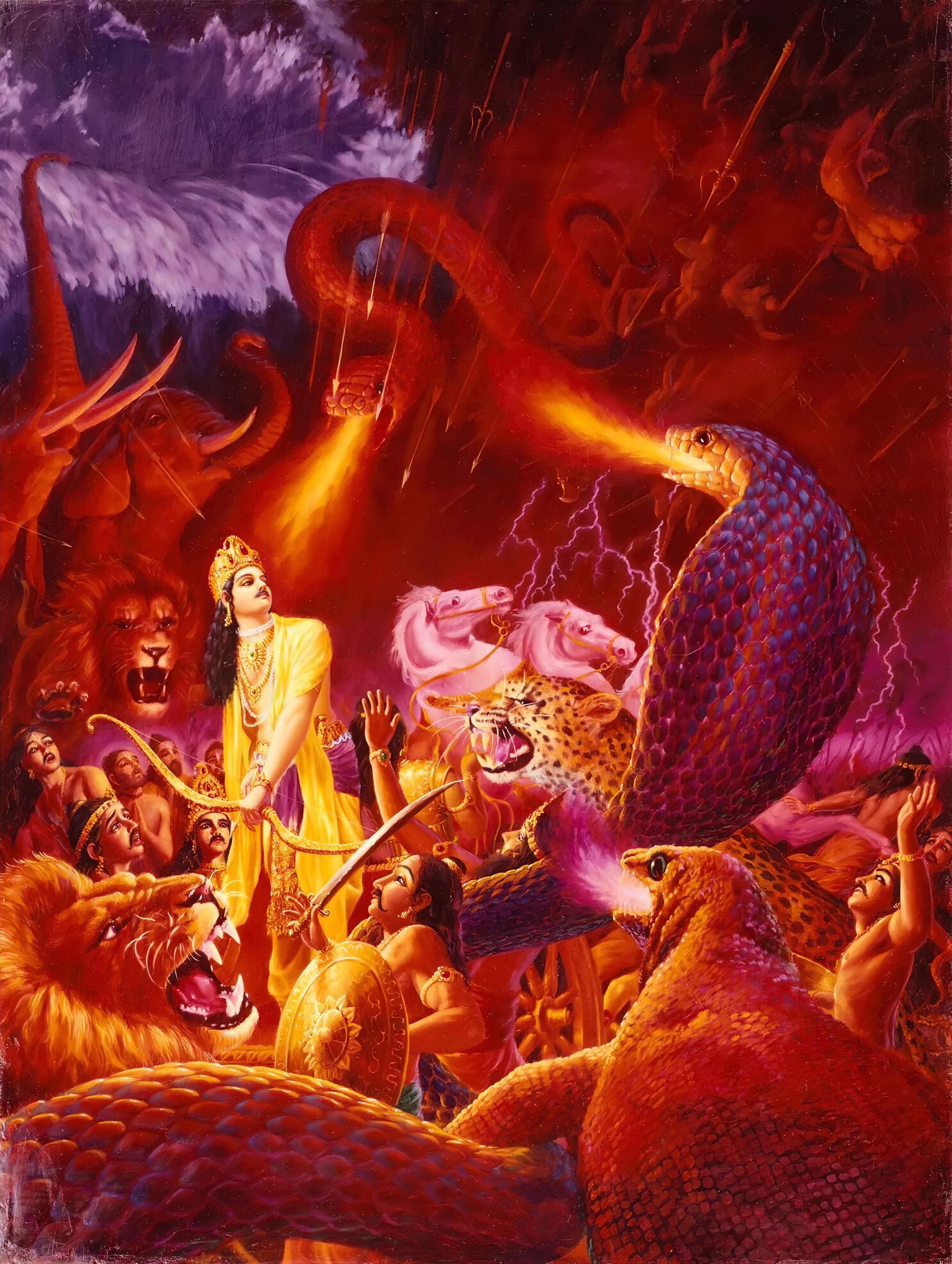
Dhruva conquered them using his bow, killing many soldiers and making the rest flee. However, using their power of illusion, the Yakṣas created terrible illusions, with dead bodies falling from the sky, dangerous animals coming to devour him, etc. These illusions presented a great challenge, and even Dhruva became perplexed for a short time, just as we may become perplexed when facing difficulties.
Great sages, however, quickly approached Dhruva and instructed him to surpass all illusions by the power of chanting the holy name, which is non-different from the Lord Himself.
By chanting the holy names, we directly associate with the Lord, who is the only true shelter. We surely face many difficult and dangerous situations during life, but our connection with the Lord is established through the chanting of the holy names, which can make us surpass all difficulties. The sages who came to Dhruva were inspired by the Lord inside the heart to do so, and this also emphasizes the power of sādhu-saṅga, which can save us in the most dangerous moments.
Hearing the advice of the sages, Dhruva again became resolute. He prepared to use the nārāyaṇāstra, a specific arrow made by Lord Nārāyaṇa Ṛṣi Himself. As is the norm for using a mystic weapon, he touched the water used for purification before invoking the astra.
There is no direct description in the Śrīmad-Bhāgavatam about him obtaining this weapon, but in verse 4.11.3, Prabhupāda translates the words ārṣa-astram (the weapon of the great sages) as “the weapon given by Nārāyaṇa Ṛṣi” and on his purport to verse 4.11.1, he mentions that “Dhruva Mahārāja was given a specific arrow made by Lord Nārāyaṇa Himself”.
Nārāyaṇa Ṛṣi is the direct incarnation of the Lord, and by the context of the verses and the description by Śrila Prabhupāda, it appears that Lord Nārāyaṇa Ṛṣi was amongst the sages who instructed Dhruva Maharaja, and that He personally delivered the nārāyaṇāstra to him in the battlefield. This weapon could be invoked by Dhruva Maharaja by chanting the holy name of the Lord. In this way, the chanting of the holy name by Dhruva became not just the source of purification and spiritual strength but also a weapon that could defeat his enemies.
In his purports, Śrila Prabhupāda makes the connection with the congregational chanting of the holy names. That’s our weapon, given to us by Srī Caitanya Mahāprabhu. Just as the nārāyaṇāstra allowed Dhruva to defeat all dangers, the congregational chanting can save us from all the perplexities of modern life and put us on the path back to Godhead.
“Śrī Caitanya Mahāprabhu has also given us a nice weapon for this age, as stated in the Bhāgavatam: sāṅgopāṅgāstra — in this age, the nārāyaṇāstra, or weapon to drive away māyā, is the chanting of the Hare Kṛṣṇa mantra in pursuance of the associates of Lord Caitanya, such as Advaita Prabhu, Nityānanda, Gadādhara and Śrīvāsa.”
“Kṛṣṇa is like the sun, and māyā, or the illusory energy of Kṛṣṇa, is like darkness. Darkness means absence of light; similarly, māyā means absence of Kṛṣṇa consciousness. Kṛṣṇa consciousness and māyā are always there, side by side. As soon as there is awakening of Kṛṣṇa consciousness, all the illusory pains and pleasures of material existence are vanquished. Māyām etāṁ taranti te: constant chanting of the mahā-mantra will keep us always aloof from the illusory energy of māyā.” (SB 4.11.1-2 purport)
Just as we can instantly dispel all illusions by chanting the holy names in full faith, Dhruva was able to easily dispel the illusions created by the Yakṣas by using the weapon of Lord Viṣnu:
“Even as Dhruva Mahārāja fixed the weapon made by Nārāyaṇa Ṛṣi onto his bow, arrows with golden shafts and feathers like the wings of a swan flew out from it. They entered the enemy soldiers with a great hissing sound, just as peacocks enter a forest with tumultuous crowing.
Those sharp arrows dismayed the enemy soldiers, who became almost unconscious, but various Yakṣas on the battlefield, in a rage against Dhruva Mahārāja, somehow or other collected their weapons and attacked. Just as serpents agitated by Garuḍa rush towards Garuḍa with upraised hoods, all the Yakṣa soldiers prepared to overcome Dhruva Mahārāja with their upraised weapons.” (SB 4.11.3-4)
Some of the soldiers somehow survived the attack of the nārāyaṇāstra and came forward in a last-ditch attempt to overcome Dhruva Maharaja, who quickly dispatched them using his arrows. Because Dhruva was such a great devotee, however, all the Yakṣas killed by him were immediately purified and elevated to Brahmaloka, achieving the same result as perfect Brahmacārīs.
This is a publication for thoughtful readers who want to go deeper into Kṛṣṇa consciousness. I publish daily, and all posts are available to free subscribers. If you wish, you can also choose a paid subscription to support this work. By subscribing, you also gain access to the PDFs of all my books and drafts of books I’m working on.
If you would like to contribute further, you can find the donation links here.