

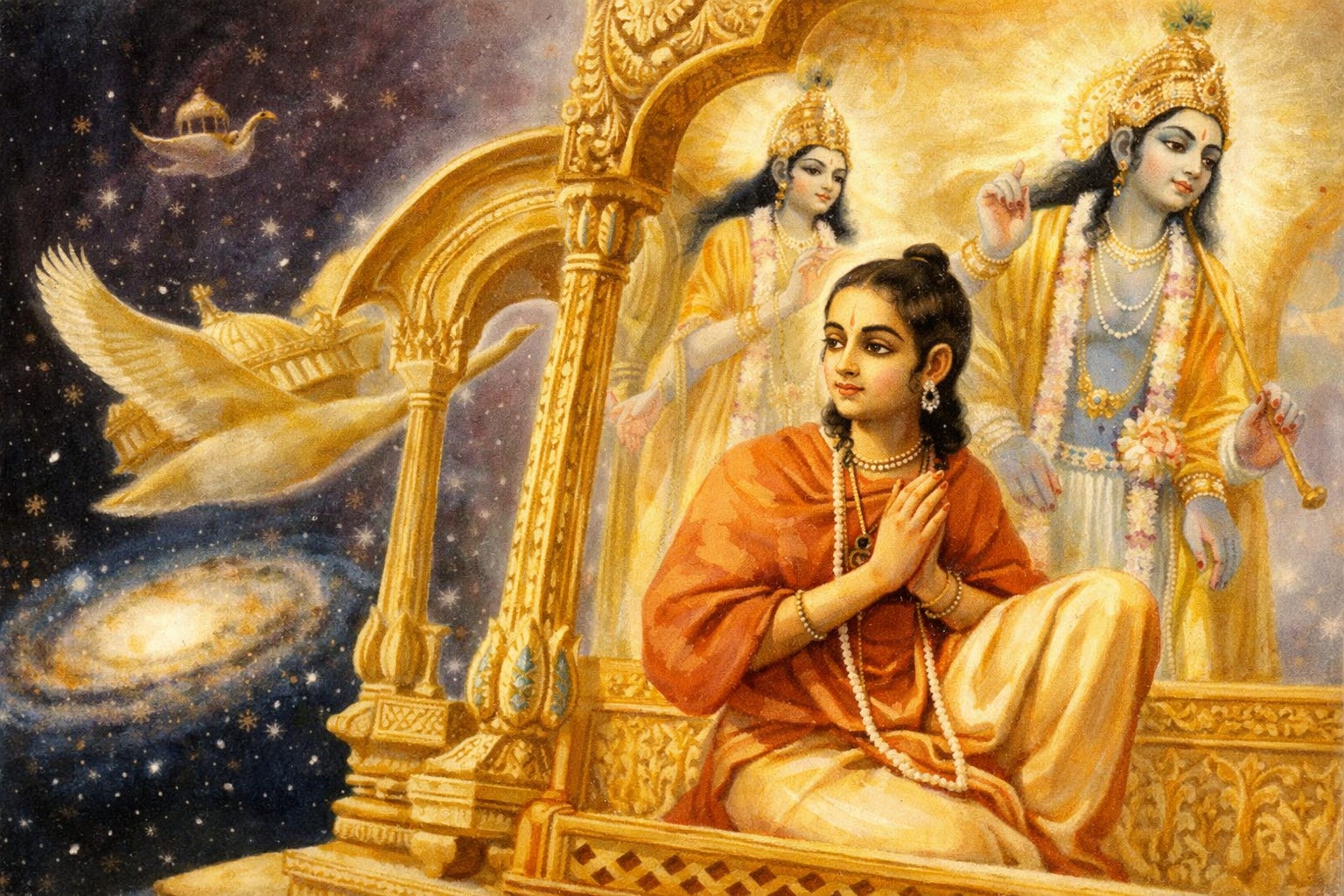
The pastime of Dhruva Maharaja being offended by his stepmother, deciding to practice austerities in the forest, and receiving the darśana of Lord Viṣnu is very well known. Lesser-known is how the pastime ends: how Dhruva finally goes back to Godhead after ruling as a king and fighting with the Rakṣasas.
How does it go?
After concluding his allotted time as the king of earth, Dhruva Maharaja installed his son on the throne and retired to Badarīkāśrama to dedicate himself fully to the practice of devotional service. By the mercy of the Lord, he had the opportunity to enjoy the experience of being a king, including the execution of different types of duties and satisfaction of all material desires. However, just like other saintly kings, he was not attached to his position. As soon as a qualified son was ready to take the post, he left, considering his palaces, gardens, and other dominions to be creations of the illusory energy.
Badarīkāśrama is situated close to Bhārata-varṣa in the region of the higher-dimensional Himalayas. This is the abode of great sages, led by Nara-Nārāyaṇa Ṛṣi, the ideal place for meditating on the Lord.
Like other perfect devotees, Dhruva Maharaja became completely free from material conditioning while still living in the body. Just like the pulp of a dry coconut becomes separated from the shell, even while still inside of it, a mahā-bhāgavata becomes disconnected from his material body, even while living in it. This means that one fully identifies with his eternal spiritual nature as a servant of the Lord and not with the temporary material identity connected with the false ego.
This stage is different from the simple disconnection from the gross material body we all experience at the time of death. At death, the gross body expires, but due to the false ego, the consciousness of the soul remains covered by the subtle body, which carries it to the next body. The situation of a perfect devotee is different. Dhruva Maharaja is described as mukta-liṅgaḥ because he became free from the covering of the subtle body by breaking the bounds of the false ego.
Normally, when a devotee attains the stage of liberation, he continues living in the body until the results derived from the prārabdha karma (the karma that is already giving fruits) completely cease. This gives a devotee the opportunity of further perfecting his devotional service and also the opportunity of teaching others. In the Mundaka Upanisad (3.1.4), it is mentioned that “Indeed, the Lord is the supreme life force behind everything. He shines in all beings, and He is the shelter of all. One who realizes that becomes absorbed in meditation into the Lord and enjoys the transcendental bliss of His association. He teaches others about devotional service and becomes dear to the Lord.”
In the case of Dhruva, however, there was nothing further to realize and nothing more to achieve in this world. Therefore, as soon as he attained this stage of perfect devotional service, he saw an airplane coming from Vaikuṇṭha to bring him to the eternal abode, driven by Nanda and Sunanda, two confidential servants of the Lord.
Dhruva was at first puzzled by the vision, but because he chanted the holy names, the Viṣṇudutas became immediately satisfied. Nanda and Sunanda glorified Dhruva Maharaja by describing how he performed severe austerities when just five years old and in this way satisfied the Lord. They then revealed their mission of taking him back home, back to Godhead, escorting him to Viṣṇuloka, the Polestar, the abode of Lord Kṣīrodakaśāyī Viṣnu, whom the Lord desired would be ruled by Dhruva Maharaja. Because of him, the planet is now known as Dhruvaloka.
Although the Polestar appears inside our universe, it is not a material planet but an eternal Vaikuṇṭha planet that just manifests inside the material universe, just as Vṛndāvana, Navadvīpa, and Jagannātha Purī, which are part of Goloka Vṛndāvana, are also manifested here. Dhruva’s position in the Polestar is eternal, just as when one attains any of the other Vaikuṇṭha planets. When the universe is finally destroyed, his planet remains as part of the spiritual sky, and he eternally resides there with the Lord.
Dhruva desired to achieve a position superior to all his ancestors. Nanda and Sunanda reveal that his achievement is unique: no one before in the history of the universe became the ruler of a Vaikuṇṭha planet as he did. This position is much superior to the position of Brahma, who rules an insignificant material universe for just a short period.
It’s also interesting to note that Dhruva Maharaja didn’t board the airplane immediately after meeting the Viṣṇudutas. After getting notice of his departure, he took a bath, dressed himself suitably, performed his daily sādhana, and took blessings from the great sages present in Badarīkāśrama. This indicates that the performance of devotional service by Dhruva Maharaja was natural and spontaneous, and not just to attain liberation. As Prabhupāda notes, this also shows how he was alert in the performance of his spiritual practice, and he didn’t become proud in receiving the news of his liberation, taking time to ask for the blessings of the sages.
In the spiritual world, everything is alive. Everything is part and parcel of the Lord, even seemingly inanimate objects. In truth, there is nothing unconscious in the spiritual world. Rocks may not move, but even they are conscious. Understanding this perfectly, Dhruva Maharaja worshiped not only the associates of the Lord but also the airplane they were boarding. In the process, he assumed a golden, spiritual form.
Everyone has to face death at some point. Usually, we don’t see death itself but just feel its effects. Death, however, has a predominating deity, just as all other material potencies do. Dhruva could literally see personified death approaching him, but instead of being afraid, he just used him as a stepping stone to board the plane, stepping on his head. A materialist fears death because death means the end of the illusory life he is so attached to, but for a pure devotee, death is not a cause of fear, since he doesn’t fear losing his material body. On the contrary, death for a pure devotee is an opportunity to join the Lord in His eternal pastimes.
The departure of a pure devotee to the spiritual world is an extremely auspicious event, and thus, as Dhruva boarded the plane, kettledrums resounded from the sky, Gandharvas sang, and demigods showered flowers. Dhruva, however, remembered his mother and questioned himself: “How shall I go alone to the Vaikuṇṭha planet and leave behind my poor mother?”
Suniti showed the way of spiritual realization to Dhruva by instructing him to search for the Lord in the forest. Although Nārada Muni later gave him initiation and more instructions, everything started with his mother. Dhruva was thus concerned about her.
Suniti was a great devotee on her own merit, and the connection with her exalted son made her even more qualified to return back home, back to Godhead. If one can help his or her son, daughter, or disciple to attain perfection, he or she will also be able to go back to Godhead. Depending on the circumstances, this may happen in the same life or in the next few lives, but liberation will be assured. The mother of Dhruva went back to Godhead in the same life, while Hiraṇyakaśipu, the father of Prahlāda Maharaja, took two more lives, but both attained perfection.
This is a publication for thoughtful readers who want to go deeper into Kṛṣṇa consciousness. I publish daily, and all posts are available to free subscribers. If you wish, you can also choose a paid subscription to support this work.
If you would like to contribute further, you can find the donation links here.