

Subscribe to receive all new articles directly by e-mail. It’s free, but if you like, you can pledge a monthly or annual donation to support my work:
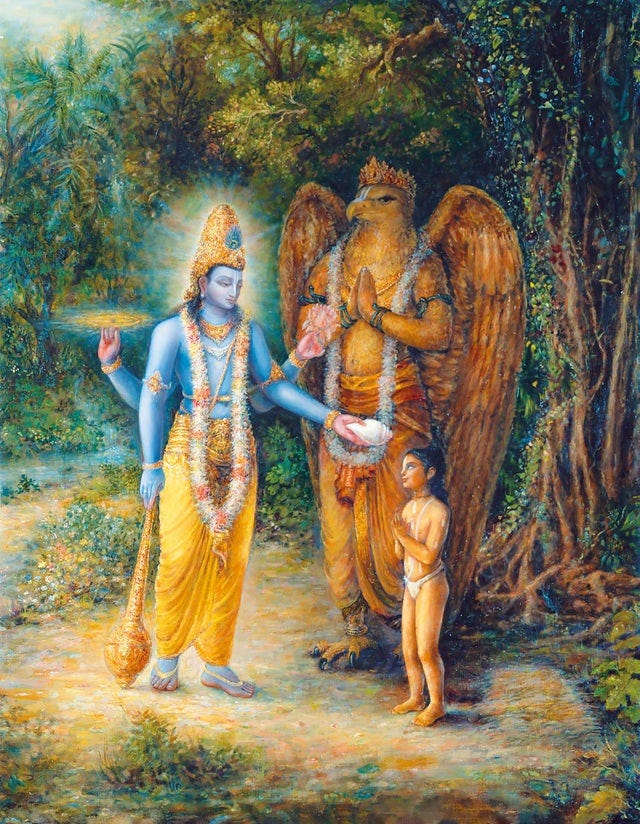
After performing his legendary meditation in which he was able to stop the breath of the whole universe, the Lord appeared personally before Dhruva Maharaja to bless him.
Dhruva desired to immediately offer prayers to the Lord, but being just a child, he didn’t have proper knowledge. Understanding the awkwardness of Dhruva, the Lord touched him with His conch, blessing him with all Vedic knowledge. Dhruva then offered beautiful prayers to the Lord that are registered in chapter 4.9 of the Śrīmad Bhāgavatam.
What did he say? These are the main points:
a) The real body of the living entity is his dormant spiritual body, which includes spiritual senses, mind, intelligence, and ego. In material life, the soul is sleeping, performing illusory activities under illusion, using the illusory material body. When the soul is finally awakened to spiritual realization, our real activities begin. When he was touched by the conch of the Lord, Dhruva fully awakened to spiritual realization, understanding his original position as a servitor of the Supreme Lord. The Lord is a person, and we are separate persons; therefore, our constitutional position is in an eternal loving relationship with Him. The process to attain the same spiritual realization Dhruva attained is to engage our current body, mind, and senses in the service of the Lord. In the beginning we may engage our senses mechanically following the rules and regulations and the instructions of the spiritual master, but after attaining spiritual realization, we can be engaged in full spiritual understanding. When the Lord becomes satisfied with us, He can reveal to us our original spiritual senses, and using them, we can fully glorify the Lord.
b) The Lord acts through His different energies, creating, maintaining, and finally destroying the material creation. The Lord is fully spiritual, and thus all His energies, being part of Him, are also spiritual. The internal potency is spiritual, the jīvas are spiritual particles, and the external potency, used by the Lord to create this material world is also spiritual. Pure devotees can thus see this material world as ultimately spiritual and connected to the Lord. Everyone else, due to their desire of lording over the material creation, is covered by māyā, the illusory energy, that makes them see the material world as separate from the Lord. Māyā (or Mahāmāyā) is a feature of the external potency, or bahiraṅga-śakti. It is also ultimately spiritual, but it has a specific function, which is to make rebellious souls forget their original spiritual nature and become engaged in this material world. Just as Yogamāyā is the deluding potency that creates the scenarios for the transcendental platforms of the Lord and inspires the inhabitants of the spiritual planets in their service, Mahāmāyā is the illusory potency that creates the conditions for material enjoyment and pushes us in the direction of sense gratification. As long as we want to enjoy separately from the Lord, we remain under the influence of Mahāmāyā, and when we desire to serve the Lord we come under the influence of Yogamāyā. When this happens, we suddenly realize the Lord was always with us.
c) The Lord is called ārta-bandhu, the friend of the distressed. All conditioned souls suffer in this material world, but when one finally surrenders to the Lord, he is saved from the material ocean. When the Lord sees one constantly engaged in devotional service, He gives him intelligence from within so he can make further progress. The devotee then feels obliged to the Lord for this transcendental reciprocation, and his devotion increases to the point he can’t forget the Lord even for a moment. This process of spiritual elevation is compared by Dhruva Mahārāja to the process of someone awakening from sleep. He uses the example of his grand-grandfather Brahma, who received knowledge from the Lord and became capable of performing his wonderful activities.
d) Conditioned souls are very anxious for material enjoyment, but when one comes to a platform of knowledge, he can understand that this material enjoyment so sought after is not valuable at all. Not only is it temporary, but it is also illusory. Sense enjoyment is more or less like trying to get pleasure by touching something with thick rubber gloves or tasting honey by licking a bottle. Real enjoyment can be tasted only on the spiritual platform using our spiritual senses, and not through the dull material body that covers our real self. The Lord is the very source of this unlimited spiritual pleasure; therefore, to approach Him to ask for sense gratification is like approaching a billionaire to ask for fake money. Dhruva thus regrets having approached the Lord, hankering for a material kingdom.
e) The transcendental bliss of serving the Lord in a personal relationship can’t be compared to the pleasure of impersonal liberation. What to say then about temporary enjoyment in the celestial planets? Even if one can attain the celestial planets by acting like a pious person, his’s staying there is temporary and thus ultimately valueless. All other positions apart from the original position of service of the soul are ultimately temporary, and this original nature can be uncovered by the mercy of the Lord.
f) Devotional service to the Lord can’t be complete and relishable without the association of devotees. Dhruva Maharaja, therefore, is anxious for the association of great devotees who are fixed in the transcendental service of the Lord and situated in an uncontaminated state of life. Once we obtain such an association, devotional service flows naturally, just like the waves of an incessantly flowing river, and becomes the cause of the development of further devotional service.
g) Although the scriptures repeat that we are not the body over and over again, it is not easy for a conditioned soul to effectively realize he is not the body and lose interest in it. Even great yogis remain interested in regulating their breath, which is nothing more than a bodily performance. By associating with pure devotees, however, one experiences a higher taste and becomes thus naturally detached from his material body, bodily relationships, offspring, friends, home, wealth, spouse, etc., which are so dear to materialistic persons. By this simple process of association with saintly persons, a devotee becomes more advanced in spiritual consciousness than even the greatest yogis.
i) Before becoming self-realized and seeing the Supreme Lord, Dhruva had experienced material life and seen different species of plants, animals, etc. In verse 13, he emphasizes the difference between these two states of consciousness. He is now fully Krsna conscious and engaged in the service of the Lord, while different living entities are simply serving their senses. Every living entity, whether in the conditioned or liberated state, has to serve because this is the eternal nature of the soul. The question is who we want to serve. When we decide to serve Krsna and become Krsna conscious, we can appreciate the transcendental form of the Lord, instead of being attracted to different material objects.
j) The Lord appears in innumerable forms, such as Kṣīrodakaśāyī Vishnu, Garbhodakaśāyī Vishnu, Mahā-Vishnu, and so on. However, a pure devotee understands that in all these forms the Lord is the same, and that He is the creator and master of everything that exists. This perfect knowledge was also revealed to Dhruva by the Lord Himself.
k) All material activities are performed under the three modes of material nature. The Lord also performs activities, but His activities are transcendental. As the creator of the three modes, the Lord is not entangled by them, therefore He is called try-adhīśa, the master of the three modes. Even though the Lord gives all living entities the means and sanction to perform material actions as they please, He remains aloof. Even though He is the enjoyer of all sacrifices, He is unattached. The Lord has nothing to do with this material world and doesn’t desire anything from here. However, He creates the whole material manifestation just to give an opportunity to the conditioned living entities to perform devotional service and return to their original spiritual consciousness.
l) The impersonal Brahman is the immediate cause of the material manifestation. From it all the material potencies emanate, as well as the material duality, composed of knowledge and ignorance, pious and impious, good and bad, etc. However, Krsna is the ultimate cause, because He stands behind this source of all material causes. Powerful as it may be, the impersonal Brahmajyoti is just the bodily effulgence of Krsna. A transcendentalist who is not very advanced may think that the impersonal Brahmajyoti is the ultimate source and destination of everything, but another, more advanced, can understand that the Lord has multiple energies and performs unlimited pastimes.
m) In the material world, people desire different types of benedictions, believing that such benedictions will make them happy. Dhruva, for example, desired to have a kingdom greater than his ancestors. However, as Dhruva understood, the greatest happiness is to be engaged in unmotivated service to the Lord, who is the pañcama-puruṣārtha, the ultimate goal of life, the very source of all pleasure. Pure devotional service includes not praying to the Lord for wealth, a husband or wife, etc. However, the Lord is so merciful that even if someone approaches Him desiring some material benefit, the Lord takes care of him, just as a cow maintains her calf. The Lord satisfies the desires of such a devotee in ways that gradually elevate him to the position of pure devotional service, giving him intelligence to surpass all impediments. Dhruva, however, asks for the Lord to protect him from such desires, so his devotional service may not be hampered.
You can also donate using Buy Me a Coffee, PayPal, Wise, Revolut, or bank transfers. There is a separate page with all the links.
If you prefer, you can also receive the updates on Telegram.