


Subscribe to receive new articles by e-mail. It’s free, but if you like, you can pledge a donation:
Join the Telegram group if you would like to join the live lessons. This course is maintained with your donations. Click here to donate.
💬 Text of the lesson
What does “yojana” mean?
One important point when we study the Vedic Universe is the distances. All the measurements of the universe given in the Puranas are based on a unit called yojana. This is a measure of distance based on characteristics of the human body, much like the inches and feet used in the imperial system.
One definition is that a yojana equals 8,000 times the height of a man. Another is that it equals 32,000 sets of 24 finger widths. Yet another definition states that a yojana equals four times the maximum distance a healthy man can shout and still be heard. That’s one of the reasons the length of the yojana varies through different sources, sometimes as 5 miles, 8 miles, etc.
The difficulty with the Vedic model is that when the distances described in the Śrīmad Bhāgavatam are taken literally, the universe is described as being very small, with just 4 billion miles in diameter. When we take out the vast areas of Aloka-varṣa, the Golden land, and the Garbhodaka Ocean, which are uninhabited, the inhabited universe becomes even smaller, with just 656 million miles (two times 41,100,000 yojanas, the diameter of the inner border of the golden land) and about two billion miles in height (from Bhū-mandala to the upper covering). It is very difficult to imagine that everything we see in the sky could fit in such a small space.
To have an idea, taking the relative distances of the stars of our Galaxy, a universe of just four billion miles would result in each star having just a few dozen meters in diameter. If we fit what is believed to be the observable universe (with all the galaxies), then the size of each star would fall into the scale of microns.
Taking the idea of 4 billion miles literally, the only logical conclusion would be to take just our solar system as the Vedic universe and, from there, conclude that other solar systems are separate universes. This, however, results in many contradictions that just grow as we try to reconcile with different passages from the scriptures.
There is, however, another possible interpretation that perhaps makes more sense.
The Vedas describe that other species that live in our universe (like the celestial humans living in the other varṣas of Bhū-mandala, as well as demigods and great sages living in the upper planetary systems) have different physical characteristics. They are much larger than us, and can travel for much greater distances, apart from having different mystical perfections that allow them to perform feats impossible to us. 8,000 times their height, 32,000 sets of 24 of finger widths, or four times the maximum distance they can be heard would surely be much more than it is in our case.
It is thus not completely implausible to believe that the effective scale of a yojana may correspond to different dimensional metrics in different planes. In other words, what is a yojana for us may be perceived differently by inhabitants of different planets, and, conversely, what is a yojana for them, in their abodes, may be very different from what it is for us.
Imagine a yogi traveling through the cosmos using the mystical process prescribed in the Vedas. Being an inhabitant of Satya-yuga, he starts from the higher-dimensional reality of Bhū-mandala that we study in the pages of Śrīmad Bhāgavatam (which is already much more refined than our gross reality). It is described that from this level, he has to traverse a vertical distance of 100,000 yojanas to reach Svargaloka, traveling using the rays of the sun, first reaching the sun itself, and from there reaching the desired planet in the celestial planetary system.
By the time he reaches there, he is free from all sinful reactions and has acquired a much more elevated state of consciousness, which makes him qualified to assume a celestial body that is larger, subtler, and much more powerful than the body he had while living in Bhū-mandala. Now, his perception of distance becomes different. What is now a yojana for him is much more than what a yojana is for the inhabitants of Bhū-mandala, and even more than what it is for us.
Now, imagine that he again sits in meditation, this time aiming to reach Maharloka, the next planetary system, which is 10,000,000 yojanas above, by what is now his measure. This time, he travels a distance that is inconceivable to an inhabitant of Bhū-mandala, and even more for us. For this trip, he elevates his consciousness even further, which leads him to acquire an even subtler and more powerful body. Now, the yojana, in his higher dimensional reality, is even larger, incalculable to us.
Now, imagine he continues traveling upwards, traveling the 20,000,000 yojanas (from his measure) to Janaloka, and then the 80,000,000 yojanas to Tapoloka, then the 120,000,000 yojanas to Satyaloka, then the 5,000,000,000 yojanas of the first covering, the 50,000,000,000 yojanas of the second covering, etc. How many miles is it for us?
If we see from this perspective, the universe described in the Vedas is even larger than what is believed in modern science, incalculable from our perspective. The only way to travel through it and reach the spiritual side is thus by following the process of purification described in the scriptures and not by building a spaceship. This is precisely the point made in the Śrīmad Bhāgavatam.
The main point is that although we are limited by such distances, higher beings are not. Inhabitants of Satyaloka can thus easily reach all regions of the cosmos, while we can travel only around our planet, or close by.
Therefore, when we study the model of the universe described in the Śrīmad Bhāgavatam, it makes more sense to try to understand it as a map of different levels of consciousness, a description of how each level is progressively harder to attain than the previous, and the process to achieve it, rather than a literal description of distances measured in earthly inches or meters.
There is another illustration that may help to understand this concept:
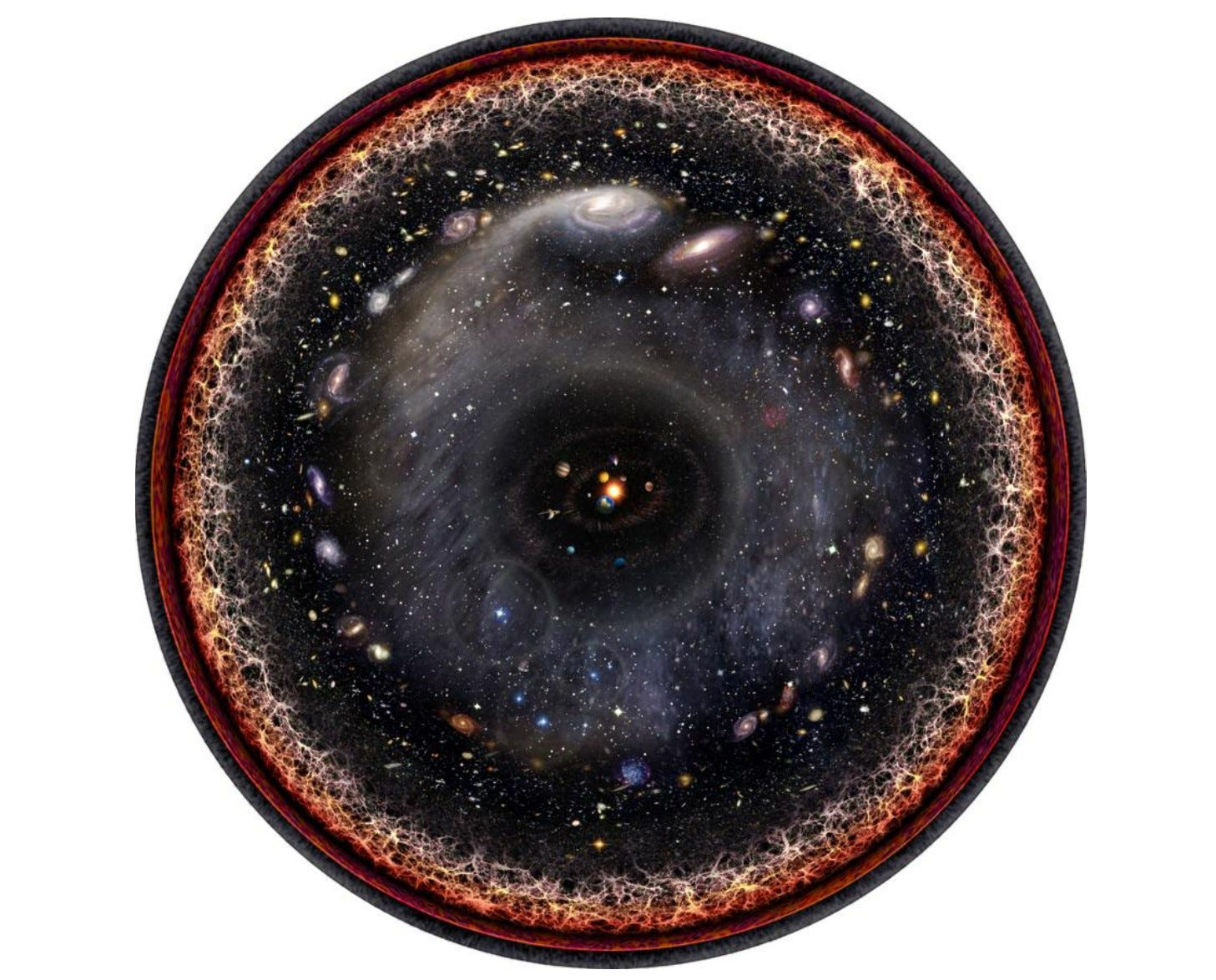
What is it?
This image is an artistic representation of the modern understanding of the observable universe, with our solar system in the middle and the rest of the structures of our Milky Way galaxy, as well as other galaxies positioned around it, with the distances increasing at a logarithmic scale. This means that everything becomes exponentially smaller as we move away from the center of the image. In this way, we have our solar system in the center, surrounded by the other stars of the Milky Way galaxy and by other galaxies.
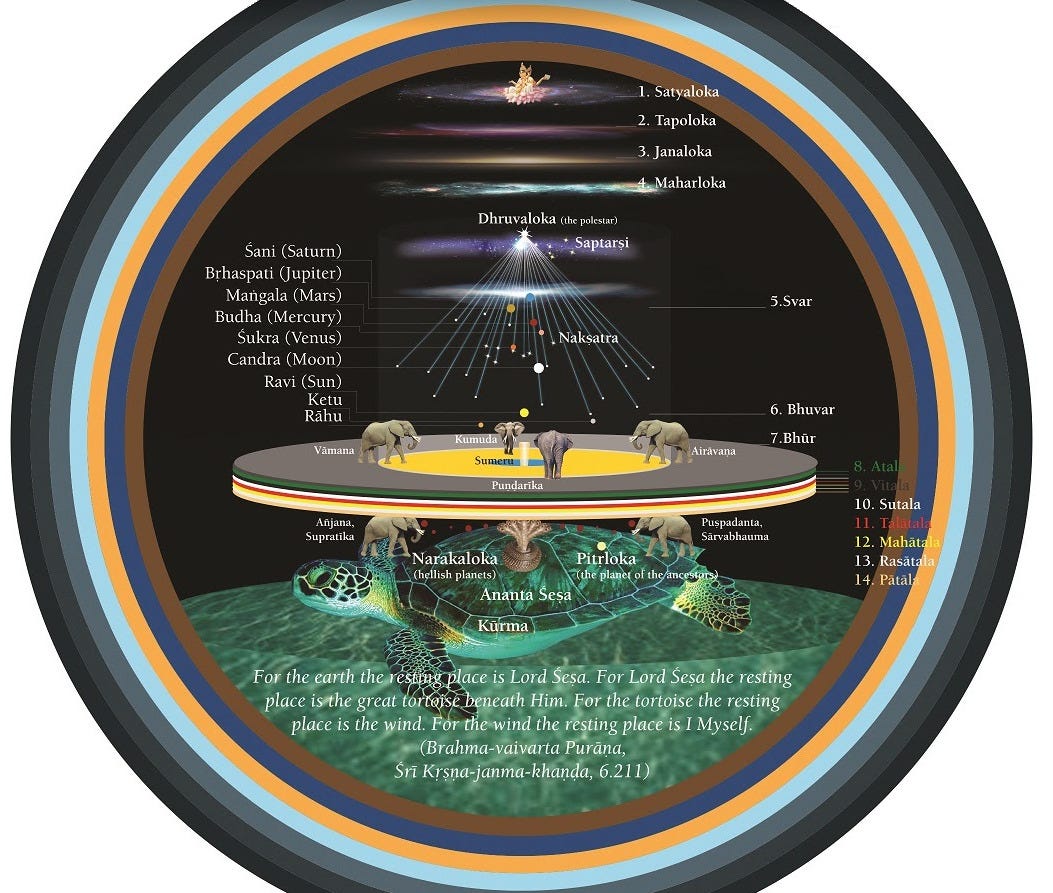
We can notice that it’s actually very similar to artistic representations of the Vedic Universe, where the seven coverings are also depicted on a logarithmic scale. In reality, each one of the coverings is 10 times the circumference of the previous, with the first covering being 10 times the circumference of the Universe itself. However, to keep things in a manageable size, these illustrations depict a big Universe and narrow coverings around it, in a logarithmic scale, similar to the previous illustration. When we see from this perspective, these two views of the Universe are actually not so different:
Time dilatation and other mysterious features of the Vedic universe
This concept of distances being perceived differently as we go upwards in the hierarchy of planetary systems of the universe may sound like mere speculation at first, but there is another similar concept described in the Vedas, which is time dilation. In short, each planetary system of the cosmos has its own clock rate, with time being experienced differently by different inhabitants of the universe. What is 360 years for us, is just a year to the demigods in Svargaloka, and what is 8.64 billion years is just a set of day and night in Brahmaloka. As we go higher, the concept of time changes radically and lifetimes extend for millions or even trillions of years. In this way, there are years both here and in Brahmaloka, but what we call “year” is very different from what is a “year” in their calculation.
This dilatation of time is also studied in modern science, following the relativity theory of Einstein, which concludes that time runs faster near massive or higher-energy regions.
One practical example of this working in practice is the story of King Kakudmī, described in the Śrīmad Bhāgavatam. He stayed for just a few minutes in Brahmaloka, but when he returned, many sets of four yugas had passed:
“Taking his own daughter, Revatī, Kakudmī went to Lord Brahmā in Brahmaloka, which is transcendental to the three modes of material nature, and inquired about a husband for her. When Kakudmī arrived there, Lord Brahmā was engaged in hearing musical performances by the Gandharvas and had not a moment to talk with him. Therefore Kakudmī waited, and at the end of the musical performances he offered his obeisances to Lord Brahmā and thus submitted his long-standing desire. After hearing his words, Lord Brahmā, who is most powerful, laughed loudly and said to Kakudmī: O King, all those whom you may have decided within the core of your heart to accept as your son-in-law have passed away in the course of time. Twenty-seven catur-yugas have already passed. Those upon whom you may have decided are now gone, and so are their sons, grandsons and other descendants. You cannot even hear about their names. O King, leave here and offer your daughter to Lord Baladeva, who is still present. He is most powerful. Indeed, He is the Supreme Personality of Godhead, whose plenary portion is Lord Viṣṇu. Your daughter is fit to be given to Him in charity.” (SB 9.3.29-33)
Another example is Brahmā himself briefly returning to his planet after taking away the cowherd boys and the calves from Kṛṣṇa. He stayed for just a moment in his planet, quickly returning to earth, afraid of the result of his mischief. However, by this time, a whole year had passed in our planet.
These descriptions make two points:
a) The Vedic universe has a higher-dimensional geometry. The flow of time becomes different as we move from the earthly regions to the celestial regions and from there to the upper regions of the cosmos.
b) Travel between the different planetary systems involves movement through subtle dimensions. Even though the distances separating the planetary systems are huge, higher beings can travel very fast between them using these subtle passages, just as King Kakudmī quickly returning from Brahmaloka to earth in order to marry his daughter to Balarāma. A very crude example to illustrate how this can be possible inside the concept of a multidimensional universe is that a two-dimensional being can only travel horizontally or vertically on a map. A tridimensional being, however, can just fold the map and make two points very close, while a four or five-dimensional being could manipulate the map in ways we can’t even imagine.
We can see an example of this subtle manipulation of space in the pastime where Kṛṣṇa shows Brahmā many forms of Viṣnu, each one complete with His own universe, and then brings all the Brahmās together, leaving the Brahmā of our universe completely disconcerted and bewildered.
Each universe is separated from the other by trillions of yojanas, and each Brahmā never leaves his respective universe. Kṛṣṇa, however, the master of all mystic power, could not only show one universe inside of another, but bring all Brahmas together, without any of them leaving their respective universe. It seems Kṛṣṇa knows a few extra dimensions that are beyond what even Brahmā can understand.
Kṛṣṇa Himself, personally, is another example. From our perspective, He appears to be the size a regular human child, but at the same time everything that exists is inside of Him. Similarly, what is a Mahā-kalpa, a whole cycle of creation for us is just a breath for Mahā-Viṣnu, and so on.
The same way Kṛṣṇa can bent space and time in ways we can’t even imagine, a small fragment of His potency can create all the variety of abodes and experiences we have in the cosmos.
When we take this into perspective, the idea that, just as time, the concept of distances for inhabitants of the higher planetary systems may be radically different, doesn’t sound too implausible. If we see from this perspective, the universe described in the Vedas is incalculable from our perspective, matching the apparently unlimited vastness we see when we look into the sky.
Therefore, when we study the model of the universe described in the Śrīmad Bhāgavatam, it makes sense to try to understand it as a map of different levels of consciousness (a description of how each level is progressively harder to attain than the previous, with a higher level of existence and even different perceptions of time and distances), rather than a literal description of distances measured in earthly inches or meters.
A non-Euclidean space
Another way to explain it is this: When we study the description of distances contained in the Śrīmad Bhāgavatam, we tend to presume that the distances add linearly, just like when we drive through different cities or countries of our planet. Therefore, when we read that a yojana is 8 miles, we presume that this is the same distance we can run in about 95 minutes everywhere in the cosmos. However, the description of the Bhāgavatam resists this reading.
When we try to apply the model of the Bhāgavatam to what we see when we look to the sky, we face many apparent contradictions: the Vedic universe appears to be too small to fit all the stars we see. The descriptions of demigods traveling through the cosmos in short periods of time appear to be impossible according to what we understand as physical laws, and so on. This adds to all the other questions we may have when we study the text: How can Sumeru be surrounded by gigantic islands and oceans, and why can’t we see them? How can Lokāloka block the rays of the sun? How can yogis travel through the rays of the sun? How can the time flow differently in different planetary systems?
One way to reconcile this is to conclude that the problem is not in the description of the Bhāgavatam, but in our assumption of the universe being a linear, Euclidean space. When we examine the description through the thesis of the universe being a multidimensional space, where the perception of distances depend on the dimension one inhabits, it becomes much easier to understand and relate to our perception of the cosmos.
In the level we live in, Bhū-loka, our reality is composed of gross elements, time goes slowly, and the universe appears to be unlimitedly vast. In the level of the demigods, Svargaloka, reality is formed by subtle material elements. Time and distances are experienced differently. Demigods probably see our limited reality just as we see an ant-colony. If we go to the level of great sages, culminating with Brahmaloka, reality is even subtler, almost a mental space rather than a physical dimension. There is enormous time dilatation (8.64 billion years for us equal just one day), and the perception of distance is radically different.
The 14 planetary levels described in the scriptures are thus organized like pages of a book, with each page bringing a different paradigm from the previous. The pages are close to each other, but moving from one page to another requires a different process than just moving horizontally or vertically in the same page. The different planetary systems described in the Vedic universe can be thus seem like 14 different realms stacked on top of each other, accessible through different combinations of consciousness, karma, and qualities. Moving to a higher realm gives access to a whole new level of reality, changing one’s perception of space and time.
These are just a few points that I hope may serve as food for thought.
The ultimate conclusion
All of this, however, is just my personal thesis. If you prefer to believe that the universe is literally just four billion miles in diameter, and that we can reach the coverings after traveling just two billion miles in any direction, you may also find passages that appear to support that. If you can find a way to explain the whole observable universe in this framework, your guess is as good as mine.
The main point, however, is to accept that the universe is a mechanism built by an intelligent and conscious God, and not just the result of mechanical physical laws, and that the way to travel through the universe and reach the spiritual side is by following the process of purification described in the scriptures, and not by building a spaceship. This is precisely the point made in the Śrīmad Bhāgavatam.
The movements of the sun
Based on what we learn in school, the sentence “movements of the sun” may sound nonsensical. Which movements, if the sun is stationary in the center of the solar system?
When it comes to the Vedas, however, there is a different explanation for the sunset and sunrise, as well as the passages of the seasons. The crucial difference is that the Vedic model assumes that the earth is stationary (as part of the fixed structure of Bhū-mandala), while the sun, together with all the stars and other planets circle around.
In other words, the Vedic model explains the movements of the sun from a geocentric perspective, instead of a heliocentric one. Because all the movements of the sun and stars are relative, it can’t be proved or disproved by modern science. Astronomers conclude that the earth orbits the sun because it makes more sense to them based on their models, while the Vedas conclude that the sun circles the earth because Kṛṣṇa decided it would be so. The main point is to understand that the Vedic model also works, and it actually explains the movements of the sun in a more natural way, explaining it from the perspective of someone standing on our planet and looking to the sky.
In his description of chapter 5.21, Śrila Prabhupāda gives us a synopses of the whole model:
“The sun is not stationary; it is also moving like the other planets. The sun’s movements determine the duration of night and day. When the sun travels north of the equator, it moves slowly during the day and very quickly at night, thus increasing the duration of the daytime and decreasing the duration of night. Similarly, when the sun travels south of the equator, the exact opposite is true — the duration of the day decreases, and the duration of night increases. When the sun enters Karkaṭa-rāśi (Cancer) and then travels to Siṁha-rāśi (Leo) and so on through Dhanuḥ-rāśi (Sagittarius), its course is called Dakṣiṇāyana, the southern way, and when the sun enters Makara-rāśi (Capricorn) and thereafter travels through Kumbharāśi (Aquarius) and so on through Mithuna-rāśi (Gemini), its course is called Uttarāyaṇa, the northern way. When the sun is in Meṣa-rāśi (Aries) and Tulā-rāśi (Libra), the duration of day and night are equal.
On Mānasottara Mountain are the abodes of four demigods. East of Sumeru Mountain is Devadhānī, where King Indra lives, and south of Sumeru is Saṁyamanī, the abode of Yamarāja, the superintendent of death. Similarly, west of Sumeru is Nimlocanī, the abode of Varuṇa, the demigod who controls the water, and north of Sumeru is Vibhāvarī, where the demigod of the moon lives. Sunrise, noon, sunset and midnight occur in all these places because of the movements of the sun. Diametrically opposite the place where the sunrise takes places and the sun is seen by human eyes, the sun will be setting and passing away from human vision. Similarly, the people residing diametrically opposite the point where it is midday will be experiencing midnight. The sun rises and sets with all the other planets, headed by the moon and other luminaries.”
What does it mean?
Here, the orbit of the sun is explained from the perspective of someone standing on earth and looking to the sky. Every day we see the sunrise and sunset, but as the year go on, we observe that the sun passes high in the sky during the summer season, and lower (closer to the horizon) as winter approaches, making the days longer or shorter. Days and nights occur in opposite times on different sides of the globe. What is midday for someone in Brazil is midnight for someone in Japan and vice versa. Similarly, the seasons are also inverted in the northern and southern hemispheres. December, for example, is summer in Brazil.
In modern cosmology, this is explained in terms of two movements: the rotation of the earth and its orbit around the sun. You can see how this works in this illustration:
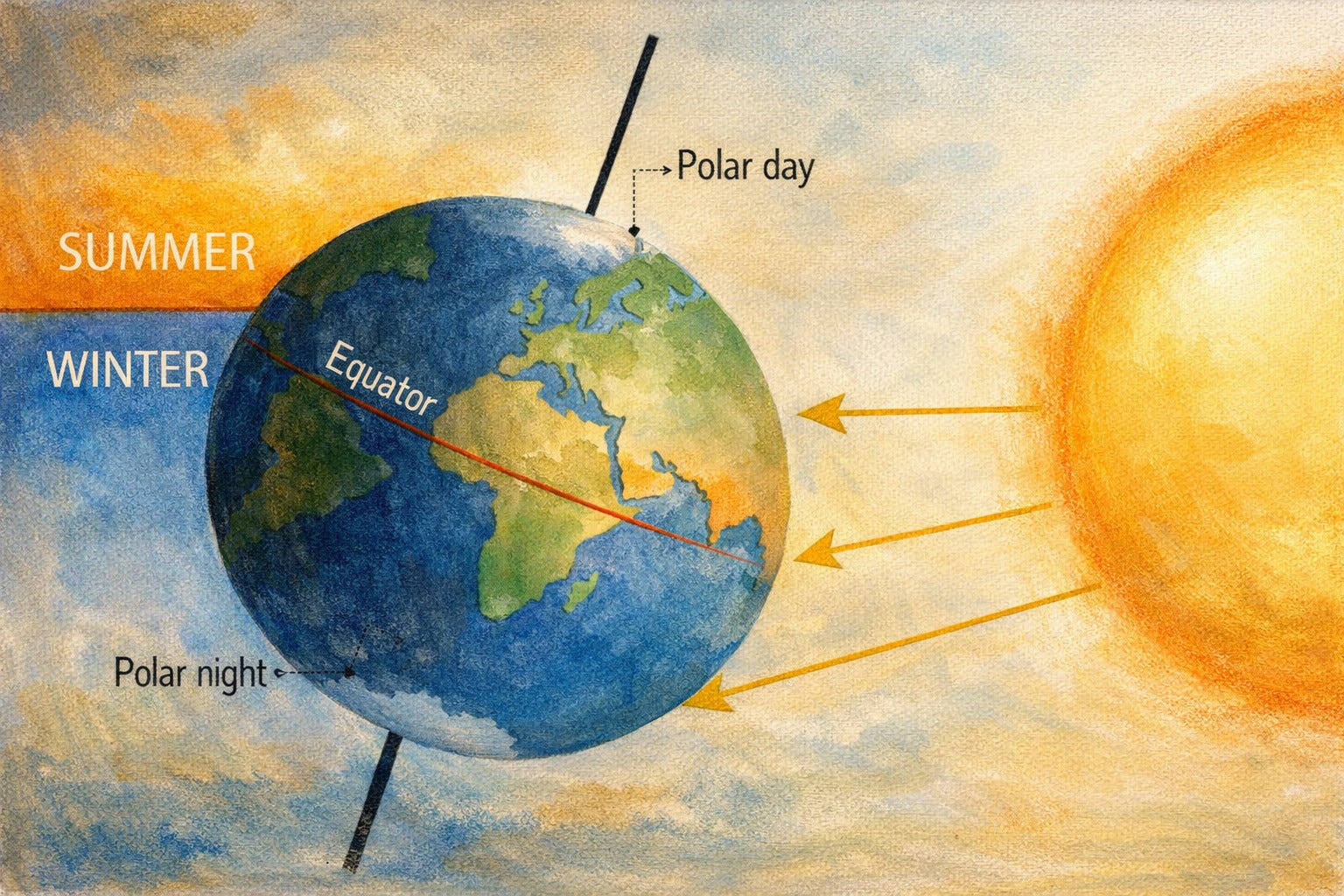
Modern cosmology uses a heliocentric model (the sun at the center), explaining days and nights in terms of the rotation of the planet on its own axis, and the passages of the seasons through the movement of the planet around the sun. Note also that in this model the axis of the planet is tilted. This creates two separate axes: the daily rotation of the planet, which happens on the line of the equator (the celestial equator), and the path of the light of the sun reaching our planet, which is called the ecliptic. The annual movement of the sun on this path makes the days longer in the summer and shorter in the winter, leading to the appearance of the seasons.
That’s how modern cosmology explains it. What about the Vedic model?
The Vedas explain the same two axes. The difference is that the phenomenon is explained in terms of two separate movements (the annual orbit of the sun, and the daily movement of the whole sky), explained on a geocentric model (the earth at the center).
In the Vedic model, the earth is fixed on the plane of Bhū-mandala, and the sun, as well as all the stars and planets, move around the whole structure.
Śrila Prabhupāda uses the example of a chandelier that rotates. We can imagine all the stars and planets as components of a gigantic chandelier. All the parts of this cosmic chandelier are kept together by ropes of subtle wind, some kind of attraction force that is unknown in modern science. As the whole chandelier rotates, all the parts move together as part of the chandelier, but at the same time, each part has its own motion relative to the other parts. The combination of both motions when observed from our planet results in the movements of the sun, planets, and stars that we see when we look into the sky.
Here we have an illustration showing this chandelier model:
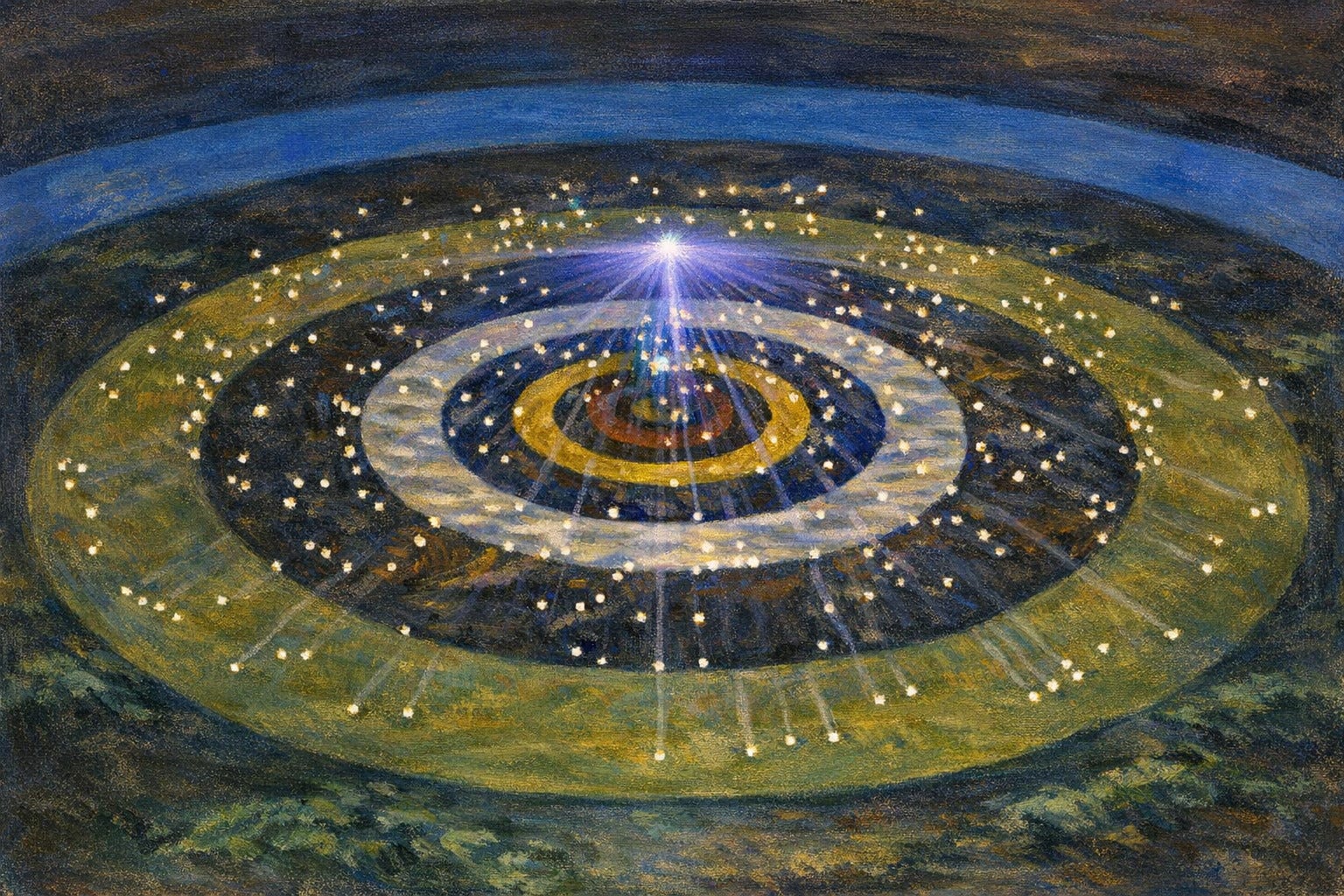
Here you can see Dhruvaloka shining on top of Bhū-mandala, with all the stars, as well as the sun and planets circumambulating it. The whole structure rotates daily, creating the passage of the days and nights.
We can imagine something like many particles of dust caught in a whirlwind. All the particles are moving with the whirlwind, but at the same time, each particle is moving independently in relation to the others. In other words, all the particles are moving in relation to the ground, following the general flow of the wind, but each particle moves in a subtly different way, and thus the particles also move in relation to each other.
In this model, the sun circles around our planet every 24 hours, following the rotation of the whole sky. This is the clockwise rotation around Dhruvaloka, on the path of the Mānasottara Mountain. This movement is perceived not only by us, but by all inhabitants of Bhū-mandala as the passage of the days and nights.
However, there is also the counterclockwise rotation, which takes one full year to complete. This second movement is the independent movement of the chariot of the sun facing the signs of the zodiac. The two movements go on simultaneously; thus, from the perspective of someone standing on earth, the sun passes higher in the sky during summer days and lower during winter days, making the length of days and nights to vary according to the seasons.
One way to imagine this model is to imagine a clock with just one arm, which takes 360 seconds to complete a circle. Imagine we put a lamp, representing the sun, at the end of this arm. Now imagine that the whole clock is moving in horizontal circles, each circle taking one second. The sun, at the end of the arm, is moving very fast in a circle, together with the clock, but at the same time it has its slower, independent vertical movement. As the horizontal circles go on, the lamp goes gradually up and down. The movement of the sun is not fully vertical like a clock, but this is a crude example that can help to visualize it.
This model may seem complicated when explained in terms of text and diagrams, but it can be presented in a simpler way in the form of a working model, showing how the movements work in practice. That was the idea of Prabhupāda in insisting in the construction of the temple of the Vedic planetarium. His idea is that having a working model would make regular people understand the system and see the universe through the eyes of the scriptures, as a divine creation. Once we accept that the universe is created by God, life gains a purpose, and we start the process of using things for Him.
This is a publication for thoughtful readers who want to go deeper into Kṛṣṇa consciousness. I publish daily, and all posts are available to free subscribers. If you wish, you can also choose a paid subscription to support this work. By subscribing, you also gain access to the manuscripts of the books I’m currently working on.
If you would like to contribute further, you can find the donation links here.