

You can receive new articles directly in your inbox. Subscription is free; donations are welcome.
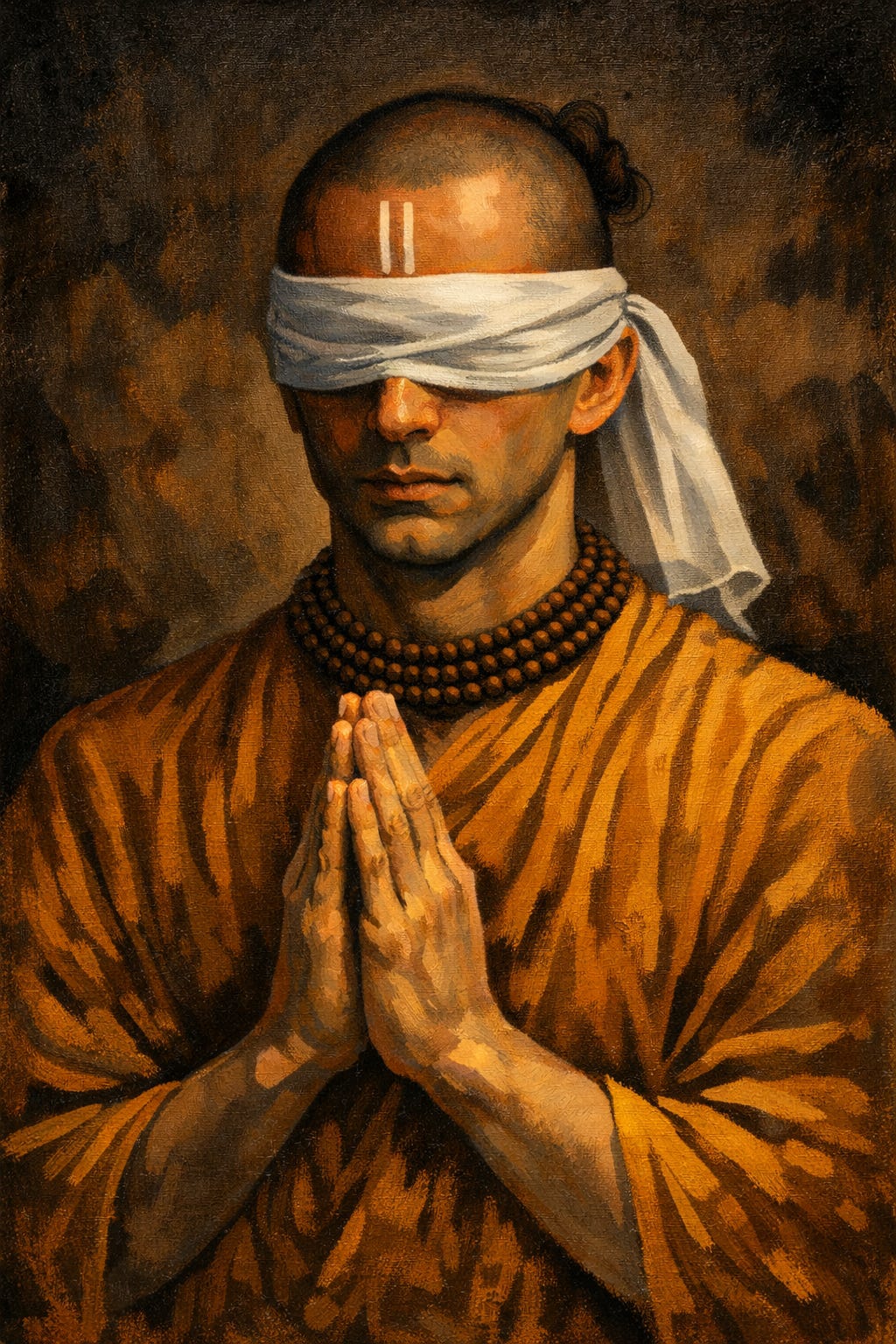
Sometimes we hear the idea of following blindly being equated with obedience and submission to spiritual authorities. We are fed the idea that we should just do as we are told and not try to understand too many things. Is that really part of spiritual life?
The short answer is no. In his purport to Bg 4.34, Śrila Prabhupāda mentions that, “In this verse, both blind following and absurd inquiries are condemned. Not only should one hear submissively from the spiritual master, but one must also get a clear understanding from him, in submission and service and inquiries.”
This same point is further expanded in a lecture from 24 August 1966: “But faith should not be blind. Blind faith is useless. Now we have already discussed that one should go to the spiritual master with surrender and question and service—three things. First of all, for acquiring knowledge we have to find out the suitable personality, and if we are fortunate enough to find out such suitable personality, then first thing is to surrender. And that, after that surrender, there are questions. One must be very intelligent to put questions to the spiritual master. Without questions, you cannot make progress. So blind faith is never required, neither questions should be in a mood of challenge.”
We should use our intelligence to understand the spiritual path and surrender unto Kṛṣṇa, and not to simply discard our intelligence and follow on a sentimental basis. One may start following Kṛṣṇa Consciousness out of sentiment, but usually sentiment doesn’t bring us very far in spiritual life, since one who is today sentimental about Kṛṣṇa Consciousness will probably be tomorrow sentimental about something else. There are many challenges in our path back to Godhead, and to surpass these challenges, we need to properly understand what we are doing and why we are doing it.
Śrila Bhaktivinoda Thākura explained about sambandha (the understanding of who we are, who Kṛṣṇa is, and what our current situation is), prayojana (the ultimate goal), and abhidheya (the process to achieve such a goal). It’s very difficult for a devotee to achieve prayojana without a proper understanding of sambandha and abhidheya; therefore, one who is trained to just follow blindly has usually little opportunity to rise above the neophyte stage.
Why do some try to impose such blind following on others in our movement, since it doesn’t come from Śrila Prabhupāda? That’s a good question.
I can see four possible explanations. One is that a devotee himself was trained in this way and is just repeating the way he learned without really questioning if this is the proper way or another. Another possible explanation is just indolence: it’s easier to control a group of blind followers than a group of questioning individuals, since blind followers, by nature, ask fewer questions. A third possibility may be ego. To have a group of followers who blindly follow us, and only us, can bring more personal satisfaction than a group of educated individuals who question things and sometimes outgrow us. One of the traps in spiritual life that many of us face at a certain point is the possibility of attracting followers and exerting power over them.
Finally, there is the fourth possibility. Blind following is present in many mundane philosophies, such as fascism, communism, and so on. Some of us may have been inspired by some of such philosophies and, as a consequence, end up trying to pass traces of such philosophy as components of Kṛṣṇa Consciousness.
Śrila Bhaktivinoda Thākura mentions 13 apasampradāyas in his works, including the aulas, baulas, sahajiyās, and others. You can read more about them in the book I published a few years ago.
Many such apasampradāyas appeared exactly because of the introduction of alien concepts into Vaiṣnava philosophy, like the neda-nidi, who mix Vaiṣnava practices with tantric rituals.
There is even one apasampradāya based on the idea of blind following: the Kartābhajā.
This is a sect based on the blind following of a self-proclaimed spiritual leader. For then, no one is worshipable except the leader, and even if he performs immoral acts, his activities are always considered divine. The activities of the leader are always considered unquestionable.
As Śrila Prabhupāda mentions in the purport I quoted in the beginning, both blind following and absurd inquiries are condemnable. One is supposed to learn from his spiritual authorities and ask questions, but without a spirit of challenge. This is the part that needs to be well understood.
In material consciousness, we tend to swing between two extremes, going from blind following to open challenge and all the way back. To properly understand this topic, we should be able to properly avoid both extremes. One should be able to question and ask questions, but at the same time, he should be able to surrender to the proper authorities when the proper knowledge is attained.
This is a publication for thoughtful readers who want to go deeper into Kṛṣṇa consciousness. I publish daily, trying to offer high-quality spiritual content, and all posts are available to free subscribers. If you wish, you can also choose a paid subscription to support this work.
You can also receive the updates on WhatsApp or Telegram.
If you would like to contribute further, you can find the donation links here.
Nice explanation, Hari bol