

You can receive new articles directly in your inbox. Subscription is free; donations are welcome.
Time is an essential factor in the Vedic universe. It is the energy that puts the whole material manifestation in motion. The influence of time leads to the transformations that both create and destroy all living beings and material objects. Due to the influence of time, everything is created at a certain point due to certain transformations. This includes planets, material objects, people, demigods, and so on. These transformations then continue until their death or destruction. Because of time, everything that is material has a beginning and also an end, just like the universe itself. Everything spiritual, however, passes through no transformations and thus has no beginning and no end.
This description of the units of time is divided into two parts. The first are the units of time that are smaller than the lifespan of a human being, or in other words, the units of time we use in our practical life, starting from the truti, the smallest division of time according to the Vedas, all the way to the vatsara (year):
One danda = 30 minutes
One laghu = 2 minutes
One kastha = 8 seconds
One ksana = 1.6 seconds
One mimesa = 0.533 seconds
One lava = 0.177 seconds
One vedha = 0.0592 seconds
One truti = 0.000592 seconds (1 second divided by 1,687.5)
We have then larger units of time that go up to the year:
2 dandas = 1 muhurta (1 hour)
3 muhurtas = 1 prahara (3 hours)
8 paharas = 1 ahani (24 hours)
15 ahanis = 1 pakṣa (fortnight)
2 pakṣa = 1 māsa (month)—24 hours in Pitṛloka.
6 masa = 1 ayanam (half of the year, one movement of the sun from south to north of the equator)
2 ayanam = 1 vatsara (year)—24 hours for the demigods, 360 days for us.
Human beings live for 100 years. Higher beings, however, have much larger lifespans.
We have then the concept of Divya-yuga.
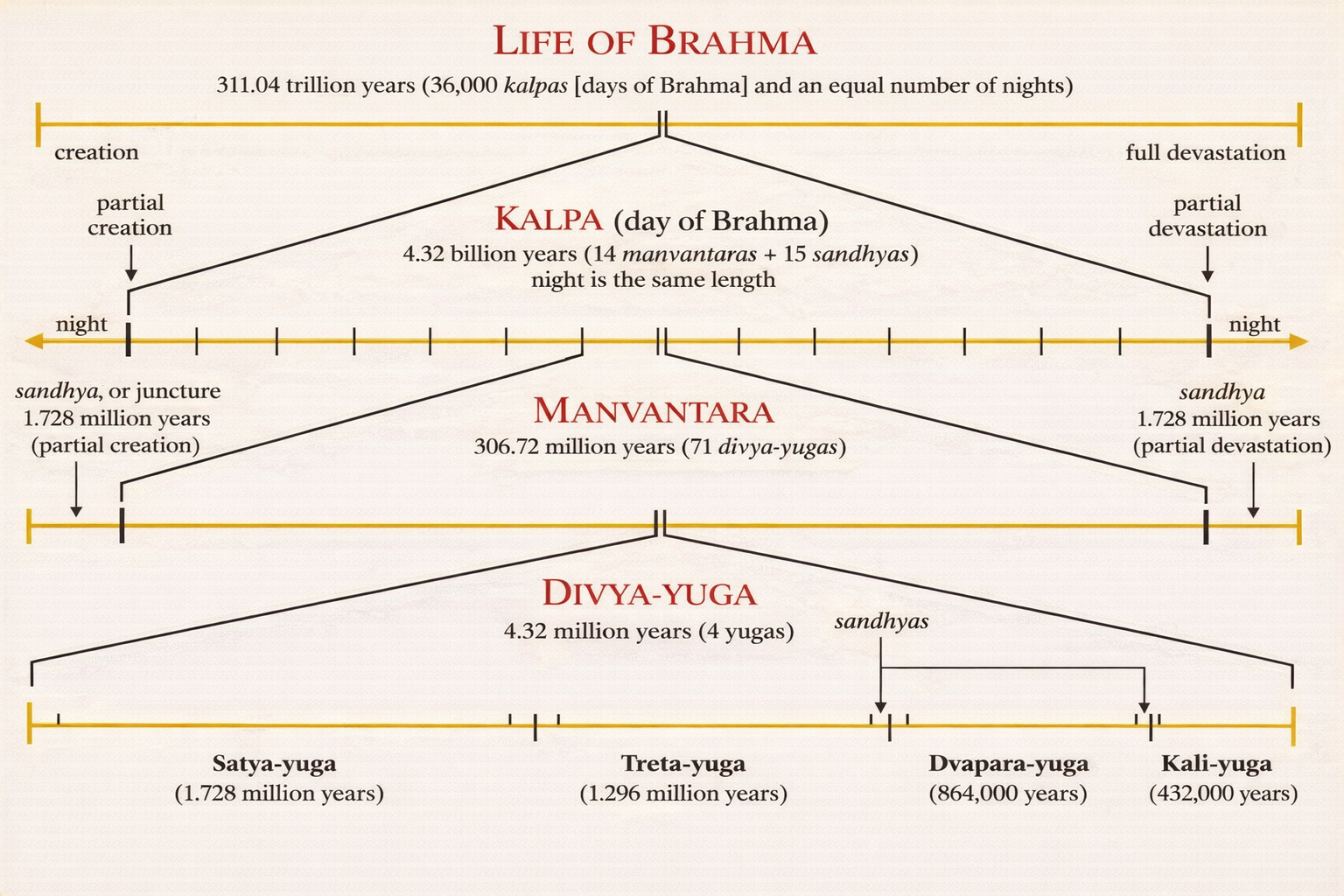
Our planet goes through a cyclic sequence of four ages: Satya-yuga, Treta-yuga, Dvāpara-yuga, and Kali-yuga. Each cycle of these four eras is called a Divya-yuga. There are 71 Divya-yugas in each Manvantara and 1,000 on each day of Brahmā.
Satya-yuga lasts for 4,800 celestial years. Each celestial year corresponds to 360 years of our time, and therefore Satya-yuga lasts for a total of 1,728,000 years.
Treta-yuga lasts for 3,600 celestial years, or 1,296,000 years of our time. Dvāpara-yuga lasts for 2,400 celestial years, or 864,000 years. It’s followed by Kali-yuga, the shortest of the four eras, lasting for just 1,200 celestial years, or 432,000 years.
Next are the really large cycles of time, which measure time up to the total duration of the universe. That’s the full unit during which time remains active, influencing matter, a complete cycle of creation.
A Manvantara is composed of 71 Divya-yugas and lasts for a total of 852,000 celestial years, or 306,720,000 years, and 14 Manvantaras, together with their sandhyās, form a day of Brahmā (4.32 billion years). The same is the duration of his night.
All the devas, led by Manu, stay in their posts for the period of a single Manvantara. When the period is concluded, they are promoted to Maharloka, and a new Manu, as well as a new generation of demigods, takes their places.
1 divya-yuga (set of 4 yugas) = 4.32 million years (12,000 celestial years)
1 manvantara (71 divya-yugas) = 306.72 million years (852,000 celestial years)
1 kalpa (a day of Brahmā) = 4.32 billion years
360 of such days and nights constitute one of Brahma’s years, and 50 of such years comprise a parārdha. Brahmā lives for two such parārdhas, and thus his life is divided into two halves.
With this, we enter into the really large units of time:
2 kalpas (a day and night of Brahmā) = 8.64 billion years
1 parārdha (50 years of Brahmā) = 155.52 trillion years
2 parārdhas = 1 mahā-kalpa (311,04 trillion years)
1 mahā-kalpa (a life of Brahmā) = 1 mimesa for Lord Mahā-Viṣnu
The total duration of the life of Brahmā equals just one mimesa (about half a second) for Lord Mahā-Viṣnu, which gives us an idea of the insignificance of our limited lifespans in this material world. In material terms, we are insignificant both in terms of physical size and duration of life. It is better to accept our eternal spiritual nature, which is eternal and full of bliss.
Here is a diagram showing how all these different units of time fit together:
How to remember all these different units? There is an easy way.
To remember the length of the four ages, we can keep in mind that Dvāpara-yuga lasts twice the period of Kali-yuga, Treta-yuga lasts three times as long, and Satya-yuga lasts four times as long. Combined, the four eras last for 10 times as long as Kali-yuga.
We have, thus, just to remember this sequence of three numbers: 4, 3, 2. Make it 432,000. Then remember: 1 + 2 + 3 + 4 = 10. With this, we master the length of the four ages (432,000; 864,000; 1,296,000; and 1,728,000) and come to the total of 4,320,000 for the Divya-yuga, or the four ages combined.
Now remember the numbers 71 and 1000. When we multiply the 4,320,000 years of the Divya-yuga by 71, we come to the 306.72 million years of the Manvantara, and by multiplying it by 1000, we come to the 4.32 billion years of Brahmā’s day (12 hours). To get his 24 hours, we multiply it by two: 8.64 billion years.
Brahmā lives for 36,000 days (100 years of 360 days); thus, if we multiply 8.64 billion by 36,000, we come to the total of his life: 311.04 trillion years. These are, in turn, divided into two halves: 155.52 trillion years each. By learning these simple formulas, we can easily learn all these cosmic periods of time and never forget.
Here are a few significant verses in this connection:
In the Gītā, Kṛṣṇa mentions: sahasra-yuga-paryantam, ahar yad brahmaṇo viduḥ, rātriṁ yuga-sahasrāntāṁ, te ’ho-rātra-vido janāḥ.
“By human calculation, a thousand ages taken together form the duration of Brahmā’s one day. And such also is the duration of his night.”
In the Śrīmad-Bhāgavatam, Maitreya explains:
“Thus the process of the exhaustion of the duration of life exists for every one of the living beings, including Lord Brahmā. One’s life endures for only one hundred years, in terms of the times in the different planets.
The one hundred years of Brahmā’s life are divided into two parts, the first half and the second half. The first half of the duration of Brahmā’s life is already over, and the second half is now current.
The duration of the two parts of Brahmā’s life, as above mentioned, is calculated to be equal to one nimeṣa [less than a second] for the Supreme Personality of Godhead, who is unchanging and unlimited and is the cause of all causes of the universe.” (SB 3.11.33-34, 38)
This is a publication for thoughtful readers who want to go deeper into Kṛṣṇa consciousness. I publish daily, trying to offer high-quality spiritual content, and all posts are available to free subscribers. If you wish, you can also choose a paid subscription to support this work.
You can also receive the updates on WhatsApp or Telegram.
If you would like to contribute further, you can find the donation links here.