

You can receive new articles directly in your inbox. Subscription is free; donations are welcome.
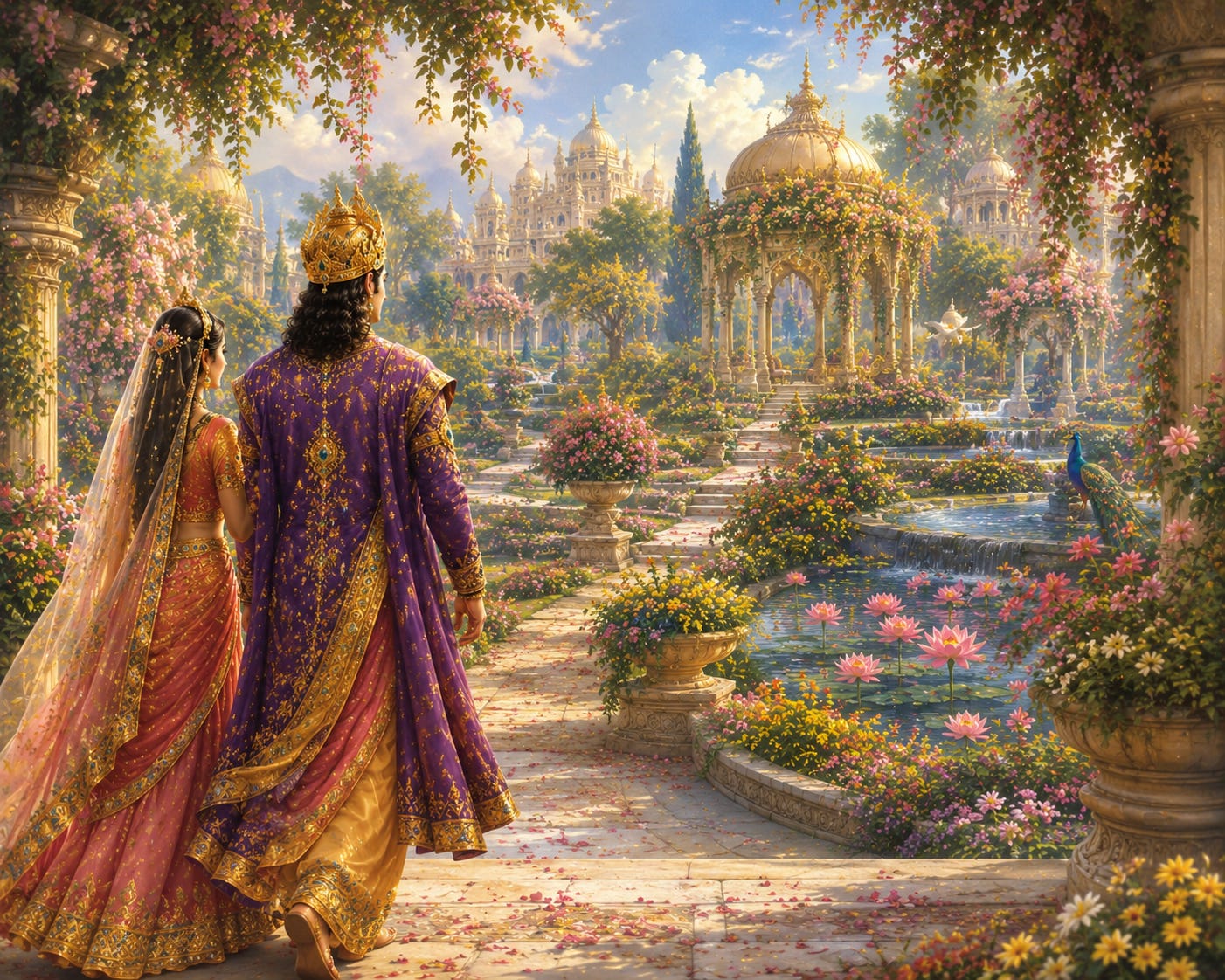
In the Fourth Canto of Śrīmad-Bhāgavatam, we hear the allegory of King Purañjana, the story of every conditioned soul living inside the body. One of the central parts of the allegory is the description of the material body as a city that offers many different possibilities for sense enjoyment.
In the allegory, Purañjana (the soul) meets the material intelligence, who invites him to enter the material body and enjoy there for some time.
In the Gītā, Kṛṣṇa explains that “The senses, the mind and the intelligence are the sitting places of this lust. Through them lust covers the real knowledge of the living entity and bewilders him.” The material intelligence helps us to understand the world around us and make plans to satisfy our ambitions, but it will never be able to find the way out of this material world. The intelligence that can free us is a different type of intelligence, awakened through the study of the scriptures under the spiritual master. As we receive the correct conclusions and mold our understanding of life around them, we awaken this spiritual intelligence that sets us free.
In this way, Purañjana and the material intelligence became firmly united, and together they entered the city and there enjoyed life for one hundred years:
“The great sage Nārada continued: My dear King, those two — the man and the woman — supporting one another through mutual understanding, entered that city and enjoyed life for one hundred years. Many professional singers used to sing about the glories of King Purañjana and his glorious activities. When it was too hot in the summer, he used to enter a reservoir of water. He would surround himself with many women and enjoy their company.” (SB 4.25.43-44)
Even though the life expectancy of different human species all over the cosmos is radically different, going from 311.04 trillion years in the case of Brahma, to just 100 years in our planet in the current age, the perception of time for everyone is similar, with a lifetime being perceived as a period of 100 years. During this period, one is born, grows, forms a family, generates descendants, becomes old, and dies. At the end, we take with us only what we learned, and the results of our activities.
The main trap of material existence is unregulated sexual enjoyment, for it leads to all other kinds of bad habits, which lead one to degradation. In the allegory, Purañjana went on this path, and the result is that he was dragged to hell at the end of his life, and from there to a new material body.
Sexual life can be regulated in two ways: by complete abstinence and by married life, where one is restricted to just one wife or husband. Married life is also a form of abstinence, because it controls one’s tendency to go to multiple partners and thus become more and more entangled. Family life, however, is not a solution in itself; it must be combined with spiritual practice and transcendental knowledge.
This passage applies to both men and women, because in material life, both see themselves as the “male”, the enjoyer, who wants to enjoy the opposite gender, the “woman”. This propensity to enjoy continues even in old age, with men dreaming about getting involved with some young girl, and women dreaming about recovering their youthful appearance and attracting the attention of some handsome man.
Starting from text 4.25.45, the allegory gives more detail of the life of enjoyment of Purañjana, from the perspective of the soul inside the body. Here are the main elements of the allegory:
a) The city of the body has nine gates, seven in the surface (eyes, nostrils, ears, and mouth) and seven subterranean (rectum and the genital) through which the living entity contacts the external world and enjoys different types of sense pleasures.
b) Of the nine doors, five led toward the eastern side. These are the eyes, nostrils, and mouth. It is said they face the east because they face the sun, which appears on the eastern side. The two ears are the doors facing the north and south, and the rectum and genital are the gates facing the western side.
c) The two eyes are called Khadyotā and Āvirmukhī, and passing through these two gates, Purañjana used to go to the city of Vibhrājita, accompanied by a friend whose name was Dyumān (the sun). The name Vibhrājita indicates something that is made brilliant by an external force. All material objects are dark in nature, but they become brilliant when illuminated by the sun. Khadyotā and Āvirmukhī mean “glowworm” and “torchlight” because they are not only unequal (one eye sees better than the other) but also limited in their capacity to see, being dependent on the sun and other sources of light. One who depends only on the eyes to see will have a patchy picture of reality. To see properly, one requires the spiritual light of higher knowledge.
d) The two nostrils are called Nalinī and Nālinī, and through them, accompanied by Avadhūta (air), Purañjana used to go to the city of Saurabha (aroma). Nalinī (lotus) and Nālinī (tube) indicate the two functions of the nostrils, serving both as tubes for inhaling and exhaling, and also to smell aromas.
e) The mouth is called Mukhyā (the chief), and through this gate the king would go to Bahūdana and Āpaṇa, accompanied by Rasajña and Vipaṇa. The mouth is called the chief because it is used both to eat and to speak. Eating is not just the most essential activity for maintaining the body, but it is also one one the greatest sources of pleasure for the conditioned soul, while the capacity of speaking is used to conduct all kinds of social interactions, work, commerce, etc. Bahūdana means “abundance of food” and Āpaṇa means “marketplace”, illustrating the social interactions related to the voice. Rasajña means “minister of taste”, the friend who coordinates the first function (eating), while Vipaṇa means “trader” and is connected with the second function (speaking).
Although in materialistic life, eating and speaking about mundane subjects are more prominent, the tongue can also be used to speak about spiritual knowledge, which can liberate us from material captivity. Unfortunately, Purañjana was not very diligent in this direction.
f) The right ear (the southern gate of the city), called Pitṛhū, is distinguished from the left. Through this gate, the king used to visit Dakṣiṇa-pañcāla, accompanied by Śrutadhara. The significance is that the right ear is used for fruitive activities, with the goal of gaining elevation to Ptṛloka or the celestial planets, while the left is used to hear spiritual knowledge. The friend, Śrutadhara, means memory, which stores instructions and rules for the practice of rituals, and Dakṣiṇa-pañcāla means the injunctions of the scriptures for fruitive performances and regulated enjoyment. In other words, Purañjana would use the right ear to hear about fruitive performances and practice them with the help of his memory. These ritualistic performances, however, were not sufficient to save him from a new birth.
g) The left ear (the gate on the northern side) is called Devahū. Through this passage, Purañjana used to go with the same Śrutadhara (memory) to Uttara-pañcāla.
Devahū means “the one who calls the devas”, because this is the ear used to receive initiation and receive spiritual knowledge. This higher knowledge is stored in the memory, and using it, the soul can go to Uttara-pañcāla (the Northern Pañcāla, in the sense that the soul goes upwards, to Maharloka, Tapoloka, and Brahmaloka, or directly to the transcendental world). As Prabhupāda explains, the right ear is always eager to hear about sense gratification, which culminates with elevation to the celestial planets, but if one can resist this push and instead use the left ear to receive transcendental knowledge, one can attain a permanent position in the spiritual sky.
h) The genital (the gate on the western side) is called Āsurī, because it is especially destined for the asuras, who become overly attracted to sex life, and thus degrade themselves. Through this gate, Purañjana used to go to the city of Grāmaka (sex life, or gross sense gratification), accompanied by his friend Durmada (sinful madness). In the Gītā, Krsna mentions that He is the sex life, which is not contrary to religious principles. Sex life has its purpose, but when one becomes too attracted to it, one becomes insane, and this insanity leads to the performance of acts that are progressively more sinful, often going to an extreme of depravity. In this way, one degrades his consciousness and becomes more and more burdened with sinful reactions, creating a dark path of suffering for the future.
i) The last gate is the rectum, described as Nirṛti (the painful gate). Purañjana used to go through this gate accompanied by his friend Lubdhaka (greed). This greed manifests in the form of eating more than necessary. This gluttony leads to Vaiśasa (pain) while evacuating. Another meaning is that the rectum is the gate of the body through which the sinful soul leaves the body, escorted by the Yamadūtas. It is thus the gate of pain in both senses.
j) Out of all the inhabitants of the city, Purañjana used to spend most of his time associating with two blind men, called Nirvāk and Peśaskṛt. These are the hands and legs that are blind and mute. This means he was absorbed in performing different material activities with his limbs, instead of using his time to cultivate spiritual knowledge. The human body offers all the facilities for cultivating spiritual knowledge, but if we spend all our time running here and there, we miss the opportunity.
k) Sometimes he used to go to his private home with Viṣūcīna (the mind), one of the chief servants of the intelligence. Viṣūcīna means “going in every direction”, which is a graphic description of the mind, which is so restless. The mind paints all sensory experiences with illusion, making them appear desirable or undesirable, and makes us enjoy or suffer through many different feelings and emotions originating from contact with the three material modes. As long as we are engaged in material life, we remain under the mental weather created by the workings of the mind. Unless we engage Viṣūcīna in the names, form, pastimes, etc. of Krsna, we remain captive of the dictations of the mind.
This is a publication for thoughtful readers who want to go deeper into Kṛṣṇa consciousness. I publish daily, trying to offer high-quality spiritual content, and all posts are available to free subscribers. If you wish, you can also choose a paid subscription to support this work.
You can also receive the updates on WhatsApp or Telegram.
If you would like to contribute further, you can find the donation links here.