

« Things I Wish Someone Had Taught Me When I Started Krishna Consciousness
Every saint has a past, and every sinner has a future
One point that can help us to deal with the mistakes of others is to understand the potency of the process of Kṛṣṇa Consciousness. Although serious crimes should be punished, and devotees in positions of leadership should not be negligent in dealing with such cases, there are a host of other minor faults and falls that can be rectified with time if we continue practicing the process of Kṛṣṇa Consciousness. Even the most fallen person can become a saint in due time if he or she continues practicing the process long enough.
The story of Bilvamangala Thākura, the great ācārya who became self-realized after receiving instructions from a prostitute, teaches us to appreciate this process. He was born in a pious brāhmana family and received a good education, but he suffered from strong lustful desires. Because of this, he got involved with a prostitute called Cintāmaṇi, meeting her regularly and using money from his inheritance to buy her expensive gifts. He became so attached to their regular meetings that even at the funeral of his father, he couldn’t contain himself. He engaged some brāhmanas in doing the necessary rituals and left for her house outside the city. That day, however, the weather was not on his side. There was a very strong storm, and there was a flood in the Ganges. Despite this, he was so determined that he decided to swim across the river (something extremely dangerous even on regular days, what to say during a storm), up to the point of using a dead body to stay afloat.
After crossing the river, he came to the closed gates of the house, since Cintāmaṇi was not expecting him to come with such weather. He tried to use a vine to jump over the wall, but when he caught it, he saw it was actually a snake! Still, he was so determined that he used the snake as a rope to jump the wall, despite all danger.
Finally, he knocked at the house, all wet, bloody, and dirty. Understanding what happened, Cintāmaṇi said to him that if he had the same determination he had to touch her body to worship Kṛṣṇa, he would easily go back to Godhead. Although working as a prostitute due to her life circumstances, Cintāmaṇi was a devotee and could examine situations like that from a spiritual standpoint. While externally accepting the gifts and money offered by Bilvamangala, internally, she understood how unfortunate it was that he was wasting his life for mere sexual enjoyment, when he could better use his determination and other assets to serve Kṛṣṇa.
Her simple words carried a lot of weight. These were not just her words, but the words of the Supersoul, who empowered her to say exactly what was needed, and at the exact time to provoke a change in the heart of Bilvamangala. He suddenly became determined in spiritual life and decided to abandon his sinful life and go to Vṛndāvana.
However, his lusty desires still disturbed him. On the way, he became attracted to one lady, then to another. His eyes were just going everywhere. Once, he stayed as a guest in the house of a brāhmana who had a young wife. He became strongly attracted to her. The lady told her husband that this pilgrim was following her, and the husband came to him. Bilvamangala shamelessly confessed that he had such strong lust, and because of that, he became attracted to his wife. Instead of becoming angry, the brāhmana conceded and told his wife to sleep with him. The simple lady somehow agreed.
She dressed and put on her jewelry, and prepared to meet Bilvamangala, but when he finally saw her, he had a change of heart. He asked for her hairpins and used them to blind himself. He understood that he was committing so many sins because of his eyes and decided he would be better without them.
This passage is difficult to understand, but it makes more sense when we examine the results. Later, Bilvamangala Thākura composed songs revealing how his spiritual master came to him in the form of Cintāmaṇi to reveal to him the right path. This reveals how the episode was not just a coincidence, but was inspired by the Supersoul, who wanted to show special mercy and free him from material bondage.
Similarly, this event with the brāhmana and his wife should be seen in the same light. Somehow, the Lord inspired this brāhmana to have an extremely liberal reading of the rules of hospitality, and also his wife to behave the way she did, all to create the situation that would make Bilvamangala finally free from lust, and put him on the path that would bring him to perfection.
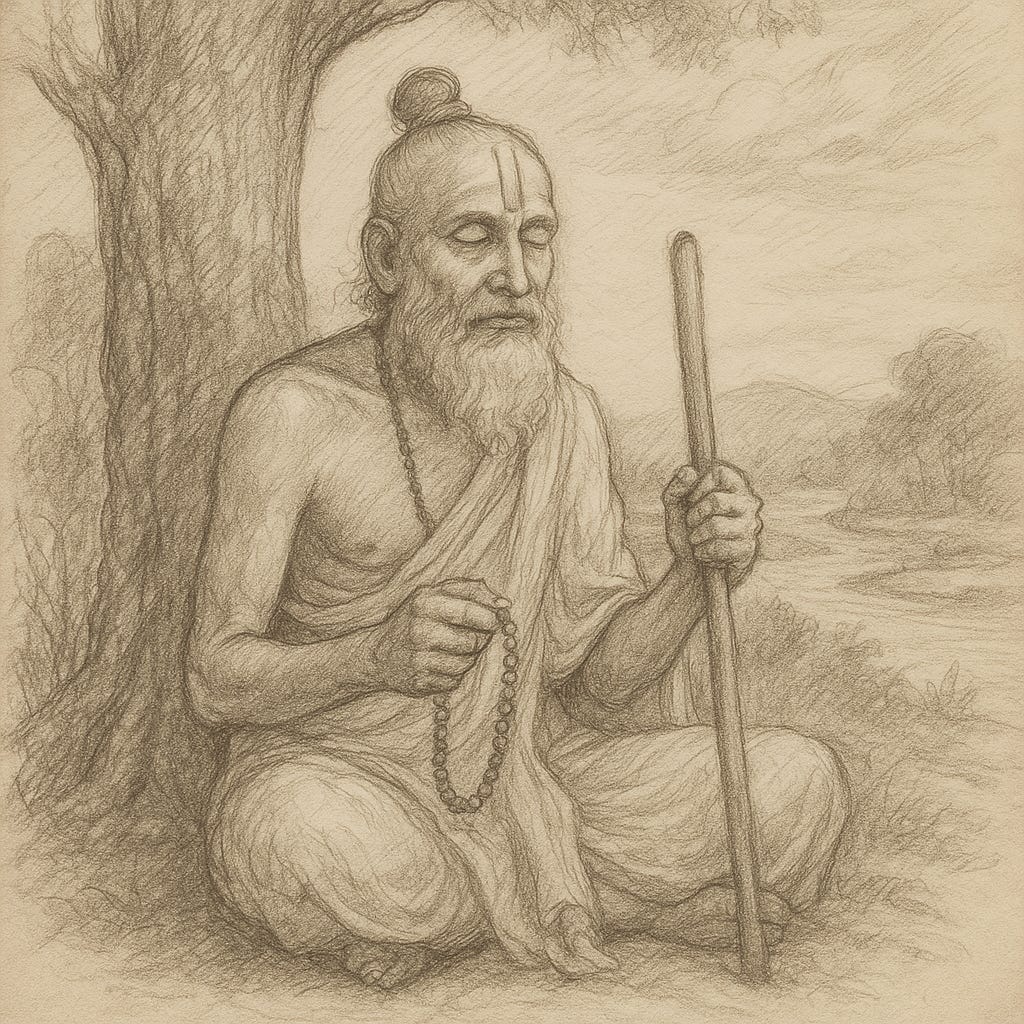
What happened to him after that? He somehow or other was able to continue his trip and eventually reach Vṛndāvana. He just sat under a tree and started chanting very attentively. Without his eyes, there were no distractions, and he was finally able to serve Kṛṣṇa without falling.
Observing his extraordinary determination, Kṛṣṇa started coming personally to him to bring him milk every day, and due to His association, Bilvamangala very quickly attained love for Godhead. Later, he wrote the Kṛṣṇa-karṇāmṛta, an extremely beautiful book, where he shares his realizations.
In this book, he thanks his siksa-guru, Cintāmaṇi, who, although a prostitute, was a devotee of Kṛṣṇa and was able to bring him back to the path with her timely words.
The first question one may ask is how Cintāmaṇi could be a prostitute since she was a devotee. The point is that a person in any situation of life can become a devotee; this has more to do with his or her attitude to Kṛṣṇa than the external situation. In previous times, it was relatively common for widows and unmarried ladies without other means of subsistence to associate with men outside of marriage in search of someone who would maintain them, and because of this, they would be called prostitutes in the rigid societies of the time. Back then, this term didn’t always have the same meaning it has today.
The second question is how Bilvamangala Thākura could become so determined in spiritual life, having such a sinful nature. This is explained by his previous birth:
In his previous life, he was a brāhmana who had a desire to build a temple for Kṛṣṇa. At some point, a princess died, and the body was cremated with a lot of jewelry on it. No one took the jewels from the burned body, and he thought it was such a waste. By selling this jewelry, he could get money to build the temple. When he finally decided to take the jewels, he heard a voice: “Please, don’t take these jewels.”
He looked around and could not see anyone. It was the voice of the princess who had passed away. She told him she had more jewels in a chest at the palace, and he could take them in exchange for not taking the ones left at the body. He went to the palace and explained everything to the king, who allowed him to take the chest with the jewels.
He sold the jewels and started building the temple, but the money was not sufficient to finish it. He again thought of the jewels in the body and went there to take them. This time, the princess cursed him to become a sinful person in his next life. That’s how he became Bilvamangala and had such a lusty nature, despite being born into a family of brāhmanas.
However, due to his past devotional service, Kṛṣṇa remembered him through Cintāmaṇi, so he could continue his service and finally go back to Godhead. That’s something we should keep close to our hearts: we may pray for the mercy of Kṛṣṇa, but His mercy always comes through the Vaiṣnavas. One may look far from perfect on the outside, just like Cintāmaṇi, who was prostituting herself, but this doesn’t prevent Kṛṣṇa from speaking to us through him or her. Without the association of Vaiṣnavas, there is no way for us to receive the mercy of Kṛṣṇa.
Most of us were practicing Kṛṣṇa Consciousness in previous lives, and that’s why we became attracted now. However, taking birth in Kali-yuga, we are now battling with our sinful minds. We may fall one time, two times, three times, until we also become serious in spiritual life and somehow gather the determination to curb our senses and dedicate our lives to serving Kṛṣṇa. Of course, the example of Bilvamangala Thākura is extreme. That’s not something we should imitate, but it gives the idea of how determined we should be. By worshiping Kṛṣṇa in His deity form and being firmly engaged in devotional service, reaching others, and chanting, we can lose the attraction to the objects of the senses. This is the process of becoming “blind” to the material world without having to destroy one’s eyes.
Another point we can learn from this story is that every saint has a past, and every sinner has a future. We all committed sins in the past, and we may even fall down from time to time. However, Kṛṣṇa does not see the bad: he sees only the good. That’s the reason we can be pardoned for our previous mistakes and come back to the practice of devotional service. In the same way Kṛṣṇa forgives us, we should also forgive others, understanding that they have the same difficulty in controlling their senses that we have.
« Things I Wish Someone Had Taught Me When I Started Krishna Consciousness
You can also donate using Buy Me a Coffee, PayPal, Wise, Revolut, or bank transfers. There is a separate page with all the links. This helps me enormously to have time to write instead of doing other things to make a living. Thanks!