

« The ‘Fall’ of the Jīva, as Explained by Śrīla Prabhupāda
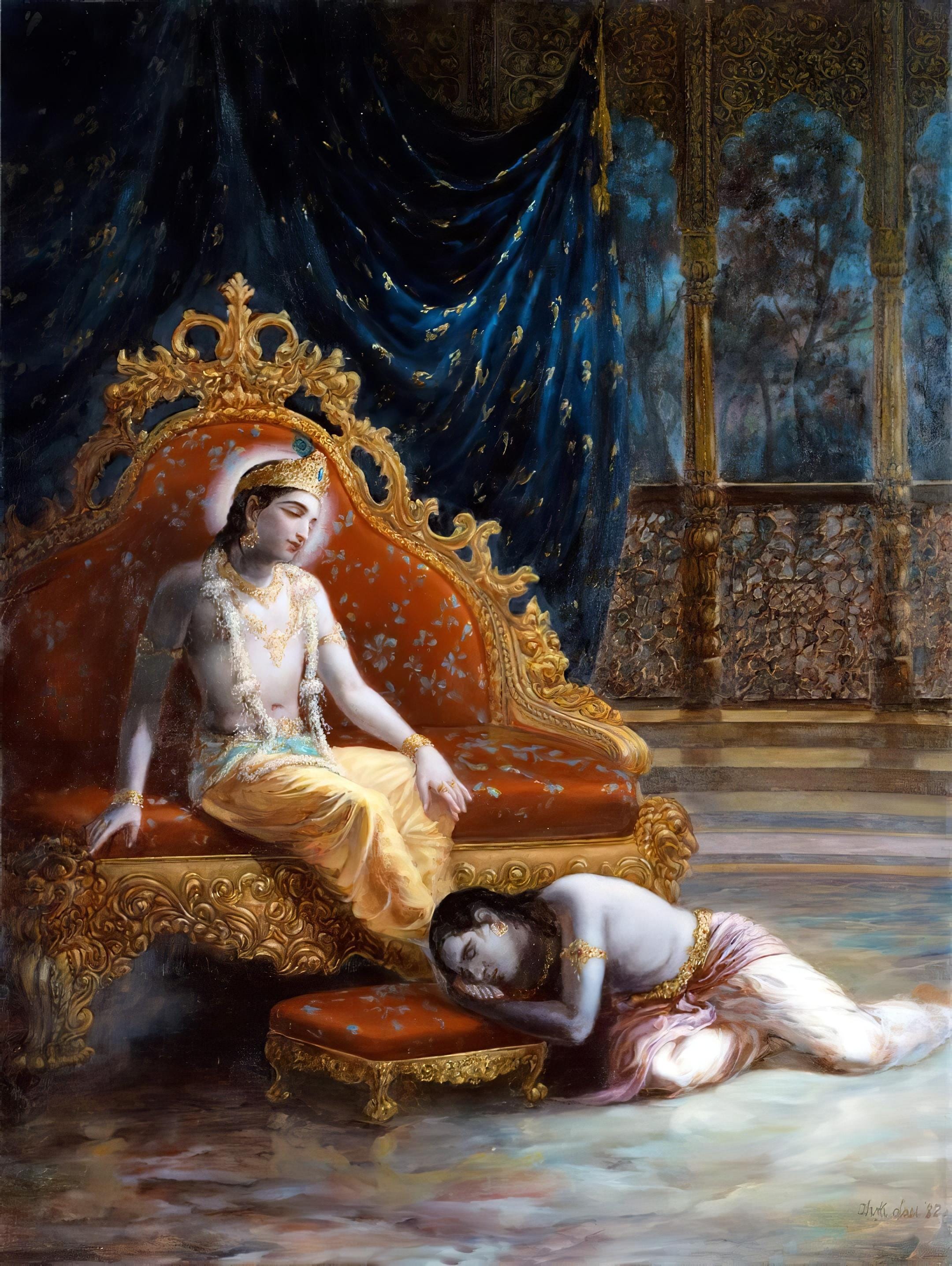
Everyone should surrender to the Lord
The four Kumāras were initially instructed by Brahmā on the path of jñāna, but they were promoted to the perfection of the path of bhakti when they came in contact with the Lord in Vaikuṇṭha. Even while still Brahmavādīs, they were so pure that they could visit Vaikuṇṭhaloka and curse the Lord’s eternal associates, so we can only imagine their perfection after becoming perfect devotees. Because he has experience of both paths, Sanat-kumāra can speak knowledge relevant to both jñānis and devotees, and which can elevate both to the platform of pure devotional service.
From texts 32 to 40, Sanat-kumāra concludes his teachings. He starts with a stark warning for all transcendentalists:
“There is no stronger obstruction to one’s self-interest than thinking other subject matters to be more pleasing than one’s self-realization. For human society, constantly thinking of how to earn money and apply it for sense gratification brings about the destruction of everyone’s interests. When one becomes devoid of knowledge and devotional service, he enters into species of life like those of trees and stones.” (SB 4.22.32-33)
It was already defined that sense gratification is the enemy of self-realization, just like a drug for the conditioned soul, which we have been hooked on since time immemorial. To cure an addiction, we need to avoid it, or at least restrict its use. Because of this, the scriptures prescribe many rules to restrict sense gratification even inside family life. In text 32, Sanat-kumāra emphasizes the danger, and then, in text 33, he describes the consequences. Unrestricted sense gratification makes one devoid of knowledge and devotional service, making one glide down into the lowest forms, down to trees and stones. As Prabhupāda explains in his purport:
“Human life is especially meant for self-realization. “Self” refers to the Superself and the individual self, the Supreme Personality of Godhead and the living entity. When, however, one becomes more interested in the body and bodily sense gratification, he creates for himself obstructions on the path of self-realization. By the influence of māyā, one becomes more interested in sense gratification, which is prohibited in this world for those interested in self-realization. Instead of becoming interested in sense gratification, one should divert his activities to satisfy the senses of the Supreme Soul. Anything performed contrary to this principle is certainly against one’s self-interest.”
Most forms of life lack high intelligence, such as animals and trees. That’s what living in the material world really is: an irrational struggle for sense gratification, where the soul remains practically eternally, going from one animal or plant species to the other, forgetful of one’s real self.
In this great ocean, human life is offered as an opportunity, where the soul finally becomes a little awakened and can cultivate knowledge, coming to the position of knowledge about the self (jñāna) and realized spiritual knowledge (vijñāna). If we properly use this opportunity by accepting a spiritual master, controlling our senses, and developing our Kṛṣṇa Consciousness, we can progress further toward the spiritual platform. However, if we transform our human life into a royal version of animal life, repeating the same script of mindless sense gratification, we fall back into the animal or plant species for another long term of imprisonment, devoid of higher intelligence.
What exactly does it mean to avoid sense gratification in order to live a progressive life? In the paths of jñāna and dhyāna (meditation), sense gratification is completely avoided. Traditionally, householders are not even accepted until they become renunciants. On the path of bhakti, however, there is no objection for one to practice as a householder, as long as one follows the basic regulative principles. Even if one is sinful, one can still advance by practicing devotional service. It’s not that the path of bhakti is lower, and thus has lower standards, as some insinuate, but precisely the opposite. Because the paths of jñāna and dhyāna are indirect, their potency is limited, while the path of bhakti is supremely powerful and thus capable of gradually purifying even the most sinful person. Bhakti is thus just like a very potent medicine that works even if diluted, while jñāna and dhyāna (devoid of bhakti) are weak medicines that have a limited effect, and even then only in concentrated doses.
Sanat-kumāra then proceeds in answering a question previously asked by Pṛthu Maharaja: How can a soul entangled in this material world quickly achieve the ultimate goal of life?
As long as we are involved with this material world, we will have a tendency to perform fruitive activities and be bound in the pursuit of economic development and the search for sense gratification. We will also have a tendency to impersonalism, which is an even greater calamity. Sanat-kumāra dedicates his last instructions to clearing these misconceptions and offering a clear path for us to progress:
“We accept as blessings different states of higher life, distinguishing them from lower states of life, but we should know that such distinctions exist only in relation to the interchange of the modes of material nature. Actually these states of life have no permanent existence, for all of them will be destroyed by the supreme controller.” (SB 4.22.36)
Because life in this material world is always so difficult, we are anxious to improve our material condition, hankering for a position that will be safer and more comfortable. If we obtain these things, we accept them as a great blessing, and if we don’t, we feel morose. This struggle in the material duality keeps us bound in the material world, struggling to maintain one temporary situation after the other. By calling our attention to this, Sanat-kumāra brings us to the inevitable conclusion that we should seek something eternal. As Prabhupāda explains in his purport:
“Therefore we should not be satisfied simply by a promotion to the higher planetary systems. We should try to get out of the material cosmic manifestation, go to the spiritual world and take shelter of the Supreme Personality of Godhead. That is our highest achievement. We should not be attracted by anything material, higher or lower, but should consider them all on the same level. Our real engagement should be in inquiring about the real purpose of life and rendering devotional service to the Lord. Thus we will be eternally blessed in our spiritual activities, full of knowledge and bliss.”
Kṛṣṇa tends to give material opulences easily to neophyte devotees in order to strengthen their faith. However, in the case of advanced devotees who are getting closer to the ultimate goal, He often does the opposite, frustrating their material attempts, so they can easily surrender unto Him. Prabhupāda dedicates most of his purport to this verse to describe this concept:
“When a Vaiṣṇava, pure devotee, tries to be materially opulent and at the same time desires to serve the Supreme Lord, his devotional service is checked. The Lord, in order to show him a special favor, destroys his so-called economic development and material opulences. Thus the devotee, being frustrated in his repeated attempts at economic development, ultimately takes solid shelter under the lotus feet of the Lord. This kind of action may also be accepted as īśa-vidhvamsitāśiṣām, whereby the Lord destroys one’s material opulences but enriches one in spiritual understanding.”
Understanding that we should not be concerned about higher or lower statuses of life, what should be our concern? This is answered in the next verse:
“Sanat-kumāra advised the King: Therefore, my dear King Pṛthu, try to understand the Supreme Personality of Godhead, who is living within everyone’s heart along with the individual soul, in each and every body, either moving or not moving. The individual souls are fully covered by the gross material body and subtle body made of the life air and intelligence.” (SB 4.22.37)
In the previous verses, liberation was recommended as the goal for everyone. Reinforcing the idea of liberation as devotional service to the Lord, Sanat-kumāra emphasizes that we should try to understand not the impersonal Brahman, but the Supreme Lord in His personal feature, who is very close to us and with whom we have an eternal relationship.
Both the Lord and the soul are living inside the heart, just as two birds residing in the same tree. The difference is that we become attracted to the fruits of the tree and thus become involved in material actions and reactions. The Lord, on the other hand, remains always in His transcendental position, and He can thus help us to become free. He is called the caitya-guru, the spiritual master within the heart. Sometimes He helps us from within, and sometimes He manifests externally as the spiritual master to give us instructions, so we may finish our material activities and go back home, back to Godhead. In this way, this verse also reinforces the previous instruction of approaching a bona fide spiritual master and learning the transcendental science from him. Understanding the Lord means joining the paramparā, following the footsteps of the previous ācāryas, rather than trying to understand Him by speculation.
Prabhupāda concludes his purport by saying:
“If a person, out of sentiment or for some other reason, takes to the shelter of the lotus feet of the Lord and in due course of time does not succeed in coming to the ultimate goal of life or falls down due to lack of experience, there is no loss. But for a person who does not take to devotional service yet executes his material duties very nicely, there is no gain.”
When one finally becomes sincere in inquiring about the Lord, he is faced with the last snare of Māyā: impersonalism. One can come in contact with the idea that the form of the Lord is material, existing under the influence of the mode of goodness, and that the impersonal Brahman behind this material form is supreme. Under this false conception, one fails to understand the different potencies of the Lord and falls under the false conception that everything is one, and that there is no individuality once freed from the illusion of this material world. One then claims to be God and sees devotional service as just a stair that can be used to achieve the stage of liberation, and then be rejected, together with the spiritual master and everything else. In text 38, Sanat-kumāra warns of this calamity:
“The Supreme Personality of Godhead manifests Himself as one with the cause and effect within this body, but one who has transcended the illusory energy by deliberate consideration, which clears the misconception of a snake for a rope, can understand that the Paramātmā is eternally transcendental to the material creation and situated in pure internal energy. Thus the Lord is transcendental to all material contamination. Unto Him only must one surrender.” (SB 4.22.38)
The misconception of a rope for a snake mentioned here refers to the vivarta-vāda, the philosophy that sees no distinction between the energies of the Lord, and leads to the mistaken conception that we are all God. This philosophy is nowadays propagated by the Māyāvādis, but it was also present in previous ages, even during the time of Pṛthu Maharaja.
The Vaiṣnava concept is called pariṇāma-vāda, the doctrine of by-products. It explains that the Lord has diverse potencies that make everything that exists. The Lord has three fundamental energies, called antarāngā śakti, bahirangā śakti, and taṭasthā śakti. The antarāngā śakti is the spiritual potency that includes all the spiritual planets and all the paraphernalia used by the Lord in His pastimes. The bahirangā śakti is the illusory potency, or external energy, which is permuted into the material manifestation. Both the spiritual reality and the material creation exist simultaneously. The jīvas are originally part of the spiritual potency, but they have the choice of remaining there or joining the material creation. Because they can go from one to the other, they are called taṭasthā śakti, the marginal potency. Marginal in this case does not indicate physical or geographical location, but the possibility of choice. In the pariṇāma-vāda, all these different energies are considered simultaneously one and different. They are one in the sense of being all spiritual and eternal (even the external potency is originally spiritual, appearing to be material only due to the misconceptions of the conditioned souls in seeing it as separated from the Lord), but different in the sense of being eternally separated. Because the jīvas and the Lord are eternal individuals (although eternally connected), the conclusion is that we should serve the Lord in a transcendental relationship, leading to the ultimate conclusion of devotional service to the Lord as the ultimate goal of life.
In the vivarta-vāda, on the other hand, there is no differentiation of energies or potencies. Brahman is one, an undifferentiated spiritual mass that has no qualities and performs no activities. Somehow, this supreme Brahman falls under illusion and mistakenly thinks that it has become many, and that is bound to this material manifestation.
In the vivarta-vāda, the material creation is considered false, the fruit of mere illusion, just like one may see a rope on the road and mistake it for a snake. There is no snake, but due to this mistake, one feels fear. When one is illuminated by proper knowledge, they say, one sees that there is no snake. Similarly, according to them, when one is illuminated with proper knowledge, one understands that this material world is false and we are all one, we are all God.
As you can see, vivarta-vāda is a calamitous doctrine that attacks the very roots of the eternal relationship of the soul and the Lord. More than that, it concludes that all forms and relationships are the product of illusion, and thus that when the Lord comes to this world, He does so under the influence of māyā, assuming a material form and performing activities under the material mode of goodness. Devotional service is then seen as yet another illusion, aimed to help one ascend to the platform of liberation, where one finally realizes he is God himself. Even the spiritual master and transcendental knowledge are seen in the same light, as something disposable, that helps us up to a certain level, as a ladder, but that should also be ultimately rejected as part of the material illusion.
Sanat-kumāra warns against this calamity, encouraging us to reject the misconceptions of vivarta-vāda, understanding that the form of the Lord is eternal and transcendental, that we are separated individuals (although sharing the same spiritual nature), and that we should thus surrender unto the Lord.
You can also donate using Buy Me a Coffee, PayPal, Wise, Revolut, or bank transfers. There is a separate page with all the links. This helps me enormously to have time to write instead of doing other things to make a living. Thanks!