


You can receive new articles directly in your inbox. Subscription is free; donations are welcome.
Much is spoken about the brahmacārī and gṛhastha āśramas. We are supposed to be trained in spiritual principles during our youth and then use this spiritual knowledge to go through the challenges of family life without losing sight of the goal of life. That’s the general Vedic idea, and it’s something that can be very valuable in current society. If instead of making youth an age of drinking and promiscuous sexual life, people could be trained in spiritual principles, this would certainly make society much better.
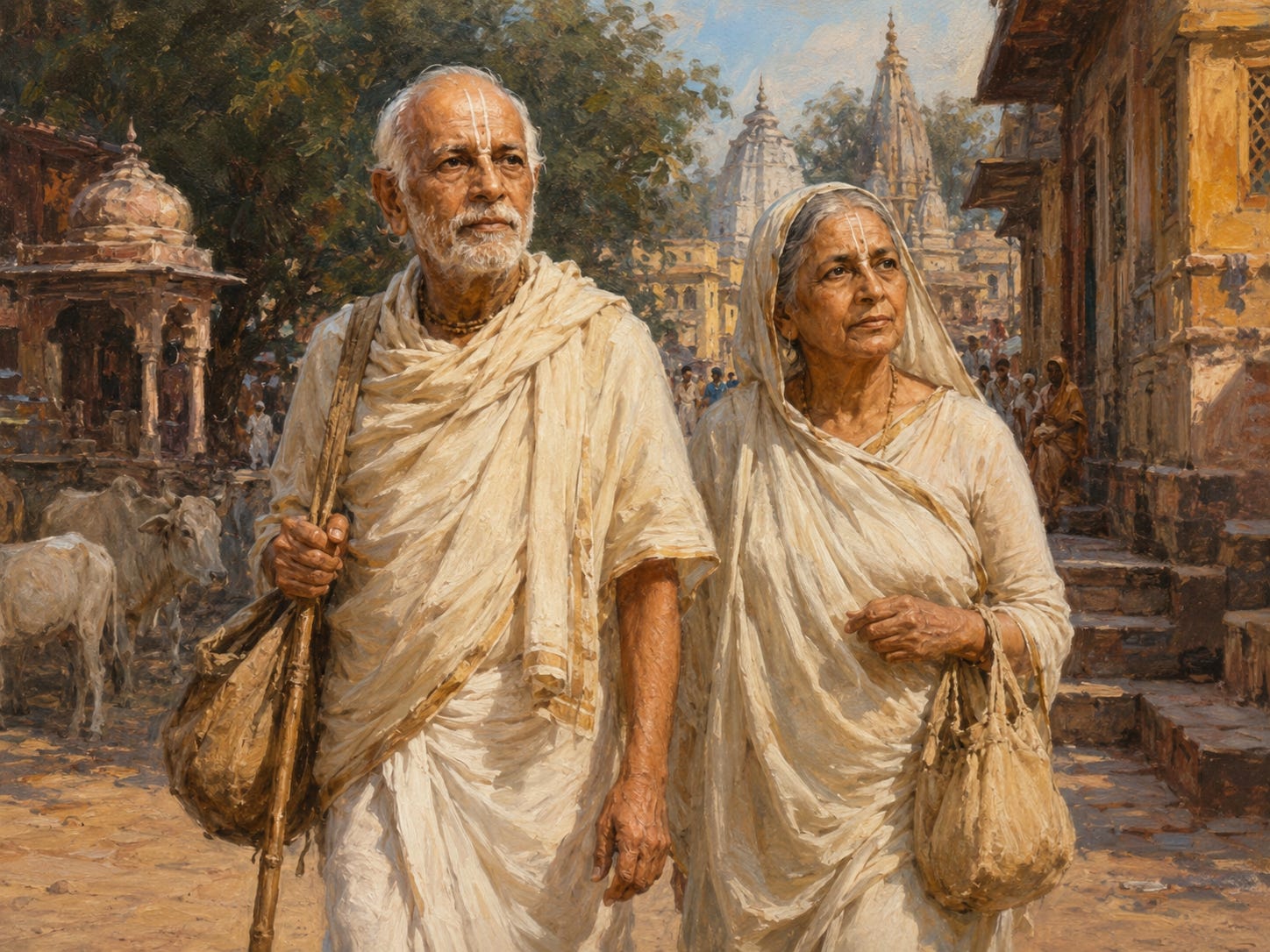
There is, however, another stage that comes after that. We often think of sannyāsa as the final stage of life, but sannyāsa is not very recommended for our age. A few exceptionally dedicated devotees can do it, but unless we are at a similar level, that’s not something to be imitated. Instead, we can go for the vānaprastha stage, retired life, that offers the same practical benefits of sannyāsa, without all the crushing requirements. Vānaprastha is thus the stage recommended for most devotees in their final years, in which one retires from family life after the children are grown up to accumulate spiritual realization, teach, and prepare for returning back home, back to Godhead.
Different from sannyāsa, vānaprastha can be practiced by both men and women. Surprisingly, however, we don’t find so much information about it.
Prabhupāda explains the vānaprastha stage in the Fourth Canto of Śrīmad-Bhāgavatam in the last stages of the allegory of King Purañjana.
He mentions that while devotees used to go to practice austerities in forests, high hills, or mountains, such severe austerities are not possible these days. Instead, he brings our attention to something we can do practically: control our eating and reduce our body weight as a way to facilitate our spiritual advancement. As he mentions, “Śrīla Bhaktisiddhānta Sarasvatī Ṭhākura severely criticized his fat disciples. The idea is that one who intends to advance in Kṛṣṇa consciousness must not eat very much.”
He makes the point that overindulgence in food makes one inactive and lazy, apart from increasing our tendency for sense enjoyment and making us sleep more than necessary. Human form is meant for austerity, and the two main means of austerity are to control the sex drive and food intake. We often think that eating can be used as an escape valve for other restrictions, but Prabhupāda alerts us to the mistake of this approach.
In family life, the emphasis is on performing our duty. Sex life is allowed, and a certain level of sense gratification, including nice food, is allowed. In vānaprastha life, however, the idea is to get out of this mentality of sense gratification and become fixed in a platform of austerity, fixing instead in the higher taste of serving Kṛṣṇa, chanting His names, hearing about Him, and speaking about Him.
As he mentions:
“Bhakti-yoga will automatically liberate a person from the dualities of life. In bhakti-yoga, Kṛṣṇa is the center, and Kṛṣṇa is always transcendental. Thus in order to transcend dualities, one must always engage in the service of the Lord”.
He supports this by quoting the Gītā (14.26):
“One who engages in full devotional service, who does not fall down in any circumstance, at once transcends the modes of material nature and thus comes to the level of Brahman.”
By practicing devotional service with determination, we can be elevated to the transcendental platform, from where we can control the tongue, as well as all other senses. We can see thus that everything needs to be done simultaneously, creating a virtuous cycle. By controlling our eating as far as possible and fasting on the appropriate days, we nourish our practice of devotional service, and by advancing in devotional service, we have more facility to control the senses, creating a virtuous cycle. If, however, we use prasāda as an excuse to overindulge in food or let our minds become fixed in any other form of sense gratification at this stage, our advancement can be stopped, bringing us to the opposite result.
“If one is factually engaged in the service of the Lord, bhakti-yoga, he will automatically control his senses, his tongue and so many other things. Once engaged in the bhakti-yoga process with all sincerity, one will have no chance of falling down. Even if one falls down, there is no loss. One’s devotional activities may be stunned or choked for the time being, but as soon as there is another chance, the practitioner begins from the point where he left off.”
Another essential aspect of the vānaprastha stage is the cultivation of knowledge:
“King Malayadhvaja attained perfect knowledge by being able to distinguish the Supersoul from the individual soul. The individual soul is localized, whereas the Supersoul is all-pervasive. He became perfect in knowledge that the material body is not the soul but that the soul is the witness of the material body. In this way King Malayadhvaja attained perfect knowledge because in his pure state he was directly instructed by the Supreme Personality of Godhead. By means of such enlightening transcendental knowledge, he could understand everything from all angles of vision.” (SB 4.28.39-41)
Usually, a soul has to spend many lives going from one philosophic misunderstanding to another, but when we finally find a self-realized soul who can give us the perfect understanding, we are finally situated on a platform of proper knowledge (sambandha) and from there can practice appropriately and attain the ultimate goal. Prabhupāda put all the correct conclusions in his books, and even repeated the most essential concepts in many passages to make it impossible to miss them. If we just accept the conclusions he gives, the path becomes open for us.
As he explains in his purport to text 4.28.41:
“The Lord is the Supersoul seated in everyone’s heart, and He acts as the caitya-guru, the spiritual master within. However, He gives direct instructions only to the advanced, pure devotees. In the beginning, when a devotee is serious and sincere, the Lord gives him directions from within to approach a bona fide spiritual master. When one is trained by the spiritual master according to the regulative principles of devotional service and is situated on the platform of spontaneous attachment for the Lord (rāga-bhakti), the Lord also gives instructions from within (teṣāṁ satata-yuktānāṁ bhajatāṁ prīti-pūrvakam/ dadāmi buddhi-yogaṁ tam). This distinct advantage is obtained by a liberated soul. Having attained this stage, King Malayadhvaja was directly in touch with the Supreme Lord and was receiving instructions from Him directly.”
The Lord guides us from both the inside, as Paramātmā, the caitya-guru (inner guide), and externally as the spiritual master. The word guru is often used in the plural (gurūn) because different spiritual masters guide us at different stages of life. There should be just one diksa guru, but the instructing spiritual masters can be many. They are, however, one in the sense that they speak the same message. We study the teachings of Prabhupāda under the supervision of all these spiritual masters. By this process, we can be elevated to the platform of rāga-bhakti.
Text 4.28.42, then reads:
“King Malayadhvaja could thus observe that the Supersoul was sitting by his side, and that he, as the individual soul, was sitting by the side of the Supersoul. Since both were together, there was no need for separate interests; thus he ceased from such activities.”
What does it mean? Prabhupāda liked to use the word “dovetail”, which means to connect in a seamless way. It comes from carpentry, when two wooden boards are chipped on the borders and connected in a very strong and elegant way, acting like one unit, even though clearly distinct. Krsna Consciousness means to dovetail our desires and goals with Krsna’s, and thus cease to have separate interests from Him. In other words, it means to discard our selfish and materialistic goals and instead cooperate in the service of the Lord. A harmonious relationship happens when two people have similar goals and interests, and can thus work together in the same direction. To have such a deep relationship with Krsna is the goal of life. We may feel we are very distant from it right now, but this is due to our current material contamination. This dovetailing of one’s desires with Krsna is our natural position, and as this original nature is uncovered by the practice of bhakti, we become absorbed in the service of the Lord and cease having any separate interest from Him.
As Prabhupāda explains in his purport:
“In the advanced stage of devotional service, the devotee does not see anything separate between his own interests and those of the Supreme Personality of Godhead. Both interests become one, for the devotee does not act for a separate interest. Whatever he does, he does in the interest of the Supreme Personality of Godhead. At that time he sees everything in the Supreme Personality of Godhead and the Supreme Personality of Godhead in everything. Having attained this stage of understanding, he sees no distinction between the spiritual and material worlds. In perfect vision, the material world becomes the spiritual world due to its being the external energy of the Supreme Lord. For the perfect devotee, the energy and the energetic are nondifferent. Thus the so-called material world becomes spiritual (sarvaṁ khalv idaṁ brahma). Everything is intended for the service of the Supreme Lord, and the expert devotee can utilize any so-called material thing for the Lord’s service. One cannot serve the Lord without being situated on the spiritual platform; thus if a so-called material thing is dovetailed in the service of the Lord, it is no longer to be considered material. This is how the pure devotee, in his perfect vision, sees from all angles.”
The material creation is only really “material” to the extent we see it as separated by Krsna. He directly explains that in SB 2.9.34, and Prabhupāda repeats the idea in several of his purports. A pure devotee sees the so-called material world as the energy of Krsna and thus no different from the Lord. A materialist questions if there is a God, since he can’t see Him, but a pure devotee sees that there is nothing apart from Krsna.
How does this apply to women? Prabhupāda explains it in his purport to CC Madhya 24.259:
“This is the process of renunciation at the stage of vānaprastha. After enjoying householder life for some time, the husband and wife must leave home and distribute their riches to brāhmaṇas and Vaiṣṇavas. One can keep his wife as an assistant in the vānaprastha stage. The idea is that the wife will assist the husband in spiritual advancement. Therefore Nārada Muni advised the hunter to adopt the vānaprastha stage and leave home. It is not that a gṛhastha should live at home until he dies. Vānaprastha is preliminary to sannyāsa. In the Kṛṣṇa consciousness movement there are many young couples engaged in the Lord’s service. Eventually they are supposed to take vānaprastha, and after the vānaprastha stage the husband may take sannyāsa in order to preach. The wife may then remain alone and serve the Deity or engage in other activities within the Kṛṣṇa consciousness movement.”
A woman can follow her husband in the vānaprastha stage, following him and following the same process of austerity and absorption in spiritual life, or she may stay at home with the grown-up children and do similarly while living as a saintly lady absorbed in her spiritual practice, aloof from family affairs. The specific details of renounced life may be different for men and women, but the goal and mentality are the same. We may stay for some time in family life, growing our children and developing the foundations of our spiritual life, but in old age, it’s recommended that we become free from the encumbrances of family life and dedicate our remaining time to perfecting our Krsna Consciousness.
As described in the first canto (SB 1.15.50), after the disappearance of Krsna, the five Pandavas left home for the Himalayas to perfect their devotional service, while Draupadī and Subhadrā attained the same results by staying home and absorbing themselves in thought of Krsna.
Read also:

This is a publication for thoughtful readers who want to go deeper into Kṛṣṇa consciousness. I publish daily, trying to offer high-quality spiritual content, and all posts are available to free subscribers. If you wish, you can also choose a paid subscription to support this work.
You can also receive the updates on WhatsApp or Telegram.
If you would like to contribute further, you can find the donation links here.