

« Things I Wish Someone Had Taught Me When I Started Krishna Consciousness
Finding our way out of battles of quotes
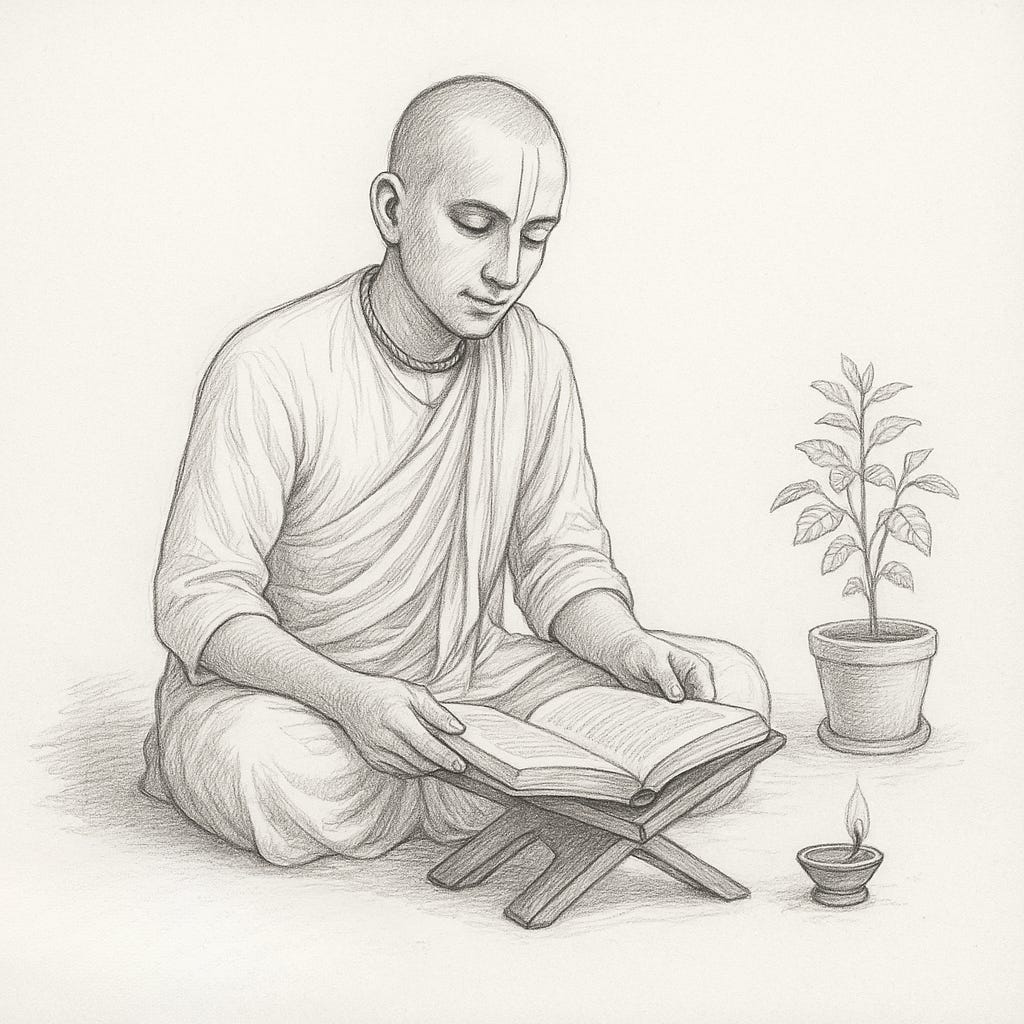
A great challenge when we desire to find the truth about philosophical topics is that often different verses of the scriptures, or different passages from our ācāryas, appear to contradict each other. This leads to devotees assuming different opinions and taking sides, which can be destructive. There is, however, a process to find the truth, although it requires us to delve a little deeper into the philosophy.
Most mistaken conclusions come from basing conclusions on isolated quotes. This is a point made by Śrila Jīva Goswami in his Sat-Sandarbhas: isolated quotes from the scriptures are of very little value since verses must be understood within a context. When verses are taken out of context, they can be misused to support all kinds of conclusions.
Although we use quotes all the time to sustain different philosophical conclusions, as a general rule, no isolated passage can be accepted in itself as proof of a philosophical thesis. We need to examine the context of the passage inside the book, studying the verses that precede and follow it, as well as understand what the general conclusions of the book and the Vedas as a whole are. In the case of a passage from Śrila Prabhupāda, for example, one has to examine the context of the quote, the general conclusions of the book, and take into consideration the general conclusions Prabhupāda gives on his teachings. If a passage appears to suggest that Prabhupāda supports divorce, for example, it must be taken within the general context that Prabhupāda was condemning divorce, and thus accepted as an exception for a special case, and not the rule. By examining the context, we can then understand what exactly it means.
A good book to study to develop the critical sense necessary to deconstruct mistaken ideas sustained by isolated quotes is the Govinda-bhāṣya of Śrila Baladeva Vidyābhūṣaṇa. I published a commentary on it, available on the website.
The whole work of Baladeva is based on examining mistaken philosophical propositions and finding the real meaning of passages used to sustain them. One example of discussion from the book is the passage that deals with the argument around Indra being the supreme, centered around a verse from the Kauṣītakī Upanisad. There is a passage there that appears to suggest that Indra defines himself as the Supreme Lord. If taken out of context, this passage can be used both to sustain that Indra is God or that everyone is God. However, Baladeva teaches us to understand and deconstruct this mistaken argumentation.
In the passage, Patardana, the son of Divodasa, meets Lord Indra after showing his prowess on the battlefield. Indra is satisfied with him and wants to offer him a benediction, but Patardana asks him to choose it himself. This results in Indra giving him a series of instructions. Amongst them, there is the passage:
prāṇo ‘smi prajñātmā tam mām āyur-amṛtam upasasva
“I am prāṇa, the intelligent ātmā; meditate on me as that prāṇa, the nectar of life.”
In the previous sūtras of the Govinda-bhāṣya, it was already concluded that prāna is ultimately Brahman, the Supreme Lord. However, this passage appears to suggest something else: that prāna is the jīva inside the body and not the Supreme Brahman. If accepted, this interpretation would ultimately lead to the conclusion that Indra is God, or that we are all God.
The full passage from the Kauṣītakī Upanisad is quite long, but the central point is that it appears that Indra is referring to himself as prāna and instructing Patardana to meditate on him. To this, Vyāsadeva answers (on sūtra 28), prāṇas tathānugamāt: The word prāna should be understood as referring to Brahman because of the context.
In other words, in this sūtra, Indra is not speaking about himself, but about Paramātmā, who is situated inside his body. According to this argument, the word “prāna” in this passage can’t refer to Indra or any other jīva because of the context (tathānugamāt). The word “prāna” thus doesn’t refer to Indra but to Paramātmā.
In the same discussion from the Kauṣītakī Upanisad, it is mentioned that:
sa esa prāna eva prajñātmānando ‘jaro ‘mrtah
eșa lokādhipatir esa sarveśvarah“Prāna is the Supersoul present in all living entities. Prāna is the transcendental bliss. Prāna remains eternally untouched by old age and death. Prāna is the master of all living entities and all planets. Prāna is the Supreme Controller.”
The prāna described in this passage is present in all living entities. He is transcendental and full of bliss, free from old age and death. These are not attributes of the individual soul, but of the Supreme Soul, Paramātmā, who is inside the body together with the individual soul.
We can’t say that Indra is free from death. He is also not completely transcendental or full of bliss, nor is he present inside the hearts of all living entities. He is also not the Supreme Controller, since he is often defeated by the demons. These are qualities shown only by the Supreme Lord. In his commentary, Śrila Baladeva Vidyābhūṣaṇa quotes several passages from the same Upanisad to sustain this argument, which is consistent with the point made by Śrila Vyāsadeva.
For example, when Patardana asked for the most beneficial gift (in other words, how to attain liberation), Indra answered, “Worship me as prāna”. As a demigod, Indra can’t give liberation. Prāna, as the life air, also can’t give liberation, since it is itself composed of material elements. The only one who can give liberation is the Supreme Lord, and therefore, the passage must refer to Paramātmā.
We can see how this passage teaches us that verses must always be understood according to the context. When taken in isolation, passages can be easily misinterpreted, leading to all kinds of wrong conclusions, as in this case. Each book should be studied as a whole unit, as a set of arguments and counterarguments that lead to an ultimate conclusion. All the passages need to be taken in the context of this conclusion, and not as isolated units. The Upanisads ultimately speak about the Supreme Lord, who is clearly defined as personal and transcendental. It’s a mistake to use any isolated passage to try to sustain that there is no God, we are all God, Indra is God, or anything else. Different passages of the Vedanta-sūtra deconstruct these mistaken ideas, helping the reader to stick to the correct conclusion.
This is just an example of how the real meaning of a passage can be very different from what it may appear at first. Most mistaken philosophies based on the Vedas, such as Māyāvāda, atheistic Sānkhya, etc., are based on misinterpretations of passages of the scriptures. This phenomenon is nothing new, because that’s the general tendency of the conditioned souls. When we use passages of the scriptures to try to sustain whatever ideas we have, instead of trying to understand what they really mean, we take part in it.
The way to obtain perfect knowledge is to receive it from perfect souls, through the Paramparā. We receive the correct conclusions of the scriptures from the commentaries of Śrila Prabhupāda, understood through the spiritual master, and with these conclusions in hand, we can understand other passages from the scriptures.
« Things I Wish Someone Had Taught Me When I Started Krishna Consciousness
You can also donate using Buy Me a Coffee, PayPal, Wise, Revolut, or bank transfers. There is a separate page with all the links. This helps me enormously to have time to write instead of doing other things to make a living. Thanks!