


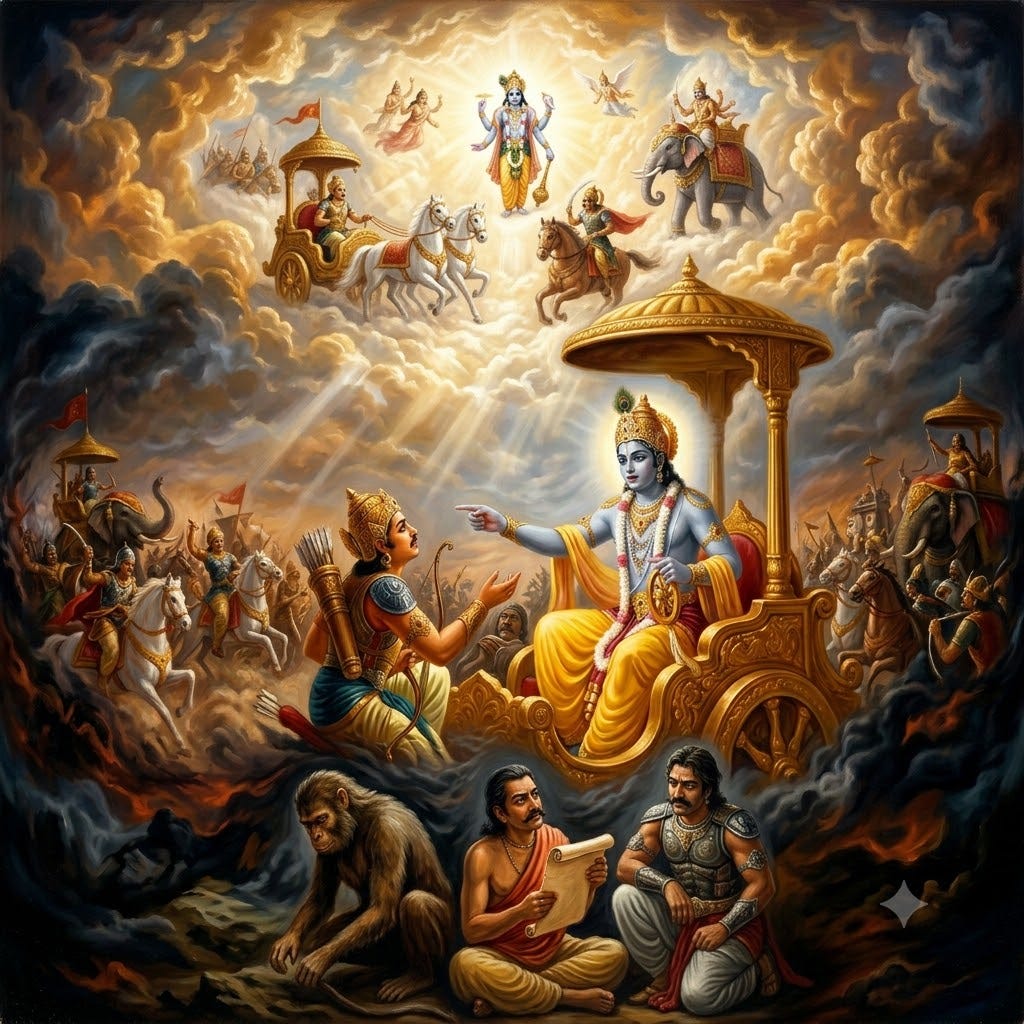
In the Bhagavad-gītā, 4.40, Kṛṣṇa makes an emphatic statement: “For the doubting soul there is happiness neither in this world nor in the next.”
If we think about it, it can sound quite heavy. Everyone is looking for happiness, but Kṛṣṇa categorically says that for one who has no faith in transcendental knowledge, there is no possibility of happiness. Nor here, in this life, nor even in the future. What exactly does it mean, and how to not fall into this category of faithless? It actually goes deeper than we may think at first.
The whole fourth chapter of the Gītā is dedicated to the topic of transcendental knowledge. How to acquire it and use it to mold our actions, producing true renunciation.
When we hear about the cultivation of knowledge, our first idea may be that knowledge should lead to inactivity and placid contemplation. That’s, however, not what Kṛṣṇa has in mind. He explains about transcendental knowledge because he wants Arjuna to transcend his lamentation and elevate himself to a platform of devotional service performed in full knowledge. The conclusion of the chapter is not “sit and meditate,” but uttiṣṭha: stand up and fight. The main message of the chapter is that knowledge must lead to devotional service.
Arjuna’s fight was on the battlefield of Kurukṣetra. Our fight may be somewhere else, according to our position and duties, but the conclusion is the same: we should act using our talents for Kṛṣṇa, in a dutiful and detached way, offering the results to Him.
What are the qualities for the development of transcendental knowledge? Kṛṣṇa answers in 4.39, mentioning dedication to transcendental knowledge and control of the senses. In his purport, Prabhupāda adds a third quality: faith. This faith is the preliminary quality that leads us to dedication and eventually to controlling the senses. This faith, however, is not merely sentimental. It is something strengthened by spiritual practice. By chanting and serving, the heart is cleansed, and as the heart becomes cleaner, our conviction becomes stronger. This reinforces the point of knowledge becoming realized through service, and not just intellectual study alone.
On the other extreme, we have the faithless, who doubt the words of Kṛṣṇa and His devotees, and thus never start on the process. Whatever position they have in this life, because they are not using it properly, they are destined to fall from it in the direction of animal life. Without following the spiritual process, there cannot be any lasting happiness, and without at least some preliminary faith, it is not possible to start. This lack of faith comes from impious life, but because such a person is not inclined at all to start the process of humbly inquiring and serving, there is no way out. One is forced to remain in material illusion, going after illusory happiness, life after life, until one eventually comes to the position of approaching spiritual knowledge with humility.
Śrīla Viśvanātha Cakravartī Ṭhākura elaborates on the position of the unfaithful, dividing them into three categories: ajñaḥ, aśraddadhānaḥ, and saṃśayātmā, following Kṛṣṇa’s description. Prabhupada also mentions them in his purport.
The ajñaḥ are completely covered by ignorance; they are “almost like animals,” with no faith or knowledge. These are ordinary materialists who have no knowledge of the scriptures.
The aśraddadhānaḥ have some knowledge of the scriptures, but they have no faith in them, or their faith is misdirected. Some may have studied the scriptures, but have no understanding of their true meaning nor faith in them. His knowledge is merely academic or argumentative, not submissive. Others may have studied books like the Bhagavad-gītā but have no faith in Kṛṣṇa. They may have some faith in the scriptures, but their faith is misdirected.
The saṃśayātmā has knowledge of the scriptures and may even be in contact with devotees, but his consciousness is ruled by doubt. He cannot commit to worshiping Kṛṣṇa or accept a spiritual master, nor follow the process of devotional service. He may hover around, question, keep options open, but he does not surrender. We may at first think that these are the ones who are closer, but in reality, their position is more complicated than the other two, because even after coming in contact with proper knowledge and with devotees, they still don’t commit to the process.
Prabhupāda singles them out when he mentions that, “Even an ignorant person can learn, and even a weak person with some faith can gradually advance, but one who is chronically doubtful cannot become steady in Kṛṣṇa consciousness.”
An ignorant person can be taught. A person with weak faith can be strengthened, but the chronically doubtful is a complicated case. Kṛṣṇa emphasizes that for such a doubting soul, “there is happiness neither in this world nor in the next.” One may come to the door of the best restaurant, but if he does not enter, he will remain hungry. Another example is that one can bring the horse to the water, but if the horse refuses to drink, nothing can be done.
We should thus be careful not to fall into this category. We should strive to gradually understand the message of Kṛṣṇa, and as we understand, we should try to put it into practice. We should not waste our opportunity of human life by just becoming cynical and disregarding this knowledge, even after studying it.
This is a publication for thoughtful readers who want to go deeper into Kṛṣṇa consciousness. I publish daily, trying to offer high-quality spiritual content, and all posts are available to free subscribers. If you wish, you can also choose a paid subscription to support this work.
You can also receive the updates on WhatsApp or Telegram.
If you would like to contribute further, you can find the donation links here.